David Dickinson posted: "It's a busy week for the Moon. While our large solitary natural satellite reaches Full and interferes with the 2016 Geminids, it's also beginning a series of complex bright star occultations of Aldebaran and Regulus, giving us a taste of things to come in"
It's a busy week for the Moon. While our large solitary natural satellite reaches Full and interferes with the 2016 Geminids, it's also beginning a series of complex bright star occultations of Aldebaran and Regulus, giving us a taste of things to come in 2017.
First up, here's the lowdown on this week's occultation of Aldebaran by the Moon, coming right up tonight:
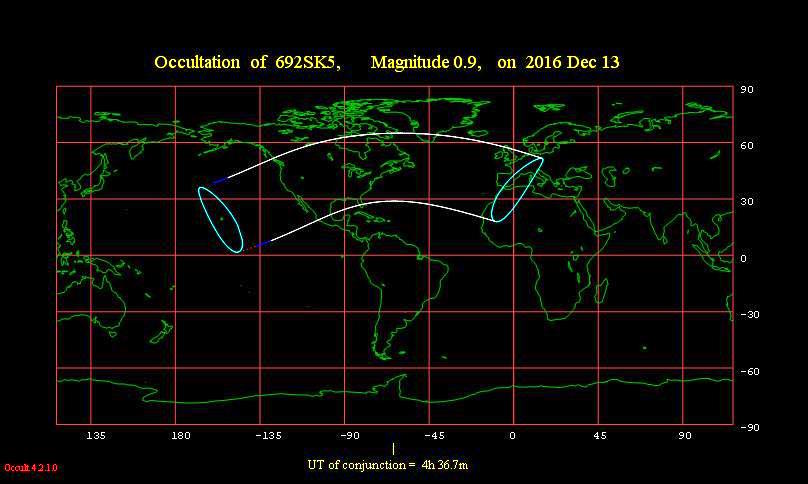
The footprint for tonight's occultation of Aldebaran by the Moon. You can find specific ingress and egress times for major cities near you on the IOTA event page. Credit: Occult 4.2.
The 99% illuminated waxing gibbous Moon occults the +0.9 magnitude star Aldebaran on Monday, December 12th. The Moon is just 19 hours and 30 minutes before reaching Full during the event. Both are located 167 degrees east of the Sun at the time of the event. The central time of conjunction is 4:37 Universal Time (UT). The event occurs during the daylight hours over Hawaii at dusk during Moonrise, and under darkness for Mexico, most of Canada and the contiguous United States. The event also includes the United Kingdom and southwestern Europe at Moonset near early dawn. This is the final occultation of Aldebaran by the Moon for 2016; The Moon will next occult Aldebaran on January 9th, 2017. This is occultation 26 in the current series of 49, running from January 29th, 2015 to September 3rd, 2018.
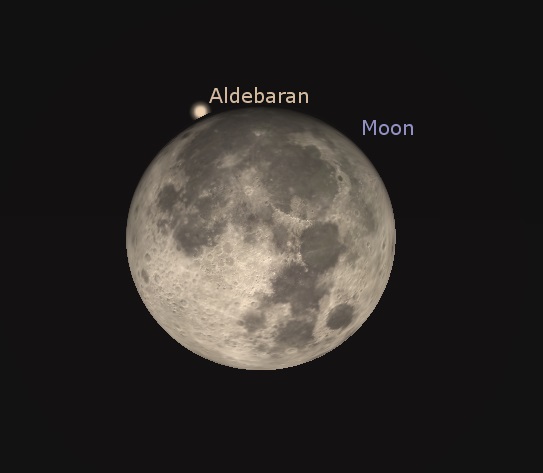
The view from Gibraltar just prior to this week's occultation of Aldebaran by the Moon. Credit: Stellarium.
Four 1st magnitude stars are along the Moon's path in the current epoch: Regulus, Aldebaran, Antares and Spica. In the current century, (2001-2100 AD) the Moon occults Aldebaran 247 times, topped only by Antares (386 times) and barely beating out Spica (220 times). The Moon also occults Regulus 220 times this century, and occultations of Spica and Antares resume on May 2024 and July 2023, respectively.
And yes, this Supermoon 3 of 3 for 2016, though actual perigee occurs at 23:28 UT tonight, 39 minutes past our own '24 hour from Full' rule. The Moon reaches Full on Wednesday, December 14th at just past midnight at 00:07 UT. This is also the closest Full Moon to the December 21st winter solstice next week, and the Full Moon will ride high in the sky this week for northern hemisphere observers on long winter nights.
Keep an eye out for Geminid meteors tonight as well... sure, 2016 may be an off year for this usually spectacular shower, but a few brighter fireballs may still punch through the lunar light pollution.
Clouded out? Be sure to catch the Supermoon action tomorrow night live online starting at 16:00 UT, courtesy of Gianluca Masi and the Virtual Telescope Project.
And there's more. This coming weekend marks the start of an upcoming new cycle of occultations of Regulus by the Moon. These run right through 2018, as the Moon visits the bright star Regulus five days after crossing the Hyades and occulting Aldebaran for every lunation pass in 2017.
Here's the specifics for Sunday's event:
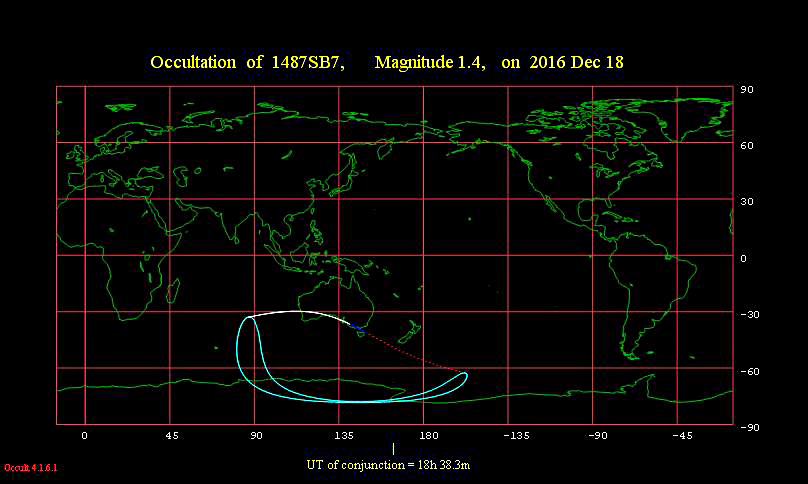
The footprint for Sunday's occultation of Regulus by the Moon. You can find specific ingress and egress times for major cities near you on the IOTA event page. Credit: Occult 4.2.
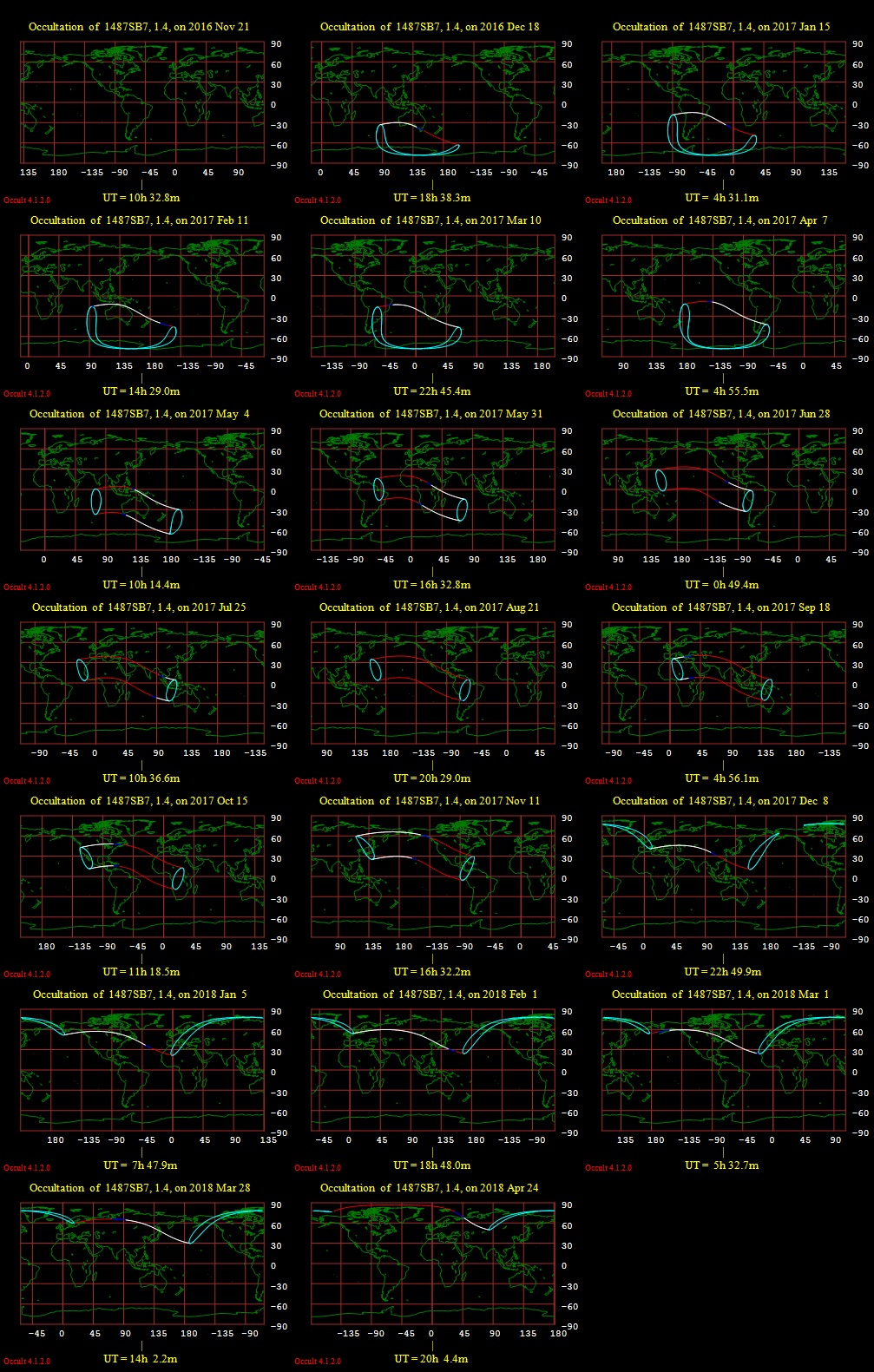
The 73% illuminated waning gibbous Moon occults the +1.4 magnitude star Regulus on Sunday, December 18th. The Moon is just four days past Full during the event. Both are located 117 degrees west of the Sun at the time of the event. The central time of conjunction is 18:38 Universal Time (UT). The event occurs during the daylight hours over Tasmania, and under darkness for the southwestern tip of Australia, including Perth. The Moon will next occult Regulus on January 15th, 2017. This is the first occultation in a new series of nineteen, running from this weekend to April 24th, 2018.
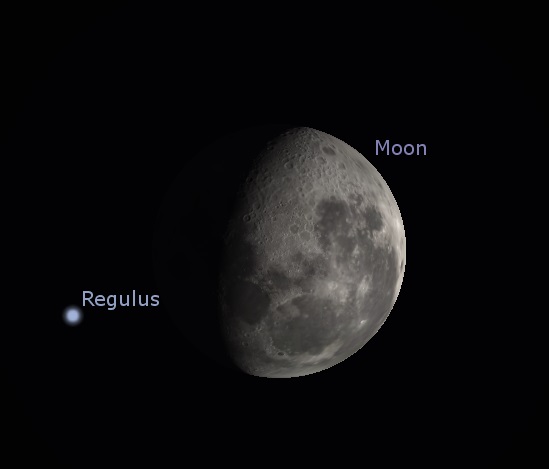
The view of Sunday's event from Perth, Australia. Credit: Stellarium.
It's worth noting that the graze line for Sunday's occultation of Regulus by the Moon runs just north of the Australian city of Perth and the Perth Observatory... let us know if anyone 'Down Under' witnesses the first occultation of Regulus in the new cycle.
Can you spy Regulus' white dwarf companion? Located 77 light years distant, the Regulus system has at least four components: a B/C pair shining at a combined magnitude of +8, with an apparent separation of 3", (5,000 AU physical distance in a ~600 year orbit) and an unseen white dwarf companion in a tight 40 day orbit. We know that said white dwarf companion exists from spectroscopic analysis... and it would shine at an easy magnitude +13, were it not near dazzling Regulus shining over 10,000 times brighter. Could this elusive companion turn up just moments before the reappearance of Regulus from behind the Moon? Remember, the dark limb of the Moon leads the way during waxing phases, then trails as the Moon wanes. These and other amazing facts are included in our forthcoming free guide to 101 Astronomical Events to watch out for in 2017.
Every occultation of Regulus for the upcoming cycle. Credit: Occult 4.2.
Follow that Moon, and don't miss these fine astro-events coming to sky above you this week!
(1 of 2) New Zealand Prime Minister Bill English, left, stands with the Governor-General, Dame Patsy Reddy, after being sworn-in at Government House in Wellington, New Zealand, Monday, Dec. 12, 2016. English, former New Zealand's finance minister and a former farmer, was sworn in as the country's 39th prime minister on Monday after his colleagues in the Parliament chose him as their new leader. (Mark Mitchell/New Zealand Herald via AP)
For the past eight years, the 54-year-old has played the role of dependable deputy to the more charismatic John Key. And it seemed it would stay that way heading into the 2017 election, until Key shocked the nation last week by resigning.
English was chosen as the new leader by the conservative National Party caucus after two other candidates for the job withdrew last week. A practicing Roman Catholic, English is more conservative than Key on social issues. He is opposed to abortion and euthanasia, although he said Monday that he's changed his mind on gay marriage, which he voted against when it was legalized in New Zealand three years ago.
"Just seeing the impact it's had with couples, I think it doesn't erode marriage," he said. "In some ways, it's an affirmation of the concept." English said he won't use his new role to try to influence policy on such issues, which are often left to the conscience of individual lawmakers rather than voted on by party affiliation.
In some ways, English embodies the qualities that many New Zealanders value, casting himself as a down-to-earth rural bloke, a father-of-six who believes in hard work and steps into the limelight with some reluctance.
But his history is more complicated. He studied commerce and then literature at university, graduating with an honors degree. He did work briefly as a farmer but has been a politician for most of his career, after he was first elected to Parliament 26 years ago.
He rose to become leader of his party in 2001 and led them to a disastrous defeat in an election the following year. The National Party gained just 21 percent of the vote, its worst-ever showing. After he was replaced as leader in 2003, it seemed his star had faded. But he learned from that defeat, he said.
This time, he has his economic record to highlight. After becoming finance minister in 2008, English helped the nation weather the global downturn and has since helped return annual GDP growth to more than 3 percent and unemployment to below 5 percent.
He's put a lot of emphasis on getting the government books into shape and has managed to return small budget surpluses over the past couple of years. His economic platform remains more prudent than exciting.
"In the coming months and years we will focus on building the roads, public transport, schools and houses needed to support a strong economy and a growing population," English said. "We'll also focus on better incomes for households, safer communities, and smarter government support for the most vulnerable."
One of his biggest challenges will be curbing runaway house prices which have made it difficult for working families to buy homes, especially in the biggest city, Auckland. English will also find it hard to emulate his predecessor's ability to charm other leaders and elevate New Zealand's role in world affairs. Key played golf with President Barack Obama and helped New Zealand secure a temporary seat on the U.N. Security Council.
"We've had a period of a good relationship between John Key and President Obama, and that's now changed," English said. "As a small country, we have to do all of the work." Key, who said he wanted to leave while he was on top of his game and spend more time with his family, said he didn't expect English would travel much next year as he focused domestically on the election. But Key said English would build relationships over time and already had a good international reputation as finance minister.
Key departed with his party doing far better in opinion polls that the main opposition, the liberal Labour Party. But his opponents have been buoyed by Key's resignation. Labour Party leader Andrew Little said English had "basked in John Key's fame and glory" and doesn't represent the change that New Zealanders want or need.
"It's not right in a country like New Zealand that thousands of young couples can't afford to buy their first home," he said. "It's not right that thousands of elderly people who need hospital care turn up to their hospital and get told the hospital can't afford to treat them."
(1 of 2) Mexican students Yatziri Tovar, left, and Roxanna Herrera, discuss their travel plans at City College of New York. Young immigrants who live illegally in the country and are traveling abroad have been advised to return to the U.S. before Donald Trump is sworn in as president on January 20th. Some advocates, lawyers and universities say they fear that if the immigrants go overseas they might not be allowed to re-enter the U.S. because the president-elect promised during his campaign to immediately scrap the program that protects them.
Some advocates, lawyers and universities are concerned that Trump might immediately rescind an Obama program that had allowed these young immigrants to work and travel for humanitarian, educational or employment purposes.
That could lead, they fear, to some people traveling abroad being barred from re-entering the U.S. "We are recommending all travel be completed by or before Jan. 20 in the event laws or procedures experience a drastic change," said Angelica Salas, executive director of the Coalition for Humane Immigrant Rights of Los Angeles. "We wouldn't want to expose them to an uncertain situation should they not be allowed back to the U.S."
Trump made illegal immigration the cornerstone of his campaign, promising to build a wall along the Mexican border and deport millions of people living in the country illegally. His actual plans, though, have yet to be revealed. Recently, he has said he wants to focus on people who have committed crimes.
During a recent Time magazine interview, Trump expressed sympathy for the 741,000 people in Obama's Deferred Action for Childhood Arrivals program, which started in 2012. "We're going to work something out that's going to make people happy and proud," Trump said. "They got brought here at a very young age, they've worked here, they've gone to school here. Some were good students. Some have wonderful jobs. And they're in never-never land because they don't know what's going to happen."
Advocates are still being cautious. Nancy Lopez-Ramirez, a 20-year-old student born in Mexico who is planning a trip there as part of a City College of New York class, said she is glad the group is returning by Jan. 15.
"My mom is like 'I am concerned with you not coming back, I want you to be able to come back,'" she said. "It is nerve-wracking but I think that at the end it is going to be worth it," said the political-science student, who was brought to the U.S. when she was 4.
City College, part of the City University of New York, is one of the institutions advising students in the DACA program to return before Inauguration Day. So is California State University, which told administrators to tell participants in the program "that if they are outside of the United States as of January 20, 2017, there is no assurance they will be allowed to return to the U.S."
Trump can rescind the promised protection right away through an "operational memo" because Obama implemented it through one, said William Stock, president of the American Immigration Lawyers Association.
He said the program's participants should not consider traveling overseas unless they absolutely need to. U.S. Customs and Border Protection spokesman Anthony Bucci said his agency "cannot speculate" when he was asked how long would it take for CBP officers to deny entry to the U.S. to program participants if Trump eliminated the protection.
U.S. Citizenship and Immigration Services records said that as of Dec. 31, 2015, about 22,340 people in the DACA program were approved for the "parole" that allows them to travel outside the U.S. Trump called the program an "illegal amnesty" during his campaign.
Tatyana Kleyn, an associate professor at City College who organized the upcoming Mexico trip, said interest in it actually surged among students after the presidential election. "So right now our bus fits 18 and we are bringing 20," she said. "It feels like a last chance."
ISTANBUL (AP) — Turkey declared a national day of mourning and paid tribute to the dead Sunday after two bombings in Istanbul killed 38 people and wounded 155 others near a soccer stadium. The carnage was claimed by a Turkey-based Kurdish militant group.
(1 of 15) Turkish police officers salute as fans of Galatasaray, some holding a Turkish flag, observe a minute of silence for the victims of the attacks on Saturday prior to their Turkish championship soccer match against Gaziantep, in Istanbul, Sunday, Dec. 11, 2016. Turkey declared a national day of mourning, launched a full investigation and paid tribute to the dead Sunday after two bombings outside the Besiktas football club stadium in Istanbul, following a soccer match on Saturday night, killed dozens of people and wounded scores of others others. Turkish authorities have banned distribution of images relating to the Istanbul explosions within Turkey.
The Kurdistan Freedom Falcons, or TAK, said two of its members had sacrificed their lives in the Saturday night attack that targeted security forces outside the Besiktas stadium shortly after the conclusion of a match.
"Two of our comrades were heroically martyred in the attack," according to a statement posted on TAK's website. It described the blasts as reprisal for state violence in the southeast and the ongoing imprisonment of Abdullah Ocalan, the leader of the Kurdistan Workers' Party, or PKK. TAK is considered by authorities as a PKK offshoot.
The twin car-and-suicide bombings near the stadium enraged top officials, including President Recep Tayyip Erdogan, who vowed to hunt down the perpetrators. The attack was the latest large-scale assault to traumatize a nation confronting an array of security threats.
Turkey is a NATO member and a partner in the U.S.-led war against the Islamic State group. The attack targeted police officers, killing 30 of them along with seven civilians and an unidentified person, Turkish Interior Minister Suleyman Soylu told reporters. He said 13 people had been arrested in connection with the "terrorist" act.
In an address at a funeral for the slain police officers before TAK's statement was released, a furious Soylu condemned Kurdish rebels and their allies in the West, referring to the PKK as "animals." "Have you accomplished anything beyond being the servants, pawns and hit men of certain dark forces, of your dark Western partners?" he asked.
Turkish officials didn't make any further comments after the TAK claim of responsibility was posted. The battle between the PKK and the Turkish state has resulted in the deaths of tens of thousands of citizens. Turkish officials frequently accuse the West of supporting the Kurdish insurgency and of interfering in Ankara's fight against the militants.
Erdogan vowed his country would fight "the curse of terrorism till the end" after paying a visit to some of the wounded at Haseki Hospital in Istanbul. Hundreds of flag-carrying demonstrators marched along Istanbul's coastline toward the stadium at the heart of the blast area. Flags flew at half-staff across the country and at Turkey's foreign missions. Passers-by placed flowers on barriers surrounding the soccer stadium.
The first and larger explosion took place about 10:30 p.m. Saturday after Besiktas beat Bursaspor 2-1 in the Turkish Super League. Erdogan said the attack's timing aimed to maximize the loss of life, but most fans had left before the detonation.
Soylu said the first blast was caused by a passing vehicle that detonated in an area where police special forces were located at the stadium exit. A riot police bus appears to have been the target. Moments later, a person who had been stopped in nearby Macka Park committed suicide by triggering explosives, according to the minister.
He said 136 people remained hospitalized Sunday after the attack, including 14 in intensive care. TAK claimed the Turkish people weren't their target but warned "no one should expect a comfortable life" as long as the ruling party "continues to torture the mothers of Kurdistan every day."
Armed conflict between the Turkish state and Kurdish militants resumed in July 2015 after peace talks unraveled. While much of the violence has concentrated in the impoverished and pre-dominantly Kurdish southeast, it has also spread to other cities, including the capital, Ankara, where TAK has claimed February and March suicide bombings.
Experts have determined that up to 400 kilograms (880 pounds) of explosives were used in the car bomb, Deputy Prime Minister Numan Kurtulmus told CNN Turk. To the mournful sound of trumpets, funeral services were held at Istanbul's police headquarters for some of the slain officers. Their comrades solemnly carried the coffins, which were draped in the Turkish flag, as a sea of mourners wept around them.
Erdogan presided over a security meeting after the funeral ceremony and hospital visit. Soccer fans proved their resilience by showing up to watch a game pitting Istanbul's Galatasaray and Gaziantepspor at a different stadium.
"What happened last night was extremely saddening but they need to know that Turkish people will not yield to such things," Galatasaray supporter Erkan Duman told The Associated Press. "It's not like we will give up things, especially things we love, just because they want us to."
Turkey has witnessed a spate of IS and Kurdish-linked attacks this year. Saturday's bombings were one of the bloodiest to hit Istanbul, a city at the crossroads of Europe and Asia, until recently a popular tourist destination.
That changed after a series of IS-linked suicide bombings targeting tourists, including a sophisticated attack on the city's Ataturk Airport in June that killed 44 people and wounded scores of others. PKK-linked militants have claimed other deadly attacks in Ankara, Istanbul and areas in southeast Turkey.
A state of emergency is in force following a failed July 15 coup attempt and the resulting government crackdown on alleged coup sympathizers has landed thousands in jail and forced tens of thousands of people from their jobs. Critics call the move a witch hunt.
Cinar Kiper, Ayse Wieting and Bulut Emiroglu contributed to this report.
detained a day earlier pointing to a new recruitment tactic by Islamist militants, they said.
Authorities are also concerned about smaller cells being formed by militants in Muslim-majority Indonesia, which is grappling with a resurgence in homegrown militancy, inspired in part by Islamic State.
Counter-terrorism police were looking for two more suspects after the arrests on Saturday of a woman and two men near Jakarta on suspicion of planning a bomb attack on vital national assets, national police spokesman Awi Setiyono said.
He did not elaborate, but on Saturday police said targets in Jakarta included the changing of the guard at the presidential palace.
'It is possible that their method to recruit new actors is not just limited to men,' Setiyono told a news conference, noting previously recruitment had been limited to men. 'The point is they are looking for people who want to wage jihad.'
Police said they had intercepted a letter the woman had intended to send to her parents stating her intention to carry out jihad.
Later an unexploded bomb was found in a room the woman had rented in Bekasi, about an hour outside Jakarta, police said.
The suspects had been communicating with and received money from Bahrun Naim, an Indonesian militant known to be fighting with Islamic State in Syria, Setiyono said.
'On the orders of Bahrun Naim, they formed small cells and assembled bombs with other suspected militants,' he said.
Naim has been linked to a number of failed attacks in Indonesia this year, including a July suicide bombing in the Javanese city of Solo, which killed the bomber but only wounded one other person.
He was also linked to a suspected militant arrested during a raid last month where police said they found enough chemicals to build a bomb twice as powerful as the one used in the Bali bombing of 2002, which killed 202 people.
Among the chemicals found then were TNT and RDX, both military-grade explosives, and a peroxide-based explosive TATP - also known in militant circles as the 'mother of satan', which was used in the Brussels attacks this year.
Indonesia suffered its first Islamic State-linked attack earlier this year, when a gun-and-bomb assault in central Jakarta killed four people.
Security is usually stepped up in Indonesia at this time of year after attacks in previous years during Christmas and New Year celebrations.