MITRA MANDAL GLOBAL NEWS

China sets policy directions for developing Tibet

Authentic news,No fake news.


-- Efforts must be made to build a new modern socialist Tibet that is united, prosperous, culturally advanced, harmonious and beautiful, Xi said at a high-level meeting on Tibet-related work.

-- Xi stressed a long-term commitment to the CPC Central Committee's policy to ensure Tibet has support from the central authorities and assistance from the whole country.

-- Work related to Tibet must focus on safeguarding national unity and strengthening ethnic solidarity.

-- More education and guidance should be provided for the public to mobilize their participation in combating separatist activities, thus forging an ironclad shield to safeguard stability.

BEIJING, Aug. 29 (Xinhua) -- President Xi Jinping has called for efforts to build a new modern socialist Tibet.

Xi, also general secretary of the Communist Party of China (CPC) Central Committee and chairman of the Central Military Commission, made the comments at the two-day seventh Central Symposium on Tibet Work, which ended in Beijing Saturday.

Xi underlined the need to fully implement the CPC's policies on governing Tibet for a new era.

Xi called for efforts to ensure national security and enduring peace and stability, steadily improve people's lives, maintain a good environment, solidify border defense and ensure frontier security.

Efforts must be made to build a new modern socialist Tibet that is united, prosperous, culturally advanced, harmonious and beautiful, Xi said.

Chinese President Xi Jinping, also general secretary of the Communist Party of China Central Committee and chairman of the Central Military Commission, speaks during a high-level meeting on Tibet work in Beijing, capital of China. (Xinhua/Li Xueren)

Since the sixth symposium in 2015, Tibet has made comprehensive progress and historic achievements in its various undertakings, Xi said, noting achieving sustained stability and rapid development in Tibet constitutes a major contribution to the overall work of the Party and the state.

Since the 18th CPC National Congress in 2012, policies on governing Tibet for a new era have taken shape, Xi said, stressing that the CPC leadership, the system of socialism with Chinese characteristics and the system of regional ethnic autonomy must be upheld to carry out work related to Tibet.

Work related to Tibet must focus on safeguarding national unity and strengthening ethnic solidarity, Xi said.

More education and guidance should be provided for the public to mobilize their participation in combating separatist activities, thus forging an ironclad shield to safeguard stability, Xi noted.

Xi stressed that patriotism should be incorporated into the whole process of education in all schools.

He called for continuous efforts to enhance recognition of the great motherland, the Chinese nation, the Chinese culture, the CPC and socialism with Chinese characteristics by people of all ethnic groups.

Tibetan Buddhism should be guided in adapting to the socialist society and should be developed in the Chinese context, Xi said.

While stressing the implementation of the new development philosophy, Xi noted that efforts should be sped up to advance high-quality development.

More work, measures and support are needed to consolidate the achievements made in poverty alleviation, Xi said.

Chinese President Xi Jinping, also general secretary of the Communist Party of China Central Committee and chairman of the Central Military Commission, speaks during a high-level meeting on Tibet work in Beijing, capital of China. (Xinhua/Rao Aimin)

A number of major infrastructure projects and public service facilities will be completed, including the Sichuan-Tibet Railway, Xi said.

Conserving the ecology of the Qinghai-Tibet Plateau is the greatest contribution to the survival and development of the Chinese nation, Xi said, emphasizing that scientific research should be further advanced on the plateau.

He also stressed strengthening the building of leadership teams at all levels, cadre teams and primary-level Party organizations in order to improve the capacity to respond to major struggles and prevent major risks.

Cadres and workers in Tibet should be cared for and supporting policies regarding their income, housing, medical care and retirement, as well as education for their children, should be further improved and well implemented, Xi noted.

Xi stressed a long-term commitment to the CPC Central Committee's policy to ensure Tibet has support from the central authorities and assistance from the whole country.

Continued and increasing support will be offered to Sichuan, Yunnan, Gansu and Qinghai provinces in their Tibet-related work, Xi said.

Other senior Chinese leaders were at the symposium, which was presided over by Li Keqiang. Li Zhanshu, Wang Huning, Zhao Leji and Han Zheng were in attendance, while Wang Yang spoke to sum up the event.

Xi's speech at the symposium is a guiding document on Tibet-related work in a new era, Li Keqiang said while presiding over the event.

In his concluding speech, Wang Yang also called for efforts to study Xi's speech, which laid out fundamental rules for carrying out Tibet-related work in a new era.

Future of Education Is Here

Authentic news,No fake news

.Yasmine Sherif, Director of Education Cannot Wait


NEW YORK, Aug 19 2020 (IPS) - There are moments when the world has no choice but to come together. Those moments become historic turning points. This is one of them. We are now faced with the greatest education emergency of our time. Over one billion children are out of school. The COVID-19 pandemic has created an unprecedented crisis of such magnitude and depth that the next generation might neither have the capacity and tools, nor the will, to rebuild – let alone build back better.

Yasmine Sherif

The world has not planned well for the future. At its worst, education has for too long been underprioritized, and at its best, has been viewed as just one among many competing priorities. Before COVID-19, the funding gap for education in low-income and middle-low income countries – many already plagued with extreme poverty, weak infrastructure, armed conflicts, climate-induced disasters and forced displacement – amounted to $148 billion. This funding gap is now estimated to increase by up to one-third.

COVID-19 has laid bare our collective failure to prioritize education. “The pandemic has exacerbated inequalities and magnified the global learning crisis. The future of an entire generation is at risk,” warned United Nations Secretary-General Antonio Guterres when launching his Policy Brief on Education earlier this month, “The COVID-19 pandemic has created the largest disruption of education systems in history.”

The number of out-of-school children who may never set foot in a school again is now rapidly escalating. An estimated 30 million children and youth are of immediate concern, according to UNESCO’s assessment. In a letter to the international community, UN Special Envoy for Global Education and Chair of the Education Cannot Wait’s High Level Steering Group, the Rt. Hon. Gordon Brown, together with 275 world leaders, politicians, academics and civil society, calls for urgent action to address the global education crisis triggered by COVID-19.

In support of the mission of Education Cannot Wait, they state: “We cannot stand by and allow these young people to be robbed of their education and a fair chance in life. Instead we should be redoubling our efforts to get all children into school – including the 260 million already out of school and the 75 million children affected by protracted conflicts and forced displacement, including 35 million children living as refugees or internally – with the comprehensive help they need – and to make it possible for young people to start or resume their studies in school further and higher education.”

Similarly, the Geneva Global Hub for Education in Emergencies, composed of UN agencies and non-governmental organizations, has issued an urgent call for firm political action to make financial investments in education for those left furthest behind in armed conflicts, forced displacement and climate-induced disasters, calling on the international community to “act fast and keep recovery and preparedness in sight.”

In the same spirit, the global education community has come together to Save Our Future, a coalition composed of the UN, the World Bank and civil society, raising the alarm of an entire generation at risk due to the rapidly escalating learning crisis, as a result of the massive funding gap, “The Covid-19 pandemic brought about the biggest cataclysm to education any of us have seen!”

On the ground, joint programming supported by pooled funding keeps delivering results. Education Cannot Wait’s 2019 Annual Results Report, Stronger Together in Crisis, launched on 11 August, illustrates that it is possible to deliver quality education to those left furthest behind – provided we come together, politically, strategically, programmatically and financially.

As the global fund for education in emergencies and protracted crises, ECW’s joint investments are rolling out the New Way of Working and ensuring humanitarian-development coherence, bringing together all partners: host-governments, affected populations, UN agencies, civil society, private sector, the World Bank, the Global Partnership for Education, and the International Facility for Financing Education, among others. Stronger together, we share a sense of absolute urgency and uncompromising commitment to results, which is put into action thanks to sustained funding by our strategic donor partners.

As a result, Education Cannot Wait has already reached 3.5 million children and youth since its inception. Yet, the scale and the depth of the education emergency in crisis-affected countries needs to be matched by adequate and scaled up financial investments to end the learning crisis for those left furthest behind, and to swiftly shift the course towards the SDGs. With 20 times more funding, the estimated 75 million children and youth can be reached. Indeed, financing stands between what is possible and what is not for these vulnerable girls and boys.

This truly is the defining moment in our time. There can be no sustainable development goals without education. “Education is a fundamental human right, the bedrock of just, equal and inclusive societies and a main driver of sustainable development,” the UN Secretary-General stated at the launch of his Policy Brief on Education, “As the world faces unsustainable levels of inequality, we need education – the great equalizer – more than ever. We must take bold steps now, to create inclusive, resilient, quality education systems fit for the future.”

We now have a chance to learn from the past by acting in the present, and, as the Secretary-General concluded, recognize the fact that: “The future of education is here!”

Germany's biggest union calls for 4-day week to save thousands of jobs

Authentic news,No fake news.

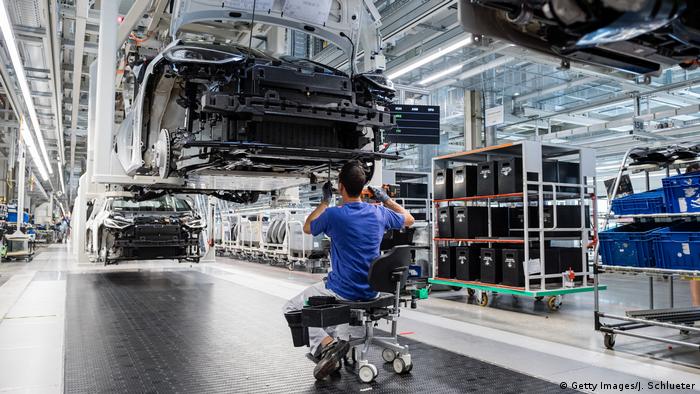
German car factory

Germany's largest trade union IG Metall proposed a four-day working week ahead of the next round of collective bargaining talks due to begin next year, reported German media on Saturday.

The shorter week would be "the answer to structural changes in sectors such as the automotive industry," said union chair Jörg Hoffman to German national newspaper Süddeutsche Zeitung.

"With this, jobs in the industry can be kept instead of being written off," added Hoffman.

Germany's automotive industry — one of the mainstays of the country's economy —is undergoing a major transformation to e-mobility, spurred by concerns over climate change as well as increasing automation and digitalization. The sector was also hit by the pandemic-induced financial crisis, although it is showing signs of recovery.

IG Metall, which represents workers from major carmakers such as Audi, BMW and Porsche, is Europe's largest industrial union. Analysts consider it a major national trendsetter in bargaining.

Read more: How coronavirus pandemic has spurred change in Germany

 
Watch video06:48

Making masks instead of car parts. Zender reinvents itself

Firms already trialing shorter hours

Firms such as Daimler, ZF and Bosch all made agreements this summer to reduce working hours. These companies were forging the way for all businesses in the metalwork and electronics industries, said Hoffman.

He proposed compensatory wage adjustments for employees.

It was in companies' interests to shorten working hours instead of cutting staff numbers — it ensured specialists were retained and saved on redundancy costs, said Hoffman.

Read more: German industry demands subsidies for fossil fuel cars

Challenging times                                         

Germany's automotive industry sustains around 830,000 people and contributes around 5% of the country's Gross Domestic Product (GDP).

Earlier this year, a research agency funded by the German government suggested that in a worst-case scenario, more than 400,000 jobs in the German car industry could be gone by 2030.

In the upcoming union talks, Hoffman said IG Metall would call for a wage increase for workers, despite the recession.

Arrest of Hong Kong's 'Goddess of Democracy' may complicate Japan-China ties

Authentic news,No fake news.

The Japan Times


The recent arrest of Hong Kong pro-democracy activist Agnes Chow under the national security law pushed by Beijing has put the severity of human rights issues in the territory in the spotlight and stirring up anti-Chinese sentiment among many Japanese.

Chow, dubbed "Goddess of Democracy," played a key role in the 2014 Umbrella Movement that called for democratic change in the former British colony. She often delivered her messages to around 500,000 Twitter followers in fluent Japanese.

As conservative Japanese lawmakers, who place importance on the alliance with the United States, have urged Prime Minister Shinzo Abe to review his diplomatic strategy toward China, Chow's arrest may become another issue complicating Sino-Japanese ties.

"Agnes Chow is well-known in Japan. If China wants to maintain amicable relations with Japan in the midst of escalating tensions with the United States, it should not have arrested her," a diplomatic source in Beijing said.

In the wake of her arrest last week, a larger number of Japanese have finally "recognized China as a country that ignores human rights," the source said. Chow's fans, the source added, "will never forgive the Chinese Communist Party."

The 23-year-old pro-democracy activist, who has appealed the plight of Hong Kong in rapid-fire Japanese on television and via social media, has garnered much media attention in Japan. Chow said she taught herself the language while absorbed in Japanese comics and animated films.

What came to her mind during the detention were the lyrics of the hit song "Fukyowaon (Disharmony)," which depict a firm stance against pressures from others, sung by popular Japanese all-female dance group Keyakizaka46.

Chow has been "active" in discussing "Hong Kong's quest for a more democratic political system to Japanese people in Japanese," said Stephen Nagy, a senior associate professor at International Christian University in Tokyo.

A 42-year-old Japanese male worker in Beijing said, "I have become interested in Hong Kong affairs since last year thanks to the Goddess of Democracy, although I know she said in the past that she did not like this nickname."

Chow also received media exposure when massive demonstrations sparked in Hong Kong by a now-withdrawn extradition bill with mainland China morphed into an anti-government movement in 2019, with protesters seeking a probe into police use of force.

After the former student group leader was arrested on Monday, the hashtag #FreeAgnes was trending on Japanese Twitter in an outpouring of support for Chow.

The hashtag had been used by more than 178,000 Twitter accounts as of Tuesday afternoon. At least another 57,000 had used a hashtag saying in Japanese, "We protest the arrest of Agnes Chow."

In late June, the mainland imposed the national security law on Hong Kong to crack down on what it views as secession, subversion, terrorism and collusion with foreign forces, apparently aiming to quell protests against the pro-Beijing government in the territory.

Since then, many Western nations, including the United States and Britain, have been lambasting the sweeping legislation for jeopardizing freedoms and human rights in the special administrative region, where democracy is supposed to be guaranteed.

Under China's "one country, two systems" principle, Hong Kong was promised it would enjoy the rights and freedoms for 50 years following its return to Chinese rule in 1997.

In July, U.S. President Donald Trump signed an order to fully end the special treatment extended to Hong Kong under American law, saying he will hold China accountable for its "oppressive actions" against the people of the territory.

Chow was released one day after she was arrested for alleged breaches of the national security legislation, but she is "set to be prosecuted," a source familiar with Chinese politics said.

Speaking to reporters outside a police station, Chow said she had been arrested four times while engaging in social activities in Hong Kong. The latest one, however, was the "scariest," she added.

"The reason for arrest I was told was that I colluded with foreign forces by using SNS since July," but "I don't understand why I was arrested" as the accusations were vague, she said. "The national security law was certainly used for political suppression."

Another diplomatic source in Beijing said the growing anger over her arrest could further erode ties with Tokyo.

"If more Japanese people feel sympathy for her, anti-Chinese sentiment would grow further, hurting relations between the two countries," the source said.

China-Japan ties have been improving by effectively shelving their territorial dispute in the East China Sea and the two are believed to be eager to work together to revitalize their economies that have been hit hard by the coronavirus pandemic.

Nevertheless, the enforcement of the national security legislation and Chow's arrest would prevent the two Asian powers from getting any closer.

"Japanese businesses will watch the situation carefully to test whether the arrest of Chow and others is eroding the business environment in Hong Kong and mainland China," Nagy said.

Meanwhile, Chinese President Xi Jinping's first state visit to Japan since he took power in 2013, which has been delayed owing to the pandemic, may not be realized amid the backlash from the public in Japan and in the United States.

"Given future relations with China, it is extremely difficult to invite President Xi to visit Japan," a Japanese government source in Tokyo said.

No More Lost Generations: Global Fund Provides Education for Children in Crisis

Authentic news,No fake news.

Refugee Rohingya children in Coz's Bazar aren't allowed to attend local school. For many, continuing their education was unattainable until Bangladesh announced in January that refugee children could also receive a formal education, and would be educated on the school curriculums used in both Bangladesh and Myanmar in preparation for their repatriation. Credit Stella Paul/IPS

Refugee Rohingya children in Coz's Bazar aren't allowed to attend local school. For many, continuing their education was unattainable until Bangladesh announced in January that refugee children could also receive a formal education, and would be educated on the school curriculums used in both Bangladesh and Myanmar in preparation for their repatriation. Credit Stella Paul/IPS

HYDERABAD, India , Aug 14 2020 (IPS) - 15-year-old Humaira* sits on the mud floor of her hut in Ukhiya camp, Cox’s Bazar, listening as the rain beats down on the tarpaulin roof.

Three years ago, Humaira arrived in Bangladesh at the refugee camp in Cox Bazar, which is now the largest such camp in the world, housing nearly a million Rohingyas. Her family had fled their home in Rakhine state, Myanmar, after her father had been killed by the army.

As a refugee child, Humaira wasn’t allowed to enrol in a local school. Confined to home, Humaira, who dreams of becoming a school teacher someday, suffered silently.

But things changed in January when the government of Bangladesh announced that refugee children could also receive a formal education, and would be educated on the school curriculums used in both Bangladesh and Myanmar. In addition, they could also learn professional skills that could help them find jobs in the future.

The news excited Humaira, who had been depressed, says her mother Samuda Khatun. “For the first time since the death of her father, my daughter was smiling again,” Khatun tells IPS.

  •  The shift in government policy came after Bangladesh announced its plan to repatriate the Rohingyas to Myanmar, the preparations for which have already begun.
  • A formal and accredited education would help the refugee children to return to schools in Myanmar after being repatriated.

Returning to Rakhine state, which is still in the middle of an armed conflict, is upsetting most Rohingyas. But Humaira doesn’t seem to care. “All I want is to study,” she says.

The schooling year was meant to start in April, but by then the COVID-19 pandemic resulted in a national lockdown across Bangladesh. And Humaira’s dreams of schooling were postponed.

Funding children’s education in crisis

Humaira is one of 75 million children and youth across the world living in crisis today.

Many of them have never been to school or have lost two to three years of education due to war and  displacement. Education Cannot Wait (ECW), a multilateral global fund, is now addressing the funding gap for education in crisis. In fact, ECW figures show that in 2015 some 39 million girls alone were out of school because of war and disasters.

Since 2016, ECW has reached nearly 3.5 million children and youth in 29 humanitarian crisis-hit countries, including Bangladesh. Of them, 48 percent are girls.

Working with 75 partner organisations, ECW has so far provided $662.3 million for supporting education in emergencies.

On Aug. 11 ECW launched its 2019 Annual Results Report tiled Stronger Together in Crisis.

According to the report, ECW has committed $12 million to support Rohingya refugee children’s education in Bangladesh, of which $6 million has already been provided. The funding has so far helped 63,000 students enrol at various learning centres run by ECW partners and local communities. The goal is to reach 88,500 children, 51 percent of whom are girls.

The challenges surrounding Rohingya children are many. About 65 percent of them can only read letters, not words or a sentence.  Only seven percent of Rohingya refugee children can read a paragraph of text or do basic maths. To address this, ECW has taken a holistic approach to education, which includes adopting a series of ‘out of the box’ techniques.

In the Rohingya refugee camps, teachers in the learning centres are trained in inclusive education, child protection, emergency preparedness and giving  psychosocial support to children dealing with trauma. 

A special focus has been on non-formal learning opportunities like solar installation and maintenance, hand sewing, embroidery and tailoring. Alongside, separate toilets for boys and girls have been built to help the girls feel secure and at ease.

A holistic approach

Henritetta Fore, executive director of the United Nations Children’s Fund, which hosts the ECW secretariat, described the holistic approach the fund has been taking to support education in crisis.

We have created a focus on five areas. One, affordability: we need to make sure a girl can afford to go to school. Second is distance learning. We have got to  try to get every girl reached by distance learning. Third, we have to mobilise communities, so there is lots of help out there. Fourth, protection. There is so much difficulty if you are an IDP or a refugee, so we need to help. And lastly, we really want young people to participate.  So, education is a ladder out of poverty. Its the greatest asset we can give to young people,” Fore said. She was speaking at a high-level virtual seminar host by ECW on Aug. 12.

The webinar was also addressed by former United Kingdom prime minister Gordon Brown, Jan Egeland, Norwegian Refugee Council secretary-general,  Afghanistan minister of education H.E. Rangina Hamidi, Theirworld president Justin Van Fleet, Norway minister of international development Dag-Inge Ulster and Canada’s parliamentary secretary Kamal Khera, among others.

Deborah Kalumbi, a 3rd-year student at Cavendish University, Lusaka, and the recipient of a U.N.High Commissioner for Refugees scholarship, was another attendee.

Kalumbi’s family fled to Zambia from their home in the conflict-torn Democratic Republic of Congo when she was just seven. Unlike many other fellow refugee children, Kalumbi was able to enrol in school, which she describes as challenging as well as enriching.

It was difficult as everything was new and different. We were also treated as different. However, education made me understand the diversity that exists and value its importance,”  said Kalumbi, who is now a vocal advocate for the rights and education of refugee youths.

A collective achievement

From the beginning, ECW has focused on building strong partnerships at global and local level, to deliver inclusive, equitable, quality education for children and youth caught in crisis. According to the new report, this approach has been successful as there is a distinct growth in political commitment for the emergency education sector. Similarly, education in humanitarian crisis is also becoming a priority.

For example, globally, the share of education in all humanitarian funding increased from 4.3 per cent in 2018 to 5.1 percent in 2019, representing a record amount of over $700 million.

At the webinar, ECW director Yasmin Sherif credited the progress to the partnership model the fund had adopted. “It’s all about being together. We were able to move fast because we acted together,”  Sherif said, pointing to the fund’s continued investment during the COVID-19 crisis.

In the first four months of 2020, ECW has provided $60 million to 33 countries to educate refugee and displaced children and youths aged three to 18 who were hard-hit by COVID-19 .

Call for more support

However, despite the significant progress of the past tree years, ECW is still underfunded. So it is now  calling upon other donors and partners to step up and provide further financing to fill the gap.

“ECW and its partners are working to urgently mobilise an additional $310 million to support the emergency education response to the COVID-19 pandemic and other ongoing crises. Together with in-country resource mobilisation, this will allow us to reach close to nine million children annually,” Sherif said.

Khera, Canada’s parliamentary secretary who also spoke at the webinar, said that when a crisis breaks out, the list of priorities usually excluded education. She said it was now time to change this in order to avoid the risk of a generation getting lost without education.“We must combine measures to ensure continuity of education during the COVID crisis,” Khera said.

Keeping hope alive

One of the most notable speakers on the webinar was Brown – former United Kingdom prime minister and chair of the ECW high-level steering group. Delivering a strong message to the global community, Brown said that there was an urgent need to support education of children and youths in a global crisis like the pandemic.

Half a world away, in Cox’s Bazar, Humaira also waits in hope of the day when she can start her schooling.

Since September, mobile internet services have been banned in her camp, so children here live on the other side of the digital divide, unable to attend any possible online classes that were set up during the lockdown. So Humaira just has to wait for the pandemic to be over.

Once this disease is over, I can go to school. Once I become a teacher, my mother will get some relief. Our lives will change,” she says, hope flickering in her eyes. 

*Surname withheld upon request

N. Korean, Russian leaders pledge stronger ties on Liberation Day exchange

Authentic news,No fake news.

SEOUL, Aug. 15 (Yonhap) -- North Korean leader Kim Jong-un and Russian President Vladimir Putin exchanged greetings Saturday to mark the 75th anniversary of Korea's liberation from Japan, Pyongyang's state media reported.

In their messages, the two men expressed their desire to further deepen bilateral ties based on the agreement for cooperation reached during their first summit in Russia's Far Eastern city of Vladivostok in April of last year, according to the North's official Korean Central News Agency (KCNA).

According to the KCNA, Kim said in his message that the cooperative relations between the two countries "would steadily grow strong at a higher level" based on the summit agreement reached in April of last year.

Kim also wished Putin "bigger success in his responsible work" for building a powerful Russia and the prosperity of its people.

The KCNA cited Putin as saying that the North Korea-Russia agreement from last year "contributes to further developing the reciprocal cooperation and promoting peace and security on the Korean Peninsula and throughout the Northeast Asian region."

Kim traveled to the Russian border town of Vladivostok in 2019 for his first-ever summit with Putin. They agreed to boost bilateral cooperation in various areas.

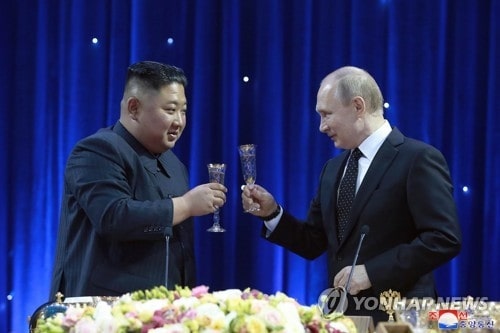
North Korean leader Kim Jong-un (L) toasts Russian President Vladimir Putin during a post-summit dinner at the Far Eastern Federal University in Vladivostok, Russia, on April 25, 2019, in this photo carried by the Korean Central News Agency the next day. (For Use Only in the Republic of Korea. No Redistribution) (Yonhap)

North Korean leader Kim Jong-un (L) toasts Russian President Vladimir Putin during a post-summit dinner at the Far Eastern Federal University in Vladivostok, Russia, on April 25, 2019, in this photo carried by the Korean Central News Agency the next day. (For Use Only in the Republic of Korea. No Redistribution) (Yonhap)

Putin, Lukashenko say problems in Belarus will be solved as protests surge

Authentic news,No fake news.

MINSK/MOSCOW (Reuters) - The leaders of Russia and Belarus agreed on Saturday that the problems in Belarus would be resolved soon, the Kremlin said, as tens of thousands took to the streets in Minsk once again to urge President Alexander Lukashenko to quit.

Accused of rigging last Sunday’s election, Lukashenko had earlier issued an appeal to Russian President Vladimir Putin as the Belarus leader grapples with the biggest challenge to his 26-year rule and the threat of new Western sanctions.

Ties between the two traditional allies had been under strain before the election, as Russia scaled back the subsidies that propped up Lukashenko’s government. Russia sees Belarus as a strategic buffer against NATO and the EU.

Statements by both sides contained a pointed reference to a “union state” between the two countries. Lukashenko has previously rejected calls by Moscow for closer economic and political ties as an assault on his country’s sovereignty.

Mitra-mandal Privacy Policy

This privacy policy has been compiled to better serve those who are concerned with how their  'Personally Identifiable Inform...