MITRA MANDAL GLOBAL NEWS

मौत से डर नही लगता-हॉकिंग

Authentic news,No fake news.


 Deutsche Welle 

ब्रह्मांड को समझा पर महिलाओं को नहीं: हॉकिंग

मौत से डर नही लगता बल्की इससे जीवन का और ज्यादा आनंद लेने की प्रेरणा मिलती है, यह कहने वाले महान वैज्ञानिक और अंतरिक्ष वैज्ञानिक स्टीफन हॉकिंग की जिंदगी उनकी खोजों की तरह ही अचंभित कर देने वाली है.
default
 1988 में जर्मन पत्रिका डेय स्पीगल को दिए इंटरव्यू में उन्होंने कहा था कि हम सभी यह जानते है कि हम कहां से आए हैं. 10 लाख से अधिक प्रतियों में बिक चुकी उनकी प्रसिद्ध पुस्तक ए ब्रीफ हिस्ट्री ऑफ टाइम ने बिग बैंग सिद्धांत, ब्लैक होल, प्रकाश शंकु और ब्रह्मांड के विकास के बारे में नई खोजों का दावा कर दुनिया भर में तहलका मचाया था. इस पुस्तक के प्रकाशित होने के बाद हॉकिंग न सिर्फ आम जनता में लोकप्रिय हो गए बल्कि विज्ञान जगत का चमकता सितारा बने.
ब्लैक होल थ्योरी
1974 में इस हॉकिंग ने दुनिया को अपनी सबसे महत्वपूर्ण खोज ब्लैक होल थ्योरी से रूबरू करवाया. उन्होंने बताया कि ब्लैक होल क्वांटम प्रभावों की वजह गर्मी फैलाते हैं. 1974 में महज 32 वर्ष की उम्र में वह ब्रिटेन की प्रतिष्टत रॉयल सोसाइटी के सबसे कम उम्र के सदस्य बने. पांच साल बाद ही वह कैम्ब्रिज यूनिवर्सिटी में गणित के प्रोफेसर बन गए. यह वही पद था जिस पर कभी महान वैज्ञानिक आइनस्टीन नियुक्त थे.
BdT Gelähmter Hawking erfüllt sich Traum Schweben in der
मौत को मात
हॉकिंग को बचपन में ही एएलएस नामक गंभीर बीमारी हो गई थी. इसमें शरीर की मांस पेशियां काम करना बंद कर देती हैं. हॉकिंग चल फिर नहीं सकते, वह बातें भी कंप्यूटर की सहायता से कर पाते हैं. डॉक्टरों का अनुमान था कि वह पांच साल से ज्यादा जिंदा नहीं रह सकेंगे लेकिन उन्होंने इन दावों को झुठला दिया. हॉकिंग के पास अपना एक उपकरण है जो उनकी व्हीलचेअर में लगा है. इसकी सहायता से वह रोजमर्रा के कामों के आलावा अपनी खोज में भी जुटे रहते हैं. बीते बरसों में हॉकिंग ने अपने सॉफ्टवेयर को अपग्रेड करने के लिए भारतीय वैज्ञानिक और सॉफ्टवेयर इंजीनियर अरुण मेहता से भी संपर्क किया था.
हॉकिंग की ऊंची उड़ान
2007 में विकलांगता के बावजूद उन्होंने विशेष रूप से तैयार किए गए विमान में बिना गुरुत्वाकर्षण वाले क्षेत्र में उड़ान भरी. वह 25-25 सेकेण्ड के कई चरणों में गुरुत्वहीन क्षेत्र में रहे. इसके बाद उन्होंने अंतरिक्ष में उड़ान भरने के अपने सपने के और नजदीक पहुचने का दावा भी किया.
नहीं होता स्वर्ग
बीते साल हॉकिंग ने स्वर्ग की परिकल्पना को सिरे से खारिज करते हुए इसे अंधेरे से डरने वालों की कहानी करार दिया. उन्होंने कहा की उन्हें मौत से डर नहीं लगता बल्कि इससे जीवन का और अधिक आनद लेने की प्रेरणा मिलती है. हॉकिंग ने ये भी कहा है की हमारा दिमाग एक कम्पूटर की तरह है जब इसके पुर्जे खराब हो जाएंगे तो यह काम करना बंद कर देगा. खराब हो चुके कंप्यूटरों के लिए स्वर्ग और उसके बाद का जीवन नहीं है. स्वर्ग केवल अंधेरे से डरने वालों के लिए बनाई गई कहानी है. अपनी नई किताब द ग्रैंड डिजायन में प्रोफेसर हॉकिंग ने कहा है कि ब्रह्मांड खुद ही बना है. यह बताने के लिए विज्ञान को किसी देवी शक्ति की जरूरत नहीं है.
200 साल के भीतर धरती तबाह
Stephen Hawking
प्रोफेसर हॉकिंग ने यह कहकर भी सनसनी फैला चुके हैं कि 200 साल के भीतर धरती का विनाश हो जाएगा. 2010 में दिए गए इस बयान में हॉकिंग ने कहा कि बढ़ती आबादी, घटते संसाधन और परमाणु हथियारों के इस्तेमाल का खतरा लगातार धरती पर मंडरा रहा है. अगर इंसान को इससे बचना है तो अंतरिक्ष में आशियाना बनाना पड़ेगा. विपरीत परिस्थितियों में जिंदा रहने के सिद्धांत का हवाला देते हुए हॉकिंग ने कहा की पहले इंसान के अनुवांशिक कोड में लड़ने-जूझने की जबरदस्त शक्ति थी. अब ऐसा नहीं है. 100 साल बाद यदि इंसान को अपना अस्तित्व बचाना है तो धरती को छोड़कर कोई दूसरा ठिकाना खोजना होगा.
मार्लिन मोनरो के दीवाने
हॉकिंग अतीत में जाने का रास्ता और भविष्य में जाने का शॉर्टकट खोजना चाहते हैं. कहते हैं एक जमाने में बीते कल की यात्रा की बात को वैज्ञानिक सनक मान जाता था. वह खुद भी इस बारे में बात करने से डरते थे. लेकिन अब उन्हें इसकी परवाह नहीं है. वह भी गुजरे जमाने की यात्रा करने के दीवाने हैं. हॉकिंग के अनुसार यदि उनके पास टाइम मशीन होती तो वह हॉलीवुड की सबसे खूबसूरत अदाकारा मानी जाने वाली मार्लिन मोनरो से मिलने जाते. उनके मुताबिक कोई भी चीज असम्भव नहीं है. तर्क देते हैं कि हर भौतिक वस्तु के कई आयाम होते हैं. बीते कल की यात्रा का मतलब ही है कि आयामों के पार जाना.
महिलाओं को नहीं समझ पाए
1974 में हॉकिंग ने भाषा की छात्रा जेन विल्डे से शादी की. दोनों के तीन बच्चे हुए लेकिन 1999 में तलाक भी हो गया. इसके बाद हॉकिंग ने दूसरी शादी की. कुछ दिनों पहले जब एक इंटरव्यू में उनसे पूर्ण रहस्य के बारे में पूछा गया तो जवाब दिया कि महिलाएं अभी भी पूर्ण रहस्य ही हैं.
रिपोर्ट: जितेंद्र व्यास
संपादन: ओ सिंह

Rural Women’s Empowerment — the Road to Gender Equality & Sustainable Developmen

Authentic news,No fake news.

Lakshmi Puri is a former UN Assistant Secretary-General & Deputy Executive Director of UN Women
Rural women and girls face the brunt of the feminization of poverty and its inter-generational consequences, the impacts of climate change, desertification, extreme weather events and natural disasters.
Credit: Mallika Aryal/IPS
NEW DELHI, Mar 7 2018 (IPS) - When we celebrate the International Women’s Day (IWD) this year we shine the brightest light on the vast majority of women – especially in developing countries that live and work in rural areas and whose empowerment is about bringing the farthest left behind to the forefront of being the prime beneficiaries and drivers of sustainable development, peace and security, human rights and humanitarian action.
Lakshmi Puri
For are not the rural woman and girl the poorest, most discriminated against in a boy-preferred and girl- averse patriarchal society ? Are not rural areas, where sex selection including through female foeticide and infanticide, led to skewed sex ratios in many countries.
Are they not the ones who bear the biggest burden of care and domestic work and time-poverty as they juggle fetching water and firewood from long distances, cooking and cleaning , child bearing and caring for children and the aged with back breaking work in the farms and fields ?
All this while trying to cope with the deprivation of education and decent work opportunities, deficits in healthcare, including sexual and reproductive health and rights (SRHR), electricity , clean cookstoves, transport, finance and other basic infrastructure and services their urban sisters have a better chance of getting .
Rural women and girls face the brunt of the feminization of poverty and its inter-generational consequences, the impacts of climate change, desertification, extreme weather events and natural disasters. They are also the most vulnerable in conflict situations, as migrants and refugees and in humanitarian crisis. Disability rates are higher among rural women and girls , support systems weak or non existent and they are stigmatized to boot .

The irony is that although they are the primary growers of food crops and processors of food, they mostly get to eat last and the least the nutritious food they need to be healthy and strong.
Rural women and girls face the brunt of the feminization of poverty and its inter-generational consequences, the impacts of climate change, desertification, extreme weather events and natural disasters. They are also the most vulnerable in conflict situations, as migrants and refugees and in humanitarian crisis. Disability rates are higher among rural women and girls , support systems weak or non existent and they are stigmatized to boot .
Indigenous women , ethnic and racial and other minorities , young women and elderly women included – face further marginalization and human rights challenges in most rural settings- what we call multiples forms of compounded discrimination and intersectionalities.
They are the most targeted for all forms of violence in domestic life, workplaces and in public spaces. Rural areas are also fertile grounds for harmful traditions and practices like child marriage and child maternity, female genital mutilation (FGM) and cutting, witch hunting, dowry and bride price, honor killings etc .
Rural women and girls rarely have any consciousness about their human rights especially their right to have control over their bodies, their sexuality and reproductive function or their right to choose who and when they marry or when to have children . These decisions are most often imposed on them to the detriment of their health, economic and social well-being and happiness .
Their voices are often disregarded in governance at all levels and their participation and leadership more an exception than the rule. They have little access to justice and redress of their grievances. Gender equal Laws of the land are controverted by parallel / personal / religious laws / norms and custom to disempower them. They seldom have equal access, ownership and control over land, property and other productive assets like finance entrepreneurship and other skills and capacity building.
That is not to say progress has not been made in many parts of the world including in developing countries. This gives hope that rural women’s empowerment is possible and yields rich dividends for all women and girls as well as for the economy , society and democratic governance, peace and sustainable development for all .
Rural women and girls therefore have to be prioritized if we are to implement fully, effectively and in an accelerated way the Beijing Platform For Action for Women , the 2030 agenda for Sustainable Development (SDG), and the unprecedented and historic Gender Equality Compact that the international community has adopted, especially in the last 7 years .
Take SDG 5 on achieving Gender Equality and empowering all women and girls and its nine targets . For this: – We need to get all governments at all levels – federal , state and local – in Parliament , executive and judiciary and law enforcement- to ensure SDG 5.1 is implemented.
– That means to ensure that there is no discrimination against rural women and girls in law and practice in any way .
– In fact they should enact special laws , policies and measures , programs and schemes to take affirmative action in all areas .
Equally social norms and customary laws that perpetuate discrimination must be firmly opposed and outlawed and a public movement launched with support from all stakeholders especially a vibrant civil society and citizens engagement.
Similarly all our efforts need to be made to prevent violence and harmful practices against rural women and girls their sexual exploitation and to provide for multisectoral, critical services to them. Perpetrators must be prosecuted and victims and survivors must have access to justice.
Rural women’s participation and leadership in local government is progressing but needs to pushed further as much as in national government so that rural women’s interests and needs get reflected in governance and budgeting. They must participate equally with men in public, political and economic life at all levels.
Equal Land and water rights, inheritance and property rights are especially to be targeted as must technology and ICT along with other aspects and attributes of economic empowerment and autonomy. They must have access to both physical and social infrastructure and essential services. Their access to comprehensive sexuality education along with their male counterparts, to contraceptives and to SRHR services and rights is vital.
Overall progress in sustainable agriculture and rural development will contribute to transformation for gender equality and rural women and girl’s empowerment. Finally never before have I felt so strongly about education of rural girls and women and of their families as one major enabler of a big leap to their empowerment.
On my return to India last month, one of my first engagements was to visit a women’s college in the heart of patriarchal rural Haryana as a chief guest at the convocation. As I spoke there to brilliant young rural women graduates and postgraduates in commerce, business administration, science and arts I could feel their confidence and the audacity of their ambition to forge ahead in life and career as empowered individuals.
As my friend and amazing champion of rural women Shamim joined me in exhorting them poetically to throw away their shackles and soar high they retorted with equal gusto and said “We will. We have got wings now ! “. I also leant that education – primary, secondary, tertiary, vocational must be taken to rural areas. As Shamim said “We have to take the torch to where there is darkness !”

A Fair Reflection? Women and the Media

Authentic news,No fake news.

Audrey Azoulay, Director-General of UNESCO
Gender inequality is the greatest moral and social issue of our time — and the world’s most critical economic challenge.
Globally, women are grossly underrepresented in scientific research and development (R&D). Credit: Bigstock
PARIS, Mar 6 2018 (IPS) - Information and communication technologies have the potential to open up new worlds of ideas and the media – television, newspapers, advertising, blogs, social networks, film – is increasingly omnipresent in the lives of many of us. In line with one of the major themes of this year’s Commission on the Status of Women, UNESCO is assessing how the media and ICTs shape the lives of women.
In the mass media,women are often relegated to archetypical roles, or to peripheral characters. They are often underrepresented and are more likely to be portrayed as passive victims.
When women in the media are reduced to stereotypes it is deeply damaging psychologically. Films continue to fail the simple “Bechdel Test” to measure gender bias, created by satirist Alison Bechdel, whereby two female characters talk to each other about something other than a man.
In advertising – a good litmus test for public attitudes – cleaning products still tend to be pitched to women whilst ads for banks, cars and other major financial investments are pitched to men.
A Fair Reflection? Women and the Media
Audrey Azoulay, Director-General of UNESCO. Credit: UNESCO/Christelle ALIX
Alas, nearly 40 years on, the words of Margaret Gallagher in her 1979 UNESCO report The Portrayal and Participation of Women in the Media (the first major global report on the subject) still ring true: “The media have been observed to lag behind change in the broader social system. For even if, in many cases, the media cannot realistically be expected to initiate change, they can certainly be expected to reflect it.”
In the news media, some progress has been made. But the 2015 Global Media Monitoring Project Report made some alarming conclusions: women still make up less than a quarter of the persons featured in newspapers, television and radio news and only 13% of stories specifically focus on women. Fewer than one in five experts interviewed by the media are women, and not only because they are underrepresented in the respective fields of expertise.
This means that major issues that affect women’s lives do not make it into the global conversation: the pay gap, voice and representation in public spheres, the challenges of balancing family with career, spouse and child abuse, the culture of victim-shaming of survivors of rape and harassment…
Part of the root problem is that women are underrepresented in newsrooms: female reporters are responsible for only one third of all stories. Yet, extrapolating from the Global Media Monitoring 2010 report, female reporters are more likely to challenge stereotypes and ensure gender equality in their coverage.
Women still make up less than a quarter of the persons featured in newspapers, television and radio news and only 13% of stories specifically focus on women. Fewer than one in five experts interviewed by the media are women, and not only because they are underrepresented in the respective fields of expertise.
Through our Gender Sensitive Indicators for Media,UNESCO is leading the way, providing guidance for policy-makers, editors and journalists to avoid falling into the pitfalls of archetypal gender roles and ensuring women’s participation. And since 2000, the UNESCO Women Make the News initiative has encouraged newsrooms to promote content related to women and encourage female journalists.
When women’s voices are heard, it makes a real difference to their lives.
One woman, trained in Tanzania through UNESCO’s Local Radio Programme, described how women reporters mounted pressure on the authorities to arrest an accused rapist. This amplified call for justice could no longer fall on deaf ears.
It is not just mass media, the internet has changed the way we use, contribute to and comment on media. It has the power to remedy asymmetries. Unfortunately, the internet often replicates these problems and has, in fact, thrown up new challenges. For example, only 17% of Wikipedia’s profiles relate to women and their achievements, according to the Wikimedia Foundation.
To redress this balance, this Women’s Day we are running a “editathon” with some 100 volunteers who will create and update pages about dozens of women who have contributed to knowledge in the fields of science, culture and education – the core of UNESCO’s work.
Creating information is not enough if it cannot be used. Across the world too many women still cannot unleash the broader potential of mobile technologies to gain access to information.
A recent Broadband Commission report, co-authored by UNESCO, concluded that there were over 250 million fewer women online than men that year due to a widening gender gap in digital skills, which actually exacerbates existing power imbalances. This is why UNESCO supports women and girls access to ICTs through our flagship Mobile Learning Week, which this year will focus on Skills for a Connected World.
Even for those women with access, the internet has opened up a new arena in which they are subject to sexual harassment, rape and violence threats, and cyberstalking. For example, a 2014 study conducted by the think tank Demos found that on Twitter, female journalists receive nearly three times as much abuse as male journalists.
The subject is, as yet, under-researched but UNESCO is working to address online abuse, particularly aimed at women, through our Media and Information Literacy programme.
Young generations are sometimes described as digital natives – skilled in media and ICTs. This International Women’s Day is our chance to find ways to ensure that all women and girls also have the opportunities to become digital citizens, empowered to access and participate equitably in our global knowledge society.

Rise of Feminism & the Renewed Battle for Women’s Rights

Authentic news,No fake news.


Sanam Naraghi-Anderlini is co-founder & Executive Director of the International Civil Society Action Network (ICAN) and Adjunct Professor at Georgetown University.
Sanam Naraghi-Anderlini
WASHINGTON DC, Mar 2 2018 (IPS) - In 1909, the Socialist Party of America, in support of female garment workers protesting working conditions, designated March 8 as a day to honor women. By 1917, women in Russia were protesting for ‘bread and peace’ against a backdrop of war. In recognition of that protest and women’s suffrage in Soviet Russia, The International Socialist movement designated March 8 as International Women’s Day.
Over the past 101 years, women, governments and the UN around the world have marked the day of solidarity and recognition of our rights. I appreciated its true significance in 2010 when, I spent the day among a group of Masai women in Kenya.
I was leading a delegation of women peacebuilders from Pakistan, Sri Lanka, Canada and the US. We drove miles through dusty plains speckled with the occasional tree and giraffe herds to meet the Masai. They had walked hours to join us at their community center, a cinder block building that they’d paid for by making and selling jewelry and crafts.
They knew it was International Women’s Day and they were excited to be included as women in the world. It was humbling to be with them and it felt like a universal sisterhood.
In 2017, in the wake of the massive women’s protests, in the US on March 8th women wore red. For just that day on the sidewalks and in traffic, in government buildings and beyond, we the women signaled our mutual solidarity through our shared flash of red. It was symbolic, reassuring and empowering.
So 101 years on as March 8th 2018 dawns, how far have we come and how far do we still need to go? In America, it is easy to feel angry.
We are witnessing the most deliberate and targeted rollbacks of basic rights for women to be enacted by a government. Domestically in 2017 the Trump administration revoked the Fair Pay act that enabled women and minorities to determine if they were being subject to pay discrimination.
Health care provisions particularly reproductive rights are at perpetual risk. Vice President Mike Pence has openly stated that they aim to put an end to abortion – presumably the legal, safe variety – in his time.
Internationally too, the US is retrenching. In February 2018 the State Department announced that its annual global human rights report would no longer highlight the range of abuses and violations that women and girls typically experience. In the name of expediency and to ‘sharpen the focus’, the US has determined that violence against women is not a sufficiently egregious form of abuse – despite its prevalence among and relevance to at least 50% of the world’s population.
To give simple context: Globally women and girls make up 71 percent of the victims of human trafficking – a vast source of revenue for criminal and violent organizations. Three quarters of them are sexually abused. Of the women murdered globally in 2012, their partners or their own relatives killed half of them. But according to the US administration this evidence does not amount to egregious abuse.
Such denial makes for strange bedfellows internationally. The Trump administration puts the US in the same camp as Cuba, China, Iran, Syria, all of which refused to acknowledge violence against women as a gendered issues in recent years. On seeking to assert state control over women’s bodies particularly in terms of reproductive health issues, it is aligned with among others, Sudan, Russia, and the Vatican/Holy See – a nation of some 570 citizens, of whom just 30 are women –
Globally too, there is room for concern. In recent years, we have seen a co-opting of the rights and equality agenda in insidious ways. Many conservative states have become champions of girls’ education on the global stage. Yet scratch the surface and their agenda is not one of equal rights, opportunity or freedom to choose their own paths. They want to educate girls so they can be good wives and better mothers.
In other words, girls’ education is not for the purpose of fulfilling a human being’s potential, rather it is to prepare her to be subservient to male dominance, and cede the public sphere where decisions are made and power is wielded. And most tellingly no state is making the effort to educate men to be good husbands and better fathers. That would certainly go a long way towards reducing levels of violence.
Another recent trend has been to claim support for the women, peace and security agenda, by opening militaries to female recruitment in combat roles. The latest to join the ranks is Saudi Arabia, which in February 2018 announced that women could join the army as security officers but not as combat soldiers (The irony that these women would still need to live with their male guardians seems lost on the state).
So in the name of equality, women are being deployed to wield weapons and if needed, oppress, perpetrate violence, maim or kill. But an equal chance to fit into existing structures does not equate to an equal chance to transform the entrenched status quo.
When it comes to the women, peace and security issues for example, many of us advocates would argue that our cause is not to enable our daughters to be drafted into armies on equal footing as our sons. Rather ours to ensure that neither our daughters nor our sons have bear witness or engage in the horrors of war. That is the paradigm shift and equality we strive for – much like the Russian women in 1917.
But neither Saudi Arabia nor many other countries are matching their purported awakening to gender equality with a commitment to ensuring women’s effective participation in the realms where decisions – particularly about peace and security – are being made. It is evident by the paucity of women in the negotiations regarding the fate of Yemen and Syria.
Meanwhile conservative forces that rail against women’s rights and feminism, have co-opted the empowerment agenda by deploying their own army of women. From ISIS to the White Supremacist, they understand that women have power and influence. They also understand that women have aspirations and capacity to contribute to a cause.
In the US the fact that the National Rifle Association (NRA) has a female spokesperson and television series with female heroes is no accident. They recognize that the optics work in their favor. Their spokeswomen inevitably appear more disarming (pun intended), conveying an image of both modernity and traditionalism, femininity and empowerment, even if they are handmaidens to the male leadership.
But the anger is also giving rise to positive developments. Trumpism sparked the women’s marches and a linking of arms among women across nations, of every generation. Feminism, long taken for granted and even denigrated, is fashionable again. It is fueled by indignation and action.
The #MeToo campaign founded by Tarana Burke long before Trump arose, has surged and its impact is evident in every sector. In the political realm despite the negative stance of the administration, Congress has passed two critical pieces of legislation – the Women, Peace and Security Act and a new Anti-online Sex trafficking bill that is heading to the Senate.
Perhaps the greatest sign of hope is the younger generation. Our teenage girls, who grew up in the Obama years that brought kindness, respect and a ‘can-do’ attitude to the fore, and whose political consciousness evolved in tandem with the rise of social media and greater connectivity, are emerging as new leaders. This too is a global phenomenon.
In the US, high school students Emma Gonzalez and Delaney Tarr who survived the Marjory Stoneham Douglas High School shooting in Florida have become leading activists in the tough, overwhelmingly male dominated debates on security and gun control.
In Palestine, 17-year old high schooler, Ahed Tamimi has become the symbol of resistance against the Israeli occupation, after confronting armed Israeli soldiers about shooting her unarmed young cousin. Pakistani Malala Yousefzia, survivor of a terror attack and already a veteran activist at 21, won the Nobel Prize for daring to confront the Taliban about attacks on schools girls.
In Iran, a younger generation of women are confronting the state’s compulsory hijab laws by provocatively standing in public spaces, waving their scarves like flags on a pole. It is notable that in every instance they are either working on equal footing with men, or they have men recognizing their courageous leadership and cheering them on.
In each instance, these young women activists, stands on the shoulders of the many who came before them. They may not be familiar with the terms of the Convention on the Elimination of Discrimination Against Women (CEDAW), the Beijing Platform for Action, Security Council Resolution 1325 and its 7 sister resolutions, the Millennium or Sustainable Development Goals. They may even take much of it for granted, but that itself is an indication of empowerment, as this new generation is taking the struggle into a new phase.
This younger generation’s starting point is one of absolute equality. They not only feel entitled to speak, but feel entitled to be heard. And as my 17 year old daughter remarks, ‘Years of dystopic novels with female heroes saving the day, combined with lessons in civil rights, means of course we want to speak out and act.”
So if their grandmother’s generation fought to get into the system and participate in the status quo set by men, and their mother’s generation fought to transform systems from within by being collaborative, this younger generation is standing their own ground. They are setting their own terms, shaping their own narratives, and creating their own space – particularly through their adept handling of social media.
As they stand up to might of the vested interests and security state offering common sense solutions–be it in the US, Israel, Iran or Pakistan – but being rebuked violently, they reveal how naked and absurd the emperor truly is.
So a century on from the first International Women’s Day, these young women are lifting the veil off the systems that have perpetuated discrimination and violence and calling them out. In solidarity with women of the past they are saying ‘Time’s up”. I know they mean it. So it is with pride and confidence that I, for one, am happy to pass the baton.

क्रांतिकारियों के खून पसीने से बने पंजाब नेशनल बैंक का इतिहास (Origin of PNB )

Authentic news,No fake news.

Punjab under the British especially after annexation in 1849 witnessed a period of rapid development giving rise to a new educated class fired with a desire for freedom from the yoke of slavery. Amongst the cherished desires of this new class was also an overriding ambition to start a Swadeshi Bank with Indian Capital and management representing all sections of the Indian community. The idea was first mooted by Rai Mool Raj of Arya Samaj who, as reported by Lala Lajpat Rai, had long cherished the idea that Indians should have a national bank of their own. He felt keenly "the fact that the Indian capital was being used to run English banks and companies, the profits accruing from which went entirely to the Britishers whilst Indians had to contend themselves with a small interest on their own capital".
At the instance of Rai Mool Raj, Lala Lajpat Rai sent round a circular to selected friends insisting on an Indian Joint Stock Bank as the first special step in constructive Swadeshi. Lala Harkrishan Lal who had returned from England with ideas regarding commerce and industry, was eager to give them practical shape.
`PNB was born on May 19, 1894. The founding board was drawn from different parts of India professing different faiths and a varied back-ground with, however, the common objective of providing country with a truly national bank which would further the economic interest of the country.
The Bank opened for business on 12 April, 1895. The first Board of 7 Directors comprised of Sardar Dayal Singh Majithia, who was also the founder of Dayal Singh College and the Tribune; Lala Lalchand one of the founders of DAV College and President of its Management Society; Kali Prosanna Roy, eminent Bengali pleader who was also the Chairman of the Reception committee of the Indian National Congress at its Lahore session in 1900; Lala Harkishan Lal who became widely known as the first industrialist of Punjab; EC Jessawala, a well known Parsi merchant and partner of Jamshedji & Co. of Lahore; Lala Prabhu Dayal, a leading Rais, merchant and philanthropist of Multan; Bakshi Jaishi Ram, an eminent Civil Lawyer of Lahore; and Lala Dholan Dass, a great banker, merchant and Rais of Amritsar. Thus a Bengali, Parsi, a Sikh and a few Hindus joined hands in a purely national and cosmopolitan spirit to found this Bank which opened its doors to the public on 12th of April 1895. They went about it with a Missionary Zeal. Sh. Dayal Singh Majithia was the first Chairman, Lala Harkishan Lal, the first secretary to the Board and Shri Bulaki Ram Shastri Barrister at Lahore, was appointed Manager.
A Maiden Dividend of 4% was declared after only 7 months of operation. Lala Lajpat Rai was the first to open an account with the bank which was housed in the building opposite the Arya Samaj Mandir in Anarkali in Lahore. His younger brother joined the Bank as a Manager. Authorised total capital of the Bank was Rs. 2 lakhs, the working capital was Rs. 20000. It had total staff strength of nine and the total monthly salary amounted to Rs. 320.
The first branch outside Lahore was opened in Rawalpindi in 1900. The Bank made slow, but steady progress in the first decade of its existence. Lala Lajpat Rai joined the Board of Directors soon after. in 1913, the banking industry in India was hit by a severe crisis following the failure of the Peoples Bank of India founded by Lala Harkishan Lal. As many as 78 banks failed during this crisis. Punjab National Bank survived. Mr. JH Maynard, the then Financial Commissioner, Punjab, remarked...."Your Bank survived...no doubt due to good management". It spoke volumes for the measure of confidence reposed by the public in the Bank`s management.
The years 1926 to 1936 were turbulent and loss ridden ones for the banking industry the world over. The 1929 Wall Street crash plunged the world into a severe economic crisis.
It was during this period that the Jalianwala Bagh Committee account was opened in the Bank, which in the decade that followed, was operated by Mahatma Gandhi and Pandit Jawaharlal Nehru. The five years from 1941 to 1946 were ones of unprecedented growth. From a modest base of 71, the number of branches increased to 278. Deposits grew from Rs. 10 crores to Rs. 62 crores. On March 31, 1947, the Bank officials decided to leave Lahore and transfer the registered office of the Bank to Delhi and permission for transfer was obtained from the Lahore High Court on June 20, 1947.
PNB was then housed in the precincts of Sreeniwas in the salubrious Civil Lines, Delhi. Many a staff member fell victim to the widespread riots in the discharge of their duties. The conditions deteriorated further. The Bank was forced to close 92 offices in West Pakistan constituting 33 percent of the total number and having 40% of the total deposits. The Bank, however, continued to maintain a few caretaker branches.
The Bank then embarked on its task of rehabilitating the displaced account holders. The migrants from Pakistan were repaid their deposits based upon whatever evidence they could produce. Such gestures cemented their trusts in the bank and PNB became a symbol of Trust and a name you can bank upon. Surplus staff posed a big problem. Fast expansion became a priority. The policy paid rich dividends by opening up an era of phenomenal growth.
In 1951, the Bank took over the assets and liabilities of Bharat Bank Ltd. and became the second largest bank in the private sector. In 1962, it amalgamated the Indo-Commercial Bank with it. From its dwindled deposits of Rs. 43 crores in 1949 it rose to cross the Rs. 355 crores mark by the July 1969. Its number of offices had increased to 569 and advances from Rs. 19 crores in 1949 to Rs. 243 crores by July 1969 when it was nationalised.
Since inception in 1895, PNB has always been a "People`s bank" serving millions of people throughout the country and also had the proud distinction of serving great national leaders like Sarvshri Jawahar Lal Nehru, Gobind Ballabh Pant, Lal Bahadur Shastri, Rafi Ahmed Kidwai, Smt. Indira Gandhi etc. amongst other who banked with us.

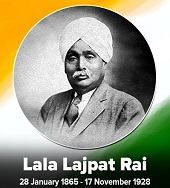
Punjab Keshari Lala Lajpat Rai (Saluting The Spirit Of Our Founding Father)

The Life And Times Of Lala Lajpat Rai

The Life and Times of Lala Lajpat RaiThere are few leaders of the pre-independence era who, after having plunged themselves into the political struggle, continued to take an active interest in social, cultural and educational work. Lala Lajpat Rai was one of such leaders. Born on 28th January, 1865 at a small village, Dhudike in the Ferozepur district of Punjab, he belonged to the Agarwal Baniya caste and it was perhaps because of this, in addition to taking part in social and political life of the country, he took keen interest in industrial and financial matter also. His father was a teacher of Persian and Urdu in a government school.
Having passed the final examination in Law from Punjab University, he started his practice in1883, when he was barely 18 years old. Endowed with a rich legacy of moral and intellectual background, Lala Lajpat Rai had benefit of education in the practical rationalism of western science combined with the religious purity and moral elevation of Eastern literature that put on him the hallmark of true culture. While sympathizing with and aiding every movement made for progress, Lala Lajpat Rai identified himself very closely with Arya Samaj, in which he found ample scope for the exercise of his patriotism, philanthropy and religious zeal.
Having qualified as a pleader, Lala Lajpat Rai started practice at Hissar and soon became a leading lawyer of the district. He organized the Arya Samaj there and put it on proper lines. In 1892, he transferred his practice to the wider field at Lahore.Education, both secular and religious, was in Lala Lajpat Rai’s view an important factor in national development. He took part in the foundation of the D.A.V. College at Lahore.

Lalaji And Politics

Lala Lajpat Rai always felt drawn towards politics. It was in 1888 that he joined the Indian National Congress when it met at Allahabad under the presidency of Mr. G. Yule. In 1905, the Indian National Congress Committee having recognized in him an austere, sincere and selfless devoted worker selected him as one of its delegates to place before the British, the political grievances of the Indian people. He met the expenses of his trip from his own pocket. He along with Gokhale carried on the political campaign in various parts of England and brought home to the mind of the British, the evils of an unsympathetic and bureaucratic government under which India was labouring and pleaded in eloquent language, adding facts and figures in supporting their contention, cause of the half starving and half dying people of India. Lala Lajpat Rai created an impression on the English Populace. After his return from England, he was busy devising and organizing ways and means for political advancement and industrial emancipation of the country.
The movement of “Swadeshi” was in the offing and he put his heart and soul into it. He preached the message of Swadeshi to the people of Punjab and made it very popular. This naturally enraged the bureaucracy and he came to be regarded as a revolutionary by the Britishers and the Anglo-Indian press. He was openly dubbed as a Revolutionary and an instigator of the armed forces.
The Jalianwala Bagh tragedy and the Government`s denial to censure the conduct of its officers made him a complete non cooperator. He lost his faith in the British and threw himself whole heartedly into the non-cooperation movement.In 1925, he joined the Swaraj Party and became its deputy leader. He took active part in the deliberations of the debates of the Assembly. It was he, who moved the resolution for the Boycott of the Simon Commission in the Assembly. It was while leading the boycott procession at Lahore on the 30th October, 1928 that he received lathi blows on his chest which ultimately brought about his death on the 17th November, 1928.

Lala Lajpat Rai And PNB

Lalaji was keenly concerned with the fact that though Indian capital was being used to run English Banks and companies, the profits went entirely to the British, while Indians had to contend themselves with a small interest on their capital. He echoed this sentiment in one of his writing while concurring with Rai Mul Raj of Arya Samaj who had long cherished the idea that Indians should have a National Bank of their own. At the instance of Rai Mul Raj, Lala Lajpat Rai sent a circular to selected friends insisting on an Indian joint stock Bank as the first step in constructive Swadeshi and the response was satisfactory After filing and registering the memorandum and Articles of Association on 19 May, 1894, the bank was incorporated under Act VI of the 1882 Indian Companies Act. The prospectus of the bank was published in the Tribune, and the Urdu Akhbar-e-Am and Paisa Akhbar. On 23rd May, 1894, the founders met at the Lahore residence of Sh. Dyal Singh Majithia, the first Chairman of PNB, and resolved to go ahead with the scheme. They decided to hire a house in the famous Anarkali Bazar of Lahore opposite the post office and near well known stores of Rama Brothers.On 12th April 1895, the Bank opened for business, a day before the great Punjab festival of Baishakhi. The essence of the Bank’s culture was clear at this first meeting itself. The fourteen original shareholders and seven directors took only a modest number of shares; the control of the Bank was to lie with the large, dispersed shareholders, a purely professional approach that was as uncommon then as it is today.
Source-Website Of  P N B

Korean Olympic athletes mark Lunar New Year with joint traditional ceremony

Authentic news,No fake news.

GANGNEUNG/INJE, South Korea, Feb. 16 (Yonhap) -- South Korean Olympic athletes took part in a joint ceremony on Friday to mark the Lunar New Year, when Koreans pay respects to their ancestors and eat a family meal with traditional soup.
The Korean Sport & Olympic Committee set the table for the traditional service for ancestors at Team Korea House in Gangneung, Gangwon Province, as the Olympic athletes celebrate the Lunar New Year apart from their families.
Every name of the 220-member Team Korea was recited as the joint service began. The chief delegate for Korea Kim Ji-yong bowed down and made an offering of liquor as part of the traditional procedure.
Culture Minister Do Jong-hwan and Korean Sport & Olympic Committee chief Lee Kee-heung joined the ceremony, along with athletes, including Aileen Frisch, a German-born luge player who is competing as a Korean athlete in the Olympics.
Bowls of "tteokguk," soup with sliced rice cake topped with egg and beef, were served as part of the breakfast eaten during the holiday.
Minister Do wished the athletes good health and the best Olympic performances, saying, "I hope the honor and joy of each athlete will lead to the honor and joy of the Koreans."

  
In the nearby county of Inje, Gangwon Province, North Korean cheerleaders who are currently in South Korea for the Olympic Games marked the Lunar New Year with a quiet joint breakfast of Korean soup and other traditional dishes.
Clad in their uniforms of red and white training suits, the North Korean cheerleaders showed up for the breakfast at Inje Speedium Hotel & Resort, their accommodation in South Korea.

Poland says ready to cooperate with Russia in culture, tourism and history

Authentic news,No fake news.


WARSAW, February 16. /TASS/. Polish Foreign Ministry said on Friday it saw prospects for Polish-Russian cooperation in spheres like culture, tourism and history.
This follows from a reply the ministry gave to a query filed by TASS.
Following a meeting between Poland’s Foreign Minister Jacek Czaputowicz and the Russian Ambassador in Warsaw, Sergei Andreyev, the ministry said Czaputowicz had voiced readiness "to unblock bilateral relations in selected areas". TASS asked in its query to clarify what specific areas the minister might have in mind.
"Poland states its readiness to seek the forms of livening up bilateral dialogue with Russia and cooperation [with Moscow] on international floor, particularly in the spheres like culture, tourism, humanitarian contacts, and the economy," the ministry said in a press release.
"The forthcoming FIFA World Cup, due to be held in Russia, could help rehabilitate contacts between people, while and a conference devoted to the founder of Memorial association, Arseny Roginsky, which will take place in April at the initiative of Polish embassy in Moscow, might be helpful in the sphere of culture," the press release said.
"In addition to it, Poland is open for constructive historical dialogue, which is made manifest in the joint work of Polish and Russian historians on history textbooks on history," it said. "Their public presentation will take place in Warsaw soon."
"We consider this initiative as a confirmation of the two sides’ capability to cooperate in the complicated but highly important sphere like the history of Polish-Russian relations," the ministry said.


More:
http://tass.com/politics/990482

Russian and Ukrainian top diplomats discuss Ukrainian settlement, UN role in Donbass

Authentic news,No fake news.


MOSCOW, February 16. /TASS/. Ukrainian settlement, the implementation of the Minsk agreements and the United Nations’ role in Donbass was in focus of a meeting between Russian and Ukrainian Foreign Ministers, Sergey Lavrov and Pavel Klimkin, in Munich, the Russian foreign ministry said on Friday.
"The sides discussed a number of aspects concerning the Ukrainian settlement and the realization of the Package of Measures on the implementation of the Minsk agreements of February 12, 2015, as well as the United Nations’ role in Ukraine," the ministry said.
The two top diplomats had their first personal meeting in December 2017 in Vienna, on the sidelines of an OSCE ministerial meeting. Back then, they discussed issues of prisoner exchange between the parties to the conflict in Donbass.
In January 2018, Lavrov and Klimkin had a telephone conversation that focused on Russia’s initiative to deploy a United Nations mission to ensure security of the OSCE Special Monitoring Mission in Donbass.


More:
http://tass.com/politics/990499

Mitra-mandal Privacy Policy

This privacy policy has been compiled to better serve those who are concerned with how their  'Personally Identifiable Inform...