MITRA MANDAL GLOBAL NEWS

Business news for July 26, 2017

Authentic news,No fake news.

Boeing second-quarter earnings top estimates; raises 2017 forecast again
(Reuters) - Boeing Co on Wednesday posted second-quarter profit and cash growth that beat analysts' estimates even though sales were less than expected, sending shares up sharply.
Lower tax rate fuels Ford beat, seen lifting full-year profit
DETROIT (Reuters) - Ford Motor Co on Wednesday reported a better-than-expected quarterly net profit due to a lower tax rate and increased U.S. sales of more-profitable pickup trucks, but forecast a slightly lower 2017 pre-tax profit and its shares dipped 1.2 percent in premarket trading.
Wall Street set to open higher on earnings; Fed in focus
(Reuters) - U.S. stock indexes were poised to open at record levels on Wednesday following a set of strong quarterly earnings, led by Boeing and AT&T, while investors awaited the outcome of a two-day Federal Reserve meeting.
Juices, low-sugar sodas help Coca-Cola profit beat estimates
(Reuters) - Coca-Cola Co's profit, in its first quarter under new Chief Executive James Quincey, beat analysts' estimates on higher demand for its healthier non-carbonated beverages as well as low and no-sugar versions of its sodas.
Fed expected to leave rates unchanged; balance sheet in focus
WASHINGTON (Reuters) - The Federal Reserve is expected to hold interest rates unchanged on Wednesday and possibly hint that it will start winding down its massive holdings of bonds as soon as September in what would be a vote of confidence in the U.S. economy.
USTR Lighthizer: Trump challenging China's industrial policies - radio interview
WASHINGTON (Reuters) - The top U.S. trade negotiator said late on Tuesday that President Donald Trump is determined to challenge China's use of unfair subsidies and "non-economic" industrial policy to build up export industries that are costing American jobs.
Exclusive: Banks dealing EU sovereign debt may be dragged out of London
LONDON (Reuters) - Banks at the heart of EU government borrowing could be forced to move some operations out of London if they want to hold on to that business after Brexit, according to three senior bankers with knowledge of the matter.
D.R. Horton posts slowest order growth in three quarters
(Reuters) - No.1 U.S. homebuilder D.R. Horton Inc posted a quarterly profit that scraped past analysts' estimates, and the company reported its slowest growth in orders in three quarters.
Oil prices rise as falling U.S. inventories stoke rebalancing hopes
LONDON (Reuters) - Oil prices rose to near eight-week highs on Wednesday, as a fall in U.S. inventories bolstered expectations that the long-oversupplied market was moving toward balance.
Hilton's profit beats; raises earnings forecast again
(Reuters) - Hilton Worldwide Holdings Inc , the owner of the Waldorf Astoria hotel chain, reported a higher-than-expected quarterly revenue and profit, as more people booked rooms at higher prices, and raised its 2017 earnings forecast yet again.

There’s Water Inside the Moon

Authentic news,No fake news.


Matt Williams द्वारा
Since the Apollo program wrapped up in the early 1970s, people all around the world have dreamed of the day when we might return to the Moon, and stay there. And in recent years, however, that actual proposals for a lunar settlement have begun to take shape. As a result, a great deal of attention and research has been focused on whether or not the Moon has indigenous sources of water.
Thanks to missions like Chandrayaan-1 and the Lunar Reconnaissance Orbiter (LRO), scientists know that there are vast amounts of surface ice on the Moon. However, according to a new study, researchers from Brown University have found evidence of widespread water within volcanic deposits on the lunar surface. These findings could indicate that there are also vast sources of water within the Moon's interior.
For their study - titled "Remote Detection of Widespread Indigenous Water in Lunar Pyroclastic Deposits" - Brown researchers Ralph E. Milliken and Shuai Li combined satellite data with new thermal profiles to search for signs of water away from the polar regions. In so doing, they addressed a long-standing theory about the likelihood of water in the Moon's interior, as well as the predominant theory of how the Moon formed.
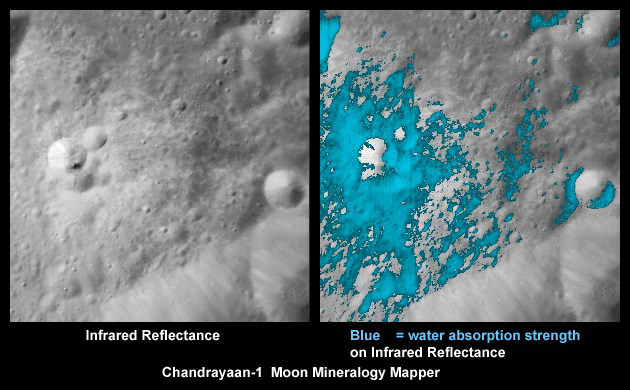
Lunar Crater as imaged by NASA's Moon Mineralogy Mapper. Credit: SRO/NASA/JPL-Caltech/USGS/Brown Univ.
As noted, scientists have known for years that there are large amounts of frozen water in the Moon's polar regions. At the same time, however, scientists have held that the Moon's interior must have depleted of water and other volatile compounds billions of years ago. This was based on the widely-accepted hypothesis that the Moon formed after a Mars-sized object (named Theia) collided with Earth and threw up a considerable amount of debris.
Essentially, scientists believed that it was unlikely that any hydrogen - necessary to form water - could have survived the heat of this impact. However, as of a decade ago, new scientific findings began to emerge that cast doubt on this. The first was a 2008 study, where a team of researches (led by Alberto Saal of Brown University) detected trace amounts of water in samples of volcanic glass that were bought back by the Apollo 15 and Apollo 17 missions.
This was followed by a 2011 study (also from Brown University) that indicated how crystalline structures within those beads contained as much water as some basalt mineral deposits here on Earth. These findings were particularly significant, in that they suggested that parts of the Moon's mantle could contain as much water as Earth's. The question though was whether these findings represented the norm, or an anomaly.
As Milliken, an associate professor in Brown’s Department of Earth, Environmental, and Planetary Sciences (DEEPS) and the co-author on the paper, summarized in a recent Brown press release:
“The key question is whether those Apollo samples represent the bulk conditions of the lunar interior or instead represent unusual or perhaps anomalous water-rich regions within an otherwise ‘dry’ mantle. By looking at the orbital data, we can examine the large pyroclastic deposits on the Moon that were never sampled by the Apollo or Luna missions. The fact that nearly all of them exhibit signatures of water suggests that the Apollo samples are not anomalous, so it may be that the bulk interior of the Moon is wet.”
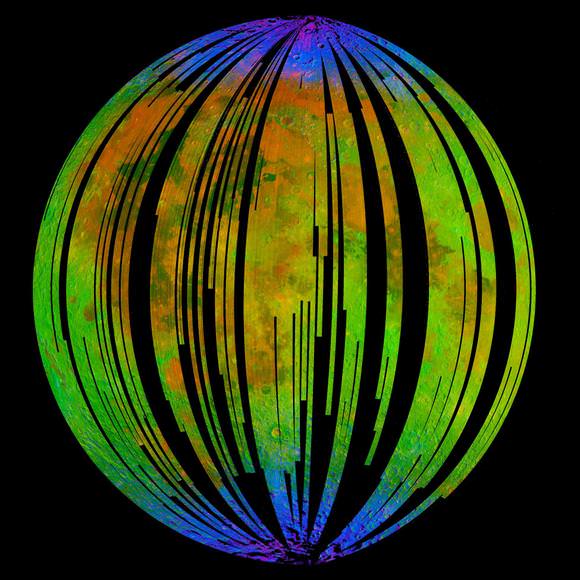
A false colour composite of the distribution of water and hydroxyl molecules over the lunar surface. Credit: ISRO/NASA/JPL-Caltech/Brown Univ/USGS
To resolve this, Milliken and Li consulted orbital data to examine lunar volcanic deposits for signs of water. Basically, orbiters use spectrometers to bounce light off the surfaces of planets and astronomical bodies to see which wavelengths of light are absorbed and which are reflected. This data is therefore able to determine what compounds and minerals are present based on the absorption lines detected.
Using this technique to look for signs of water in lunar volcanic deposits (aka. pyroclastic deposits), however, was a  rather difficult task. During the day, the lunar surface heats up, especially in the latitudes where volcanic deposits are located. As Milliken explained, spectronomers will therefore pick up thermal energy in addition to chemical signatures which this can throw off the readings:
“That thermally emitted radiation happens at the same wavelengths that we need to use to look for water. So in order to say with any confidence that water is present, we first need to account for and remove the thermally emitted component.”
To correct for this, Milliken and Li constructed a detailed temperature profile of the areas of the Moon they were examining. They then examined surface data collected by the Moon Mineralogy Mapper, the spectrographic imager that was part of India's Chandrayaan-1 mission. They then compared this thermally-corrected surface data to the measurements conducted on the samples returned from the Apollo missions.
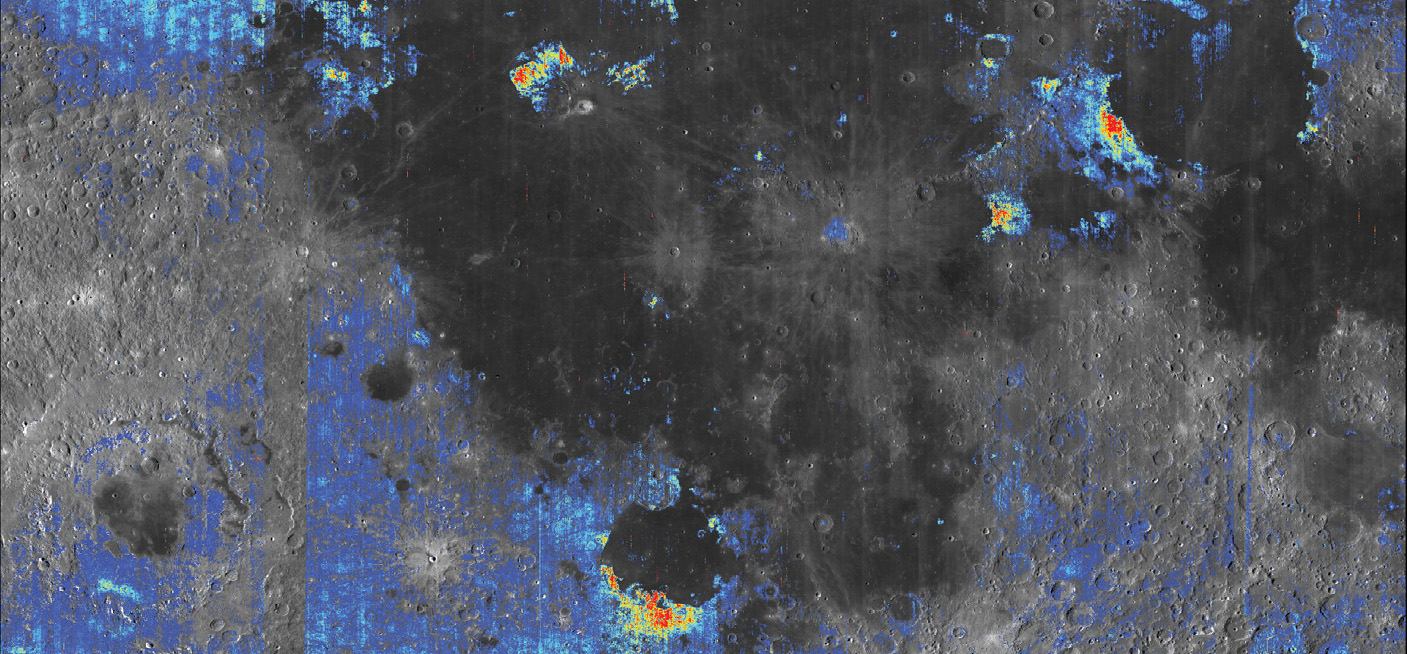
Colored areas indicate elevated water content compared with surrounding terrains. Yellows and reds indicate the richest water content. Credit: Milliken lab/Brown University
What they found was that areas of the Moon's surface that had been previously mapped showed evidence of water in nearly all the large pyroclastic deposits. This included the deposits that were near the Apollo 15 and 17 landing sites where the lunar samples were obtained. From this, they determined that these samples were not anomalous in nature, and that water is distributed across the lunar surface.
What's more, these findings could indicate that the Moon's mantle is water-rich as well. Beyond being good news for future lunar missions, and the construction of a lunar settlement, these results could lead to a rethinking of how the Moon formed. This research was part of Shuai Li's - a recent graduate of the University of Brown and the lead author on the study - Ph.D thesis. As he said of the study's findings:
“The growing evidence for water inside the Moon suggest that water did somehow survive, or that it was brought in shortly after the impact by asteroids or comets before the Moon had completely solidified. The exact origin of water in the lunar interior is still a big question.
What's more, Li indicated that lunar water that is located in volcanic deposits could be a boon for future lunar missions. "Other studies have suggested the presence of water ice in shadowed regions at the lunar poles, but the pyroclastic deposits are at locations that may be easier to access," he said. "Anything that helps save future lunar explorers from having to bring lots of water from home is a big step forward, and our results suggest a new alternative.”
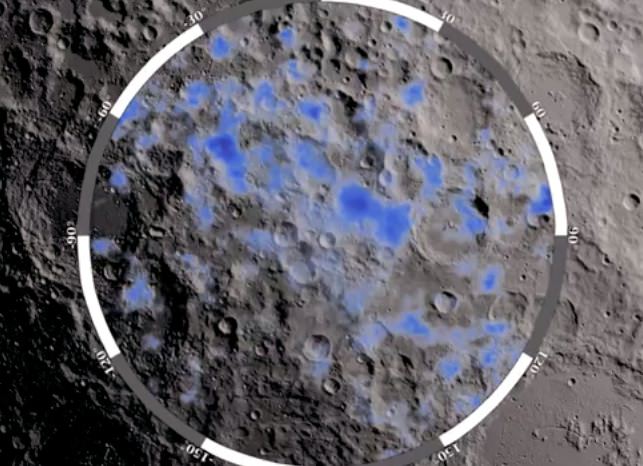
The blue areas show locations on the Moon's south pole where water ice is likely to exist. Credit: NASA/GSFC
Between NASA, the ESA, Roscosmos, the ISRO and the China National Space Administration (CNSA), there are no shortage of plans to explore the Moon in the future, not to mention establishing a permanent base there. Knowing there's abundant surface water (and maybe more in the interior as well) is therefore very good news.  This water could be used to create hydrazine fuel, which would significantly reduce the costs of individual missions to the Moon.
It also makes the idea of a stopover base on the Moon, where ships traveling deeper into space could refuel and resupply - a move which would shave billions off of deep-space missions. An abundant source of local water could also ensure a ready supply of drinking and irrigation water for future lunar outposts. This would also reduce costs by ensuring that not all supplies would need to be shipped from Earth.
On top of all that, the ability to conduct experiments into how plants grow in reduced gravity would yield valuable information that could be used for long-term missions to Mars and other Solar bodies. It could therefore be said, without a trace of exaggeration, that water on the Moon is the key to future space missions.
The research was funded by the NASA Lunar Advanced Science and Exploration Research (LASER) program, which seeks to enhance lunar basic science and lunar exploration science.
Further Reading: Brown University

Kenya and Ethiopia Join Forces to Advance Peace, Security, Development and Hope

Authentic news,No fake news.

Siddharth Chatterjee is the United Nations Resident Coordinator to Kenya.
President Uhuru Kenyatta of Kenya and Prime Minister Hailemariam Desalegn of Ethiopia have a shared vision of turning this once violent and fragile region into a prosperous & peaceful area. Moyale-07 Dec 2015. Credit: UNDP Kenya
NAIROBI, Kenya, Jul 24 2017 (IPS) - The Horn of Africa is often synonymous with extreme poverty, conflict, demographic pressure, environmental stress, and under-investment in basic social services such as health, education, access to clean water and infrastructure.
In Kenya’s Turkana, Marsabit, Wajir and Mandera counties, for instance, between 74% and 97% of the people live below the absolute poverty line and literacy rates and school enrollment rates are well below the national average. Conditions here are rife with flashpoints for potential conflict over natural resources and access to limited government services, and all too fertile for discontent, radicalization, violent extremism and recruitment of adolescents and youth into armed groups as an economic survival mechanism.
Confronting the challenges of radicalization and terrorist threats in the region calls for a focused strategy on a compendium of socio-cultural, economic, political and psychological factors. While extremism and related violence have traditionally been driven by exclusion and poverty, this paradigm is no longer adequate. As shown during the attack at Kenya’s Garissa University, not all extremists are uneducated or from poor families.
Complex, interlinked and rapidly evolving circumstances have brought about the need for a raft of interventions geared towards fostering sustainable peace in the border areas. One of the most promising initiatives to-date involves establishing social and economic interdependence across border communities.
This is the powerful rationale behind the pact between the Governments of Ethiopia and Kenya, who established a cross-border programme which straddles Marsabit County, Kenya and the Borana/Dawa Zones of Ethiopia known as the “Integrated Programme for Sustainable Peace and Socio-economic Transformation.”
This initiative was launched in December 2015 by President Uhuru Kenyatta of Kenya, and Prime Minister Hailemariam Desalegn of Ethiopia and the Inter-Governmental Authority on Development (IGAD) Executive Secretary, Ambassador Mahboub Maalim. A short video.
The programme, which is implemented in partnership with IGAD and the UN Country Teams of Ethiopia and Kenya, aims at preventing and mitigating potential violent conflicts and extremism in the borderland areas through conflict prevention mechanisms, addressing the root causes of violent extremism and focusing on the humanitarian, security and development nexus.
Kenya’s Minister Henry Rotich and Ethiopia’s Minister Kassa Tekleberhan exchange the joint agreement. Kenya’s Foreign Minster Amina Mohamed and EU Ambassador to Kenya, Stefano Dejak look on. Credit: UNDP Kenya

To galvanize support for the programme, an event titled “From Barriers to Bridges: The Ethiopia-Kenya Cross-Border Programme” was organized on 10 July 2017 at UNDP New York. It was co-chaired by the Permanent Representatives of Kenya and Ethiopia to the United Nations.
Taking stock of the programme to-date, one cannot help but marvel at how far the two countries have come and what can still be achieved. As confirmed by local community elders, local conflicts have diminished and the programme has achieved impressive results in reducing the allure of extremist groups such as Al-Shabaab among local youth, ever since joint interventions by the Government of Kenya, the UN and civil society partners started in 2015.
There have been significant socio-economic gains as well. The Isiolo-Merille-Marsabit-Moyale road, which is partially financed by the European Union (EU), is now complete and is expected to be a game-changer in enhancing integration, connectivity and promoting trade between Ethiopia and Kenya.
The World Bank has also embarked on a huge infrastructure development programme to link Isiolo with Mandera. The EU is already proposing that the Ethiopia-Kenya cross-border programme be scaled up to include the Mandera Triangle, the Omo and Karamoja clusters.
These are all welcome developments for a region with substantial development needs and considerable potential. The areas involved are home to more than half of Kenya’s livestock, which can be harnessed to create bigger and better agro-business industries.
The region’s diverse and rich culture and heritage, evidenced by local historical and geographical sites, can be an asset in developing eco-tourism. There is also a latent resource for clean and renewable energy exploitation, as proven by the recent launch of the Lake Turkana Wind Power Project, which is expected to generate 310MW.
Once operational, the wind farm will provide 310MW of reliable, low cost energy to Kenya’s national grid (i.e. approx. 15% of the country’s installed capacity). Credit: Lake Turkana Wind Power Project

The recent discovery of major groundwater aquifers and massive oil deposits in Turkana provides further reason for optimism.
Cross-border trade could have a positive ripple effect. It is poised to generate tremendous revenue for both countries, reduce risks of conflict, facilitate prevention of violent extremism efforts (particularly if tied to approaches that aim to strengthen social cohesion and societal resilience as well as paying attention to the social/cultural/political dimensions that drive radicalization and extremism), and improve livelihoods, especially among the marginalized and poor communities to expedite the achievement of a core goal of the SDGs – ending poverty by 2030.
The UN Assistant Secretary General and UNDP Regional Director for Africa Mr. Abdoulaye Mar Dieye has said, “The Ethiopia Kenya Cross Border Programme has a high peace and development return. If we invest in the region we can boost development and reduce insecurity. This Cross Border Programme is a regional public good. It resonates far beyond Kenya and Ethiopia and can serve the entire continent”.
Mr Abdoulaye Mar Dieye flanked by the Permanent Representative of Kenya Ambassador Macharia Kamau and the Permanent Representative of Ethiopia, Ambassador Tekeda Alemu said, “The Ethiopia Kenya Cross Border Programme has a high peace and development return”. Credit: UNDP Africa

The Kenya Ethiopia cross-border programme may well hold the key to an innovative approach to operationalizing Mr António Guterres, the UN Secretary General’s prevention agenda by addressing marginalization, radicalization and prevent violent extremism using human development and economic growth to spur peace.
Norway’s Ambassador to Kenya, Victor Ronneberg says. “this programme is a testimony of the UN’s convening role, to spur dialogue & engagement & reiterates the primacy of multilateralism even more in this day and age.”
The momentum has to be maintained and should not falter due to absence of resources. It is therefore critical for the international community to strongly support this initiative.

Ancient Volcanoes on Mars Could Have Been the Place for Life

Authentic news,No fake news.


Matt Williams द्वारा
For decades, Mars has been the focal point of intense research. Beginning in the 1960s, literally dozens of robotic spacecraft, orbiters and rovers have explored Mars' atmosphere and surface, looking for clues to the planet's past. From this, scientists now know that billions of years ago, Mars was a warmer, wetter place. Not only did liquid water exist on its surface, but it is possible life existed there in some form as well.
Granted, some recent findings have cast some doubt in this, indicating that Mars' surface may have been hostile to microbes. But a new study from an international team of scientists indicates that evidence life could be found in volcanic deposits. Specifically, they argue that within the massive geological structure known as Valles Marineris, there may be ancient volcanoes that have preserved ancient microbes.
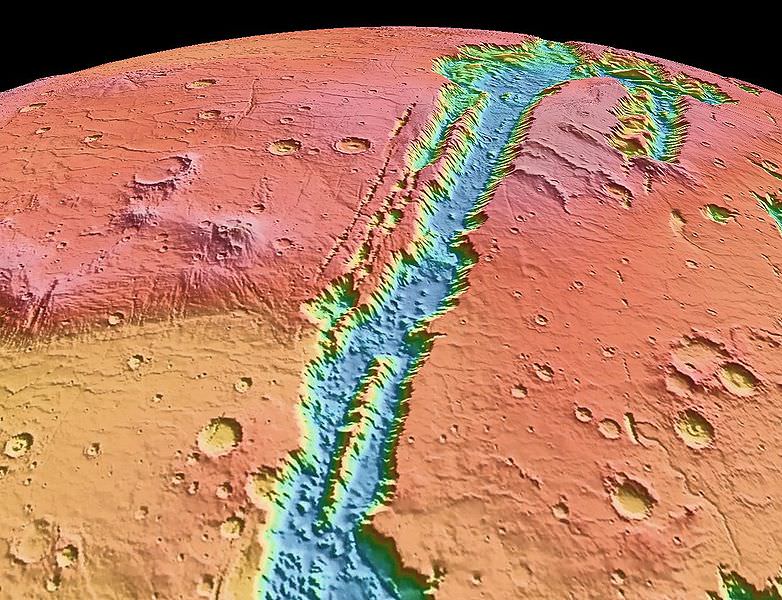
The study, titled "Amazonian Volcanism Inside Valles Marineris on Mars", recently appeared in the journal Earth and Planetary Science Letters. Led by Petr Brož of the Institute of Geophysics at the Czech Academy of Sciences (AVCR), the team examined Mars' famous Valles Marineris region - a canyon system stretching for 4000 km (2485.5 mi) - for signs of recent geological activity, which opens up the possibility of there also being fossilized life there.
Valles Marineris, part of NASA World Wind map of Mars. Credit: NASA
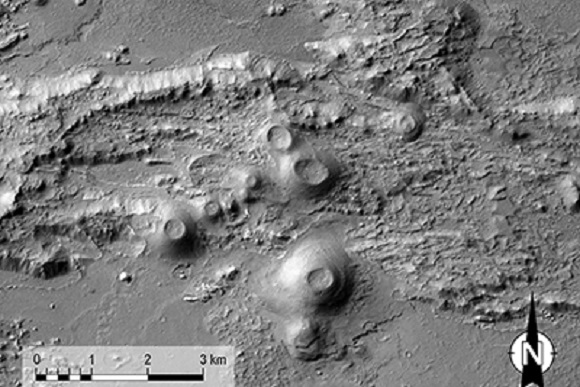
The team began by examining the Coprates Chasma canyon, one of the lowest points in Valles Marineris, which is home to over 130 volcanoes and solidified lava flows. This consisted of analyzing high-resolution images of the region that were taken by NASA's Mars Reconnaissance Orbiter (MRO), which revealed cones of basaltic lava (aka. scoria) and ash that measured around 400-meters (1300 ft) high.
After examining the cones' surface patterns and morphological details, they confirmed that these were indeed the remains of lava volcanoes (and not mud volcanoes, which was another possibility). In addition, they also noted similarities between these cone and others on Mars where mud volcanism is not possible – as well as similarities with volcanic cones here on Earth.
As Ernst Hauber, a researcher from the Institute of Planetary Research at the German Aerospace Center (DLR) and a co-author on the study, explained in a AVCR press release:
“The spatial distribution of the cones also suggests their volcanic origin. They appear to occur more frequently along tectonic fractures that formed the trough in the surface and whose fracture interfaces continue into the subsurface, creating pathways for the magma to ascend.”
Even more surprising was the apparent age of the volcanoes, which was very young. On Mars, the main period of volcanic activity ended during Mars' Hesperian Period - which ran from 3.7 to approximately 3.0 billion years ago. And while images acquired by the Mars Express mission have shown indications of younger volcanoes (occurring 500 million years ago), these tend to be located in volcanic provinces.
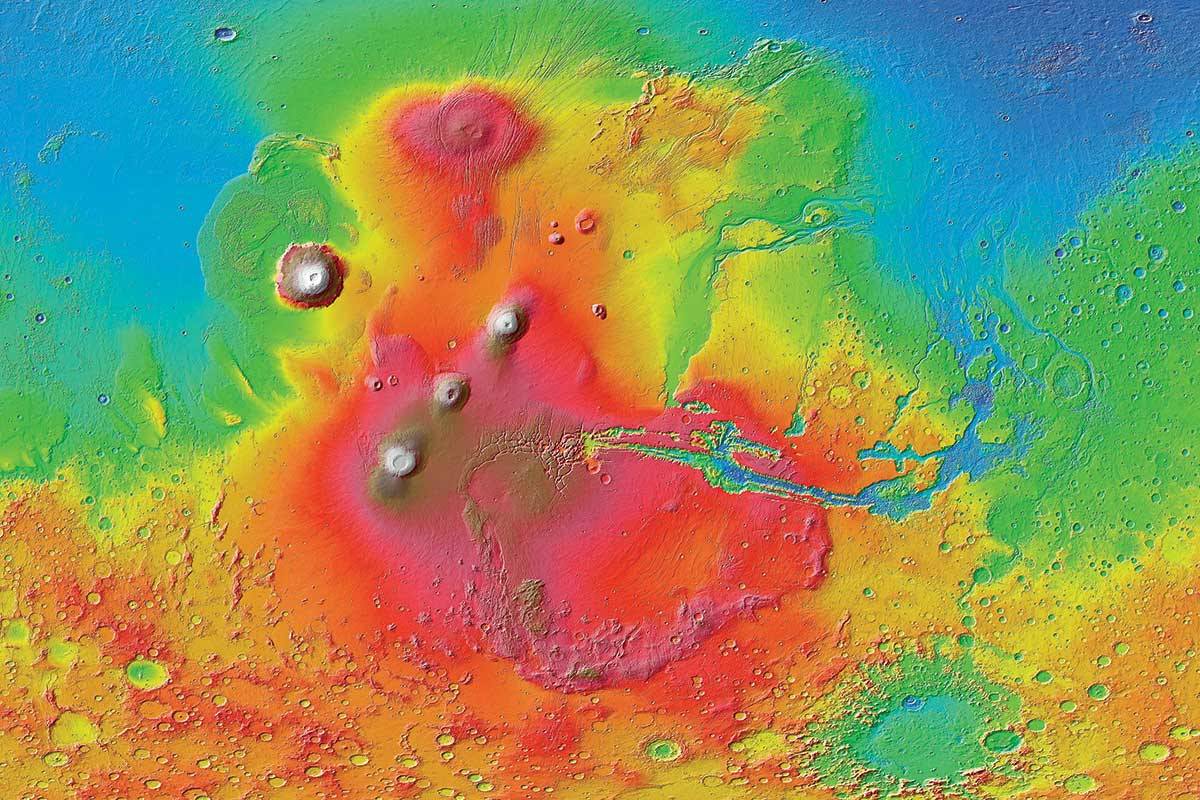
A colorized image of the surface of Mars taken by the Mars Reconnaissance Orbiter. The line of three volcanoes is the Tharsis Montes, with Olympus Mons to the northwest. Valles Marineris is to the east. Image: NASA/JPL-Caltech/ Arizona State University
A good example of this is the Tharsis Bulge, which is located several thousand km from the Coprates Chasma canyon. It is here that the Tharses Montes mountain chain is located, which consists of the shield volcanoes of Ascraeus Mons, Pavonis Mons and Arsia Mons. Olympus Mons, the tallest mountain in the Solar System (with an elevation of 22 km or 13.6 mi), is located at the edge of this region.
In contrast, the volcanic cones spotted in the Coprates Chasma canyon were estimates to be between 200 and 400 million years of age, placing them in the most recent geological period known as the Amazonian (3.0 billion years ago to the present day). This effectively demonstrates that these volcanoes formed late in Mars' history and far away from volcanic areas like Tharsis and Elysium.
It also demonstrates that these volcanoes were not part of the original formation of Valles Marineris, which is believed to be related to the formation of the Tharsis Bulge. This all took place between the Noachian to Late Hesperian periods of Mars (ca. 3.5 billion years ago), which was the last time Mars experienced widespread geological activity.
Last, but not least, the team used the Compact Reconnaissance Imaging Spectrometer(CRISM) aboard the MRO to learn more about the mineral compositions of the region's lava and volcanic cones. Once again, their findings proved to be surprising, and could indicate that the Coprates Chasma region is a suitable location to search for evidence of ancient life on Mars.
Image of young volcanoes at the base of Coprates Chasma on Mars, obtained by the Mars Reconnaissance Orbiter. Credit: NASA/JPL/University of Arizona
Essentially, the CRISM data indicated the presence of high-silica content minerals in the volcanic rock, which included opaline-like substances at one of the peaks. Opaline silicates, it should be noted, are water-bearing materials that are often produced by hydrothermal processes - where silicate structures form from supersaturated, hot solutions of minerals that cool to become solid.
On Earth, microorganisms are often found within opal deposits since they form in energy and mineral-rich environments, where microbial lifeforms thrive. The presence of these minerals in the Coprates Chasma region could therefore mean that ancient microorganisms once thrived there. Moreover, such organisms could also be fossilized within the mineral-rich lava rock, making it a tempting target for future research.
As Hauber indicated, the appeal of Coprates Chasma doesn't end there, and future mission will surely want to make exploring this region a priority:
“Coprates Chasma is not just interesting with regard to the question of previous life on Mars. The region would also be an excellent landing site for future Mars Rovers. Here we could investigate many scientifically important and interesting topics. Analyzing samples for their elemental isotopic fractions would allow us to determine with far greater precision when the volcanoes were actually active.
"On the towering, steep walls, the geologic evolution of the Valles Marineris is presented to us almost like a history book – gypsum strata and layers of old, crustal rocks can be observed, as well as indications for liquid water trickling down the slopes even today during the warm season. That is as much Mars geology as you can get!”
Scientists were able to gauge the rate of water loss on Mars by measuring the ratio of water and HDO from today and 4.3 billion years ago. Credit: Kevin Gill
In other words, this low-lying region could be central to future studies that attempt to unlock the history and geological evolution of the Red Planet. The payoffs of studying this region not only include determining if Mars had life in the past, but when and how it went from being a warmer, wetter environment to the cold, dessicated landscape we know today.
In the future, NASA, the ESA, the China National Space Agency (CNSA) and Roscosmos all hope to mount additional robotic missions to Mars. In addition, NASA and even SpaceX hope to send crewed missions to the planet in the hopes of learning more about its past - and possibly future - habitability. Between its geological history, greater atmospheric pressure, and the possibility of fossilized life, one or more of these missions may be headed to Valles Marineris to have a look around.
Matt Williams | जुलाई 25, 2017 को 5:18 अपराह्न | टैग्स: FeaturedTharsis Montes | URL: http://wp.me/p1CHIY-zwq

Mitra-mandal Privacy Policy

This privacy policy has been compiled to better serve those who are concerned with how their  'Personally Identifiable Inform...