Both Omar Khayyam and Maryam Mizrakhani complicate the vision of their common homeland, Iran, in Western imagination.
From the time that she achieved her coveted Fields Medal, Maryam Mirzakhani had begun to complicate the global image of her homeland,writes Dabashi [Harvard Math/Youtube]
Hamid Dabashi is the Hagop Kevorkian Professor of Iranian Studies and Comparative Literature at Columbia University.
"The Iranian mathematician Maryam Mirzakhani, who died on July 14, at the age of forty, was known to her colleagues as a virtuoso in the dynamics and geometry of complex surfaces - 'science-fiction mathematics', one admirer called it - and to her young daughter, Anahita, as something of an artist."
Siobhan Roberts' words in the New Yorker sums up in simplest terms the sudden sense of loss and quiet mourning millions of Iranians around the world and, with them, the world of science at large feels at the tragic ending of a beautiful mind so early in its blooming.
World-renowned mathematician and professor of mathematics at Stanford University Maryam Mirzakhani (1977-2017), the first woman to win Fields Medal prize, passed away battling cancer. Born and raised in Iran, Mirzakhani became a globally celebrated mathematician soon after she obtained her BSc in mathematics in 1999 from Sharif University of Technology in Tehran. She travelled to the US for her graduate studies earning her PhD from Harvard University in 2004. She was awarded the Fields Medal in 2014 for her "outstanding contributions to the dynamics and geometry of Riemann surfaces and their moduli spaces". She has left her immediate family, her friends and colleagues, and with them her nation at a loss for words.
Complicating the global image of a nation
Much of the reactions to the death of Mirzakhani was both normal and predictable. The Iranian President Hassan Rouhani and the Stanford University President Marc Tessier-Lavigne both issued solemn statements of condolences. The Iranian media competed in showering her with accolades. The Iranian oppositional venues in the United States and Europe began to use and abuse the occasion to denounce the Islamic Republic for its various policies, especially for the conditions conducive to "brain drain".
Maryam Mirzakhani left Iran to pursue her advanced mathematical studies in the US. She would have gone to Baghdad to do so if she were born one thousand years ago - and she would have probably gone to Beijing if she were born just a couple of decades from now. The question of "brain drain" is, of course, a serious malady in Iran and many other similar countries. But Maryam Mirzakhani was no "brain drain". Hers was a superior intelligence and she travelled where she could nourish it best - and that travelling did not suddenly turn her into this strange thing called "Iran-born", instead of just plain "Iranian".
But something else, something quite simple and significant, was also happening, just like Maryam Mirzakhani herself, gently and quietly.
Mirzakhani is comparable to Omar Khayyam not just because they were both Iranian mathematicians. But because like Khayyam, Mirzakhani too complicates the vision of their common homelands in the European and now American imagination in unpredictable ways.
Markedly brilliant minds and beautiful souls like Maryam Mirzakhani both upon their global recognitions and perforce upon their early and tragic passing become a symbol, a sign, a citation far beyond who they are and what they have achieved in their professional calling. From the time that she achieved her coveted Fields Medal, Maryam Mirzakhani had begun to complicate the global image of her homeland against the backdrop of the pervasive demonisation of Iran by one brand of warmongering or another.
Nations need to be simplified to be targeted for military strikes. Afghanistan was reduced to Mullah Omar. Iraq was reduced to Saddam Hussein. The more the image of a nation is complicated the more difficult it is for warmongers in Washington, Tel Aviv, or Riyadh targeting it for destruction.
Precisely in the quiet dignity of her work, her avoiding publicity like a plague, the tiny, cancer-ravaged body of Maryam Mirzakhani shined like a beautiful star on the dark planet of her earthly life. An Iranian, a Muslim, a woman of modest middle-class background, rising gloriously to put a big brilliant question mark in front of everything mobilised against her people!
Those exonerating Iranian people when targeting "Iran" for demonisation should take a look at what they have done to Afghanistan, Iraq, Syria, or Libya before they might believe their own delusions. Ordinary people, not governments, are the primary targets and the final victims of warmongering anywhere and everywhere.
To be sure, much to the chagrin of warmongers, the image of Iran has been complicated by other prominent Iranians, in particular, those who have put Iranian cinema on the global map. I recall vividly when another accomplished Iranian young woman, Samira Makhmalbaf first appeared in Cannes Film Festival at the age of seventeen to premier her film "Apple" in 1998. She too succeeded that year, seriously altering the image of Iran from that of a bearded angry man to a gifted young woman.
In the realm of art, no one, of course, did more to complicate the image of Iran than the late master Abbas Kiarostami who was the principal engine bringing the rest of Iranian art to global spotlight.
But much of that complexity has been in the realm of arts, not sciences. In the realm of science, the only thing publicly related to Iran is, of course, the nuclear scientists who are the targets of assassinations presumably by a settler colony on planet Mars that is very concerned about the Iranian nuclear programme. These Martians are suspected to have occasionally sent their assassins to kill these Iranian nuclear scientists.
Mirzakhani was not a nuclear physicist. A breed apart, she was a world-renowned mathematician. Her accomplishments, as a result, assume entirely historical proportions comparable to other Iranian and Muslim scientists at the historical level of Muhammad ibn Musa al-Khwarizmi, Muhammad ibn Zakariyya al-Razi, and above all to Omar Khayyam, the towering astronomer and mathematician.
Mirzakhani's uplifting of her homeland to its historical memories alerts the world to a whole different register of consciousness about Iran as a Muslim a country in circumstances that, because of pervasive Islamophobia in the US, even Rumi is read as if he were a New Age guru from California.
Mirzakhani is comparable to Omar Khayyam not just because they were both Iranian mathematicians. But because like Khayyam, Mirzakhani too complicates the vision of their common homeland in the European and now American imagination in unpredictable ways.
The reputation of Omar Khayyam as a poet, however, widely outshines his fame as a mathematician. But the difference is only on the surface. The beauty of Khayyam's mathematical mind, it now seems, had to be translated, as it were, into poetic scepticism to be registered for mortal beings, whereas Maryam Mirzakhani's poetry was and remained in pure mathematics.
Khayyam's mathematics was sublated into his poetry for a larger aesthetic register:
"But helpless pieces in the game He plays Upon this chequer-board of Nights and Days He hither and thither moves, and checks ... and slays Then one by one, back in the Closet lays"
But if Khayyam's penchant was for the poetic absurdity of being, Maryam Mirzakhani dwelled in the poetic precision of her numbers. "I like crossing the imaginary boundaries people set up between different fields - it's very refreshing," she once said, "There are lots of tools, and you don't know which one would work," she said. "It's about being optimistic and trying to connect things". In mathematics, Mirzakhani crossed imaginary boundaries other poets do with the very mystery of life itself.
The mathematician, poet, painter
On another occasion, she said: "Of course, the most rewarding part is the 'Aha' moment, the excitement of discovery and enjoyment of understanding something new - the feeling of being on top of a hill and having a clear view. But most of the time, doing mathematics for me is like being on a long hike with no trail and no end in sight". That is the mind of a mathematician in the soul of a poet. That is Khayyam incarnate.
Mirzakhani's mathematical equations were her poetry - a poetry only a happy few can decipher to their delight. The world at large is baffled at the beauty of that poetry. Thus, the other more recent kindred soul of Mirzakhani was, of course, the Indian mathematician Srinivasa Ramanujan (1887-1920) who died even younger than her.
The famous story narrated by Ramanujan's English colleague, the prominent mathematician GH Hardy, is now known as "Hardy-Ramanujan number 1729". According to Hardy, he was once going to see Ramanujan when he was bedridden. Hardy had just ridden in a cab number 1729 and upon arrival, he remarked to his friend that the number seemed to be quite dull and that he hoped it was not an unfavourable omen. "No", Ramanujan replied: "It is a very interesting number. It is the smallest number expressible as the sum of two cubes in two different ways". The two different ways are: 1729 = 13+123 = 93+103.
Now, that is pure poetry - for what is poetry other than a truth so obviously beautiful that mortals cannot see it. The joyous eyes of Maryam Mirzakhani's little daughter could see what her mother's beautiful mind knew with mathematical precision: "At the family's home, near Stanford University," Roberts tells us in her essay on the Iranian mathematician, "Mirzakhani would spend hours on the floor with supersized canvases of paper, sketching out ideas, drawing diagrams and formulae, often leading Anahita, now six, to exclaim, 'Oh, Mommy is painting again!"
At the summit of her sublime mathematical visions, Maryam Mirzakhani left us too brutally early for her full story to unfold and yet in her little daughter Anahita (named after Avestan, the old Persian goddess of fertility, healing, and wisdom), she has left us a picture of what she was up to teaching us.
Hamid Dabashi is Hagop Kevorkian professor of Iranian Studies and Comparative Literature at Columbia University in New York.
The views expressed in this article are the author's own and do not necessarily reflect Al Jazeera's editorial policy.
The last couple of weeks have seen daily demonstrations and confrontations between Israeli forces and Palestinians in the occupied Palestinian territories.
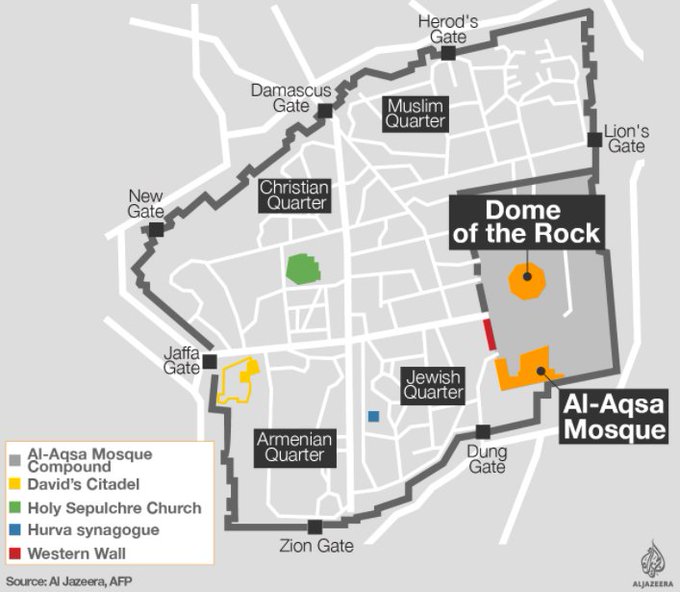
Tensions have risen in occupied East Jerusalem's Old City after Israel shut down al-Aqsa Mosque compound for the first time since 1969, after a deadly gun battle between Palestinian citizens of Israel and Israeli forces.
The attack, which took place on July 14, ended in the deaths of two Israeli police officers and three Palestinian attackers. Israel subsequently closed the site for Friday prayers and reopened it the next Sunday with new measures of control, including metal detectors and additional cameras, at the compound's entrances.
Palestinians have been refusing to enter the compound until Israel removes the new measures, which are being seen as the latest move by Israel to impose control and Judaise the city. They have been praying outside the gates in protest for more than a week.
During Friday prayers on July 21, thousands of Palestinians came out to pray in the streets outside of Lion's Gate, one of the entrances to the Old City. Tensions raged after peaceful demonstrations were violently suppressed by Israeli forces, resulting in hundreds of injuries. Four Palestinians have so far been shot dead in occupied East Jerusalem and the West Bank, one of whom was shot by an Israeli settler.
The following is a breakdown of why the al-Aqsa Mosque compound is a constant point of contention in the Palestinian-Israeli conflict.
1. What is al-Aqsa Mosque compound and why is it important?
Al-Aqsa is the name of the silver-domed mosque inside a 35-acre compound referred to as al-Haram al-Sharif, or the Noble Sanctuary, by Muslims, and as Temple Mount by Jews. The compound lies in the Old City of Jerusalem, which has been designated a World Heritage site by the United Nations cultural agency, UNESCO, and is important to the three Abrahamic religions.
The site has been the most contested piece of territory in the Holy Land since Israel occupied East Jerusalem, including the Old City, in 1967, along with the West Bank and Gaza Strip. However, the conflict dates even further back, to before the creation of Israel.
In 1947, the UN drew up a partition plan to separate historic Palestine, then under British control, into two states: one for Jews, mainly from Europe, and one for Palestinians. The Jewish state was designated as 55 percent of the land, and the remaining 45 percent was for a Palestinian state.
Jerusalem, which houses al-Aqsa compound, belonged to the international community under the administration of the UN. It was granted this special status for its importance to the three Abrahamic religions.
The first Arab-Israeli war broke out in 1948 after Israel declared statehood, capturing some 78 percent of the land, with the remaining areas of the West Bank, East Jerusalem and Gaza coming under Egyptian and Jordanian control.
Israel's increasing encroachment on the land intensified in 1967, after the second Arab-Israeli war, which resulted in the Israeli occupation of East Jerusalem, and eventually the illegal Israeli annexation of Jerusalem, including the Old City and al-Aqsa.
The illegal Israeli control of East Jerusalem, including the Old City, violates several principles of international law, which outlines that an occupying powerdoes not havesovereignty in the territory it occupies.
Over the years, the Israeli government has taken further steps towards controlling and Judaising the Old City and East Jerusalem as a whole. In 1980, Israel passed a law that declared Jerusalem the "complete and united" capital of Israel, in violation of international law. Today, no country in the world recognises Israel's ownership of Jerusalem or its attempts to change the geography and demographic makeup of the city.
Palestinians in Jerusalem, who number around 400,000, hold only permanent residency status, not citizenship, despite being born there - in contrast with Jews who are born in the city. And since 1967, Israel has embarked on a quiet deportation of the city's Palestinians by imposing difficult conditions for them to maintain their residency status.
Israel has also built at least 12 fortified Jewish-only illegal settlements in East Jerusalem, housing some 200,000 Israelis, while rejecting Palestinian building permits and demolishing their homes as punishment for building illegally.
2. The compound's religious significance
For Muslims, the Noble Sanctuary hosts Islam's third holiest site, the al-Aqsa Mosque, and the Dome of the Rock, a seventh-century structure believed to be where the Islamic Prophet Muhammad ascended to heaven.
Jews believe the compound is where the Biblical Jewish temples once stood, but Jewish law and the Israeli Rabbinate forbid Jews from entering the compound and praying there, as it is considered too holy to tread upon.
The compound's Western Wall, known as the Wailing Wall to Jews, is believed to be the last remnant of the Second Temple, while Muslims refer to it as al-Buraq Wall and believe it is where the Prophet Muhammad tied the Buraq, an animal upon which he ascended to the sky and spoke to God.
3. The site's status quo
Since 1967, Jordan and Israel agreed that the Waqf, or the Islamic trust, would have control over matters inside the compound, while Israel would control external security. Non-Muslims would be allowed onto the site during visiting hours, but would not be allowed to pray there.
But rising Temple movements, such as the Temple Mount Faithful and the Temple Institute, have challenged the Israeli government's ban on allowing Jews to enter the compound, and they aim to rebuild the Third Jewish Temple in the compound.
Such groups are funded by members of the Israeli government, though it claims a desire to maintain the status quo at the site.
Today, Israeli forces routinely allow groups, some in the hundreds, of Jewish settlers who live in the occupied Palestinian territories to descend on the al-Aqsa compound under police and army protection, stirring Palestinian fears of an Israeli takeover of the compound.
In 1990, the Temple Mount Faithful declared it would lay a cornerstone for the Third Temple in place of the Dome of the Rock, leading to riots and a massacre in which 20 Palestinians were killed by Israeli police.
In 2000, Israeli politician Ariel Sharon entered the holy site accompanied by some 1,000 Israeli police, deliberately reiterating Israeli claims to the contested area in light of then Prime Minister Ehud Barak's US-brokered peace negotiations with Palestinian leader Yasser Arafat, which included discussions on how the two sides could share Jerusalem. Sharon's entrance to the compound unleashed the Second Intifada, in which more than 3,000 Palestinians and some 1,000 Israelis were killed.
And most recently in May, the Israeli cabinet held its weekly meeting in tunnels below al-Aqsa Mosque, on the 50th anniversary of the Israeli occupation of East Jerusalem, "to mark the liberation and unification of Jerusalem" - a move that infuriated Palestinians.
Israel already restricts Palestinian entry into the compound through several methods, including the separation wall, built in the early 2000s, which restricts the entry of Palestinians from the West Bank into Israel.
Of the three million Palestinians in the occupied West Bank, only those over a certain age limit are allowed access to Jerusalem on Fridays, while others must apply for a hard-to-obtain permit from Israeli authorities. The restrictions already cause serious congestion and tension at checkpoints between the West Bank and Jerusalem, where tens of thousands must pass through security checks to enter Jerusalem to pray.
The latest measures, including the new metal detectors, are seen by Palestinians as part of Israel's efforts to impose further control on the site, and are a violation of the freedom to worship, protected under international law, according to experts.
President Mahmoud Abbas recently announced that the Palestinian leadership had frozen all contact with Israel due to the growing tensions at al-Aqsa compound, saying relations would not resume until Israel removed all security measures.
4. Recent tensions
Tensions have been simmering near al-Aqsa for the past two years. In 2015, clashes broke out after hundreds of Jews tried to enter the mosque complex to commemorate a Jewish holiday.
A year later, protests also erupted after visits by Jewish settlers groups at the compound during the last 10 days of Islam's holy month of Ramadan, in contravention of tradition.
Most clashes in the compound have occurred because of Israeli settlers trying to pray within the compound, which directly violates the status quo.
Over the last two weeks, Israeli forces fired live ammunition, tear gas and rubber-coated steel bullets at Palestinians demonstrating against the imposed measures, including the barring of Muslim men under the age of 50 from the holy site.
Following the recent events, Israel has deployed 3,000 Israeli police and border police units around the compound.
Al-Aqsa is just a small area within Palestine, but it is a symbolic part of the conflict between Israelis and Palestinians.
Though the mosque itself is significant for Muslims especially, even Palestinian Christians have protested against Israeli encroachment on the compound, joining Muslims in prayer outside of Lion's Gate on Friday.
"The issue of al-Haram al-Sharif stands as a symbolic, but very strong catalyser of the routine of injustice and oppression that Palestinians in Jerusalem are facing, and that causes a continuous eruption of popular anger and uprisings," Yara Jalajel, a former legal adviser to the Palestinian minister of foreign affairs, told Al Jazeera.
Recent clashes near al-Aqsa compound have also led to protests and violence throughout the West Bank and Gaza.
With more restrictions placed on Palestinian access to the compound and ongoing calls by Israeli religious groups to allow Jews to pray at the site, many Palestinians fear a possible division of the compound.
The Waqf stated on Wednesday that the longer Israel delays the removal of the new measures, the worse the situation will become.
![From the time that she achieved her coveted Fields Medal, Maryam Mirzakhani had begun to complicate the global image of her homeland,writes Dabashi [Harvard Math/Youtube]](https://lh3.googleusercontent.com/blogger_img_proxy/AEn0k_tO3bIfRgaRtF04sQ7gUQSM6LAziaIKKmGqlYsYQa9zLAzGnpl9cDeHlpAsMYTHwvce8aMOXwYJDR-BYVdgSFd2gC4G_Vt09bIYVX3LdWmXHydKxk22kbcXj1sEaRLXz1wfceF7l48HkwIerwAnlZ9Ru2tc9fiwfJZWseqpz--rXrAUAxM1iyAQj0wDLlbQgltXNaF1Novba6oG=s0-d "From Khayyam to Mirzakhani: Iran's beautiful minds")