Than Than Htwe's 14-year-old daughter, who stays home to look after Than Than Htwe's grandchildren, is at risk of child labour, early marriage or being forced into sex work [Katie Arnold/Al Jazeera]
Than Than Htwe with her 14-year-old daughter and two of the grandchildren she cares for each day [Katie Arnold/Al Jazeera]
Three rows of wooden stilts elevate Than Than Htwe's house above a stagnant pond in Seikkyi Khanaungdho township, an island that lies at the convergence of the Yangon river and Twante canal in Myanmar's largest city. She shares the one-room house with eight members of her family and a scourge of deadly mosquitoes that fester in the thick, green water beneath her feet.
A television used to decorate one corner of the house, balanced on a shelf to avoid the floodwater and sewage that seeped in through the floorboards while seasonal rain thrashed the hand-built structure from above. But they no longer have to worry about the television getting wet in monsoon season. They pawned it for cash earlier this year.
Than Than Htwe has struggled to support the household since her grandchildren moved in last year. With her husband out of work, she had to borrow 40,000 kyat (roughly $30) from her sister.
Every day that Than Than Htwe fails to repay the full amount, she must give her sister 2,000 kyat ($1.48) in interest. A year later and she has paid her sister far more than the original sum through these daily interest payments, but the debt still stands.
"She is really rude. She stands on the street and shouts 'I didn't give you that money for free' and other horrible things," says Than Than Htwe.
The stagnant ditch in Seikkyi Khanaungdho township where Than Than Htwe built her house. Mosquitoes, which carry a deadly strain of Dengue fever, breed in the water [Katie Arnold/Al Jazeera]
She is not the only one to be crippled by high interest loans in Yangon. In a recent survey of three townships, Save the Children discovered that 85 percent of households have taken out a loan from a local moneylender. While the loan may rescue them from an immediate financial emergency, the interest rates - which range from 5 percent daily to 30 percent monthly - trap the borrower in a perpetual cycle of debt.
"I have worked in Asia most of my life and I have not come across such high levels of indebtedness. The number of people borrowing, the amount they are borrowing and interest rates are worse than anywhere else I have seen," says urban poverty adviser Mike Slingsby.
As the commercial capital of Myanmar, Yangon is a magnet for rural migrants hoping to benefit from the country's rapid economic expansion. But stable jobs are difficult to find. Many families rely on members who work as trishaw-drivers, street vendors or casual labourers for their main source of income. These jobs do not offer regular employment and can be severely impeded during the monsoon season, which lasts for almost half the year.
A child in Seikkyi Khanaungdho township. As many as 20.3 percent of children in Yangon are stunted, a condition reflecting chronic malnutrition. Five percent are severely stunted [Katie Arnold/Al Jazeera]
More than 80 percent of the families surveyed by Save the Children live off 2,000 kyat (roughly $1.48) per person per day, less than the global poverty line of $1.90 set by the World Bank. The majority of those tried to survive off even less, just 1,000 kyat (roughly $0.74) per person per day.
Two of Than Than Htwe's sons work as trishaw drivers, earning about 5,000 kyat per day (roughly $3.7). Her son-in-law earns a similar wage as a casual labourer, but is offered only 10 to 15 days work a month.
Their household income was not enough to absorb the cost of her husband's medical bill after he sustained an injury carrying drinking water from house to house. Than Than Htwe took out another loan, this time from a neighbour living across the street. She cannot remember the initial sum, but she is unable to afford the daily interest rate and her debt has now grown to 500,000 kyat (roughly $370).
"I fear the dawn and the dusk. In the morning I am worrying about having to borrow more money, in the evening I am worrying about paying it back and at night I am worrying about tomorrow. I want to escape this. I am always worrying about my debts," says Than Than Htwe. "Just to pay my daily interest rates I have to go round [and] borrow money from neighbours, and now people resent me because I am always borrowing."
While one of the main reasons for contracting heavy loans was health-related costs, an increase in food prices means more and more people are relying on predatory loan sharks for basic living expenses.
In the areas surveyed by Save the Children, more than 50 percent of households took out a loan just to buy food. This came as a particular shock to their director of programme development, quality and advocacy, Katy Welby.
"I think this really highlights the terrible condition that people are living in - if they can borrow money then they can feed their kids; if they cannot pay it back and cannot borrow again, then they will not eat," she tells Al Jazeera.
Their research also shows that 50 percent of children drop out of school at the age of 13. While education is nominally free in Myanmar, the cost of snacks, notebooks and informal tuition fees are too much for families struggling to repay their spiralling debts.
Than Than Htwe's son dropped out of school at 16 and now supports the family by selling fruit at a nearby market. Her second daughter dropped out after just one year of education and was married at 14.
Her third daughter, now aged 14, stays at home to help her mother to look after the grandchildren. Out of school and with high familial debt, she too is vulnerable to child labour, early marriage or perhaps worse.
"With such high interest rates, a poor family can very quickly find themselves with 4 lakh (roughly $296), 5 lakh (roughly $370) or even 6 lakh (roughly $444) of debt … there are only [a] few ways to get that sort of money fast, and sex work is one of the fastest money earning activities you can find," says anthropologist Maxime Boutry. "[A family's] last recourse might be selling their daughter."
The sex industry
Ma Ei Pyi and her son at her house in Hlaing Thayar [Katie Arnold/Al Jazeera]
Ma Ei Pyi lives in a one-room shack that clings to the banks of a polluted ditch in Hlaing Thayar township, its bamboo foundations almost floating on the thick layer of refuse that suffocates the water below. She used to sell vegetables from a stall outside her house, which she shared with her father and two children while her husband worked abroad as a fisherman. She made just enough money to feed the family, until both her father and husband died.
Dying is an expensive business in Myanmar, with hospitals and monasteries charging at least 100,000 kyat (roughly $74) to bury the body and produce a death certificate, Slingsby says. Ma Ei Pyi received compensation for her husband's death but still needed to borrow 50,000 kyat (roughly $37) for her father's funeral. She was unable to afford the five percent daily interest rate and the debt quickly tripled.
"If you are the woman in the family and not educated, your only choice is sex work. Life is very hard here, especially in Yangon, and we have to find money for our family to survive," she says fighting back the tears. "In this industry I can earn a lot of money, pay off my debt, feed my children and support my family."
A man waits outside one of Yangon’s most notorious KTV bars in Mingalar Market [Katie Arnold/Al Jazeera]
Ma Ei Pyi entered the industry upon the recommendation of a neighbour. She talks about her decision with candour while her 12-year-old daughter, crouching on the bamboo floor, listens intently. "I can give my children a lot better food than the other people in this area," she says.
In 2015, Care International conducted a survey of female sex workers in Myanmar's two largest cities, Yangon and Mandalay. Debt was repeatedly cited as the trigger for women entering the industry. However, it rarely solved the issue as their families often borrowed money against future work, putting the female sex workers further into debt.
As well as supporting her two children, Ma Ei Pyi is now the main breadwinner for her mother, three siblings, sister-in-law and nephew who all moved into her one-room house. Last month she had to take out another loan of 50,000 kyat (roughly $37) to pay for her sister-in-law to give birth.
While struggling to reduce the amount she owes, Ma Ei Pyi has been relieved of daily interest rates and now pays 10 percent monthly interest on accumulative loans of 170,000 kyat (roughly $126). "I know the moneylender and they are happy to give money to a sex worker. They know I have a steady income and will pay the money back," she says.
Sex work can be lucrative. Mai Ei Pyi earns 10,000 to 15,000 kyat (roughly $7 to $11) per session, three times the average daily wage of a woman working in Hlaing Thayar's infamous garment factories. But sex work is a dangerous job in Myanmar, which outlawed the industry in 1949.
"Since November, I have not been getting many customers because there have been so many arrests. The police know who we are, they know where we meet the customer, they wait there all the time and when they see us they threaten us. If we don't pay them money then they arrest us," she says.
Ma Ei Pyi says that sometimes the police don't just demand money. She says she was among a group of sex workers forced to accompany a police officer to a local guest house and have sex with him in order to avoid being arrested.
An officer from Hlaing Thayar police department, who asked to remain anonymous, told Al Jazeera that "police are arresting sex workers more and more and making their work space narrower and narrower. There are almost no sex workers left in Hlaing Tharyar township … It is completely impossible [that we took bribes] because we are serving our duty to arrest them."
To avoid the police, Ma Ei Pyi now works with a broker who sends her clients in return for a cut. The relationship is supposed to be reciprocal, with Ma Ei Pyi recruiting virgins from the impoverished squatter camp where she lives.
"He is always asking me for young and pretty girls and offers me 50,000 kyat (roughly $37) for everyone that I recruit. I know a few people who started working in the industry because they are virgins, but I don't like doing that job," she says.
According to Maxime Boutry, it is common for severely indebted families to sell their daughters' virginity to repay their loan. "This is the most obvious link between debt and [the] sex trade … for one girl's virginity it is 5 lakh (roughly $370) for the family, this is a really big amount of money that they can not earn anywhere else."
"Most families are deceived in some way because all of these economies are interconnected. You have plenty of recruiters in these townships recruiting for commercial sex work," Boutry continues. "They don't go blindly into the area, the recruiters often rely on the money lenders who have a good knowledge of their neighbourhoods."
It is not clear who is creating the market for virgins, but some fear that it might be Chinese businessmen who believe that having sexual intercourse with a virgin will cure them of sexually transmitted diseases, including HIV.
"I am especially worried for my daughter," says Ma Ei Pyi as she leaves her home for another day's work. "I do not want her to go into the industry, that is why she I am sending her to school. I want her to finish her education."
The lender
Aye Winn Sann waits for customers at her restaurant in Dala township [Katie Arnold/Al Jazeera]
Aye Winn Sann slouches in her chair, waiting impatiently for a customer. Business at her restaurant is not going well. A few curious faces peer beneath the sun shade to see what is on offer, but no one stops to eat.
She lives in Dala, a township built on marshland south of the Yangon river. It is a 10 minute ferry to downtown Yangon, but Dala is a world apart from the colonial hotels and grand embassies that line the northern shore. Jobs are scarce here and poverty is rife.
"If you compare the restaurant to money lending, then money lending is a lot better right now," she says, wafting away flies from the untouched curries.
Aye Winn Sann says she has never heard of someone selling sex to pay off their debt. Or taking a child out of school. According to her, the risks fall solely on the money lender. "It is good because we can make a lot of profit but some people cheat us and that is the sacrifice we must make."
Earlier this year Aye Winn Sann lost two million kyat (roughly $1,480) when four families disappeared in the middle of the night, leaving behind an empty shack and a number of unpaid loans. According to Aye Winn Sann, interest rates must be high to accommodate the one in four chance that someone will not pay.
A woman makes shoes with help from a loan from the Dawna Street collective savings group in North Okkalapa [Katie Arnold/Al Jazeera]
To avoid another financial loss, Aye Winn Sann has stopped lending money to strangers but continues to lend a maximum of 30,000 kyat ($22), with 20 percent monthly interest, to her neighbours.
"If I do not lend them money then they might be in trouble. By borrowing from me they can resolve their difficulties and I make a profit, so it is a win win situation," she says assertively.
According to the 1945 Money Lender Act, those wanting to lend money must obtain an official license. Licensed money lenders must adhere to strict accounting rules and any contracts that contain compound interest or interest rates that exceed 12 percent per annum for a secured loan or 18 percent per annum for an unsecured loan are void under law.
Few pursue the legal path, concealing their operation under the cover of another business. But while they may be operating beneath the law, they are not, according to Mike Slingsby, criminals at heart.
"They are usually people in the community who have more money than their neighbours and spotted an opportunity to make even more … Some people can be quite harsh but they don't usually get violent. Social shaming is very common, that is the way they operate," he tells Al Jazeera.
Aye Winn Sann admits that on one occasion she did "smash things around" at a client's house, but usually she works with the ward administrator to collect her debts. "If I need to get money, then I usually do it by negotiating with the authorities because I am cooperating with them," she says.
Nobody from the regional government was available to respond to the allegation that they are colluding with illegal money lenders.
The collective
Win Win Moe in her beauty salon which has benefitted from a low-interest loan from the Dawna Street collective savings group [Katie Arnold/Al Jazeera]
Every inch of Win Win Moe's beauty salon is decorated with photos of her clients. Wedding photos, graduation photos, passport photos; even the plug sockets are plastered with photos.
As she rummages through a cupboard bursting with cosmetics, an image peels away from the wall, breaking the mosaic of faces that follow her every move. She emerges, proudly brandishing a pair of hair straighteners which she bought last month.
"My customers want me to stay open longer and buy even more products but I don't have enough time," she says.
The salon looked very different nine years ago. A lone mirror hung from the wall and the equipment stand housed only some scissors and a comb. With the business struggling, Win Win Moe took out a loan of 100,000 ($73) kyat with 20 percent monthly interest, to boost the family's income, but it was not enough to keep her 16-year-old daughter in school.
Her fortunes changed when the 34 women living on her street in North Okkalapa township started a collective savings group in 2009, hoping it would break the cycle of debt afflicting their lives.
A member of the collective savings group sits in her home with her son on Dawna Street [Katie Arnold/Al Jazeera]
"My business was very small before, but it has grown bigger and bigger with the help of the group … it also helped put my daughter through college," she says.
Each member invests 3,200 kyat ($2.34) per week in the group savings account - a padlocked box fiercely guarded by the group leader Aye Aye Khing. After investing for three months, members are illegible for a low-interest loan. The group's current liquidity stands at 3,321,000 kyat ($2,430).
The women take it in turns to borrow 1,000,000 kyat ($732), which is usually invested into a business. They pay 2.5 percent monthly interest which is shared among the group at the end of the year. If someone has an emergency they can immediately call on the group for an interest-free loan.
Win Win Soe made her first withdrawal to help her daughter to study psychology at college. Once she paid off the first loan she took out another, this time using the money to buy new products for her salon. Others have started making shoes, handbags, musical equipment and skincare products - the entrepreneurial energy on Dawna Street is tangible.
"This group is good because when you are not a member your family are the only ones who can help you if you are in trouble - your family or a money lender. Now we have an entire group ready to help if we have an emergency, if our child wants to continue education or needs to go to hospital," Win Win Moe explains. "There are still rules, but we really are like one big family."
The group is supported by local NGO, Women for the World, which has helped to set up 80 collective savings groups across Myanmar, effectively breaking the cycle of debt for nearly 4,000 women. Its impact, however, is localised. Just one street away from Win Win Soe's manicured garden, others live in dilapidated shacks, vulnerable to the predatory lending practices of informal loan sharks.
International NGOs are only just waking up to the scale of urban poverty in Myanmar, which the World Bank described as "surprisingly high".
"Urban poverty is still not something that people want to put their money into, it's not very fashionable," says Slingsby. "The focus is on rural poverty because more people live in rural areas and because they see urban poverty as extremely complicated."
According to the World Bank, poverty in Yangon stands at 34 percent, just three percentage points below the national figure for rural poverty.
Save the Children have begun piloting a socioeconomic graduation programme, pioneered by the Bangladesh Rural Advancement Committee (Brac) and celebrated for its impact on rural poverty.
It is, however, an expensive programme, involving a series of cash and asset transfers at the household level, and Save the Children are yet to secure a donor. It will, therefore, be a while before it is rolled out on a scale capable of solving Yangon's endemic levels of indebtedness.
Until then, more families will fall in to debt, more children will be pulled out of school and more women will be forced into the sex industry to repay their loans.
As the sun sets on Seikkyi Khanaungdho island, Than Than Htwe begins her search for another neighbour who can cover her daily interest payments. "I don't want to use money lenders," she says. "But I have no other option."
Elon Musk has never been one to keep his long-term plans to himself. Beyond the development of reusable rockets, electric cars, and revolutionizing solar power, he has also been quite vocal about establishing a colony on Mars within his lifetime. The goal here is nothing less than ensuring the survival of the human race by creating a "backup location", and calls for some serious planning and architecture.
These and other aspects of Musk's proposed mission to Mars were outlined in an essay titled "Making Humans a Multi-Planetary Species", which was published in the June 2017 issue of the journal New Space. Penned by Musk himself, the paper is a summary of the presentation he made at the 67th Annual Meeting of the International Astronautical Congress, which took place from September 26th–30th, 2016, in Guadalajara, Mexico.
In the paper, Musk addresses the various considerations that colonization of the Red Planet would entail. These include the costs of sending people and payloads to Mars, the technical details of the rocket and vehicle that would be making the trip, and possible cost breakdowns and timelines. But of course, he also addresses the key philosophical questions - "Why go?" and "Why Mars?"
Elon Musk revealing his Mars Plans at the 67th annual meetings of the IAC. Credit: SpaceX/IAC
Addressing this first question is one of the most important aspects of space exploration. Remember John F. Kennedy's iconic "We Choose to go to the Moon" speech? Far from just being a declaration of intent, this speech was a justification by the Kennedy administration for all the time, energy, and money it was committing to the Apollo program. As such, Kennedy's speech stressed above all else why the goal was a noble undertaking.
In looking to Mars, Musk struck a similar tone, emphasizing survival and humanity's need to expand into space. As he stated:
"I think there are really two fundamental paths. History is going to bifurcate along two directions. One path is we stay on Earth forever, and then there will be some eventual extinction event. I do not have an immediate doomsday prophecy, but eventually, history suggests, there will be some doomsday event. The alternative is to become a space-bearing civilization and a multi-planetary species, which I hope you would agree is the right way to go."
As for what makes Mars the natural choice, that was a bit more of a tough sell. Granted, Mars has a lot of similarities with Earth - hence why it is often called "Earth's Twin" - which makes it a tantalizing target for scientific research. But it also has some rather stark differences that make long-term stays on the surface seem less than appealing. So why would it be the natural choice?
As Musk explains, proximity has a lot to do with it. Sure, Venus is closer to Earth, getting as close as 41 million km (25,476,219 mi), compared to 56 million km (3,4796,787 mi) with Mars. But Venus' hostile environment is well-documented, and include a super-dense atmosphere, temperatures hot enough to melt lead and sulfuric acid rain! Mercury is too hot and airless, and the Jovian moons are very far.
Artist's rendition of a passenger aboard the ITS looking down on Mars. Credit: SpaceX
This leaves us with just two options for the near-future, as far as Musk is concerned. One is the Moon, which is likely to have a permanent settlement on it in the coming years. In fact, between the ESA, NASA, Roscosmos, and the Chines National Space Administration, there is no shortage of plans to build a lunar outpost, which will serve as a successor to the ISS.
But compared to Mars, it is less resource rich, has no atmosphere, and represents a major transition as far as gravity (0.165 g compared to 0.376 g) and length of day (28 days vs. 24.5 hours) are concerned. Herein lies the greatest reason to go to Mars, which is the fact that our options are limited and Mars is the most Earth-like of all the bodies that are currently accessible to us.
What's more, Musk makes allowances for the fact that colonists could start kick-starting the terraforming process, to make it even more Earth-like over time. As he states (bold added for emphasis):
"In fact, we now believe that early Mars was a lot like Earth. In effect, if we could warm Mars up, we would once again have a thick atmosphere and liquid oceans. Mars is about half as far again from the Sun as Earth is, so it still has decent sunlight. It is a little cold, but we can warm it up. It has a very helpful atmosphere, which, being primarily CO2 with some nitrogen and argon and a few other trace elements, means that we can grow plants on Mars just by compressing the atmosphere.
"It would be quite fun to be on Mars because you would have gravity that is about 37% of that of Earth, so you would be able to lift heavy things and bound around. Furthermore, the day is remarkably close to that of Earth. We just need to change the populations because currently we have seven billion people on Earth and none on Mars."
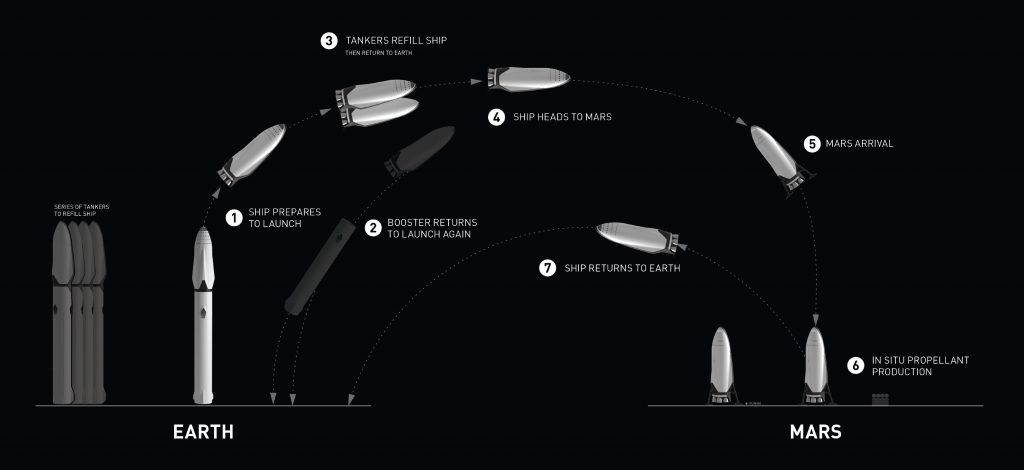
Naturally, no mission can be expected to happen without the all-important vehicle. To this end, Musk used the annual IAC meeting to unveil his company's plans for the Interplanetary Transport System. An updated version of the Mars Colonial Transporter (which Musk began talking about in 2012), the ITS will consist of two main components - a reusable rocket booster and the Interplanetary Spaceship.
The process for getting to Mars with these components involves a few steps. First, the rocket booster and spaceship take off together and the spaceship is delivered into orbit. Next, while the spaceship assumes a parking orbit, the booster returns to Earth to be reloaded with the tanker craft. This vehicle is the same design as the spaceship, but contains propellant tanks instead of cargo areas.
The tanker is then launched into orbit with the booster, where it will rendezvous with the spaceship and refuel it for the journey to Mars. Overall, the propellant tanker will go up anywhere from three to five times to fill the tanks of the spacecraft while it is in orbit. Musk estimates that the turnaround time between the spacecraft launch and the booster retrieval could eventually be as low as 20 minutes.
This process (if Musk gets its way) would expand to include multiple spaceships making the journey to and from Mars every 26 months (when Mars and Earth are closest together):
"You would ultimately have upwards of 1,000 or more spaceships waiting in orbit. Hence, the Mars Colonial fleet would depart en masse. It makes sense to load the spaceships into orbit because you have got 2 years to do so, and then you can make frequent use of the booster and the tanker to get really heavy reuse out of those. With the spaceship, you get less reuse because you have to consider how long it is going to last—maybe 30 years, which might be perhaps 12–15 flights of the spaceship at most."
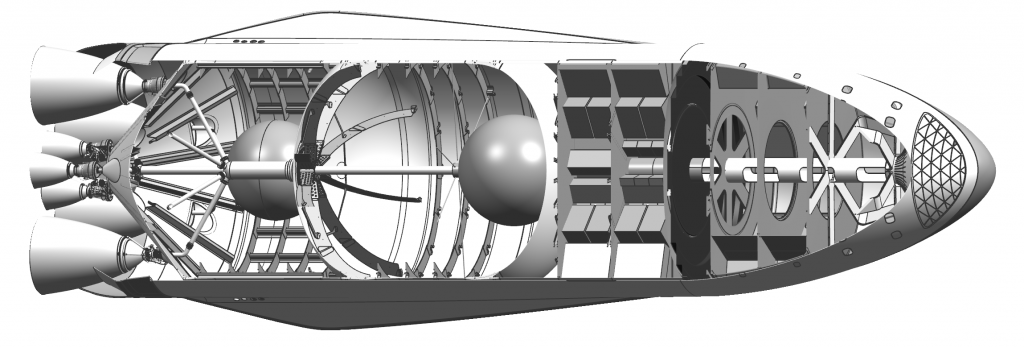
In terms of the rocket's structure, it would consist of an advanced carbon fiber exterior surrounding fuel tanks, which would rely on an autogenous pressurization system. This involves the fuel and oxygen being gasified through heat exchanges in the engine, which would then be used to pressurize the tanks. This is a much simpler system than what is currently being used for the Falcon 9 rocket.
The booster would use 42 Raptor engines arranged in concentric rings to generate thrust. With 21 engines in the outer ring, 14 in the inner ring, and seven in a center cluster, the booster would have an estimated lift-off thrust of 11,793 metric tons (13,000 tons) - 128 MegaNewtons - and a vacuum thrust of 12,714 metric tons (14,015 tons), or 138 MN. This would make it the first spacecraft where the rocket performance bar exceeds the physical size of the rocket.
As for the spacecraft, the designs calls for a pressurized section at the top with an unpressurized section beneath. The pressurized section would hold up to 100 passengers (thought Musk hopes to eventually increase that capacity to 200 people per trip), while all the luggage and cargo necessary for building the Martian colony would be kept in the unpressurized section below.
As for the crew compartments themselves, Musk was sure to illustrate how time in them would not be boring, since the transit time is a long. "Therefore, the crew compartment or the occupant compartment is set up so that you can do zero-gravity games - you can float around," he said. "There will be movies, lecture halls, cabins, and a restaurant. It will be really fun to go. You are going to have a great time!"
The system architecture of the Interplanetary Transport System. Credit: SpaceX
Below both these sections, the liquid oxygen tank, fuel tank and spacecraft engines are located. The engines, which would be directly attached to the thrust cone at the base, would consists of an outer ring of three sea-level engines - which would generate 361 seconds of specific impulse (Isp) - and an inner cluster of six vacuum engines that would generate 382s Isp.
The exterior of the spacecraft will also be fitted with a heatshield, which will be composed of the same material that SpaceX uses on its Dragon spacecraft. This is known as a phenolic-impregnated carbon ablator (PICA), which SpaceX is on their third version of. In total, Musk estimates that the Interplanetary Spaceship will be able to transport 450 tons of cargo to Mars, depending upon how many times the tanker can refill the craft.
And, depending on the Earth-Mars rendezvous, the transit time could be as little as 80 days one-way (figuring for a speed of 6km/s). But with time, Musk hopes to cut that down to just 30 days, which would make it possible to establish a sizable population on Mars in a relatively short amount of time. As Musk indicated, the magic number here in 1 million, meaning the number of people it would take to establish a self-sustaining colony on Mars.
He admitted that this would be a major challenge, and could as long as a century to complete:
"If you can only go every 2 years and if you have 100 people per ship, that is 10,000 trips. Therefore, at least 100 people per trip is the right order of magnitude, and we may end up expanding the crew section and ultimately taking more like 200 or more people per flight in order to reduce the cost per person. However, 10,000 flights is a lot of flights, so ultimately you would really want in the order of 1,000 ships. It would take a while to build up to 1,000 ships. How long it would take to reach that million-person threshold, from the point at which the first ship goes to Mars would probably be somewhere between 20 and 50 total Mars rendezvous—so it would take 40–100 years to achieve a fully self-sustaining civilization on Mars."
Cutaway of the Interplanetary Spaceship. Credit: SpaceX
When the ITS is ready to launch, it will do so from Launch Pad 39A at the Kennedy Space Center in Florida, which SpaceX currently uses to conduct Falcon 9 launches from. But of course, the most daunting aspect of any colonization effort is cost. At present, and using current methods, sending upwards of 1 million people to Mars is simply not affordable.
Using Apollo-era methods as a touchstone, Musk indicated that the cost to go to Mars would be around $10 billion per person - which is derived from the fact that the program itself cost between $100 and $200 billion (adjust for inflation) and resulted in 12 astronauts setting foot on the Moon. Naturally, this is far too high for the sake of creating a self-sustaining colony with a population of 1 million.
As a result, Musk claimed that the cost of transporting people to Mars would have to be cut by a whopping 5 million percent! Musk's desire to lower the costs associated with space launches is well-known, and is the very reason he founded SpaceX and began developing reusable technology. However, costs would need to be lowered to the point where a ticket to Mars would cost about the same as a median house - i.e. $200,000 - before any trips to Mars could happen.
Artist's impression of the ITS in transit, with its solar arrays deployed. Credit: SpsaceX
As to how this could be done, several strategies are outlined, many of which Musk and space agencies like NASA are already actively pursuing. They include full Reusability, where all stages of a rocket and its cargo module (not just the first stage) would have to be retrievable and reusable. Refueling in Orbit is a second means, which would mean the spacecraft would not have to carry all the fuel they need with them from Earth.
On top of that, there would have to be the option for propellant Production on Mars, where the spaceship will be able to refuel at Mars to make the return trip. This concept has been explored in the past for lunar and Martian missions. And in Mars' case, the presence of atmospheric and frozen CO², and water in both the soil and the polar ice caps, would mean that methane, oxygen and hydrogen fuel could all be manufactured.
Lastly, there is the question of which propellant would be best. As it stands, there are there basic choices when it comes - kerosene (rocket fuel), hydrogen, and methane. All of these present certain advantages and can be manufactured in-situ on Mars. But based on a cost-benefit breakdown, Musk claims that methane would be the most cost-effective propellant.
As always, Musk also raised the issue of timelines and next steps. This consisted of a rundown of SpaceX's accomplishments over the past decade and a half, followed by an outline of what he hopes to see his company do in the coming years and decades.
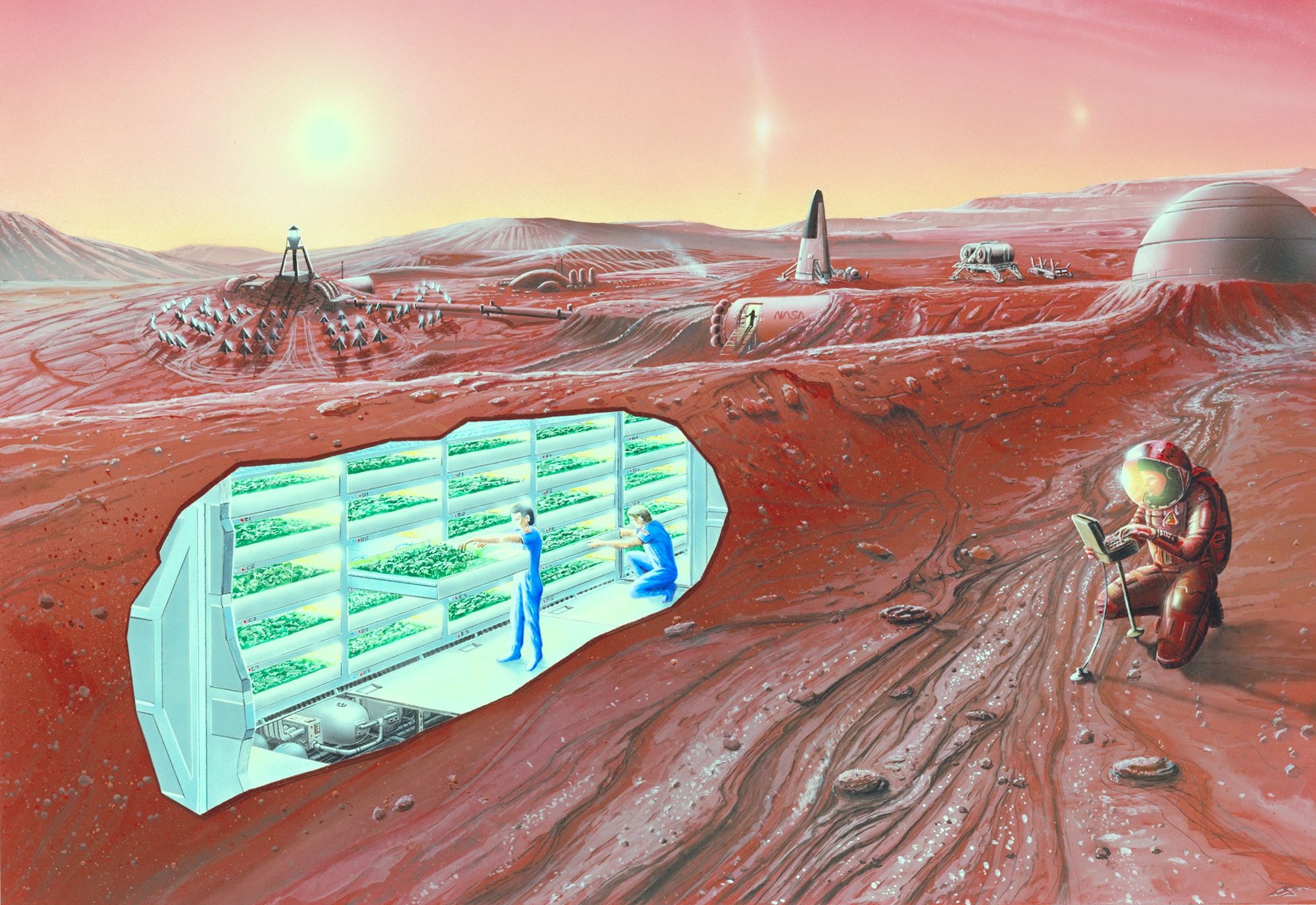
Artist impression of a Mars settlement with cutaway view. Credit: NASA Ames Research Center
These include the development of the first Interplanetary Spaceship in about four years time, which will be followed by suborbital test flights. He even hinted how the spacecraft could have commercial applications, being used for the rapid transportation of cargo around the world. As for the development of the booster, he indicated that this would be a relatively straightforward process since it simply involves scaling up the existing Falcon 9 booster.
Beyond that, he estimated that (assuming all goes well) a ten-year time frame would suffice for putting all the components together so that it would work for bringing people to Mars. Last, but not least, he offered some glimpses of what could be accomplished with ITS beyond Mars. As the name suggests, Musk is hoping to conduct missions to other destination in the Solar System someday.
Given the opportunities for in-situ fuel production (thanks to the abundance of water ice), the moons of both Jupiter and Saturn were mentioned as possible destination. But beyond moons like Europa, Enceladus, and Titan (all of which were mentioned), even destinations in the trans-Neptunian region of the Solar System were indicated as a possibility.
Given that Pluto also has an abundance of water ice on its surface, Musk claimed that a refueling depot could be built here to service missions to the Kuiper Belt and Oort Cloud. "I would not recommend this for interstellar journeys," he admitted, "but this basic system—provided we have filling stations along the way—means full access to the entire greater solar system."
Artist's impression of the ITS conducting a flyby of Jupiter. Credit: SpaceX
The publication of this paper, many months after Musk presented the details of his plan to the annual IAC meeting, has naturally generated both approval and skepticism. While there are those who would question Musk's timelines and his ability to deliver on the proposals contained within, others see it as a crucial step in the fulfillment of Musk's long-held desire to see the colonization of Mars happen in this century.
For instance, there those who see this paper as a valuable contribution to the history of space exploration, something that future generations will be able to access so they can chart the history of Mars exploration - much in the same way NASA archival materials are used to study the history of the Moon landing. As Scott Hubbard, a consulting professor at Stanford University and the Editor-in-Chief of NewSpace, remarked:
"In my view, publishing this paper provides not only an opportunity for the spacefaring community to read the SpaceX vision in print with all the charts in context, but also serves as a valuable archival reference for future studies and planning. My goal is to make New Space the forum for publication of novel exploration concepts-particularly those that suggest an entrepreneurial path for humans traveling to deep space."
Elon Musk is no stranger to thinking big and dreaming big. And while many of his proposals in the past did not come about in the time frame he originally specified, no one can doubt that he's delivered so far. It will be very exciting to see if he can take the company he founded 15 years ago for the sake of fostering the exploration of Mars, and use it instead to lead a colonization effort!
And be sure to check out this video of Musk's full speech at the 67th annual meeting of the IAC, courtesy of SpaceX:
AIIMS Rishikesh Recruitment All India Institute of Medical Sciences, Rishikesh (AIIMS) is back again with a fresh notification of recruitment for fill up of 196 vacancies for the posts of Professor, Associate Professor, Additional Professor, Assistant Professor and Tutor/ Clinical Instructor for Direct Recruitment Basis (Regular/ Deputation / Contractual). Online Application Forms are invited
Utkal University Recruitment Utkal University has declared a new notification for fill up 57 various vacancies for the posts of Lecturer and Professor in various disciplines. Suitable and deserving participants are advised to submit online application form on or before closing date for this reputed job. To apply for Teaching Posts job finders are suggested to deposit the online filled
Jharkhand SSC Recruitment Jharkhand Staff Service Commission (JSSC) has scattered an updated notification for fill up 886 nil Regular and Backlog Vacancy vacancies for the posts of Amin, Revenue Employee, Virgin Regional Investigator, State Level Animal Husbandry and other. Digitally filled Online Application Forms is invited from intelligently and awaited latest by closing date. Deserving
Pune Municipal Corporation Recruitment Pune Municipal Corporation has circulated an updated notification for fill up 175 latest vacancies for the posts of Teachers in entire region comes under this Municipal Corporation. Appliers who have teaching passion they must send filled application not later than final date. Awaited candidates who possess all the eligibilities for these openings they
Andhra Bank Recruitment Andhra Bank is back again with a fresh advertisement of jobs for fill up 17 vacancies for the posts of Part Time Sweepers. Duly filled offline Application Form is invited from all minimum qualified and ambitious applicants on or before dead line for this chance of job. Job seekers who possess stamina to do cleaning of the given branch of the same bank they must prepare
Shaheed Bhagat Singh Evening College Recruitment Shaheed Bhagat Singh College (Evening) (University of Delhi), New Delhi is going to announce jobs news for fill up vacant 29 vacancies for the posts of Assistant Professor in various subjects in the College. All those candidates must submit online application on or before dead line. Such reputed teaching job dream possessing participants will
Government Jobs in India Dear visitors welcome to this page of Ejobshub. In this page all the necessary details related to Government Jobs are stating for the job fighters who have immense desire to do and get any or specific organization government job. Now online job searching has become more popular and convenient to check the latest advertisements and notifications of recruitment and job
Latest Recruitment in India Once again we welcome our candidates on our webpage. This webpage is designed for the purpose of giving you the information of the latest recruitment notifications of the upcoming government and private jobs. Candidates should notice that there are many opportunities available in India. Candidates those who have completed their education this year should get ready
Sarkari Naukri Sarkari Naukri Notification will be circulated on this web page for all kinds of Government sectors Recruitment in India for those candidates who possess any qualification whether simple or extraordinary. As we know to get any public sector job has more security after recruitment of the desirable candidates for applied post but the fact is this that first of all you need to
Uttarakhand Rojgar Darshan Samachar Dear candidates do you belong to Uttarakhand state and searching a good job? Then you have reach at right place because on this web page because here we are announcing Uttarakhand Rojgar Darshan Samachar availability. This comes in the category of UK Employment News Paper. It provides about those jobs which are going to announce This Week. It is delivered in
Employment News This Week Welcome to all the candidates who are at present reading this article regarding Employment News This Week. Dear aspirants Employment News is a weekly jobs related news paper which mainly publishes in Hindi & English languages. In this paper form full of content having piece of paper provided details of results, upcoming educational / jobs exams, admit cards, new
www.rojgarsamachar.gov.in Dear visitors of this portal, here you are going to get details about those jobs which publish Online Rojgar Samachar in Hindi & English By State. Ejobshub.in is brought to the news of current vacancies for job seekers to provide them Latest Recruitment and Rojgar Samachar updates on monthly basis. In this page, we soon update this content to provide you all
Rojgar Samachar Welcome to all the job researchers! A good job is the first searching content of all the skilled and unskilled candidates at present time. To make this thing easy a news paper publishes as ‘Rojgar Samachar’. This paper document is also available Online in Hindi & English both the languages. Each and every aspirant can get a desired or suitable job as per qualification he/ she
Rojgar Express ejobshub.in presents one more article in the support of employment. Welcome to all the candidates who are still because the situation is going to change from jobless to job possessing. Rojgar express is a news paper which publish to provide all kinds of Central and State Government jobs for simple and technical both education. There are some different department where
Rozgar Career India Rozgar Career India is an employment news paper which is providing jobs notification from many years to the youth of the Indian. This Paper publishes in two languages that is in Hindi & English. Aspirants who are looking for jobs in any public sector / private sector they must have a close look on our page which is made for info of Rozgar career India.
11 FOD Recruitment Government of India, Ministry of Defence, Unit/Depot: 11 Field Ordnance Depot (FOD), Pin-909911, C/o 56 APO has circulated an updated notification for fill up various latest vacancies for the posts of Material Assistant, Lower Division Clerk (LDC), Tailor, Tradesman Mate and MTS. Contenders who have required education qualification they must send filled application not later
Motilal Nehru College DU Recruitment Motilal Nehru College (Evening) (University of Delhi) is back again with a fresh notification of recruitment for fill up of 48 vacancies for the post of assistant professor. Online Application Forms are invited from sensible and self motivated candidates latest by final date. Appliers should visit the official website of Motilal Nehru College (Evening) (
CCA Madhya Pradesh Recruitment Govt of India, Department of Telecommunications, Office of the Controller of Communication Accounts, MP Telecom Circle, Bhopal is back again with a new notification of careers to fill up 40 for the jobs of Group-B (Non-Gazetted) and Group-C posts on deputation basis from the officials working in Central/State Govt. Only duly filled offline applications are
BPS Medical College Admit Card Lots of job contenders have applied for this job notice to be a part of Bhagat Phool Singh Government Medical College, Khanpur. Shortlisted applicants may refer to our website to know info about BPS Medical College Admit Card. Shortlisted appliers will eligible to get this call letter in future days shortly. Aspirants who have applied for technical assistant/
SSPHPGTI Noida Recruitment Super Speciality Pediatric Hospital & Post Graduate Teaching Institute (SSPHPGTI) Noida is going to fill up 29 vacancies for the posts of Dental Technician, Assistant Store Keeper, Computer Operator Grade-A, Librarian Grade-1, Medical Superintendent, Deputy Medical Superintendent and others. Awaited appliers may apply online today. New Vacancy Form through Online
Coimbatore District Court Recruitment Tiruvannamalai District Court has defined a new advertisement of jobs to fill up 49 various vacancies for the posts of Office Assistant, Night Watchman / Watchman / Masalchi cum Night Watchman, Sweeper / Scavenger, Masalchi and Gardener. Most eligible and goal oriented job grabbers must send offline application on or before dead line. Healthy and open
Ranchi University Recruitment Ranchi University is back again with a fresh notification of great jobs for fill up 298 vacancies for the posts of Assistant Professor in several disciplines in many colleges. Responsible and energetic job grabbers who are fully eligible for this chance of jobs they must submit application on or before dead line. Digitally written content in Application form is
IGTR Aurangabad Admit Card Dear candidates if you are searching IGTR Aurangabad Admit Card then you are on exact web site. This web page is made by Ejobhub team which is giving you complete latest updates about IGTR Aurangabad technician admit card. Along with complete information we are also telling you how and where you may download hall token of technician. Like as every year Indo German
CBSE Improvement Exam Hello and welcome to all the students who are looking for CBSE Improvement Exam form for Class 10th/12th. Recently Central Board of Secondary Education has circulated a notice for the announcement of CBSE Improvement Exam to those appliers who are willing to get more in the subjects. Participants will have to submit CBSE Improvement Exam by doing Registration Form before
Gujarat ITI Answer Key Directorate of Employment and Training Government of Gujarat is going to publish Gujarat ITI Answer Key after conducted Gujarat ITI entrance examination on due date successfully. Now all the appeared students will be able to download Gujarat ITI entrance examination answer sheet in PDF file to check answers easily. Now grab exam solution sheet through this web page and
Telangana ITI Answer Key Answer Key of Telangana ITI will be updated here shortly when it declared officially. Candidates who were appear in this entrance examination they need to download PDF file of examination solution sheet to know their paper obtained marks. Directorate of Employment and Training Government of Telangana had successfully conducted this entrance exam at several examination
Command Hospital Pune Recruitment Command Hospital Pune has released a notification of jobs to fill up Group C various 42 vacancies for the posts of Barber, Sahayak, Chowkidar, Barber, T/Mate, Washerman, Mali and others. Willing and young applicants must send application form through proper channel latest by closing date. To get announced format of application aspirants may go to the official