| Renewable | |
| • | Note recall likely to make solar energy cheaper in the long run |
| • | WTO seeks trade deal on environmentally friendly 'green' products |
Energyworld.com

50th Anniversary Celebrated for Rice That Prevented Asia Famines

In about two decades, the IR8 made way to a host of other high yield varieties, but it is the parental strain for many of these. Recalling its phenomenal contribution, Mohanty said that in India alone, it is estimated to have contributed $1.3 billion annually to the rice sector.
But ensuring food security is no longer the only challenge for Asia - a continent that is far more affluent than it was 50 years ago. At the same time, malnourishment continues to haunt millions of poor in the region, especially in South Asia. And everywhere, farmers are battling climate change.
"Developing new varieties that are higher yielding and more nutritious, but ones that have less of an environmental footprint, ones that require less water, fertilizer, pesticide and ones that actually have reduced greenhouse gas emissions," said Rod Wing, an American scientist at IRRI in Manila as he outlines the challenges of the 21st century.
In recent years, new varieties that are more resistant to droughts and floods are showing promising results in east India and Bangladesh, a delta country where flash floods used to submerge or wash away crops.
"With these new varieties, we have got a real opportunity," Meah said. "It has been adopted by millions of farmers, so they see the benefits of it. And it's a real improvement for their livelihoods as well."
To improve nutritional levels, a genetically engineered strain has been developed to address Vitamin A deficiency that kills many under the age of five. On the other end of the spectrum, as Asia copes with what are sometimes called diseases of affluence and witnesses an explosion in the incidence of diabetes, scientists are developing varieties with low glycemic index, which release energy slowly.
But the core challenge of productivity that IR8 sparked has still not gone away. "The big question is how do we solve the 10 billion people question? That is, how are we going to feed three more billion people on the planet by 2050? It is a huge, daunting task," said Wing at IRRI, pointing out that rice is the staple diet of more than half the world.
And while farmers are harvesting higher and higher yields, they continue to battle other problems. "Cost of cultivation very, very high now. Labor cost is high," rued farmer Subha Rao from his home in Andhra Pradesh.
Geminid Meteors: Watching a Good Shower on a Bad Year
Geminid Meteors: Watching a Good Shower on a Bad YearDavid Dickinson द्वारा |
One of the best yearly meteor showers contends with the nearly Full Moon this year, but don't despair; you may yet catch the Geminids.
The Geminid meteor shower peaks next week on the evening of Tuesday night into Wednesday morning, December 13th/14th. The Geminids are always worth keeping an eye on in early through mid-December. As an added bonus, the radiant also clears the northeastern horizon in the late evening as seen from mid-northern latitudes. The Geminids are therefore also exceptional among meteor showers for displaying early evening activity.
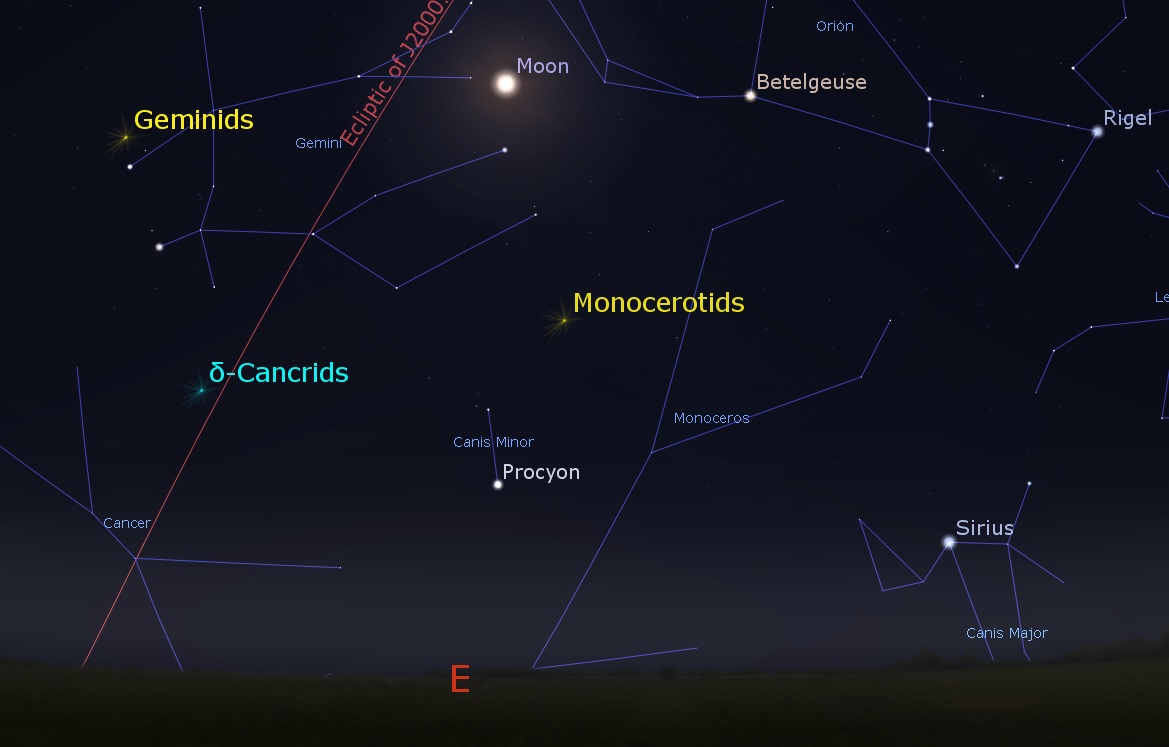
The Geminid radiant, looking east around 11 PM local on the evening of December 13th. Note the nearby Moon in the same constellation. Image credit: Stellarium.
First, though, here is the low down of the specifics for the 2016 Geminids: the Geminid meteors are expected to peak on December 13th/14th at midnight Universal Time (UT), favoring Western Europe. The shower is active for a two week period from December 4thto December 17th and can vary with a Zenithal Hourly Rate (ZHR) of 50 to 80 meteors per hour, to short outbursts briefly topping 200 per hour. In 2016, the Geminids are expected to produce a maximum ideal ZHR of 120 meteors per hour. The radiant of the Geminids is located at right ascension 7 hours 48 minutes, declination 32 degrees north at the time of the peak, in the constellation of Gemini.
The Moon is a 98% illuminated waning gibbous just 20 degrees from the radiant at the peak of the Geminids, making 2016 an unfavorable year for this shower. In previous years, the Geminids produced short outbursts topping 200 per hour, as last occurred in 2014.
The Geminid meteors strike the Earth at a relatively slow velocity of 35 kilometers per second, and produce many fireballs with an r vaule of 2.6. The source of the Geminid meteors is actually an asteroid: 3200 Phaethon.
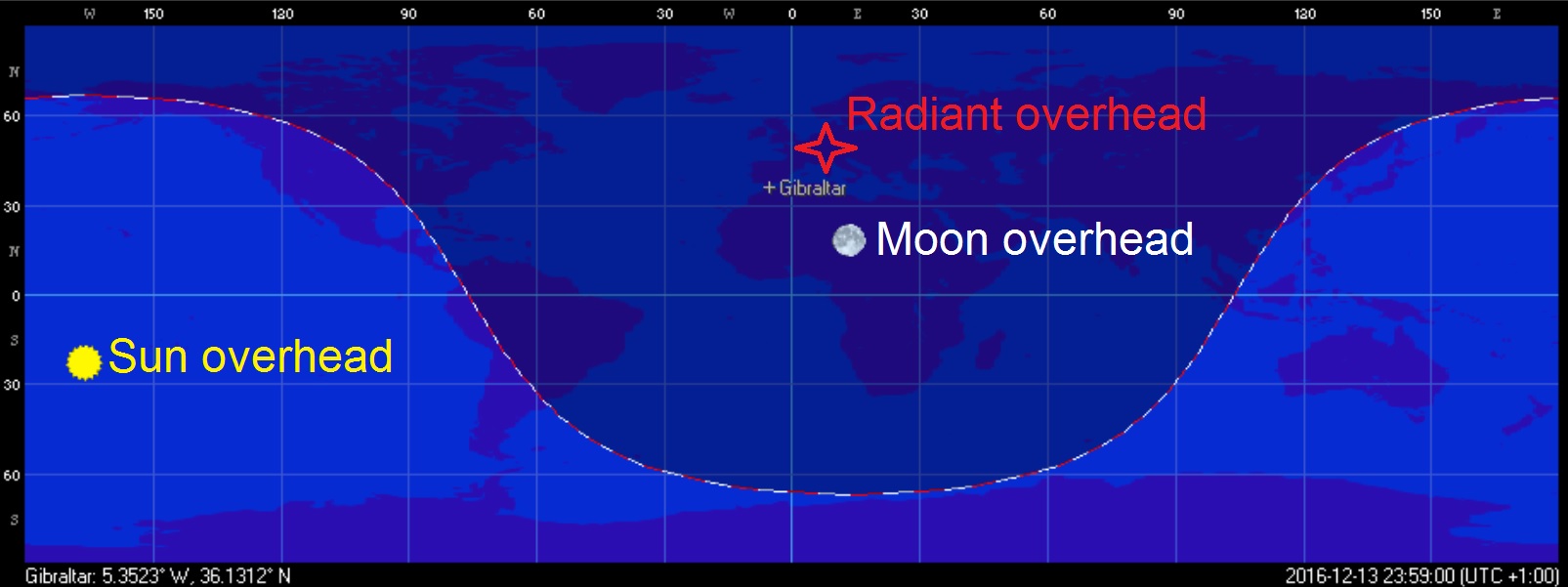
The orientation of the radiant versus the Sun, Moon and Earth's shadow just past midnight Universal Time on the evening of December 13th/14th. (Created using Orbitron).
A moderate shower in the late 20th century, the Geminids have increased in intensity during the opening decade and a half of the 21st century, surpassing the Perseids for the title of the top annual meteor shower.
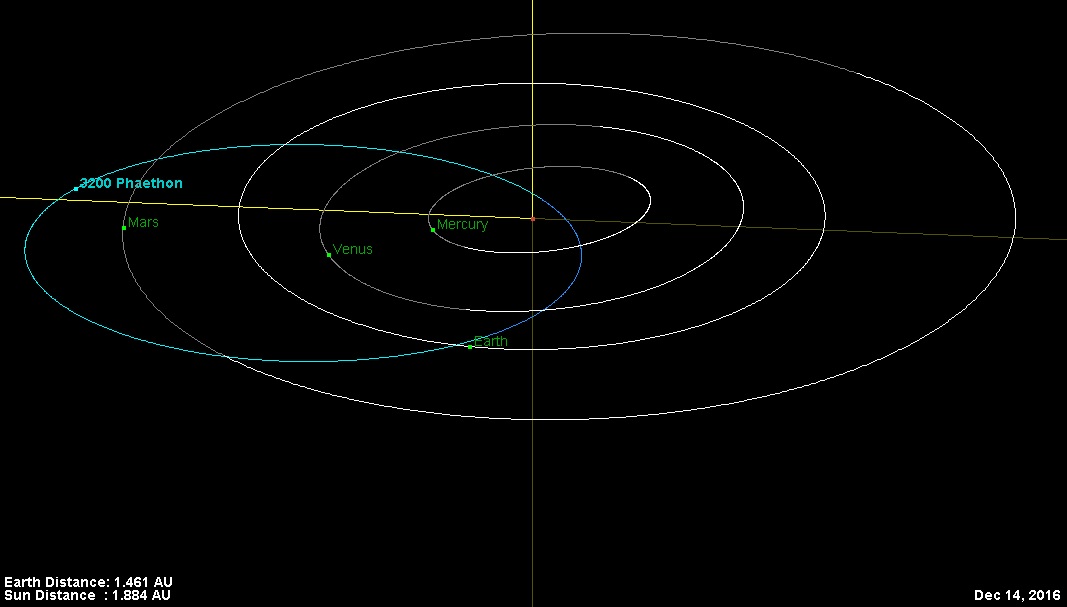
The orbit of 3200 Phaethon. Image credit: NASA JPL.
The Geminid shower seems to have breached the background sporadic rate around the mid-19th century. Astronomers A.C. Twining and R.P. Greg observing from either side of the pond in the United States and the United Kingdom both first independently noted the shower in 1862.
Orbiting the Sun once every 524 days, 3200 Phaethon wasn't identified as the source of the Geminids until 1983. The asteroid is still a bit of a mystery; reaching perihelion just 0.14 astronomical units (AU) from the Sun, (interior to Mercury's orbit) 3200 Phaethon is routinely baked by the Sun. Is it an inactive comet nucleus? Or a 'rock comet' in a transitional state?
Observing meteors is as simple as setting out in a lawn chair, laying back and watching with nothing more technical than a good ole' Mk-1 pair of human eyeballs. Our advice for 2016 is to start watching early, like say this weekend, before the Moon reaches Full on Wednesday, December 14th. This will enable you to watch for the Geminids after morning moonset under dark skies pre-peak, and before moonrise on evenings post-peak.
Two other minor showers are also active next week: the Coma Bernicids peaking on December 15th, and the Leo Minorids peaking on December 19th. If you can trace a suspect meteor back to the vicinity of the Gemini 'twin' stars of Castor and Pollux, then you've most likely spied a Geminid and not an impostor.
And speaking of the Moon, next week's Full Moon is not only known as the Full Cold Moon (For obvious reasons) from Algonquin native American lore, but is also the closest Full Moon to the December 21st, northward solstice. This means that next week's Full Moon rides highest in the sky for 2016, passing straight overhead for locales sited along latitude 17 degrees north, including Guatemala City and Mumbai, India.
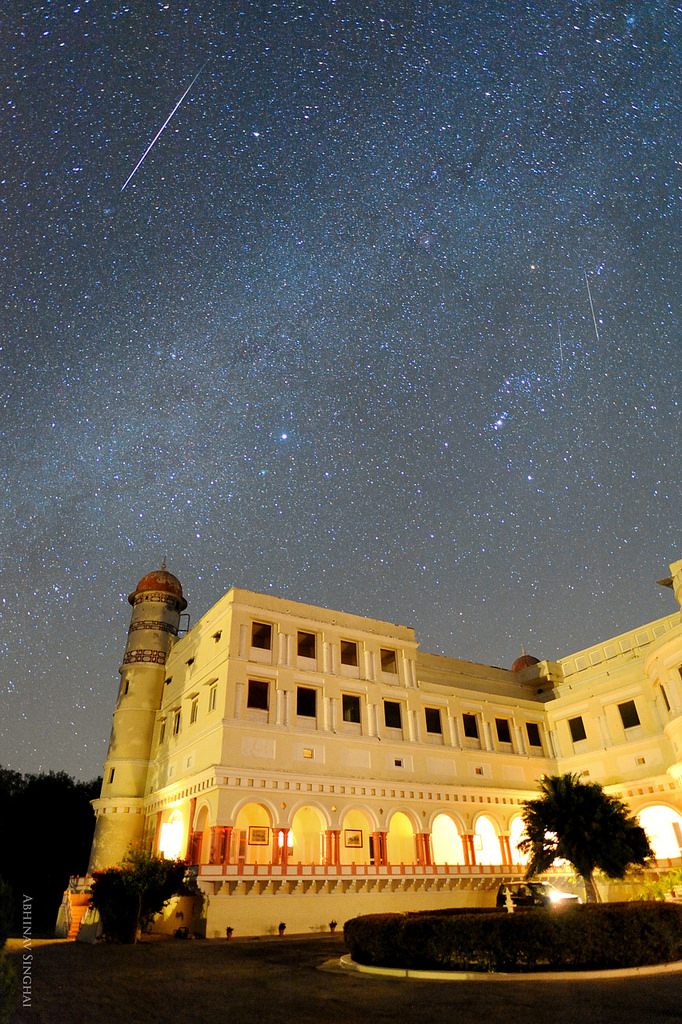
A 2015 Geminid over Sariska Palace in Rajastan, India. Image credit and copyright: Abhinav Singhai.
Photographing the Geminids is also as simple as setting a camera on a tripod and taking wide-field exposures of the sky. We like to use an intervalometer to take automated sequences about 30 seconds to 3 minutes in length. Said Full Moon will most likely necessitate shorter exposures in 2016. Keep a fresh set of backup batteries handy in a warm pocket, as the cold December night will drain camera batteries in a pinch.
Looking to contribute some meaningful scientific observations? Report those meteor counts to the International Meteor Organization.
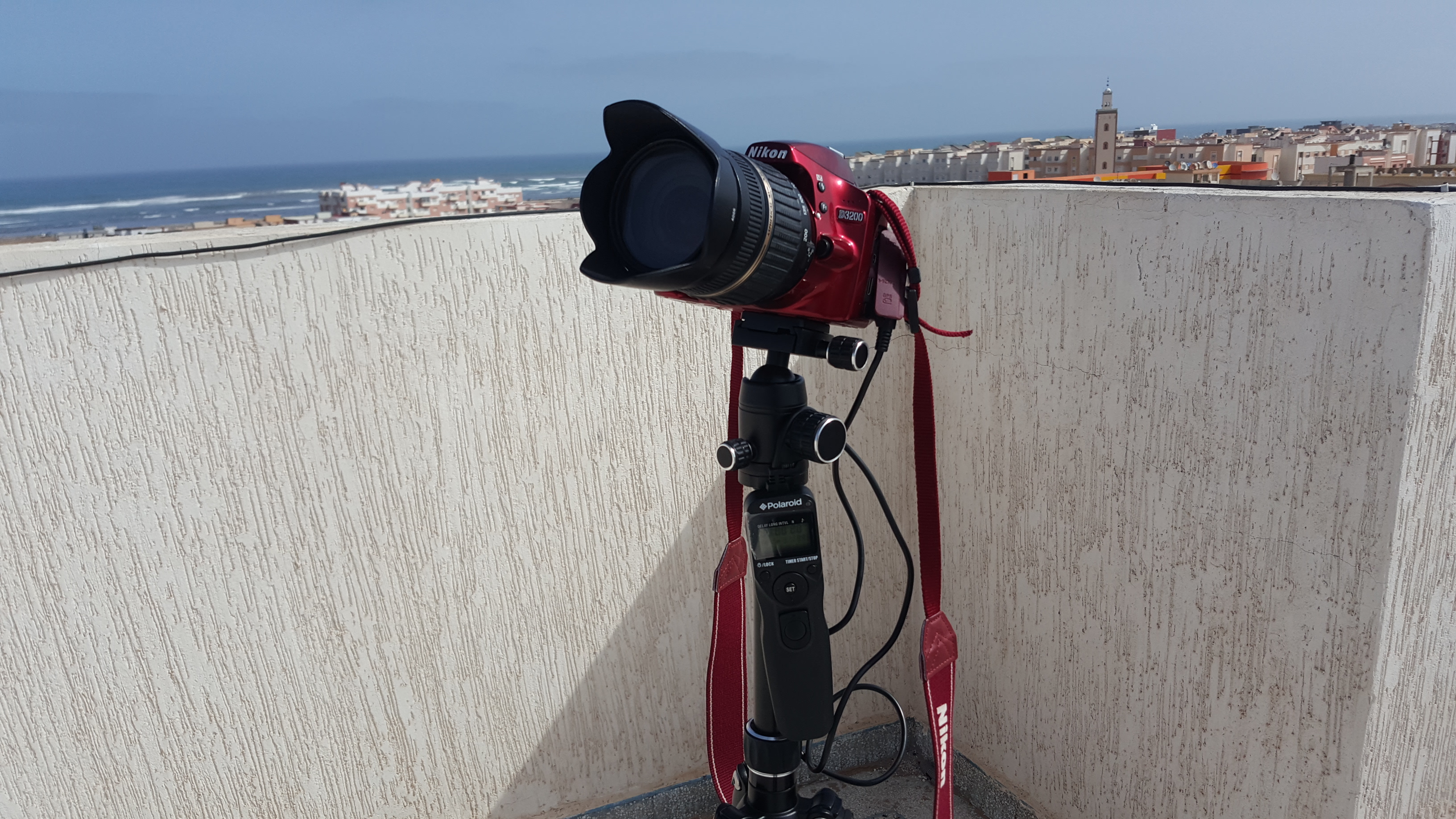
Our humble meteor imaging rig. Credit: Dave Dickinson.
And although the Geminids might be a bust in 2016, another moderate shower, the Ursids has much better prospects right around the solstice... more on that next week!
Morning Editorial Report: Trump's Taiwan Play


Subscribe to:
Posts (Atom)
-
जींद, 12 जून :भाषा: जिले के गांव खटकड़ में जाटों का धरना रविवार को भी जारी रहा। हालांकि सोमवार से जींद में जाट आरक्षण संघर्ष समिति द्वा...
-
MSHA to look at DPM exposure regulation The US government agency tasked with ensuring mine safety and health is seeking information on ...
-
Welcome Guest! Photograph (2) Leakage of toxic fumes: 2 killed on board INS Vikramaditya [ - ] Text [ + ] ...
-
Authentic news,No fake news. TNN | MUMBAI: If you can touch the sky while parasailing in Kamshet or Panchgani, dive into the depths of...
-
New Delhi, Jun 10 (PTI) India, Japan and the US today kicked off their marine war games, Malabar Exercise, close to the South China Sea ...
-
Coal India starts fuel auction for sponge iron sector State-run miner Coal India on June 10 said that auction of coal linkages for the spon...
-
New York, Jun 10 (PTI) An Indian-origin internal medicine physician has been sentenced to one year in prison by a US court for accepting...
-
New Delhi, Jun 10 (PTI) Five men were today sentenced to life imprisonment by a Delhi court for gangraping a 52-year- old Danish woman a...
-
NAIROBI, Sept. 29 (Xinhua) -- An estimated 100,000 Kenyans die annually due to cardiovascular diseases, officials said on Thursday. Dr ...
-
Authentic news,No fake news. आईएएनएस टीम ने सिरपुर में जगह-जगह शूटिंग की रायपुर छत्तीसगढ़ का पूरा इतिहास अपने अंदर कई ऐसे रह...

