MITRA MANDAL GLOBAL NEWS

/Science news-

Scientists: oxygen levels fell by 0.7% in the last million years,

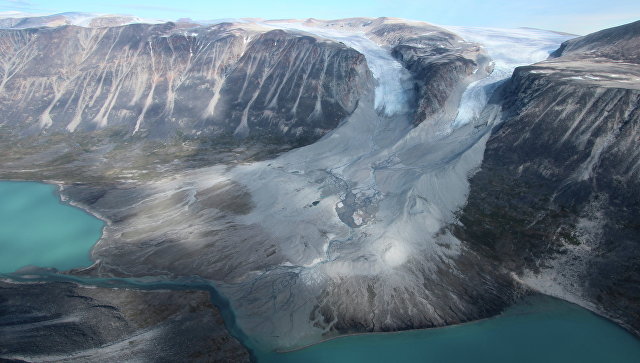
Greenland Glaciers formed in the Viking Age
MOSCOW, September 23 - RIA Novosti . The deep ice samples from Greenland told scientists that the level of oxygen in the Earth's atmosphere has decreased by almost 1% in the last 800 thousand years, the causes of which have not yet fully understood, said in an article published in the journal Science .
The oxygen level in the world, despite the opinion of ordinary people, is not a constant - in the past geological epochs, its share in the atmosphere could be higher or lower by tens of percent today. For example, during the Carboniferous period, 350-300 million years ago the oxygen level was not 21% as it is today, and 35%, so that the world lived and flourished meter predatory dragonflies, three-meter poisonous centipedes and giant spiders the size of a dog.
In another era, for example, at the end of the Permian period the oxygen concentration could fall sharply due to the different geological phenomena that caused mass extinctions and ecosystem adjustment.
Daniel Stolper (Daniel Stolper) from Princeton University (USA) and his colleagues found that on Earth right now is something similar, investigating popular today, the idea that the level of oxygen is gradually reduced, in particular due to the burning of fossil hydrocarbons and other forms of fuel.
The atmosphere, archive photo
Scientists: oxygen appeared in the atmosphere three billion years ago
For this Stolper and his colleagues carried out an expedition in Greenland and Antarctica, where there are glaciers, formed more than 800 thousand years ago. Scientists have extracted samples of ice, cut them into thin layers and examined the contents of the small air bubbles, "immured" in ice thickness.
By studying and comparing the chemical and isotopic composition of ancient air, Princeton chemists have found that 0.7% more that 800 thousand years ago, the proportion of oxygen in the Earth's atmosphere was not 20.95% as it is today, and 21.10%.
Even such a small difference indicates that some natural or biological processes has led to the fact that the lithosphere, hydrosphere and atmosphere absorb about 2% more oxygen than they gave him, over the last million years.
Sea sponges and corals.  Archival photo
Oxygen was not needed for the development of multicellular life
Scientists can not yet say exactly what led to a decrease in the proportion of O 2 in the atmosphere, but they believe that a certain role in this process could play a retreating and advancing ice during the onset and end of ice ages, whose movement has led to the fact that they were naked large areas of pyrite and sedimentary rocks of organic origin, well absorb oxygen. Another possible reason - the global cooling of the ocean waters, which enabled him to absorb more O2.
Both of these processes, to all appearances, is still ongoing, as many observation stations are fixed very slight but significant decrease in the concentration of oxygen in the atmosphere in recent decades. When this process is over, we do not know, and therefore the fate of oxygen and all life on Earth is not yet clear, reveal that as the authors believe, will help to further research how the oxygen concentration fluctuated in the past.

Lavrov: US will not be able to perform the task of delimitation in Syria

NEW YORK, September 23 -. RIA Novosti US and the coalition will not be able to perform the task of delimitation of the opposition and the terrorists in Syria, Russian Foreign Minister Sergei Lavrov at a press conference.
East Districts Aleppo.  Archival photo
All against all, and Who's Who in belligerent Syria
"The Security Council and Russian-American agreements involve mode disengagement of the parties who want to participate in the ceasefire. In December or January, I believe, for the first time received such a requirement. This objective has been repeatedly emphasized. Unfortunately, the US-led coalition, which expressed its commitment to such delimitation is not able to perform the tasks, "- he said.
US under an agreement with Russia on the cessation of hostilities in Syria pledged to ensure that "moderate opposition" to dissociate with the terrorists.

Corbyn is global symbol

Compared with the battle royale for the U.S. presidency, the question of who runs the UK’s opposition Labour Party is marginal, verging on quaint. But the divisions laid bare by bearded leftist Jeremy Corbyn, who is likely to be re-elected on Sept. 24 by his fractured party, reflect a global problem: the difficulty in identifying heroes and villains.
The rise of non-centrist politics is often attributed to globalisation. Yet that old foe of the masses seems to be in retreat. The OECD warned on Sept. 21 that trade growth has stalled in recent years – even as support for Corbyn, U.S. presidential hopeful Donald Trump and Italy’s Five Star movement, has increased. Moreover, the OECD says, it turns out trade flows have been getting less free: its index of trade liberalisation has been falling since 2000, the year before China joined the World Trade Organisation, and is lower than when the body was set up in 1995.
Maybe globalisation wasn’t even such a problem anyway. Researchers at the Resolution Foundation have redrafted the “elephant curve”, often used to show that dissolving borders have enriched the rich, who sit on the elephant’s trunk, and impoverished the poor, who ride on its tail. The new curve more resembles a slug. And U.S. claims that European aircraft maker Airbus enjoyed $22 billion of government subsidies goes against the theory that politicians are throwing domestic labour forces under the bus.
Perceived inequality persists. Yet even in Britain, whether that’s justified isn’t clear cut. Inequality measured by the so-called 90/10 ratio has been falling for more than 25 years, according to the Institute for Fiscal Studies, implying the bottom 10 percent are enjoying a greater share of consumption.
If inequality and globalisation aren’t the problem, what is? The answer, and one politicians are reluctant to own, is domestic policies. Since the WTO was established, the wage share of GDP has fallen. Corporate profits have risen, but rather than go into investment, they have resulted in higher dividends and share buybacks. That has resulted in stagnation.
Divisions have also shifted, from rich-poor to establishment-outsider, and particularly old-young. Low interest rates are creating yawning pension liabilities that politicians and companies are under pressure to fill – but value transferred to pensioners implicitly leaches opportunity from their grandchildren.
Just as there are no obvious villains, heroes also become harder to identify – because traditional right-left distinctions don’t apply. British Prime Minister Theresa May is talking about putting workers on company boards, and taking golden shares in companies that provide undefined “critical infrastructure”. That’s the language of the left. Corbyn’s suggestion of printing money to build chronically scarce housing need not be anathema to the right. The risk is that good ideas are drowned out by party politics.
Corbyn, who looks certain to lead Labour, may not trouble the world order as much as Trump, or far-right movements in France and Germany. But his rise ought not to be ignored by politicians and business people everywhere, because what he symbolises isn’t rage, but something harder to address: deep-seated confusion.

Vodafone tops up for a fight in India By Una Galani

Vodafone is topping up for a massive fight in India. The mobile giant is injecting $7.2 billion of cash into its Indian unit in what it claims is the largest-ever foreign direct investment into the country. That will help the local number two player, which accounts for 11 percent of its parent’s revenue, compete. It also suggests an initial public offering of the business is off the table for now.
The amount is more than twice what Vodafone might have hoped to raise in an IPO and half the pre-deal value of the entire business. Vodafone India generated about $1 billion of EBITDA in the first six months of 2016. Say it can keep up that pace for the rest of the year. On the same forward enterprise value multiple as rival Bharti Airtel, Vodafone India would be worth $13 billion before the cash infusion.
In reality, though, Vodafone may struggle to maintain its current momentum. New entrant Reliance Jio, backed by India’s richest man Mukesh Ambani, is offering his new superfast network free to customers until the end of the year. He has also pledged to never charge for calls. That has led to customers queuing around the block.
Expensive spectrum is another imminent challenge. At the reserve prices, a mega auction of airwaves set for October could raise a staggering $80 billion-plus for New Delhi – and help the government meet an ambitious budget deficit target. The mooted proceeds are three times the market value of the top three listed telecom operators. Barclays estimates that it would cost Vodafone $7 billion to ensure that its current share of the airwaves match that of peers when compared to its customer base.
With so many headwinds, the India unit would have struggled to hold its ground without support. Vodafone India’s revenue is growing in low single digits. Net debt was already over 6 times EBITDA at end-March. The alternative was a rapid decline. Shares of local rival Idea Cellular have almost halved this year, and its parent has indicated it is in no hurry to support the business. Vodafone has made a tough call.

Health news-

Wounded Warrior Project Challenges Group to Heal at Rehabilitative Mental Health Gathering

LONG CREEK, S.C.Sept. 23, 2016 /PRNewswire-USNewswire/ -- Injured veterans seeking treatment for combat stress recently received a new healing perspective through a Wounded Warrior Project® (WWP) multi-day mental health workshop. The five-day rehabilitative and therapeutic adventure allowed participants the chance to connect with nature, fellow wounded warriors, and the WWP staff members who could guide them to various free programs and services to assist in their recovery processes.
Warriors convened in Long Creek, South Carolina. There they tackled a variety of enjoyable yet challenging outdoor activities, including white-water rafting on the Chattooga River and traversing the treetops via zip line and high ropes courses. By working through different obstacles in a setting designed to accommodate physical injuries and social anxieties, injured veterans had the chance to develop new skills to improve both mental health and physical wellness. Most importantly, they were able to hone these skills alongside fellow wounded warriors who have shared similar experiences.   
"It helps with the isolation issues that most – if not all – of us face or have faced before," said Army veteran Greg Robles-Velez. "It's a way to have a good, strong support group – to meet people you can count on and who can count on you. Being around people who understand creates an unspoken bond."
Exposure to combat and operational trauma affects service members and veterans spiritually, psychologically, biologically, and socially. Although challenging, WWP's mental health rehabilitative multi-day experiences provide safe, private environments for warriors to express themselves and discuss their combat deployments – with laughter and tears. At the end of the rehabilitative program the warriors share lessons learned from the activities that impacted their personal struggles most and set achievable goals for their recoveries.
"I tell everyone I meet that WWP saved my life," Greg said. "During my time in service and while transitioning from the military, I was heading down a dark road with no end in sight. Without WWP, I would probably just be existing. Now I can honestly say that I enjoy life." 
The gathering was especially significant for Greg, who attended his first Project Odyssey® mental health multi-day workshop one year ago.
"One of my goals since then was to become a Peer Support Group mentor," he said. "Once I decided to do it, I sat with WWP staff members to break down my goal. I attended group meetings and made a point to get involved with other warriors."
WWP's Peer Support program is solely dedicated to ensuring every injured veteran, family member, and caregiver encourages one another in recovery, thus embodying the WWP logo of one warrior carrying another off the battlefield.
Peer support plays an important role in the healing process as injured veterans rely upon each other's learned experiences when managing day-to-day challenges. This special type of therapy reintroduces wounded warriors to the unique bonds experienced during military service. Rarely duplicated in the civilian world, these relationships act as a secure bedrock that paves the road to recovery.
Noting Greg's dedication, his group mentor and a WWP mental health services teammate for Fayetteville, North Carolina, decided he was ready and invited him to attend the rehabilitative mental health gathering in Long Creek – as a peer support group mentor.
"It was an honor and an experience I will never forget," Greg said. "Being able to assist other warriors is what it is all about."
Greg said he encourages any of his brothers and sisters in arms who might be dealing with the invisible and visible wounds of war to reach out to WWP, and he is grateful that his wife reached out to the organization on his behalf.
About Wounded Warrior Project The mission of Wounded Warrior Project® (WWP) is to honor and empower Wounded Warriors. The WWP purpose is to raise awareness and to enlist the public's aid for the needs of injured service members, to help injured servicemen and women aid and assist each other, and to provide unique, direct programs and services to meet their needs. WWP is a national, nonpartisan organization headquartered in Jacksonville, Florida. To get involved and learn more, visit woundedwarriorproject.org.

Sunoco, behind protested Dakota pipeline, tops U.S. crude spill charts

Sunoco Logistics (SXL.N), the future operator of the oil pipeline delayed this month after Native American protests in North Dakota, spills crude more often than any of its competitors with more than 200 leaks since 2010, according to a Reuters analysis of government data.
The lands of the Standing Rock Sioux Tribe sit a half mile south of the proposed route of the Dakota Access pipeline. The tribe fears the line could destroy sacred sites during construction and that a future oil spill might pollute its drinking water.
A tribal protest over the $3.7 billion project drew broad support from other Native American tribes, domestic and international environmental groups and Hollywood celebrities.
In response to the tribe's objections, the U.S. government earlier this month called for a temporary halt to construction along a section of the 1,100 mile line in North Dakota near the Missouri River.
While environmental concerns are at the heart of the Standing Rock Sioux protest, there is no reference to the frequency of leaks by Sunoco or its parent Energy Transfer Partners (ETP.N) in a legal complaint filed by the tribe, nor has Sunoco's spill record informed the public debate on the line.
Standing Rock Sioux Chairman Dave Archambault II told Reuters the tribe was aware of the safety record of Energy Transfer, but declined to elaborate.
Sunoco Logistics is one of the largest pipeline operators in the United States. Energy Transfer is constructing the Dakota Access pipeline to pump crude produced at North Dakota's Bakken shale fields to the U.S. Gulf Coast. Once completed, it will hand over the pipeline's operation to Sunoco.
Sunoco acknowledged the data and told Reuters it had taken measures to reduce its spill rate.
"Since the current leadership team took over in 2012, Sunoco Pipeline has enhanced and improved our integrity management program," Sunoco spokesman Jeffrey Shields told Reuters by email.
This significantly cut the amount of barrels lost during incidents, he said.
The U.S. Department of Justice did not make any reference to the company's spill rate when it decided to stall the project. It highlighted the need for reform in the way companies building infrastructure consult with Native American tribes.
Spokespeople for the Departments of Justice and the Interior, and the Army Corps declined to comment to Reuters on whether they were aware of Energy Transfer's leak statistics when they jointly decided to halt construction of the line.
HIGH SPILL RATE
Reuters analyzed data that companies are obliged to disclose to the Pipeline and Hazardous Materials Safety Administration (PHMSA) when they suffer spills and found that Sunoco leaked crude from onshore pipelines at least 203 times over the last six years.
PHMSA data became more detailed in 2010. In its examination, Reuters tallied leaks in the past six years along dedicated onshore crude oil lines and excluded systems that carry natural gas and refined products. The Sunoco data include two of its pipeline units, the West Texas Gulf and Mid-Valley Pipeline.
That made it the operator with the highest number of crude leak incidents, ahead of at least 190 recorded by Enterprise Products Partners (EPD.N) and 167 by Plains All American Pipeline (PAA.N), according to the spill data reported to PHMSA, which is part of the U.S. Department of Transportation.
Enterprise said it has comprehensive safety and integrity programs in place and that many spills happened at its terminals.
Sunoco and Enterprise both said most leaks take place within company facilities and are therefore contained.
Plains All American did not respond to a request for comment.
Sunoco's spill rate shows protestors may have reason to be concerned about potential leaks.
The main option that was considered for routing the line away from the Standing Rock Sioux Tribe reservation was previously discarded because it would involve crossing more water-sensitive areas north of the capital Bismarck, according to the project's environmental assessment.
To be sure, most pipeline spills are small and pipelines are widely seen as a safer way to move fuel than alternatives such as rail.
Sunoco and its units leaked a total of 3,406 net barrels of crude in all the leaks over the last six years, only a fraction of the more than 3 million barrels lost in the largest spill in U.S. history, BP Plc's (BP.L) Macondo well disaster in 2010.
Sunoco said it found that crude lines not in constant use were a significant source of leaks, so it had shut or repaired some of those arteries.
In 2015, 71 percent of pipeline incidents were contained within the operator's facility, according to a report by the Association of Oil Pipe Lines, a trade group.
While total pipeline incidents have increased by 31 percent in the last five years, large spills of 500 barrels or more are down by 32 percent over the same time, the report said.
Sunoco accounted for about 8 percent of the more than 2,600 reported liquids pipeline leaks in the past six years in the United States.
SAFETY OVERHAUL
The company has made previous efforts to improve safety, a former Sunoco employee who declined to be identified said. It overhauled safety culture after a spill in 2000, and did so again another in 2005 that dumped some 6,000 barrels of crude into the Kentucky River from its Mid-Valley Pipeline.
Sunoco acknowledged that some of its pipeline equipment dates back to the 1950s.
A 2014 corrective measure regulators issued for Sunoco's Mid-Valley Pipeline cited "some history of internal corrosion failures" as a potential factor in a leak that sent crude into a Louisiana bayou near an area used for drinking water.
Crude spills on Sunoco's lines in 2009 and 2011 drew a rebuke from the U.S. Environmental Protection Agency in a settlement announced this year.
The EPA said the settlement aimed to "improve the safety of Sunoco's practices and to enhance its oil spill preparedness and response."
In September, Sunoco received another corrective measure for its newly constructed Permian Express II line in Texas, which leaked 800 barrels of oil earlier this month. The company is already contesting a proposed $1.3 million fine from regulators for violations related to welding on that line.

(Additional reporting by Ernest Scheyder; Editing By Terry Wade, Simon Webb and Edward Tobin)
133 bodies recovered from migrant boat capsize off Egypt

At least 133 bodies had been recovered by Friday from a boat carrying hundreds of migrants that capsized off Egypt two days earlier, Egyptian officials said.
The boat sank off Burg Rashed, a coastal village on the Nile Delta. Rescue workers and fishermen said they had rescued at least 169 people, but confusion remained over how many might still be missing.
Health Ministry spokesman Khaled Megahed said 133 bodies had been retrieved from the Mediterranean, while Mohamed Sultan, governor of the Beheira region, said 148 had been recovered.
Security sources said there had been almost 600 migrants aboard the boat. However, a survivor whose comments appeared in a video posted online said the migrants had been told that about 200 people would be on board, but that the smugglers had then added another 50, causing the boat to founder.
Officials said the boat was carrying Egyptian, Sudanese, Eritrean and Somali migrants, and that they believed it was heading for Italy. Four members of the crew were arrested.
The International Organization for Migration says that more than 3,200 migrants have died while attempting to cross the Mediterranean this year, while an estimated 298,474 have reached European shores.

(Reporting by Mohamed el Sherif and Ahmed Mohamed Hassan, and Mohamed Abdella; writing by Asma Alsharif; Editing by Kevin Liffey)

Goldman Sachs cutting nearly 30 percent of Asia investment banking jobs - sources

Goldman Sachs (GS.N) is cutting almost 30 percent of its 300 investment banking jobs in Asia outside Japan in response to a slowdown in activity in the region, two sources familiar with the matter told Reuters.
The Wall Street bank is reducing the number of bankers working on mergers and acquisitions (M&A), and equity and debt capital markets deals, the sources said. Most of the jobs cuts are likely to take place in Hong Kong, Singapore and China, where Goldman's main Asian offices are located, they added.
A Goldman Sachs spokesman declined to comment.
The total value of M&A deals across the Asia-Pacific region has dropped to $572.9 billion so far this year, from $745.7 billion in the same period of 2015, according to Thomson Reuters data.
Goldman said in July it had embarked on a cost-cutting plan that would save $700 million a year in response to a "challenging backdrop" for revenue.

(Additional reporting by Saeed Azhar in Singapore and Sumeet Chatterjee in Hong Kong; Editing by Pravin Char)

मारति का निर्यात संचयी रूप से 15 लाख इकाई के पार

  • ]
पीटीआई-भाषा संवाददाता 13:26 HRS IST

नयी दिल्ली, 23 सितंबर :भाषा: देश की सबसे बड़ी कार कंपनी मारति सुजुकी इंडिया :एमएसआई: का निर्यात संचयी रूप से 15 लाख इकाई के आंकड़े को पार कर गया है।

कंपनी ने एक बयान में कहा, ‘‘ये वाहन यूरोप, लातिन अमेरिका तथा अफ्रीका समेत 100 से अधिक देशों को निर्यात किये गये। इस वर्ष की शुरूआत में कंपनी की प्रीमियम हैचबैक बालेनो पहली कार बनी जिसका निर्यात भारत से जापान किया गया। इसका विनिर्माण विशेष रूप से भारत में हुआ।

एमएसआई ने 1987-88 में निर्यात शुरू किया था। उस समय छोटी संख्या में कारें हंगरी भेजी गयी थी।

बयान के अनुसार, ‘‘उसके बाद निर्यात में निरंतर वृद्धि होती रही। समय-समय पर नये माडल और बाजार जोड़े गये। हालांकि निर्यात कारोबार गंतव्य देशों में आर्थिक एवं नीति बदलाव पर निर्भर है लेकिन कंपनी साल-दर-साल निर्यात में वृद्धि हासिल करती रही।’’ एमएसआई के प्रबंध निदेशक तथा सीईओ केनिची अयूकावा ने कहा, ‘‘मारति सुजुकी ने निरंतर अंतरराष्ट्रीय बाजारों में अपनी उपस्थिति बनाये रखी। नियमित रूप से नये उत्पाद की पेशकश की गयी और नये देशों तक पहुंचा गया। हमारा जेन, ए स्टार, मारति 800 और अल्टो माडल यूरोप के अधिक प्रतिस्पर्धी बाजारों समेत विदेशों में धाक जमाये है।

वर्ष 2015-16 में एमएसआई के शीर्ष निर्यात माडल में अल्टो, स्विफ्ट, सिलेरियो, बालेनो तथा सियाज हैं। श्रीलंका, चिली, फिलीपीन, पेरू और बोलीविया शीर्ष निर्यात बाजार हैं।

भारतीय मूल के चिकित्सक को ‘नेशनल ह्यूमैनिटीज मेडल’ से किया गया सम्मानित

 वाशिंगटन, 23 सितंबर :भाषा: अमेरिका के राष्ट्रपति बराक ओबामा ने भारतीय अमेरिकी चिकित्सक एवं लेखक अब्राहम वर्गीज को चिकित्सा के क्षेत्र में उनके योगदान के लिए अमेरिका के सबसे बड़े ह्यूमैनिटीज पुरस्कार ‘नेशनल ह्यूमैनिटीज मेडल’ से सम्मानित किया है।

स्टैनफोर्ड स्कूल ऑफ मेडिसिन में प्रोफेसर अब्राहम वर्गीज ने ‘माई ओन कंट्री’ और ‘कटिंग फॉर स्टोन’ समेत कई प्रसिद्ध पुस्तकें लिखी हैं।

वर्गीज को कल व्हाइट हाउस में आयोजित एक समारोह में इस पदक से सम्मानित किया गया। उनके साथ कई अन्य लोगों को भी सम्मानित किया गया।

पदक के उद्धरण में लिखा है, ‘‘अब्राहम वर्गीज को हमें यह याद दिलाने के लिए 2015 नेशनल ह्यूमैनिटीज मेडल दिया जाता है कि मरीज चिकित्सकीय उपक्रम का कंेद्र हैं।’’ हर साल 12 नेशनल ह्यूमैनिटीज पदक प्रदान किए जाते हैं।

स्टैनफोर्ड के औषधि विभाग के उपाध्यक्ष वर्गीज ने कहा कि उन्हें पहले और अब भी यह लगता है कि बीमार होने का मानव का अनुभव एवं बीमारी की देखभाल में उनकी रचि उनकी चिकित्सा पद्धति का उतना ही महत्वपूर्ण हिस्सा है जितना कि अग्न्याशय की कार्यप्रणाली जैसा ज्ञान महत्वपूर्ण है।

Mitra-mandal Privacy Policy

This privacy policy has been compiled to better serve those who are concerned with how their  'Personally Identifiable Inform...