At one time, scientists believed that the Earth, the Moon, and all the other planets in our Solar System were perfect spheres. The same held true for the Sun, which they considered to be the heavenly orb that was the source of all our warmth and energy. But as time and research showed, the Sun is far from perfect. In addition to sunspots and solar flares, the Sun is not completely spherical.
For some time, astronomers believed this was the case with other stars as well. Owing to a number of factors, all stars previously studied by astronomers appeared to experience some bulging at the equator (i.e. oblateness). However, in a study published by a team of international astronomers, it now appears that a slowly rotating star located 5000 light years away is as close to spherical as we've ever seen!
Until now, observation of stars has been confined to only a few of the fastest-rotating nearby stars, and was only possible through interferometry. This technique, which is typically used by astronomers to obtain stellar size estimates, relies on multiple small telescopes obtaining electromagnetic readings on a star. This information is then combined to create a higher-resolution image that would be obtained by a large telescope.

Artist's impression of a Sirius, an A-type Main Sequence White Supergiant. Credit: NASA, ESA and G. Bacon (STScI)
However, by conducting asteroseismic measurements of a nearby star, a team of astronomers - from the Max Planck Institute, the University of Tokyo, and New York University Abu Dhabi (NYUAD) - were able to get a much more precise idea of its shape. Their results were published in a study titled "Shape of a Slowly Rotating Star Measured by Asteroseismology", which recently appeared in the American Association for the Advancement of Science.
Laurent Gizon, a researcher with the Max Planck Institute, was the lead authjor on the paper. As he explained their research methodology to Universe Today via email:
Located 5000 light years away from Earth, KIC 11145123 was considered a perfect candidate for this method. For one, Kepler 11145123 is a hot and luminous, over twice the size of our Sun, and rotates with a period of 100 days. Its oscillations are also long-lived, and correspond directly to fluctuations in its brightness. Using data obtained by NASA’s Kepler mission over a more than four year period, the team was able to get very accurate shape estimates.
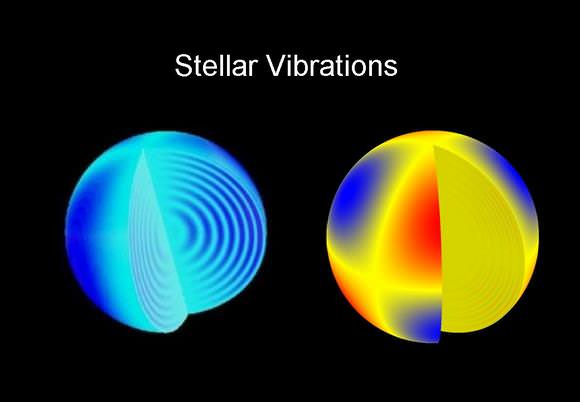
The variations in brightness can be interpreted as vibrations, or oscillations within the stars, using a technique called asteroseismology. Credit: Kepler Astroseismology team.
"We compared the frequencies of the modes of oscillation that are more sensitive to the low-latitude regions of the star to the frequencies of the modes that are more sensitive to higher latitudes," said Gizon. "This comparison showed that the difference in radius between the equator and the poles is only 3 km with a precision of 1 km. This makes Kepler 11145123 the roundest natural object ever measured, it is even more round than the Sun."
For comparison, our Sun has a rotational period of about 25 days, and the difference between its polar and equatorial radii is about 10 km. And on Earth, which has a rotational period of less than a day (23 hours 56 minutes and 4.1 seconds), there is a difference of over 23 km (14.3 miles) between its polar and equator. The reason for this considerable difference is something of a mystery.
In the past, astronomers have found that the shape of a star can come down to multiple factors - such as their rotational velocity, magnetic fields, thermal asphericities, large-scale flows, strong stellar winds, or the gravitational influence of stellar companions or giant planets. Ergo, measuring the "asphericity" (i.e. the degree to which a star is NOT a sphere) can tell astronomers much about the star structures and its system of planets.
Ordinarily, rotational velocity has been seen to have a direct bearing on the stars asphericity - i.e. the faster it rotates, the more oblate it is. However, when looking at data obtained by the Kepler probe over a period of four years, they noticed that its oblateness was only a third of what they expected, given its rotational velocity.
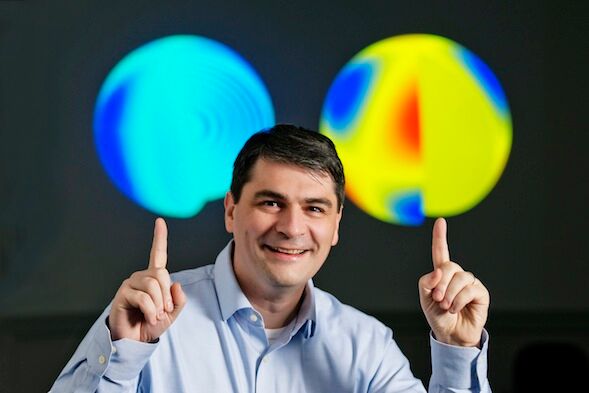
Laurent Gizon, the lead researcher of the study, pictured with asteroseismic readings of Kepler 11145123. Credit: Max Planck Institute for Solar System Research, Germany.
As such, they were forced to conclude that something else was responsible for the star's highly spherical shape. ""We propose that the presence of a magnetic field at low latitudes could make the star look more spherical to the stellar oscillations," said Gizon. "It is known in solar physics that acoustic waves propagate faster in magnetic regions."
Looking to the future, Gizon and his colleagues hope to examine other stars like Kepler 11145123. In our Galaxy alone, there are many stars who's oscillations can be accurately measured by observing changes in their brightness. As such, the international team hopes to apply their asteroseismology method to other stars observed by Kepler, as well as upcoming missions like TESS and PLATO.
"Just like helioseismology can be used to study the Sun's magnetic field, asteroseismology can be used to study magnetism on distant stars," Gizon added. "This is the main message of this study."
Further Reading: ScienceMag, Max Planck Institute
|
This Star Is The Roundest Natural Object Ever Seen

Subscribe to:
Post Comments (Atom)
-
Authentic news,No fake news. TNN | MUMBAI: If you can touch the sky while parasailing in Kamshet or Panchgani, dive into the depths of...
-
Authentic news,No fake news. Alejandro Casas’s electric taxi, which he drives in Montevideo, cost him 63,000 dollars, but he was given...
-
NAIROBI, Sept. 29 (Xinhua) -- An estimated 100,000 Kenyans die annually due to cardiovascular diseases, officials said on Thursday. Dr ...
-
Authentic news,No fake news. आईएएनएस टीम ने सिरपुर में जगह-जगह शूटिंग की रायपुर छत्तीसगढ़ का पूरा इतिहास अपने अंदर कई ऐसे रह...
-
Authentic news,No fake news. By Celeste McGovern LifeSiteNews 31 May 2021 All Global Research articles can be read in 51 languages by act...
-
Authentic news,No fake news. Monday, March 20, 2017 How much is an Afghan life worth? That depends. Nearly 16 year...
-
Authentic news,No fake news. By Sania Farooqui The following opinion piece is part of series to mark the upcoming International Women’s Da...


No comments:
Post a Comment