MITRA MANDAL GLOBAL NEWS

Iran expects oil production challenges

Authentic news,No fake news.


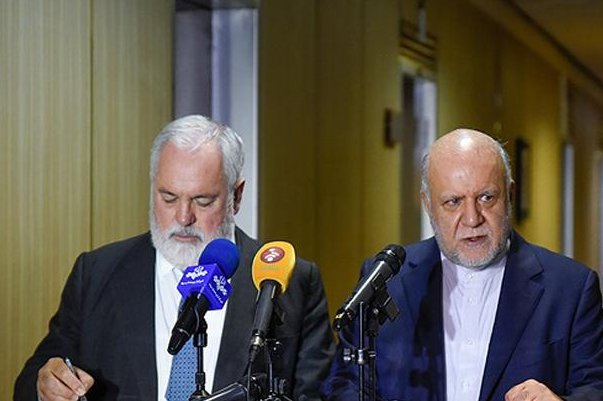
Iranian Oil Minister Bijan Zangeneh (R) met European Energy Commissioner Miguel Arias Cañete during the weekend to review a relationship in the wake of the U.S. decision to back out of a U.N.-backed nuclear agreement. Photo courtesy of Reza Rostami/SHANA
May 21 (UPI) -- It may be difficult for Tehran to continue pursuing oil production benchmarks in the face of possible sanctions pressure, the Iranian oil minister said.
Iranian Oil Minister Bijan Zangeneh met during the weekend with European Climate Action and Energy Commissioner Miguel Arias Cañete to discuss continuing a relationship in the wake of fractures in the Joint Comprehensive Plan of Action.
U.S. President Donald Trump withdrew from the JCPOA on May 8, signing legislation that set a 180-day clock ticking on the U.N-backed agreement that gives Iran waivers from oil-related sanctions in exchange for nuclear commitments. Trump said the agreement was flawed, but European leaders maintain it's essential for peace.
Eventually, Trump's decision could limit as much as 1 million barrels of Iranian barrels on the market. French energy company Total has said already that it would have to reconsider its relationship with Iran given the renewed threat of sanctions.
Zangeneh said oil clients in India and China have yet to express reservations, though ambitions to reach 4.2 million barrels in daily production could be out of reach.
"That would be difficult but we would not put that aside," he was quoted by the ministry's news website, SHANA, as saying. "It might take more time, but we will not do away with it."
Secondary sources reporting to economists at the Organization of Petroleum Economic Countries estimated that Iran produced 3.8 million barrels per day on average last month.
Cañete in his statement said both sides would strengthen ties "at all levels." Iran has been working since the JCPOA was signed in 2015 to regain a market share lost to sanctions.
Analysis emailed to UPI from consultant group Verisk Maplecroft said European investors may be faced with making a choice between siding with Iran or the United States, the world's largest economy. Torbjorn Soltvedt, the principal regional political analyst for the group, added that it may be difficult for the remaining JCPOA members to counter U.S. sanctions.
The European Commission last week introduced measures that could mitigate the impact. China, one of Iran's largest oil consumers, meanwhile, is "well beyond the reach of Washington," Soltvedt said

Reuters supports photojournalism with the announcement of 2018 grant winners

Authentic news,No fake news.

Photojournalism grant program gives eight emerging photojournalists a grant of $5,000 USD, global distribution on Reuters platforms and guidance from Pulitzer Prize-winning photojournalist Yannis Behrakhis
May 16, 2018
LONDON, May 16, 2018 – Reuters, the world’s largest international multimedia news provider, today announced the recipients of its photojournalism grant program which seeks to recruit and develop a diverse new generation of photojournalists.
The winning photojournalists will each receive a $5,000 USD grant to advance their abilities and tell new stories, and pictures taken by the recipients will be distributed globally on Reuters platforms.
Yannis Behrakis, Reuters photojournalist and senior editor, special projects, will advise recipients on their assignments and projects, providing advice and planning assistance. Yannis is well known for his coverage of the European migrant crisis and was part of a team of Reuters Pictures photographers awarded the Pulitzer Prize for Breaking News Photography for their coverage of the crisis in 2016.
The winning photojournalists are:
  • Tbilisi-based Daro Sulakauri, whose work includes a hidden narrative of the Chechen conflict.
  • Ekaterina Anchevskaya, who finds inspiration in her Russian homeland and its distinct culture.
  • Gabriel Scarlett, a student whose work so far has examined social issues in the U.S.
  • Alexandria-based Egyptian visual researcher and photographer Heba Khamis.
  • Houston-based Loren Elliott, whose recent work has focused on the U.S.-Mexico border.
  • Bolivian photographer Manuel Seoane who has covered migrant communities in La Paz.
  • Documentary photographer Nicky Woo, who divides her time between NYC and Tanzania.
  • Thomas Nicolon, who covers wildlife conservation and environmental issues in Central Africa.
"The Reuters Pictures grant program gives a rare opportunity to eight photojournalists, from diverse backgrounds and from around the world, to work with Reuters and develop their talent. I will be dedicating plenty of time to mentor each of them and help them understand in depth the needs of the industry in the digital age,” said Yannis Behrakis, Reuters photojournalist and senior editor, special projects.
“The work of our grant winners will be seen by a global audience through Reuters platforms, bringing new stories from new perspectives which might otherwise go untold."

Reuters to open new bureau in Shenzhen, China

Authentic news,No fake news.

Hong Kong, May 16, 2018 – Reuters, the world’s largest international multimedia news provider, has announced that it will open a new bureau in Shenzhen, China, later this month. 
The new bureau reflects Reuters ongoing commitment to reporting on China thoroughly and its moves to bolster business and companies coverage in China and globally. The establishment of the Shenzhen bureau recognises the pivotal role of the Pearl River Delta region, and China more broadly, in the global technology industry.
The Shenzhen bureau will be headed by Reuters new South China Correspondent, Sue-Lin Wong. Originally from Sydney, Australia, Sue-Lin joined Reuters in 2014 and has been based in Beijing since late 2015, covering economics and general news. 
“This opening of the new Shenzhen bureau is a mark of Reuters commitment to deepen our coverage of companies in Asia, especially in China, where the government is pushing a strategy of developing as a technology superpower in emerging fields, ranging from artificial intelligence to next-generation semiconductors”, said Kevin Krolicki, Regional Editor Asia at Reuters.
He added, “We also look forward to providing Reuters readers with a more deeply reported view of South China, as part of our commitment to providing comprehensive, objective reporting on China.”

20 Water-Stressed Countries Have Most Solar & Wind Potential

Authentic news,No fake news.


Tianyi Luo is a senior manager with the Aqueduct Project at the Global Water Program at World Resources Institute.
WASHINGTON DC, May 11 2018 (IPS) - Most power generation consumes water, whether to cool steam in thermoelectric plants or power turbines for hydropower. And the global demand for both water and electricity will continue to increase substantially in the coming decades.
Although growth is generally a good thing for the economy, it challenges nations—particularly ones that are water-stressed—to better manage their limited water resources and invest in the right energy systems.
Power generation from solar photovoltaic (PV) and wind is clean and requires zero or little water use. These renewable forms of energy can help countries meet their increased demand for electricity without adding carbon emissions or consuming water.
This could be particularly beneficial in countries where growing populations, farms and industries are already competing for scant water supplies. For example, a recent WRI analysis shows that India could reduce its water consumption intensity by more than 25 percent just by achieving its renewable energy targets.
Leveraging WRI’s Resource Watch, a new global data platform, we overlaid map-based data sets to identify countries that are water-stressed and have high solar and wind energy potential. These countries are places where solar PV and wind technologies are more likely to be financially attractive and provide water savings that would benefit the public greatly.
Water Stress and Solar Energy Potential
The top 20 water-stressed countries with the most average solar energy potential are in the Middle East and North African region; the rest are from Asia and Pacific, Latin America and Sub-Saharan Africa.
The list includes countries at all economic stages: three are developed (Australia, Israel and Saudi Arabia), four are some of the least developed (Afghanistan, Eritrea, Timor-Leste and Yemen), and the rest are from emerging or developing markets.
Yemen has the highest average solar energy potential in terms of global horizontal irradiance (GHI), a proxy of the strength and concentration of solar energy hitting a PV panel. It’s also one of the world’s most water-stressed and least developed countries.
The World Bank just invested $50 million in solar PV projects to restore electricity to more than one million Yemenis. However, with the ongoing civil war in the country, renewables development could still be challenging.
Eritrea and Saudi Arabia have the second- and third-highest average solar energy potential, but very different economic power. It is more challenging for countries with constrained financial resources to adopt renewable technologies at a large scale.
However, as the cost for solar and wind energy continues to decline, these options are becoming more attractive. Even oil-rich countries like Saudi Arabia are investing heavily in solar energy for domestic consumption, with a target of 9.5 gigawatts (GW) of solar and wind by 2023.
Water Stress and Wind Energy Potential
Of the 20 water-stressed countries with the most wind energy potential, eight are from the Middle East and North Africa (MENA), six from Europe, and the rest from Asia Pacific and North America. Eight of the countries are developed, 11 are from emerging and developing markets, and one is among the world’s least developed.
Andorra has the highest wind energy potential, followed by Belgium and Kazakhstan. However, for wind to be attractive in Andorra, the costs would need to be cheaper than its current electricity imports from Spain.
Seven water-stressed countries (Algeria, Bahrain, Kuwait, Morocco, Oman, Qatar and Yemen) in the MENA region have high average energy potentials for both solar and wind, as well as Australia. Some of these countries have plans to harness solar and wind energy, but many do not, and many goals fall short of their potential. Also, because of their oil wealth, some of these countries rely on desalination for water supply and might not have a water scarcity problem for now.
A full list of all countries with high water stress and their average wind energy potentials can be found at the bottom of this post.
Note: For countries that span large areas, there could be spatial mismatch between water stress and renewable potential and electricity demands, which is not accounted for in this analysis. Additionally, more comprehensive analysis would require looking at local governance, regulations, availability and cost of competing energy resources and economics. While local contexts may differ, these aggregate averages show which countries have the most to gain from renewables’ water savings overall. More granular data could be found and visualized on Resource Watch.

Trump, Iran and the 'I.S.R.A.E.L' doctrine

Authentic news,No fake news.


US President Donald Trump announces his intention to withdraw from the JCPOA agreement during a statement at the White House in Washington, US May 8, 2018 [Jonathan Ernst/Reuters]
American presidents have long devised strategic visions to guide their foreign policy, focusing on a particular enemy or threat, whether communists, Arab nationalists or "violent jihadists".
With communism defeated, Arab nationalism in crisis, and "Sunni Jihadists" on the run, the Trump administration has made Iran the object of its enmity.
After a year of confusion and uncertainty, a revised American doctrine focused on the Middle East, but with direct implementations for South East Asia, Europe and Russia is finally taking shape, for reasons that can be best explained with the telling and memorable acronym, I.S.R.A.E.L.

I for Iran 

"The Great Deal Maker" president has finally abandoned the "badly negotiated" Iran nuclear deal to pressure for a more comprehensive deal that allows for inspections anywhere and everywhere in Iran, and guarantees Tehran never comes close to a nuclear weapons programme.
Ever.
There's absolutely no surprise here. In January, Trump warned:
No one should doubt my word. I said I would not certify the nuclear deal - and I did not. I will also follow through on this pledge. I hereby call on key European countries to join with the United States in fixing significant flaws in the deal, countering Iranian aggression, and supporting the Iranian people. If other nations fail to act during this time, I will terminate our deal with Iran. Those who, for whatever reason, choose not to work with us will be siding with the Iranian regime's nuclear ambitions, and against the people of Iran and the peaceful nations of the world.
Since then, the US president has managed to get his preferred national security team in place. And now, he is ready to withdraw from the nuclear agreement and prepare for an all-out confrontation with Iran. Trump's national security trio: John BoltonMike Pompeo and James Mattis, all agree on the need to confront Iran because they believe its regime responds only to coercion and force.
After decades of mutual demonisation, Iran is an easy villain in the "Great Satan's" storyline - the flag-burning crowds, the stern-faced ayatollahs, the ideological arm of the axis of evil.
For them, the supposedly moderate Rouhani government might be tactful and pragmatic at times, but it remains part and parcel of the Iranian dictatorship. 
That's why for the Trump administration, any future deal must ensure that Iran foregoes any suspicious nuclear activity, ends its ballistic missiles programme, curtails its bellicose regional activities, and rolls back its destabilising ideology. Demands that are considered humiliating infringements on Iran's sovereignty and therefore been rejected by the country's moderates and "radicals" alike. 

S for Saudi 

Saudi Arabia, Trump's newest BFF, is the most enthusiastic supporter of the drive against Iran - perhaps more so than Israel. Riyadh took advantage of Trump's foreign policy creed and greed to incite and entice the new president against Iran with hundreds of billions of dollars in contracts. 
It's a little-known fact that Saudi and Israel pushed for attacking Iran instead of Iraq after 9/11. When the push towards Baghdad got under way, the two unlikely bedfellows campaigned for an extension of the "war on terror" to Iran to "cut the head of the serpent".  But the US debacle in Iraq not only prevented the US from imposing a regime change in Iran; it, in fact, strengthened Iran's hand in Iraq and the whole region. 
Obama might've embraced the so-called offshore balancing between Middle East powers with the US watching from a distance, but the Trump doctrine is leading to offshore blasting that could draw the US into direct confrontation with Iran.

Riyadh's wish to fight Iran "until the last American soldier" may not have materialised, but there's no giving up. The ambitious new Saudi leadership is willing to put forward its resources, soldiers and clout to confront Iran, as in Yemen, if the Trump administration agrees to tag along. And Trump has shown signs of accepting the idea of the US acting as the mercenary, for the right price; like in Syria for example
Last year, the Saudis assembled a large gathering of Muslim world leaders, minus Iran, to honour and listen to the man who, only months before, insulted them and their faith. And this year, Saudi leaders expressed openness to Trump's "deal of the century" that paves the way for new relations with Israel at the expense of Palestine. 

R for reversal of everything Obama

President Trump's approach to his predecessor's legacy is political and strategic. But it's also personal: an obsessive drive to reverse anything and everything Obama.
So, even when he agrees with Obama, Trump turns against his own impulse to keep his anti-Obama credentials intact.
READ MORE

Analysis: Trump's withdrawal from Iran nuclear deal isolates US

He may agree with Obama that the region is "a mess" and its people should resolve their own problems, but by walking away from the nuclear deal, Trump is de facto committing the US to a protracted, messy and violent involvement in the region for years to come.  
When Obama helped strike the Iran deal, he rejected objections and demands from Israel and Saudi Arabia, leading to unprecedented tensions with both nations. Trump, on the other hand, seems disposed to embrace their strategic thinking and to rely on them to help preserve US security designs for the Middle East.
Obama might've embraced the so-called offshore balancing between Middle East powers with the US watching from a distance, but the Trump doctrine is leading to offshore blasting that could draw the US into direct confrontation with Iran. 

A for Arms 

Trump's doctrine posits on US military supremacy and economic superiority, which means subsidising and supporting the US arms industry. 
As the US arms trader-in-chief, Trump has made it his passion to boost US arms exports even if that leads to an arms race and potentially more devastating wars in the Middle East and beyond.
The Gulf tops the list of US customers. Saudi Arabia alone committed more than $100bn to arms last year, leading its crown prince to boast of Saudi military superiority and beat the drums of war against Iran.
If Iran ends up abandoning the nuclear deal, the region may not only witness an arms race but potentially a devastating nuclear race.

E for engagement

When it comes to Donald Trump, don't just pay attention to what he says. It pays to pay attention to what he does. His tweets may be controversial, even entertaining, but his actions are consequential and reckless.
He says "I want to pull US troops out of Syria", then decides to keep them there and push for confrontation with Iran and its allies. He says "I will agree to what the Israelis and Palestinians decide" but recognises Jerusalem as Israel's capital and prepares to propose/impose a final deal on the Palestinians. 
Relying on Saudi Arabia and Israel will prove to be shortsighted, especially as the Trump administration has already alienated European allies by threatening all those dealing with Iran with sanctions. 
Fast-forward a few months, and watch the US expand its already numerous drones attacks, naval presence and exercises, military bases, covert operations, and bellicose activities against Iran and its allies - who have taken control of cities and regions in Syria and Yemen and are winning elections in Iraq and Lebanon. 
A confrontation with Iran will not end with more US sanctions, certainly not without secondary sanctions against European, Chinese and Russian companies dealing with Iran. That will pave the way to a full-blown international crisis; one that could leave the US, not Iran, isolated. 

L for linchpin 

It was perhaps wishful thinking to ask Donald Trump to leave the Middle East alone, as I wrote on the night of his election last year. 
Leaving aside his total ignorance of the region apart from airports, golf courses, and rich Arab tenants residing in his golden towers, the man didn't show an interest in shaping or transforming the region as some of his predecessors did. In fact, he expressed a desire to get out the business of nation-building and bullying. 
To no avail.
Every American administration since World War II has considered itself indispensable to the wellbeing and security of the region. And Trump now shares this vision of indispensability, which devolved from liberal illusion to dangerous delusion since Iran's revolution nearly five decades ago.
The US has become entrenched deeper in the Middle East with each and every crisis, as Andrew Bacevich argues brilliantly in his book, America's War for the Greater Middle East.
But today we seem to have come full circle as the Trump doctrine meets up with the 1980 Carter Doctrine, which can be summarised by the following declaration: "Any attempt by any outside force to gain control of the Persian Gulf region will be regarded as an assault on the vital interests of the United States of America, and such an assault will be repelled by any means necessary, including military force."
Trump, like his predecessors, will make sure that no other power or entity but the United States has final say about the resolution to the Arab-Israeli conflict, the proliferation or use of weapons of mass destruction, Gulf security, the flow of oil, etc. Not even the UN. 
Especially not the UN. 
Trump's America will not walk away from the Middle East. If you thought the Obama doctrine envisioned US disengagement from the Middle East, think again. The US will not leave a volatile region for Russia and Iran to dominate.
Like his predecessors, Trump will fret and frown about his predecessors' mistakes and failures and the intractable problems of the region, yet still walk in their evangelical path of righteousness to save the region from its demons. 
And like his predecessors, he won't consider, let alone admit, how US strategies and policies have only made the region more chaotic, dangerous and violent.    
All of this begs the question: What relation is there between Israel and the I.S.R.A.E.L-isation of US foreign policy? But that's a question for another day.
To be continued.
ABOUT THE AUTHOR

Online violence against women in India

Authentic news,No fake news.


Amnesty International India recently launched a campaign to address the issue of online violence faced by women in India [Amnesty International India]
Among the top 20 countries in internet usage worldwide, India has the highest yearly growth rate of internet users. Easy access to the internet has enabled many people, especially women and other marginalised groups, to overcome traditional barriers and participate in the public sphere.
However, the violence women face in these virtual spaces has in many ways left them feeling vulnerable, not empowered. More so, if one identifies themselves as a woman from a minority religious, racial or ethnic background, a woman with disabilities, or a lesbian, bisexual or transgender individual. Online violence against women - that is, violence directed at women by virtue of their gender - violates their human rights and is thus an impediment to the attainment of gender equality.
Amnesty International India recently launched a campaign to address the issue of online violence faced by women in the country. It has been interviewing women who express their opinions online, documenting their experiences of being active on social media platforms and the violence they regularly face online.
At an event organised in New Delhi on April 24 as part of this campaign, Rana Ayyub, an award-winning writer and journalist, shared how she had received rape and death threats on platforms like Twitter and how, more often than not, her complaints to the platform fell on deaf ears.
"I have reported so many profiles on Twitter, but the platform seems oblivious to all these. In addition to the hate and abuse, there are fourteen fake profiles in my name and with my picture. I have reported those profiles, but they continue to exist, because, apparently, they are not against Twitter's policies, or so I have been told."
Kiruba Munusamy, an advocate in the Supreme Court of India, has also been very vocal about the intersectionality of abuse and violence online. "While the abuse and violence faced online is gendered, it gets even worse when the abuser finds out that the person posting her picture or opinion belongs to a 'lower caste'. Comments on a short dress turn into comments on a woman belonging to a lower caste wearing them", she told the audience at the event. Despite being a practising lawyer at the Supreme Court, Munusamy was advised by some officials not to take forward a case of online abuse that she faced on Facebook, and most of the comments received on her profile were deleted without her consent. Student activists like Shehla Rashid and celebrities like Swara Bhaskar have also faced an increased wave of abusive tweets and online abuse because they are vocal about issues they feel strongly about.
In 2017, Amnesty International polled 4,000 women in eight countries, including the UK and the US, and found that nearly 76 percent of women who had experienced abuse or harassment on a social media platform changed how they used the platform. Around two-thirds of women who experienced abuse or harassment on social media platforms said that they felt a sense of powerlessness after experiencing online abuse. Forty-one percent of women said that on at least one occasion, these online experiences made them feel their physical safety was threatened.
The situation is not very different in India. Kavita Krishnan, Politburo member of the CPI(ML) and Secretary of the All India Progressive Women's Association, who has been on the receiving end of rape threats and misogyny, says that online violence needs to be taken seriously and it often has the potential to spill into physical abuse and violence. "Online abuse and it not being taken seriously emboldens people to verbally assault you. People have come up to me and told me I am of a bad character after fake news spread online of me questioning the potency of the PM and asking him to prove he is not impotent by sleeping with me."
Abuse against women on Twitter and other platforms can also include "doxxing" which involves revealing personal information or identifying documents or details about someone, on an online platform, without their consent. In April this year, Rana Ayyub's address and phone number, and an obscene video with her face morphed on it were shared online in response to a tweet that came from a fake account using her name. She feared for her safety and that of her family and filed a criminal complaint.
Women from academic circles are not spared of online vitriol, especially if their writings are not in conformity with the ideology of the abusers. Audrey Truschke, historian and author of the book, Aurangzeb, The Man and the Myth, told Amnesty International India "I mostly post about Mughal history, especially Aurangzeb. I also post about modern Indian culture and politics. I am regularly attacked, using sexist language, on the basis of my perceived race (white/Caucasian), and on the basis of my perceived religion (Christianity - sometimes specifically Catholicism or Evangelicalism - Judaism, and atheism). I stopped reporting sexist tweets to Twitter because they never did anything about it. Following Twitter's change in policy about hate speech late last year, I again began reporting the worst of the sexist tweets, and, occasionally, Twitter does something about it."
India already has laws that - while flawed - can be used to deal with online abuse. What needs attention is a better implementation of the same. This implementation needs to be coupled with non-legal measures to address the structural inequalities which stem in part from patriarchal notions of morality, lying at the heart of the online abuse faced by women. A starting point to address this gender-based abuse on online platforms can be asking these platforms to start following their own guidelines on "abuse and hateful conduct", which, as research has shown, are flouted by the platforms themselves!
The views expressed in this article are the author's own and do not necessarily reflect Al Jazeera's editorial stance. 

ABOUT THE AUTHOR

Low Awareness Restrains Growth of Solar Technologies

Authentic news,No fake news.


|
A young woman admires a parabolic solar cooker at a solar fair in Rusape, Zimbabwe. Credit: Tonderayi Mukeredzi/IPS
RUSAPE, Zimbabwe, May 7 2018 (IPS) - Every year, Amos Chandiringa, 43, a farmer in Nemaire village in Makoni district in northeastern Zimbabwe, laboriously waters his tobacco nursery with a watering can. The toil of the job often leaves him without the energy or time to do other household chores.
“I live near a dam, so I’ve access to plenty of water, but I cannot do much with the water because I lack the necessary technology to mechanise my farming. Installing an electric or diesel water pump have been options, but that is expensive,” he tells IPS.
Government, solar last mile distributors and development agencies say using solar electricity to power irrigation pumps, process harvests and for preservation of crops can transform rural lives.
In February, Chandiringa was privileged to host a combined farmers’ field day and solar fair at his homestead for the first time in his area and in the history of his farming career.
Solar entrepreneur Isaac Nyakusendwa says farmers like Chandiriga could make light work of their farming and multiply their yields if they used solar pumps to draw water from the dam to irrigate their crops or to use in the home.
Although farming is the occupation of most people in Rusape and other areas of rural Zimbabwe, the usage of solar photovoltaic systems remains limited mainly to lighting and entertainment.
Government, solar last mile distributors and development agencies say using solar electricity to power irrigation pumps, process harvests and for preservation of crops can transform rural lives by providing better crop yields, higher incomes and reducing the physical labor of farming.
Nemaire councillor Sam Maungwe says farmers in his area earn good money, mostly from tobacco farming, but due to poor knowledge of solar technologies, many of them spend their earnings on radios and household furniture.
“Farmers here largely grow tobacco, hence the area suffers from a double strain of wood cutting for tobacco curing and firewood. The use of solar in farming by our farmers would be good as it will lengthen their farming season and increase their income,” Maungwe tells IPS. “But more importantly, we want our farmers to extend the use of solar to tobacco barns so that they stop the indiscriminate cutting down of trees for tobacco curing.”
Petronella Karima, an extension officer, says there should be more platforms to educate rural farmers and expose them to new, affordable technologies because most of them are not aware of the capabilities of solar products.

“Many use solar for entertainment. Some have big solar home systems in their homes, but they don’t know that they can use it to water their crops and install water in their homes. With the knowledge they got from the solar exhibition, I believe many will now use solar to irrigate their crops and to harvest water,” Karima says.
Chiedza Mazaiwana, the Power for All Campaign Manager at Practical Action Zimbabwe, says awareness of renewable energy solutions is relatively low, with market penetration of solar lighting and home systems estimated at only 3%.
She says consumer literacy on renewable energy products is critical in unlocking the huge potential of renewable products in off grid rural communities.
“Lack of knowledge is a major barrier to the development of the solar market. Most potential rural customers are unaware of recent advances in solar technology, reductions in the cost of the technology, availability of financing solutions such as the pay-as you-go (PAYG) model that allows them to access technologies and products that would ordinarily be beyond their reach,” she adds.
The past distribution of poor quality products and installations have also undermined trust and reduced demand, making it very hard for businesses to establish a presence in rural areas.
However, as part of a rural solar market development effort, government, renewable energy firms and development agencies are concertedly using field days and solar fairs to encourage the use of solar energy as a way of improving livelihoods in rural areas.
Solar fairs are emerging as a key platform for awareness raising and consumer education on solar for off-grid communities and for solar distributors to create business linkages with farmers. Other methods include media campaigns and the use of trusted opinion leaders such as chiefs, head teachers and faith leaders to spread the word about the novelty of renewable energy solutions. This method has proved particularly effective in East Africa.
Nyakusenda, who is the chairman of the Renewable Energy Association of Zimbabwe, a grouping of solar distribution companies says, “Lack of knowledge about solar energy and its capabilities is one of the many barriers scuttling the development of the solar market. Through combined field day and solar fairs, we are facilitating, and giving farmers a perfect and rare opportunity to shop for and to interact with suppliers of solar products in one place thereby expose them to quality products and genuine companies.”
He says the PAYG model allows the farmers to pay a nominal deposit for a renewable product of their choice, and finish the payment in small, cheap monthly instalments.
During the fairs, young males and females have been particularly attracted to solar powered lighting, entertainment and communication gadgets while women liked solar cooking stoves and older males got attracted to water pumping systems.
Practical Action’s gender officer Tony Zibani says the use of solar technology can ease the triple burden of work on women and reduce gender-based violence in the homes as chores performed by women would be lessened by technology.
Over 60% of Zimbabwe’s population do not have access to energy and rely on solid biomass fuels such as firewood, charcoal and kerosene as their main cooking fuel – solutions that are expensive, unreliable and environmentally unsustainable.
While the demand for energy in rural areas is increasing, the provision of electricity is skewed greatly towards higher-income households and urban areas, leaving out a large proportion of the rural population.
Mazaiwana asserts that decentralized electrification solutions are the fastest, most cost-effective and sustainable approach to universal energy access, in addition to providing economic opportunities for communities

Across the world, militaries have a sexual violence problem

Authentic news,No fake news.


To truly address sexual violence within the military, comprehensive changes must be implemented, writes Fatima [Reuters]

In 2003, I was a young Flying Officer in the Pakistan Air Force, training under a supervisor who was notorious for making advances on women. He lived up to his reputation. During my one year at the airbase, he inappropriately touched and made indecent comments and sexually explicit jokes to me and my female colleagues. Although I was not physically assaulted, the psychological trauma from these experiences was unbearable.
It is never easy to speak of sexual abuse, and I never reported him. Instead, I tried to erase this traumatic episode of my life from my memory - until recently. Last year, the revelations of pervasive sexual harassment and assault in the US film industry, and the consequent rise of the #MeToo movement, brought back these painful memories. Like other women across different industries and countries, I found the courage to speak out.
Because armies are male-dominated - across the world men account for more than 90 percent of military staff - and are intrinsically associated with certain notions of masculinity and aggression, they are difficult workplaces for women to navigate.
Furthermore, for centuries, armies have used rape as a weapon of war and some continue to do so. In recent years, there has also been growing evidence of the pervasiveness of sexual violence perpetrated by peacekeeping forces and of sexual assault committed within the military ranks across the world. 
Despite increasing media attention on sexual crimes perpetrated by troops, information and statistics on sexual crimes within the military are still difficult to come by. Few countries around the world publish official data on the subject, and what is publicly available often underrepresents the true extent of the problem.
Israel, which mandates military service for both men and women, had 893 cases of sexual assault reported in the last year. The Pentagon estimates that 15,000 members of the US military have been sexually assaulted. In the British military, four in 10 military women are victims of sexual violence. A 2016 survey estimated that 27 percent of women in the Canadian armed forces face sexual abuse during their career. 
Official reports on sexual violence in the military are even harder to find in developing countries. In my country, Pakistan, there have not been any reports released by the military on sexual crimes committed within its ranks. In countries like IndiaPeru, North KoreaEritrea and Syria, there have been only occasional media reports on sexual assault committed by troops or anecdotal evidence published in human rights reports.
READ MORE

Why do some UN peacekeepers rape?

Across the world, sexual violence is very difficult for women in the military to address. Victims are often blamed for "provoking" the sexual abuse with their behaviour or dress. Reporting sexual harassment and assault can mean that the victim is labelled as a person of "loose morals" or as "a liar". 
In more conservative settings, virginity and notions of honour make reporting sexual violence even more difficult, as women fear bringing shame to their families and losing their chances of marriage. At times, military women also trivialise sexual harassment to fit into the masculine setting. They may also discourage other women from reporting their experiences.
One of the biggest challenges in addressing sexual violence in the army is that military laws and procedures are different from civilian ones. Speaking to the media is prohibited and military institutions can hide behind legal loopholes or national security legislation to dodge accountability for crimes.
Sexual violence cases are heard in male-dominated military courts that operate under military law, which makes it difficult for militaries to try abusive people in top leadership positions. Often perpetrators sit in the same chain of command that is supposed to act on the complaint, leaving survivors of sexual violence fearing retaliation if they report. There is a gap in evidence-based studies on the issue, but data from the US military suggest that more than 48 percent of survivors refuse to proceed with trial after reporting sexual violence. 
Solutions to the problem of sexual violence vary. Countries like Pakistan follow a strict policy of gender segregation to minimise interaction between men and women in the military. This is effective to an extent, given the conservative culture in the country.
To truly address sexual violence within the military, comprehensive changes must be implemented. These include: adapting practices to combat sexual harassment while keeping victims safe; developing action plans to prevent sexual harassment; training troops to report sexual harassment both as victims and as witnesses; creating safe and private channels of reporting sex crimes without fear of retaliation; amending military laws in countries that don't already classify sexual harassment as a specific crime to make it one; publicising the sexual harassment data and actions taken on them; and making provisions for victims to take sexual harassment cases to civil courts.Norway has taken the exact opposite route of putting men and women together in dorms and this strategy also seems to be working in reducing sexual assault rate. Countries like the USFranceUK,Israel and Canada have made some efforts to reform reporting and response mechanisms for sexual violence crimes to ensure protection for the victims and a higher likelihood for the perpetrators to be held accountable. None of these efforts has been enough, however.
These steps are essential if we want to create a safe environment for the women and men who serve
.

Mitra-mandal Privacy Policy

This privacy policy has been compiled to better serve those who are concerned with how their  'Personally Identifiable Inform...