MITRA MANDAL GLOBAL NEWS

India buzzes with fake news of 'civil war' in Pakistan

Authentic news,No fake news.

By Abid Hussain

BBC Urdu, Islamabad
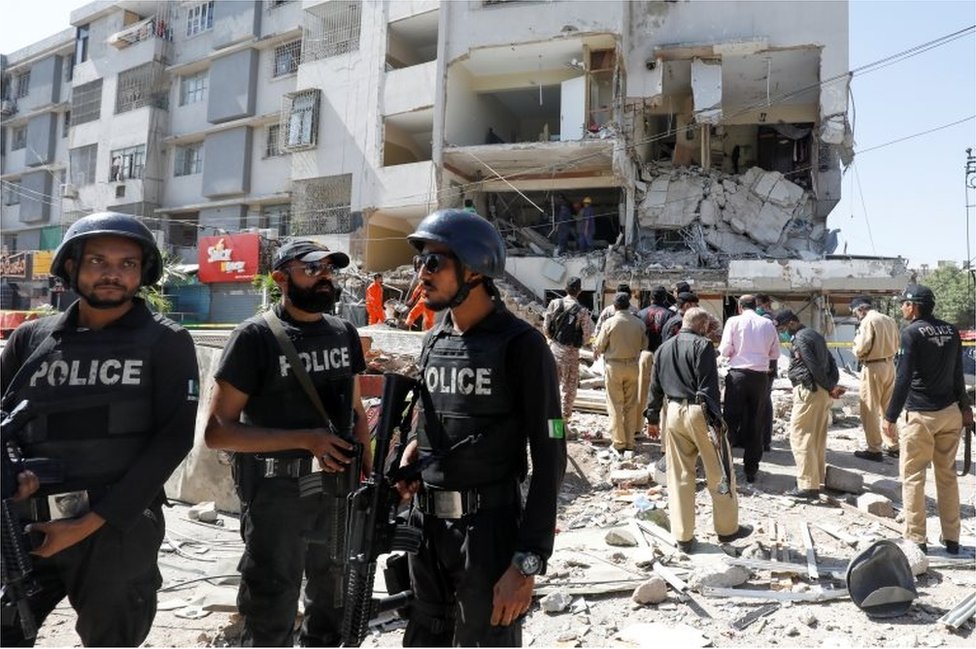

Police officers secure the site after an explosion in the multi-storey residential building in Karachi, Pakistan October 21, 2020.IMAGE COPYRIGHTREUTERS
image captionThere was an explosion caused by a gas leak in Karachi, but there were no clashes between troops and police

Fake news has been widely circulating on Indian sites and social media this week, claiming a civil war had broken out in the Pakistani city of Karachi.

The reports emerged after local Pakistani media said troops had kidnapped the provincial police chief to force him to arrest a top opposition leader.

The story was quickly picked up over the border in Pakistan's arch-rival, India, where reports went much further - saying clashes between the police and the army had resulted in the deaths of many Karachi police officers and tanks had been seen on the streets.

A fake video circulating on Twitter even claimed to show some of the alleged unrest.

In reality, none of it was true.

Many local police and opposition members had been angered by events surrounding the politician's arrest - but there was no violence.

Pakistan and India are bitter enemies and it's well known they have long used propaganda against each other - they have fought three wars since independence from Britain in 1947.
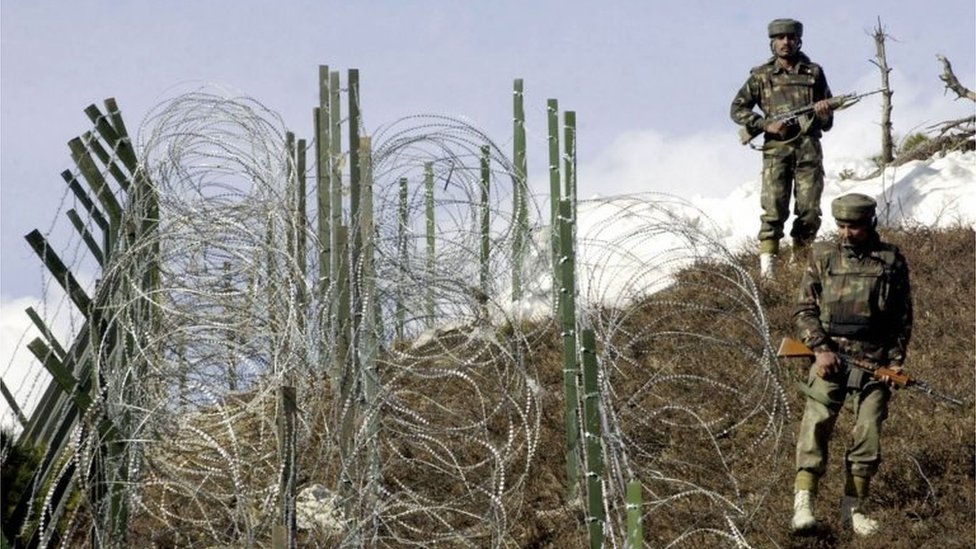
This file photograph taken on December 4, 2003, shows Indian soldiers as they patrol along a barbed-wire fence near Baras Post on the Line of Control (LoC) between Pakistan and India some 174 kms north west of Srinagar.IMAGE COPYRIGHTAFP
image captionThe de facto border between India and Pakistan, who have fought three wars

Last year, Facebook blocked networks linked to Pakistan's military and a global network of pro-Indian fake websites and think-tanks was exposed, which had been aimed at influencing decision-making in Europe.

But what's notable this time is the number of verified accounts and apparently reputable news outlets that ended up putting out news that was utterly false, to millions of followers and readers.

'Fighting' in a place that doesn't exist

Tempers seemed to be simmering down when Pakistan's army chief ordered an investigation into the circumstances surrounding the arrest on Tuesday of Safdar Awan, the son-in-law of former Prime Minister Nawaz Sharif.

A day earlier there had been a major rally against the government of Pakistan's current Prime Minister Imran Khan in Karachi, an opposition stronghold which is the capital of Sindh province.
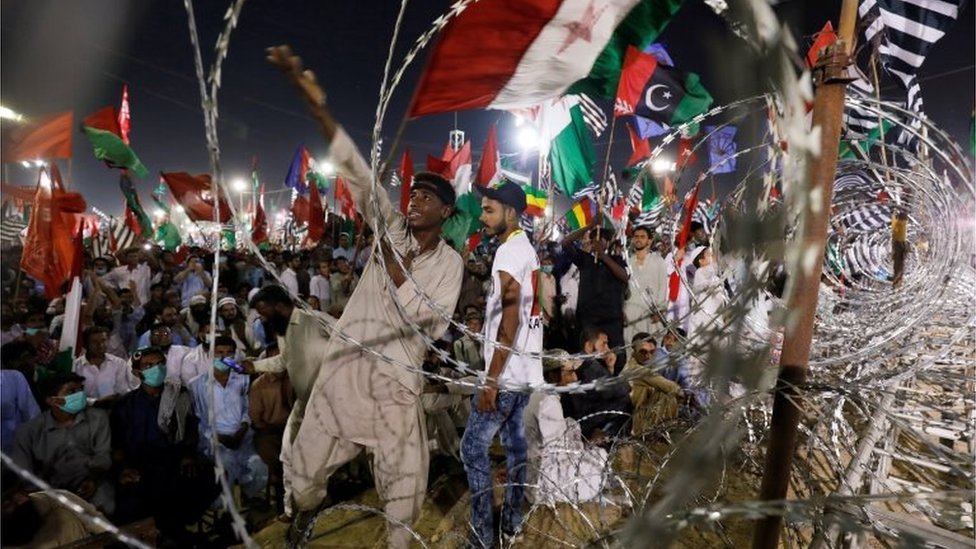
A supporter of the Pakistan Democratic Movement (PDM), an alliance of political opposition parties, reacts to a party song during an anti-government protest rally in Karachi, Pakistan October 18, 2020.IMAGE COPYRIGHTREUTERS
image captionTensions were running high in Karachi after the opposition rally

But later on Tuesday night a hitherto unknown account tweeted that a fight between troops and police had broken out, with tanks on the streets of Karachi and at least five casualties.

It's unclear who sent this initial tweet. Despite extensive digging by the BBC, it was not possible to establish who operates the Twitter account named @drapr007.

An hour later, the account tweeted again, this time saying: "#BREAKING: Heavy firefight between Pak Army and Sindh Police is going on in Gulshan e Bagh area of #Karachi..."
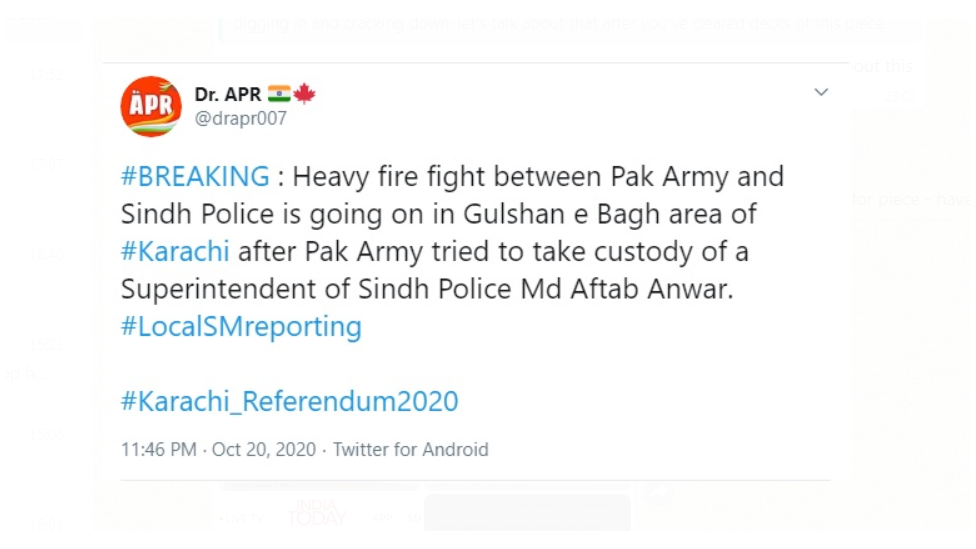
grab

Those familiar with Karachi would know there is no area there by that name - but most readers would not.

Nor had there been any fighting, or tanks seen on the streets.

However, news of the "civil war" then spread rapidly. A deadly blast in Karachi which turned out to have been caused by a gas leak added fuel to the rumours.

They were picked up by verified individuals and major Indian media outlets such as CNN18, Zee News and India Today.
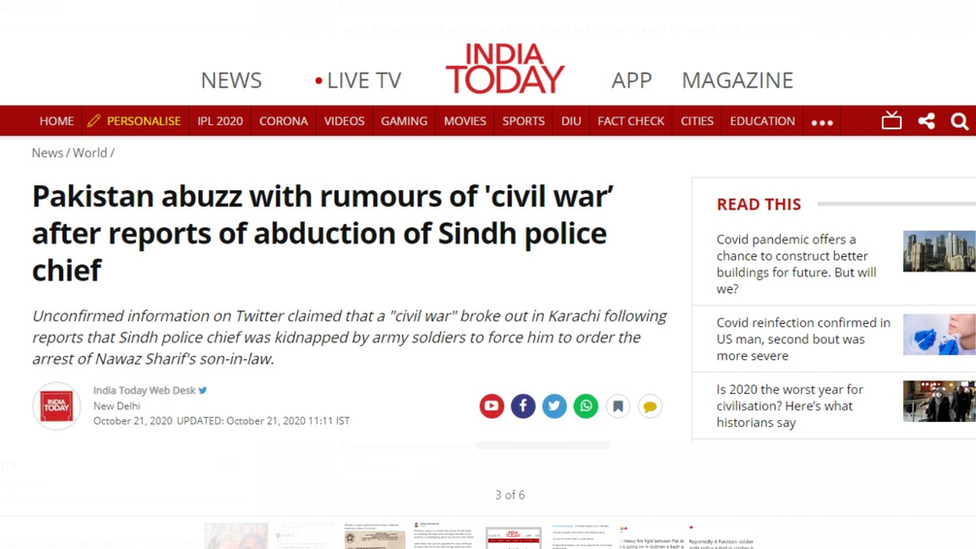
grab

One user with a verified account, Prashant Patel - whose bio says is an advocate of the Supreme Court of India - went on to put out a series of tweets where he made claims about a "civil war situation" in Karachi, deaths of policemen and soldiers, Prime Minister Imran Khan ordering patriotic songs to be played on the radio, and even the impending arrival of the US Navy in the port of Karachi.

The BBC's Reality Check team looked into some of the accounts and websites - some of them impersonating the Sindh police - which have been spreading false news about the situation in Karachi and found them to have links with India.

Video purporting to show the clashes was shared by an account under the name of International Herald.

The dark and blurry video shows young men walking towards a building with fire visible to one side. They are seen throwing stones and shouting slogans, seemingly against Pakistan's army chief. The BBC was unable to tell if the video had been doctored, or even shot in Pakistan at all.

1px transparent line

International Herald was registered under a now-defunct Indian company in 2018. It's had a Twitter account since 2015 which does not follow anyone. Its followers include two leaders of the ruling Bharatiya Janata Party (BJP) in India.

'Co-ordinated disinformation'

Mainstream Pakistani media outlets were quick to challenge the Indian media claims with fact-checks.

And Twitter users in Pakistan have had a field day ridiculing the reports, using hashtags such as "CivilwarKarachi", "fakenews" and "Indianmedia" trending on Twitter along with humorous posts and memes.

Renowned singer and actor Fakhr-e-Alam tweeted: "Karachi civil war has gotten so bad that my food panda delivery boy had to crawl through mine fields carrying his AK47, RPG & 9mm along with my nihari and Biryani. This thing is getting so serious."

Writer Bina Shah said: "I live in Karachi, where I just did my groceries, visited the bakery, bought some clothes and came home. If there's a civil war out there I couldn't find it."

Some called the reports a case of "co-ordinated disinformation" by Indian media.

1px transparent line

'So biased it does not make sense'

Hartosh Singh Bal, political editor of one of India's most respected news magazines The Caravan told the BBC: "There's a section of media in both countries which is essentially busy playing games, and what they do has little to do with journalism.

"It is so biased that it does not make sense."

media captionIndia and Pakistan's 'war-mongering' media

Another senior Indian journalist who did not want to be named said projecting a divide between the army and police in Pakistan would fit into the Indian narrative of a Pakistan in decline.

"A quick study of Twitter handles tweeting this misinformation will show that most of them are supporters of or affiliated to the ruling party."

Arslan Khalid, who advises Imran Khan on digital strategy, said it was not the first time that Indian media had run a co-ordinated disinformation campaign against Pakistan.

He questioned Twitter's commitment to its guidelines.

Despite repeated attempts, the BBC was unable to obtain a response from Twitter regarding its policies on fake news.

The BBC's Reality Check and BBC Monitoring both contributed to this report.

Over 1m people from Hong Kong could come to UK under new visa rules

Authentic news,No fake news.


More than 1m people from Hong Kong could emigrate to the UK in the next five years under new visa arrangements, according to official estimates. 

Plans were set out to allow British National (Overseas) (BNO) citizens and their families who live in Hong Kong to apply for visas and live and work in the UK. 

Read more: UK suspends extradition treaty, places arms embargo on Hong Kong

Around 3m people are thought to be eligible for BNO status and Home Office estimates suggest some 500,000 could arrive in the first year the visa becomes available in January. This “high” estimate rises to more than 1m over five years.  

The Home Office said this would be an “extreme” scenario and the more likely estimate calculates 123,000 to 153,000 people would arrive in the UK in the first year, and between 258,000 and 322,400 over five years. 

The visa will be open for applications from 31 January 2021 and BNOs will be able to apply for a 30-month or five-year visa to live, work and study in the UK. After five years they can apply to settle in the UK, and for citizenship after a further 12 months. 

It is likely to bring in a swathe of educated workers and the central assessment of the economic net impact of the arrivals is thought to boost the economy by between £2.4bn and £2.9bn. The majority of this positive boost comes in the form of additional tax collected. 

British consul-general to Hong Kong Andrew Heyn said: “This new route to the UK is part of our commitment to the people of Hong Kong. The UK is ready to welcome BN(O) citizens and their dependents to the UK.” 

Earlier this year the Home Office announced plans to help grant rights to BNOs living in Hong Kong. It came after the UK suspended its extradition treaty with Hong Kong and introduced an arms embargo in response to China’s national security laws, which ended freedom of speech for Hong Kongers. 

Read more: Hong Kong: All the tech firms pausing activity after China’s security law

Home secretary Priti Patel said the introduction of the laws breached the SIno-British joint declaration outlining the terms of the 1997 territorial handover. 

She said the visa changes were a “proportionate response” and “very generous”.

Education: Act Now, Don’t Wait for the Bill

Authentic news,No fake news.


By Stefania Giannini

PARIS, Oct 20 2020 (IPS) - School reopening doesn’t mean that education is back on course. For a start, schools remain closed in over 50 countries, affecting more than 800 million students. The poorest ones may never make it back to school, driven by poverty into child labour or early marriage. Distance learning has been out of reach for one third of the 1.6 billion students affected worldwide by school closures. They may disengage altogether if school closures continue.

Stefania Giannini

The health crisis is at risk of eroding decades of progress. For the first time since its conception, the Human Development Index is slated to decline, with education accounting for one third of its measure. At least 24 million students from early childhood through secondary school and university are at risk of dropping out because of COVID’s economic impact alone. Young children have missed out on vital health, nutrition and early learning in critical pre-school years. Youth have seen skills’ training centres shut down without any alternative. Learners with disabilities were left without support. Girls have faced heightened exposure to violence and early marriage. Adults’ literacy programmes were interrupted. University students couldn’t afford to continue their studies. The world was already facing a learning crisis before the pandemic. Now it could turn into a generational catastrophe if governments and the international community fail to prioritize education as a springboard of the recovery.

But as it stands now, education is not being prioritized. Education and training is receiving a nearly invisible share of stimulus packages set up by countries to support recovery from the COVID-19 crisis – 0.78 percent or USD 91.2 billion according to UNESCO’s preliminary research. Europe and North America allocated the largest amount to education (USD 56.9 billion) followed by Asia and the Pacific (USD 30.5 billion), while other regions may have spent around USD 3.8 billion altogether. The IMF policy tracker finds that only 37 out of 196 countries and territories cover education or training in their fiscal measures, especially stimulus packages. Leaders hardly referred to education when they met virtually at the UN last month to set priorities on financing for development post-COVID-19.

This does not stand up to economic logic. The recovery cannot be a competition for funds but one that builds on the connections between education, health, jobs and fighting poverty and inequalities. Access to education has lifetime repercussions on well-being, earnings and gender equality. Fiscal space is shrinking everywhere, but at minima, education budgets must be protected, if not increased to maintain the same level of spending. It is morally unacceptable to make governments choose between funding essential public goods and servicing debt.

There is a cost to every lost school day. Education will take time to recover from a universal disruption. The pandemic will notch up the funding gap for education by one third to as much as USD 200 billion annually in low and middle-income countries. The recovery requires investing now in campaigns to re-enrol the most marginalized students, in catch-up and second chance programmes and in health and hygiene facilities to ensure children and teachers are safe in school. As the pandemic curve is far from flattening, investments will be needed in remote and online learning options as they become an inevitable part of the “new normal”.

But by making the right investment choices now, rather than waiting, the additional funding gap incurred by the pandemic could be reduced by three-quarters. Aid to education, that was already losing steam as a priority among many donors, accounting for less than 11% of total official development assistance, could decline by 12% as a result of COVID-19. It must be stepped up. Children and youth are paying a high price for the health crisis. The pandemic cannot sound the death knell of their education – and their future. We can’t let our education systems break down in the name of a recession or a pandemic.

As an international community, we are calling on world leaders to make pledges to protect their education budgets and act in solidarity to support those farthest behind. We are convening a global meeting hosted by the Ghana, Norway and the United Kingdom this 22 October where we need to rally around the call to #PowerEducation and protect learning. Governments and the international community have it their power to prevent an educational fallout that will deepen inequalities and set back human development everywhere, threatening the already fragile social fabric of our societies. The COVID-19 generation deserves a better deal for the future, and this starts with the promise of a decent quality education.

Stefania Giannini is Assistant Director-General for Education at UNESCO

मंगल पर पाई जाने वाली खारे पानी की झीलें

Authentic news,No fake news.


मॉस्को, 30 सितंबर - आरआईए नोवोस्ती। जर्नल नेचर एस्ट्रोनॉमी के अनुसार, इतालवी वैज्ञानिकों ने मंगल ग्रह के दक्षिणी ध्रुव पर ग्लेशियरों के नीचे नमक की झीलों का एक नेटवर्क खोजा है 
यह खोज 2010 से 2019 की अवधि में प्राप्त मार्स एक्सप्रेस ऑर्बिटल जांच के आंकड़ों के आधार पर खगोलविदों द्वारा की गई थी।
शोधकर्ताओं के अनुसार, , जिनमें से सबसे बड़ा सिस्टम के केंद्र में स्थित है और 30 किलोमीटर चौड़ा है। झीलें डेढ़ किलोमीटर की गहराई पर स्थित हैं।

विशेषज्ञों ने एक बयान में कहा, "हम मानते हैं कि वे पर्क्लोरेट्स की मोटी ब्राइन से भरे हुए हैं, जो संभवतः समय-समय पर ध्रुवीय क्षेत्रों में दिखाई देते हैं।"

वैज्ञानिकों ने ध्यान दिया कि तरल पानी की उपस्थिति से मंगल ग्रह पर या इसकी सतह के नीचे सूक्ष्मजीव जीवन की संभावना बढ़ जाती है, लेकिन परिकल्पना की पुष्टि करने के लिए और अधिक शोध की आवश्यकता है।

Students used their mobile phones for over 8 hours a day during lockdown

Authentic news,No fake news.


Experts say a sedentary lifestyle increases mortality risk and excessive use of screens affects sleep quality
29-Sep-2020 2:15 PM EDTby University of Seville
Newswise — A recent study published by researchers from the University of Seville shows that university students make excessive use of their mobile phones. The study relates the number of hours that young people spend sitting down, their level of physical activity and state of mind when using a mobile phone. Students with lower levels of physical activity used their mobile phones almost three times more than others. Those reporting poorer sleep quality also used these devices more.

Another recent publication by the same research group went into these issues in greater detail and shows that young people (university students aged 20-36) used their mobile phone 6h/day on average before lockdown, increasing to over 8h/day on average during lockdown. "These data are very worrying if we consider that scientific evidence shows that a high number of hours sitting (more than 8 h/day) or an excessive use of screen devices (3-4 h/day) is linked with a higher risk of mortality," reiterates US professor Borja Sañudo.

The conclusions of the research show that the containment measures adopted during COVID-19 had a major impact on the habits of this demographic group, especially on their levels of physical activity which decreased significantly, but also on their sedentary lifestyle, increasing the time they remained seated (approximately 6h/day on average before the lockdown and about 10h/day during). These bad habits had a negative impact on the health of these young people and significantly worsened their sleep quality.

Studies such as these highlight the need to take measures that encourage people to avoid a sedentary lifestyle, contributing to increasing physical activity levels and reducing the use of mobile phones, and thus improving the population's health through behavioural changes.

Second alignment plane of solar system discovered

Authentic news,No fake news.


Newswise: Second alignment plane of solar system discovered

Newswise — A study of comet motions indicates that the Solar System has a second alignment plane. Analytical investigation of the orbits of long-period comets shows that the aphelia of the comets, the point where they are farthest from the Sun, tend to fall close to either the well-known ecliptic plane where the planets reside or a newly discovered "empty ecliptic." This has important implications for models of how comets originally formed in the Solar System.

In the Solar System, the planets and most other bodies move in roughly the same orbital plane, known as the ecliptic, but there are exceptions such as comets. Comets, especially long-period comets taking tens-of-thousands of years to complete each orbit, are not confined to the area near the ecliptic; they are seen coming and going in various directions.

Models of Solar System formation suggest that even long-period comets originally formed near the ecliptic and were later scattered into the orbits observed today through gravitational interactions, most notably with the gas giant planets. But even with planetary scattering, the comet's aphelion, the point where it is farthest from the Sun, should remain near the ecliptic. Other, external forces are needed to explain the observed distribution. The Solar System does not exist in isolation; the gravitational field of the Milky Way Galaxy in which the Solar System resides also exerts a small but non-negligible influence. Arika Higuchi, an assistant professor at the University of Occupational and Environmental Health in Japan and previously a member of the NAOJ RISE Project, studied the effects of the Galactic gravity on long-period comets through analytical investigation of the equations governing orbital motion. She showed that when the Galactic gravity is taken into account, the aphelia of long-period comets tend to collect around two planes. First the well-known ecliptic, but also a second "empty ecliptic." The ecliptic is inclined with respect to the disk of the Milky Way by about 60 degrees. The empty ecliptic is also inclined by 60 degrees, but in the opposite direction. Higuchi calls this the "empty ecliptic" based on mathematical nomenclature and because initially it contains no objects, only later being populated with scattered comets.

Higuchi confirmed her predictions by cross-checking with numerical computations carried out in part on the PC Cluster at the Center for Computational Astrophysics of NAOJ. Comparing the analytical and computational results to the data for long-period comets listed in NASA's JPL Small Body Database showed that the distribution has two peaks, near the ecliptic and empty ecliptic as predicted. This is a strong indication that the formation models are correct and long-period comets formed on the ecliptic. However, Higuchi cautions, "The sharp peaks are not exactly at the ecliptic or empty ecliptic planes, but near them. An investigation of the distribution of observed small bodies has to include many factors. Detailed examination of the distribution of long-period comets will be our future work. The all-sky survey project known as the Legacy Survey of Space and Time (LSST) will provide valuable information for this study."

Can the common cold help protect you from COVID-19?

Authentic news,No fake news.


Newswise — Seasonal colds are by all accounts no fun, but new research suggests the colds you've had in the past may provide some protection from COVID-19. The study, authored by infectious disease experts at the University of Rochester Medical Center, also suggests that immunity to COVID-19 is likely to last a long time - maybe even a lifetime.

The study, published in mBio, is the first to show that the COVID-19-causing virus, SARS-CoV-2, induces memory B cells, long-lived immune cells that detect pathogens, create antibodies to destroy them and remember them for the future. The next time that pathogen tries to enter the body, those memory B cells can hop into action even faster to clear the infection before it starts.

Because memory B cells can survive for decades, they could protect COVID-19 survivors from subsequent infections for a long time, but further research will have to bear that out.

The study is also the first to report cross-reactivity of memory B cells - meaning B cells that once attacked cold-causing coronaviruses appeared to also recognize SARS-CoV-2. Study authors believe this could mean that anyone who has been infected by a common coronavirus - which is nearly everyone - may have some degree of pre-existing immunity to COVID-19.

"When we looked at blood samples from people who were recovering from COVID-19, it looked like many of them had a pre-existing pool of memory B cells that could recognize SARS-CoV-2 and rapidly produce antibodies that could attack it," said lead study author Mark Sangster, Ph.D., research professor of Microbiology and Immunology at URMC.

Sangster's findings are based on a comparison of blood samples from 26 people who were recovering from mild to moderate COVID-19 and 21 healthy donors whose samples were collected six to 10 years ago - long before they could have been exposed to COVID-19. From those samples, study authors measured levels of memory B cells and antibodies that target specific parts of the Spike protein, which exists in all coronaviruses and is crucial for helping the viruses infect cells.

The Spike protein looks and acts a little different in each coronavirus, but one of its components, the S2 subunit, stays pretty much the same across all of the viruses. Memory B cells can't tell the difference between the Spike S2 subunits of the different coronaviruses, and attack indiscriminately. At least, the study found that was true for betacoronaviruses, a subclass that includes two cold-causing viruses as well as SARS, MERS and SARS-CoV-2.

What this study doesn't show is the level of protection provided by cross-reactive memory B cells and how it impacts patient outcomes.

"That's next," said David Topham, Ph.D., the Marie Curran Wilson and Joseph Chamberlain Wilson Professor of Microbiology and Immunology at URMC, who runs the lab that conducted this work. "Now we need to see if having this pool of pre-existing memory B cells correlates with milder symptoms and shorter disease course - or if it helps boost the effectiveness of COVID-19 vaccines."

Mitra-mandal Privacy Policy

This privacy policy has been compiled to better serve those who are concerned with how their  'Personally Identifiable Inform...