MITRA MANDAL GLOBAL NEWS

The Top 40 Most Useful Sites

Authentic news,No fake news.

There are millions and millions of websites out there, and there are certain sites that we probably visit every single day.
However, there are so many amazingly useful sites that exist to save time, save money, help us search more effectively, drill down into reference materials, and so much more. In this article, we're going to take a look at a list of incredibly useful sites that's you'll want to check out yourself.

Search and Reference

  • Wikibooks: A giant collection of textbooks that anyone can edit. Over 26K modules at the time of this writing.
  • HyperHistory: A visual timeline of history; click on a link and you're taken to a whole new panorama of information.
  • oSkope: A visual search engine that lets you search and organize items from different web services.
  • Digital History: For anyone who wants more information on U.S. history, this site is the place to look. It has essays, primary sources, and even space where you can ask a question of a professional historian.

Reading and Writing

Entertainment and Video

  • YouConvertIt: Upload any media format and change it into another media format absolutely for free, without installing any kind of software.
  • Internet Movie Poster Awards: Get the first look at the very latest movie posters here - archives go back to 1913.
  • Miro: Free, open-source Internet TV and video player. Play any video file, download YouTube videos, and a whole lot more. Free download.
  • Animoto: Make your own video using your own images and music with professional looking effects.
  • Internet Movie Script Database: If you're looking for a movie script, this is the first place to look. A great way to get another point of view on your favorite film.

Web Applications and Tools

  • Mint: Free and automatic money management. Mint is a great way to be on top of your finances.
  • Tripit: Organize your travel plans into one master online itinerary with everything you need — a fantastically useful service.
  • AmCharts: Free customizable JavaScript charts and graphics — really nice looking images here to use for your presentations or projects.

Health and Lifestyle

  • My Plate: Track what you're eating and how much you're exercising; you can also get free recipes and weight loss tips here.
  • Fitday: You can start your own free diet journal here, and track your daily food, exercise, weight loss, and fitness goals.
  • SparkPeople: A completely free personalized diet and healthy lifestyle program, including free menu plans, calorie counters, and much more.
  • SugarStats: An easy way for diabetics to track and manage their sugar intake.

Shopping and Travel

  • Woot: One of the best places to find deals on the web; mostly gadgets and technology-related deals here.
  • RetailMeNot: Find coupons from for online and "real" stores.
  • ThisNext: Save what you find around the web at ThisNext, a social shoppingcommunity.
  • FlightAware: A free live flight tracker; you can view and track the activity of any private or commercial flight here, as well as get printable airport information.

Music and Multimedia

  • Last.fm: Free streaming radio stations of any music or artist you might be looking for.
  • HypeMachine: Listen to the music that people are talking about on the Web.
  • Gnoosic: Discover new music that you didn't even know you liked.
  • Miro: Free open source internet TV and video player.
  • Magnatune: All the music you want to listen to for free.

News and Information

  • Topix: One of the best search engines out there for news and information.
  • Popurls: One of my favorite sites for getting quick information from a large variety of sources online.
  • BoingBoing: An exceedingly eclectic array of information gathered from all over the Web.
  • Techmeme: One of the best places on the Web to get breaking technology news.
  • Drudge Report: The Drudge Report is a great site to find news that is off the beaten track; he also tends to be the first one to break really big news items.

Productivity and New Media

  • Twitter: A mini-blogging application that you can use to journal your thoughts and ideas.
  • Netvibes: A starting page for the web; you can personalize your Netvibes to your unique preferences.

Fun and Games

  • Orisinal: A beautifully designed gaming site; parents love this one.
  • PaperToys: Hundreds of free custom-designed paper models that you can print out and fold yourself.
  • Web Sudoku: Play Sudoku for free with literally thousands of different combinations.
  • Miniclip: Tons of cute animated games for kids and adults.

Women & Youth Remain Politically Underrepresented in Africa’s Most Populous Nation By Ulrich Thum and Lena Noumi

Authentic news,No fake news.

Ulrich Thum is the Resident Representative of the Friedrich-Ebert-Stiftung office in Abuja, Nigeria. He has previously worked as a program coordinator for the GIZ Civil Peace Service program in Zimbabwe and as a peace worker for AGEH in South Sudan and Nigeria.

Lena Noumi holds a bachelor's degree in Political Science and is currently studying International Relations and Development Policy at the University of Duisburg-Essen.
Women queue during Nigeria's presidential election at Capital School polling unit, in Yola. Credit: Reuters
ABUJA, Nigeria, May 23 2019 (IPS) - Two months after the general elections in Nigeria, Africa’s most populous nation, things are back to normal. The incumbent President Muhammadu Buhari, a 76-year-old general and former military Head of State, clearly defeated his challengers.
With his All Progressives Congress (APC), he has been propagating the fight against rampant corruption, economic recovery and the restoration of security. Especially the North-Eastern part of the country has been terrorised by the Islamist insurgency group Boko Haram for over 10 years.
While his progress in economic recovery and restoration of security can at best be described as moderate, Buhari’s anti-corruption war is the subject of much contention. Some have trust in his efforts while others criticise his onslaught as one-sided and directed mostly at the opposition.
The main opposition party, the People’s Democratic Party (PDP), had put forward 72-year-old Atiku Abubakar, former Vice-President from 1999 to 2007, as their candidate. He’s a millionaire entrepreneur and now four-time presidential candidate who faced several allegations of corruption.
Even though the euphoria and hope that accompanied Buhari’s election in 2015 had long vanished, Atiku seemed for most to be no viable alternative to Buhari.
The opposition parties failed to come up with a joint candidate who could challenge the political establishment and bring fresh air into the country’s political scene. The tense security situation along with the postponed elections, which was announced only a few hours before, resulted in the lowest voter turnout since 1999 with only 35 per cent.
This suggests that a large portion of the population see little potential for positive change by casting their votes. Many others just sold their votes to at least reap some benefit.
Moreover, the two elderly men’s campaign was rather dispassionate and accompanied by frequent political manoeuvring and allegations against each other, rather than programmatic discussions.
In the aftermath of the election, disillusionment and frustration are widespread. The 2019 elections have shown that a real alternative to the established system of the ‘rule of old men’ has yet to emerge. Women and youths in particular, who make up the majority of the Nigerian population, are not adequately represented in the political system.
Nigeria at lowest rate of women representation
Women are gravely underrepresented in Nigerian politics. Currently, Nigeria has the lowest rate of female representation in parliaments across the continent. Globally, it ranks 181 out of 193 countries, according to the International Parliamentary Union.
Provisions to increase the percentage of women in elected and appointed positions to 35 per cent had no success. According to the Global Gender Gap Report, the gap between men and women in areas like economic participation, education and health, is not nearly as wide as in the realm of politics.
Women are deterred from entering politics by the patriarchal system, in which men are believed to be natural leaders of women, and a lack of transparency in the candidate selection process.
According to Independent National Electoral Commission (INEC), 47 per cent of registered voters and only 7 of the 71 presidential candidates for the 2019 elections were women. Nonetheless, there has never been a female president or state governor elected in Nigeria.
Women currently make up less than 6 per cent of the national parliament members. And it doesn’t look much better when looking at candidatures: of the candidates for the national and gubernatorial elections, women made up roughly one-in-eight. Why’s that?
Women are deterred from entering politics by the patriarchal system, in which men are believed to be natural leaders of women, and a lack of transparency in the candidate selection process. Cultural believes that women are supposed to be in charge of the family rather than being in politics and money politics support the existing system.
Moreover, the lack of a well organised grassroots women’s movement backing and supporting promising candidates results in poor political participation. Obiageli Ezekwesili, known through the successful #BringBackOurGirls campaign, bowed out to the final run-up for the presidential elections disillusioned.
‘We are waiting for the day the political class will now change and decide to be nice. They are never going to be nice, quote me. There is no incentive on the part of our political class to do things differently’.
Too young to run?
While registered youth voters (up to the age of 35) make up more than half of the voter population of 84 million, the young generation has no say in Nigerian politics. There might have been a sense of hope in 2018 within the circles of youth activists: as a result of the #NotTooYoungToRun campaign initiated by the Youth Initiative for Advocacy, Growth and Advancement (YIAGA), a law was passed that opened up the political space for increased youth participation. It reduced the age for presidential candidates from 40 to 35 and for House of Representatives candidates from 30 to 25 years.
Overall, there’s a positive trend in youth participation, as youth candidacy has increased from 21 per cent in 2015 to 34.2 per cent in the 2019 elections. However, the actual numbers of young women and men under the age of 35 voted into elected positions are more sobering. According to YIAGA, only twelve youth candidates under 35 managed to get elected into the House of Representatives, an increase by nine compared to 2015.
At least however, the discourse has shifted and the lack of representation is discussed publicly. For most Nigerian political parties, young people are at best seen as supporters, mobilisers or political foot soldiers.
They are hired to instigate violence, manipulate the elections and intimidate the opposing parties. Some of the smaller parties actively tried to promote women and youth participation through lowering the horrendous costs for the candidacy forms.
But for the major parties, only a few of the women and youth emerged from the primaries on state and federal political level.
The system remains the same
All in all, the Nigerian political system remains dominated by temporary political alliances of ‘old men’ and sustained by huge flows of money. Politics is a way of getting access to huge spoils of money. Political candidates have to invest heavily or are being invested in by others.
The aim is to get a return on that investment. Politicians, rather than considering themselves as representatives of the people, have obligations or intentions that are more monetary than anything else.
Women and youths do not feature well in this money game. Because their probability to win elections is more unlikely, they are not considered a secure investment.
Unfortunately, in the 2019 elections, political movements advocating for the participation of youth and women were unable to challenge the political structures of patriarchy supporting corruption and making Nigerian politics a dirty business.
Nonetheless, first important steps towards change have been made, even though they did not translate into votes yet to a significant degree.
At least however, the discourse has shifted and the lack of representation is discussed publicly. Nevertheless, it will be crucial to actually increase the representation of women and young people, without letting them become a part of the predominant system of money politics that currently exists.
Instead of seeing their future turn as a chance to get their own piece of the national pie, women and young people need to be ready and willing to be monitored and held accountable.
Accordingly, it’s important to nurture and select a future class of principled politicians, especially women and young people, who are ready to truly represent the Nigerian people.

Green party gains strength in Irish votes

Authentic news,No fake news.

BRUSSELS (AP) — The Latest on the European Parliament elections taking place Saturday (all times local): 5:40 p.m. Early vote counts and an exit poll in Ireland suggest that the Green Party is gaining strength in that European Union nation as it challenges three larger parties in local and European elections.


In the Irish votes Friday, an exit poll of more than 3,000 voters suggests that Ireland's top two parties — the governing party Fine Gael and the more conservative opposition party Fianna Fail — are running neck and neck, followed by the nationalist Sinn Fein party and the pro-environment Greens.
Early vote counts on Saturday in Ireland's local election confirmed these trends. Vote counting in the European parliament races will begin Sunday morning. The Red C Research exit poll, which had a margin of error of 3%, also suggests very strong support for a proposal to liberalize Ireland's divorce laws.
Irish voters last year decided in a referendum to overturn the country's ban on abortions.
10:15 a.m.
A far-right party in Slovakia that openly admires the country's wartime Nazi puppet state could win seats in the European Parliament for the first time.
Slovaks are among four countries voting Saturday in the Europe-wide vote, which finishes Sunday.
Polls favor the leftist Smer-Social Democracy party, the senior member of Slovakia's current coalition government to win the most votes.
Polls suggest People's Party Our Slovakia, a far-right party that has 14 seats in Slovakia's parliament, will win seats in the European legislature for the first time.
Party members use Nazi salutes, blame Roma for crime, consider NATO a terror group and want the country out of the alliance and the European Union.
The election reflects a continental struggle between nationalists who want to wrest power back from the EU and moderates who want to make the EU stronger.
8 a.m.
Voters in Slovakia, Malta, Latvia and the Czech Republic are casting ballots in European Parliament elections.
The stakes for the European Union are especially high in this year's elections, which are taking place over four days and involve all 28 EU nations.
Many predict nationalists and far-right groups will gain ground. They would try to use a larger presence in the legislature to claw back power from the EU for their national governments.
More moderate parties want to cement closer ties among countries in the EU.
Britain, Ireland and the Netherlands have already voted. The Czech Republic started voting Friday and continues Saturday. Slovakia, Malta and Latvia are holding their European Parliament elections Saturday — and all the other nations vote Sunday.
Results are expected Sunday night.

Top diplomats of S. Korea, Japan discuss Tokyo's wartime forced labor in Paris talks

Authentic news,No fake news.

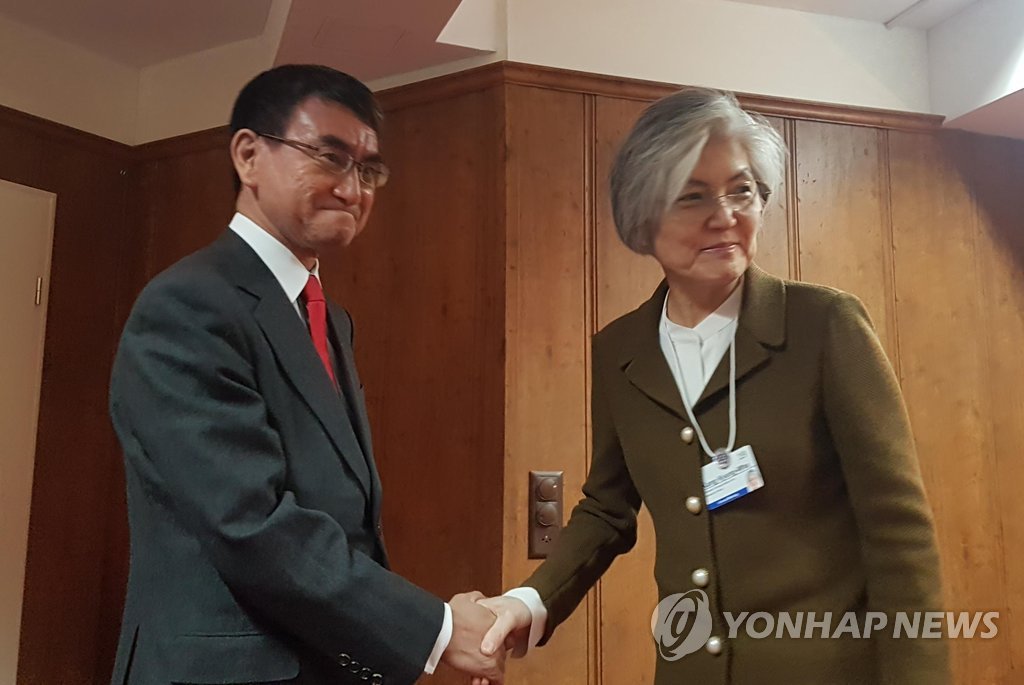
PARIS/SEOUL, May 23 (Yonhap) -- The top diplomats of South Korea and Japan discussed a simmering row over Tokyo's wartime forced labor and other pending issues on the sidelines of an international conference in Paris on Thursday.
Foreign Minister Kang Kyung-wha called for close bilateral communication. But tensions were palpable as her Japanese counterpart, Taro Kono, voiced discontent over a Seoul official's thinly veiled criticism of Japanese firms' inaction in compensating Korean victims of forced labor.
"There are difficult issues between the two countries, but it is important to closely communicate whenever opportunities arise," Kang said during the talks on the margins of the Ministerial Council Meeting of the Organisation for Economic Cooperation and Development in Paris.
Noting that the new era of "Reiwa," or beautiful harmony, opened with the recent enthronement of Emperor Naruhito, Kang voiced hope that Seoul-Tokyo relations will evolve in a forward-looking manner.
Kono took issue with remarks by Kim In-chul, spokesman of Seoul's foreign ministry, that there would be "no problems" if the Japanese firms in question comply with court orders to remunerate the victims.
Kim made the remarks in reference to Kono's recent call for South Korean President Moon Jae-in to "responsibly" address the forced labor issue.
"I think that is a very serious statement that does not understand the gravity of this matter," Kono said.
"I urge (South Korea) to share the understanding that such remarks will make Japan-South Korea relations very difficult," he added.
Bilateral ties have chilled in recent months as Japan has challenged South Korean Supreme Court rulings last year that ordered Japanese firms to compensate South Korean victims of forced labor during its 1910-45 colonization of the peninsula.
The top court has recognized victims' rights to claim damages, but Tokyo maintains that all reparation issues stemming from its colonial rule were settled under a 1965 government-to-government accord that normalized bilateral relations.
Tensions flared anew on Monday as Japan requested the formation of an arbitration panel involving a third-country member to address the forced labor issue based on dispute settlement procedures enshrined in the normalization accord.
In January, Tokyo called for bilateral diplomatic talks over the issue also based on the accord. But Seoul has remained unresponsive, refusing to weigh in on civil litigation involving private citizens and Japanese firms.
The accord stipulates that the two sides are to settle any dispute related to the accord primarily through diplomatic channels. If they fail to settle it, the case can then be referred to an arbitration panel involving a third-country member agreed on by the two sides.
Should the arbitration panel fail to hammer out a solution, Japan could bring the case to the International Court of Justice.
Seoul has so far been taking a cautious approach, saying that it honors judicial decisions and that it cannot intervene in legal disputes between private citizens and foreign firms still in progress.
The forced labor issue aside, Kang and Kono were expected to discuss the possibility of a summit between President Moon and Japanese Prime Minister Shinzo Abe on the sidelines of the Group of 20 summit slated to take place in Osaka, Japan, on June 28 and 29.
Kang and Kono last held bilateral talks on the sidelines of a security forum in Germany in February.
This file photo, taken Jan. 23, 2019, shows Foreign Minister Kang Kyung-wha (R) shaking hands with her Japanese counterpart, Taro Kono, before their talks on the sidelines of the World Economic Forum in Davos, Switzerland. (Yonhap)
sshluck@yna.co.kr

Earliest evidence of red pigment found in 3 million-year-old mouse fossil

Authentic news,No fake news.


To identify the chemical signatures of ancient pigments, scientists bathed a 3 million-year-old mouse fossil in X-rays. Photo by Phil Manning/Manchester University
May 23 (UPI) -- Redheads are at least 3 million years old. Scientists have discovered red pigment inside the fossilized fur of an ancient mouse specimen found in Germany.
The discovery, detailed this week in Nature Communications, suggests mice a few million years ago looked a lot like they do today.
"Here we find that a 3 million-year-old mouse looks just like a modern mouse," Uwe Bergmann, research scientist at the U.S. Department of Energy's SLAC National Accelerator Laboratory, told UPI. "While this might not be a big surprise, it is -- the fact that we can identify such pigments, now, will have an impact on future findings."
Bergmann and his colleagues at SLAC worked with scientists at Stanford University to identify the chemical signatures of red pigment inside the ancient mouse cells.
RELATED Study: Colored bird eggs come from dinosaurs
To confirm the presence of ancient pigment, scientists first needed to study how modern -- and less-degraded -- pigments interact with other elements. To study these chemical interactions, scientists bathed old and new cells in X-rays using the Stanford Synchrotron Radiation Lightsource.
"With our technique, we take advantage of the fact the melanins associate with metals," SLAC scientist Nick Edwards said. "Other organic pigments such as carotenoids, which produce, for example, the bright colors in parrots, do not easily associate with metals and are currently not detectable with our technique."
Researchers found the same signatures of chemical bonds between red pigment and trace metals in the old and new cells.
RELATED Scientists discover world's oldest colors
The cornucopia of color visible throughout the animal world is proof of the evolutionary importance of pigmentation, but until recently, scientists could say little about the colors of the ancient world.
"Color and pigmentation is critical for survival of a species and for evolution as camouflage, sexual selection, UV protection, heat regulation and keeping the body in equilibrium," Bergmann said. "There is also some speculation that the presence of metals, such as copper for example, potentially prevents decay of soft tissues from bacterial attacks."
By coloring the ancient world, scientists can better understand how animals interacted with one another and with the natural world. An ancient ecosystem with color is one scientists can more easily decipher.
RELATED Ancient sea turtle reveals pigment-based survival trait at least 54 million years old
"For most fossils we have no idea about the color of the living animal. For example all color depictions of dinosaurs are purely imaginative," Edwards said. "We want to know how ancient live forms looked like, also for comparison to modern life form. Knowing this helps with understanding evolution."
Bergmann and Edwards continue to look for new ways to paint a fuller picture of ancient life.
"We are currently working on a series of fossil studies to show how the fossilization processes occur, and what influence the animal fossilization process has on its local environment and vice versa," Bergmann said. "This is basically a type of chemical forensics of dramatic events that happened millions of years ago, and we find that very exciting.

मालदीव में इस्लाम का परिचय

Authentic news,No fake news.


इमरान अब्दुल्ला
मालदीव आकर्षक समुद्र तटों, गोताखोरी के अनुभवों और करामाती सुंदरता की प्रकृति से जुड़ा हो सकता है, लेकिन आप उन द्वीपों के इतिहास को याद कर सकते हैं जिनके नागरिकों को आवश्यक रूप से मुस्लिम होना चाहिए।
मालदीव का संविधान कहता है कि इस्लाम मालदीव की नागरिकता के लिए एक शर्त है। सैंकड़ों छोटे, आकर्षक द्वीपों में कोई भी मालदीव का गैर-मुस्लिम नहीं है, जो बारहवीं शताब्दी तक अरब के समुद्री यात्रियों और व्यापारियों के लिए जाना जाता है।
मालदीव की राजधानी के बीच में "अबू बराकत यूसेफ अल-बरबरी" का मकबरा है, और जैसा कि प्रतीत होता है, वह एक मोरक्को के अमाज़ी तीर्थयात्री और तीर्थयात्री हैं जिन्होंने दस हजार द्वीपों और 87 द्वीपों में से एक में अपनी यात्राओं में से एक को समाप्त कर दिया।
मालदीव के सुल्तान ने मालदीव के सुल्तान अबू बक्रत को सौंप दिया, उसके बाद उनके हमवतन लोगों ने बौद्ध धर्म की पूजा की और सुल्तान ने मस्जिदों और स्कूलों का निर्माण लोगों को उनके नए धर्म की शिक्षा देने के लिए किया जिसमें उन्होंने प्रवेश किया।
मालदीव और मुसलमानोंथा जनसंख्यामालदीव से पहले उनके इस्लाम Marhunin आदतों नीचे अपने जीवन तौला बोझिलइस तरह के अवसर प्रदान करने केऔरत होने के लिएभेंटहै कि वे क्या "समुद्र राक्षस" कहते हैं, और जनजातियों थे मालदीव Tguetra चयन करने के लिएमहिला को हर महीने होमानव शिकार LCF क्रोध और बुराई जिन समुद्र "Ranamare"।

मालदीव के कानूनों में नागरिकों को मुस्लिम होने की आवश्यकता है (वेबसाइट)
मालदीव के कानूनों में नागरिकों को मुस्लिम होने की आवश्यकता है (वेबसाइट)
मोरक्को के अमेजिह यात्री ने चौदहवीं शताब्दी में द्वीपों की यात्रा के दौरान इब्न बतूता को इसके निवासियों और रीति-रिवाजों की स्थितियों के बारे में भी बताया। उन्होंने अपने इस्लाम की कहानी बताई: "फिर उन्होंने अबू बराक अल-बरबारी नामक एक मोरक्को को प्रस्तुत किया। वह महान कुरान के रक्षक थे। वह एक पुराने घर में चले गए। और उनकी योगिनी की केवल एक बेटी थी, अबू बकरत ने उससे कहा: मैं रात में तुम्हारी बेटी को बदलने जा रहा हूं, और आमद चेहरा था, और मैंने उससे कहा, और वे उस रात उसे ले गए, और वे उसे मूर्तियों के घर में ले आए, और उसे पानी पिलाया गया “उसने कहा।
अगली सुबह, जब बूढ़ी औरत और उसके माता-पिता लड़की को बाहर निकालने और उन्हें जलाने के लिए आए, उनके रीति-रिवाजों के अनुसार, उन्होंने अपना स्थान पाया। आशीर्वाद का पिता कुरान पढ़ता है। इब्न बतूता ने अपना उपन्यास पूरा करते हुए कहा: "वे अपने राजा के पास गए और उन्हें शूर्नजा कहा गया। "राजा ने उससे कहा," अगले महीने तक हमारे साथ रहो। यदि आप ऐसा करते हैं, तो आप अशुद्धता से बच जाएंगे। "
इब्न बतूता अगले महीने की घटनाओं को पूरा करता है, जब राजा ने मूर्तियों को सौंप दिया और मूर्तियों को तोड़ दिया, और घर को नष्ट कर दिया, "और द्वीप के सबसे सुरक्षित लोगों को, और बाकी द्वीपों में भेजा गया, Vslm लोग, और मोरक्को के अधिकांश लोगों को स्थापित किया और अपने सिद्धांत में, इमाम मलिक के सिद्धांत पर ईश्वर की दया करें।" , और उनके नाम से एक मस्जिद का निर्माण किया।
इब्न बतूता ने माले की राजधानी में मस्जिद के बारे में बताते हुए कहा: "मैंने लकड़ी में उकेरी गई मस्जिद के इंटीरियर को पढ़ा: सुल्तान अहमद श्नौराजा ने मोरक्को के बर्बर अबू बाराकत को सौंप दिया, और सुल्तान ने एक तिहाई लोगों को राहगीरों के लिए धर्मार्थ बनाया।
यद्यपि इस्लाम ने बारहवीं शताब्दी तक हिंद महासागर में अरब व्यापारियों के माध्यम से मालदीव में देर से प्रवेश किया, लेकिन यह परिवर्तन देश के इतिहास में आधुनिक मालदीव के लिए जाना जाने वाला सबसे महत्वपूर्ण बिंदु था।
अरब व्यापारी सातवीं शताब्दी ईस्वी से इस्लाम के लिए मालाबार तट (भारत के उप-महाद्वीप के दक्षिण-पश्चिमी तट) की आबादी के परिवर्तन का कारण थे, और उसी समय में मुहम्मद बिन कासिम अल-थकाफी के नेतृत्व में विजय प्राप्त करने के बाद से सिंध और पंजाब (अब पाकिस्तान) मुस्लिम बन गए हैं। जबकि इस्लाम धर्म परिवर्तन तक मालदीव 500 वर्षों तक बौद्ध राज्य बना रहा।
मालदीव के अंतिम मालदीव मालदीव के राजाओं के इस्लाम की ओर अग्रसर होने के साथ, सुल्तान मोहम्मद अल-अदेल को छह इस्लामिक राजवंशों द्वारा लाया गया, जिनमें अस्सी-चार शक्तियां थीं, जो 1932 तक चली जब सल्तनत एक निर्वाचित राज्य बन गया।
1965 तक सुल्तान का आधिकारिक शीर्षक भूमि और समुद्र का सुल्तान, बारह हज़ार द्वीपों का स्वामी और मालदीव का सुल्तान महामहिम था।
अरबी ऐतिहासिक रूप से वहां के प्रशासन की प्रमुख भाषा थी, न कि आसपास के इस्लामिक देशों में उपयोग की जाने वाली फारसी और उर्दू भाषाओं की तुलना में। मालदीव में उत्तरी अफ्रीका का एक और लिंक न्यायशास्त्र का मलिकी स्कूल था जो मोरक्को में प्रचलित था और 17 वीं शताब्दी तक उन लोगों में आधिकारिक स्कूल था।


मालदीव में सरितु के नाम से जाना जाने वाला "शरिया", मालदीव (संचार स्थल) का मूल कानून है
"इस्लामी कानून" में भाषा की मालदीव , के रूप में जाना Alsarret गठन की मूल विधि मालदीव (नेटवर्किंग साइटों)
यही कारण है कि इब्न बतूता ने मालदीव में न्यायपालिका के आदेश का पालन करना मुश्किल नहीं पाया, जब वह दौरा किया, जहां वह वर्षों तक रहा जिसमें उसने शादी की और 14 वीं शताब्दी ईस्वी के मध्य में अपने लोगों और उनकी संस्कृति और रीति-रिवाजों के इस्लाम के बारे में लिखा।
क्या अबू अल-बरकत मोरक्को या सोमाली था? कुछ शोधकर्ताओं का कहना है कि एक अन्य परिदृश्य यह है कि इब्न बतूता ने मालदीव के बारे में एक गलती की है, और बारबेरियन बर्बर से अमाज़ह (बेरर्स) के अनुपात में माघरेब कथाओं के पक्षपाती थे, जबकि अबू बाराकबरी बारबेरिया (उत्तरी सोमालिया में एक पुराना वाणिज्यिक बंदरगाह) से उतारा जा सकता है।
जब इब्न बतूता ने द्वीपों का दौरा किया, उस समय द्वीप के गवर्नर सोमाली अब्दुल अज़ीज़ अल-मकदीशवी (सोमाली मोगादिशु) थे। अब्दुल अजीज एक सुल्तान मुस्लिम सुल्तान था, जो मध्य युग में अफ्रीका के हॉर्न के बड़े हिस्से पर शासन करता था।
इस उपन्यास के अनुसार, अबू बराकत अल-बरबारी यूसुफ इब्न अहमद अल-कुनिन के समान था, जिसने हॉर्न ऑफ़ अफ्रीका में अल-वुश्मा के परिवार की स्थापना की, जिसने पूर्वी अफ्रीका में सल्तनत ऑफ एफेट और सल्तनत ऑफ जस्टिस पर शासन किया।
यह उपन्यास मालदीव पर शासन करने के लिए अरबी भाषा के उपयोग और पूर्वी एशिया में गैर-भौगोलिक भौगोलिक संदर्भ में मलिकी स्कूल के प्रभुत्व को समझाने में भी मदद करता है।
मालदीव एक रहस्यमय सूफी की विरासत को बरकरार रखता है और रमजान में दिन के दौरान कैफे और रेस्तरां बंद करता है और मालदीव में "इस्लामिक कानून" बनाता है जिसे मालदीव का सरितु मूल कानून कहा जाता है।
स्रोत: अल जज़ीरा, 

Mitra-mandal Privacy Policy

This privacy policy has been compiled to better serve those who are concerned with how their  'Personally Identifiable Inform...