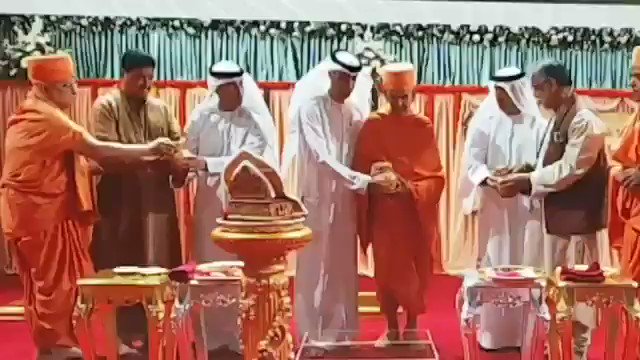
अबू धाबी अरब की खाड़ी में पहला हिंदू मंदिर का उद्घाटन (अमीरात समाचार एजेंसी)
खाड़ी में पहले हिंदू मंदिर की आधारशिला रखने के बाद, इज़राइल ने खुलासा किया - गर्व से - दुबई में एक आराधनालय का अस्तित्व, अंतिम अवधि के लिए गुप्त रखने के बाद।
"इज़राइल इन द गल्फ" - ट्विटर पर इज़राइल के विदेशी खातों में से एक - यूएई का कदम और अपनी भूमि पर रहने वाले विभिन्न धर्मों के अनुयायियों के प्रति सम्मान, यह तनाव कि सरकार ने दुबई में एक आराधनालय की उपस्थिति में समापन किया।
وضعت الإمارات حجر الأساس لأول معبد هندوسي في الخليج. نبارك حكومة الإمارات على هذه الخطوة التي تؤكد تسامحها الديني واحترامها لأتباع مختلف الديانات التي تعيش على أرضها، وهو ما توج بوجود كنيس يهودي أيضا في دبي لتتعانق المساجد والكنس والمعابد تحت مظلة الإمارات
यह आराधनालय की पहली आधिकारिक मान्यता है, और दूसरे इजरायली चैनल ने दिसंबर 2018 में कहा कि संयुक्त अरब अमीरात के अधिकारियों की मंजूरी के साथ दुबई के अमीरात में एक आराधनालय बनाया गया था, जिसने पिछले तीन वर्षों में इसकी देखरेख की थी।
इजरायल चैनल दुबई में यहूदी व्यापारियों पुष्टि की है कि है कि वह गुप्त आराधनालय, वे साल पहले बनाया है, जिसमें काम कर रहा था।
ब्लूमबर्ग की रिपोर्ट के अनुसार एक रिपोर्ट पिछले साल के अंत में, कि यहूदी समुदाय नवजात संयुक्त अरब अमीरात दुबई, जहां एक मंदिर यहूदी कानून के अनुसार भोजन तैयार करने के लिए प्रार्थना और एक रसोई के लिए एक जगह शामिल के शहर में पहले आराधनालय स्थापित है।
अमीरात नींव का पत्थर के रूप में आधिकारिक समाचार एजेंसी द्वारा की सूचना दी, अरब की खाड़ी में पहली हिंदू मंदिर के लिए कल रखा गया है, राजधानी अबू धाबी मंत्रियों और अधिकारियों ने भाग लिया में एक समारोह में।
चाल, संचार के साधन के माध्यम से भौहें कार्यकर्ताओं उठाया के रूप में उनमें से कुछ एक विरोधाभास संयुक्त अरब अमीरात, जो सहिष्णुता, अरब और मुसलमानों के साथ प्रकट नहीं होता है मानव अधिकार आलोचना अबू धाबी के लिए निर्देशित है, साथ ही कतर की घेराबंदी की संकट में और यमन में और कहीं और युद्ध में अपनी भूमिका के संदर्भ में प्रतिबिंबित करने के लिए विचार किया गया।
WASHINGTON (Reuters) - The United States demanded a cut off of Iranian oil exports to major importers like China and India who had been granted exemptions from sanctions, sending crude prices to six-month highs on fears the U.S. action could lead to a supply crunch.
Secretary of State Mike Pompeo, in a briefing on Monday, said the aim was to halt Iran’s exports entirely, as it continues to pressure Tehran to curtail its nuclear program, ballistic missile tests and support for conflicts in Syria and Yemen.
The Trump administration said it was working with top oil exporters Saudi Arabia and the United Arab Emirates to ensure the oil market was “adequately supplied” but the market, already fretting about tight supplies, raised skepticism about whether Riyadh could take a slower approach in boosting exports.
The United States reimposed sanctions in November on exports of Iranian oil after U.S. President Donald Trump unilaterally pulled out of a 2015 nuclear accord between Iran and six world powers last May. After renewing sanctions, it granted waivers to eight major buyers for a six-month period, which ends in May.
“We are going to zero. We’re going to zero across the board,” Pompeo said, adding that the United States had no plans for a grace period beyond May 1 for countries to comply. He said the aim is to deprive Iran of its lifeline of $50 billion in annual oil revenues.
While Saudi Arabia is expected to boost output again, analysts fear the U.S. move – along with sanctions on Venezuela’s oil industry – will leave the world with inadequate spare capacity.
The international Brent crude oil benchmark rose to more than $74 a barrel on Monday, highest since November, due to the uncertainty surrounding increased supply from Saudi Arabia and other OPEC nations, while U.S. prices hit a peak of $65.99 a barrel for the first time since October 2018.
“Combined with declines in global crude stocks, continued losses in Venezuela production as well as a possible disruption in Libya, a zero-waivers Iran decision will present a challenge to keeping global oil prices in check,” Joe McMonigle of Hedgeye said in a note to clients.
Pompeo said he was confident of Riyadh’s commitment to making sure there was sufficient supply in the market. Saudi Arabian Energy Minister Khalid al-Falih said on Monday the OPEC exporter would coordinate with other oil producers to ensure a balanced market.
He said it was “monitoring the oil market developments” after the U.S. statement, without committing to raising production. OPEC is next scheduled to meet in June.
FILE PHOTO: A gas flare on an oil production platform in the Soroush oil fields is seen alongside an Iranian flag in the Persian Gulf, Iran, July 25, 2005. REUTERS/Raheb Homavandi/File Photo/File Photo
QUESTIONS ABOUT WORLD SUPPLY
Trump has been clear to his national security team over the past few weeks that he wants the waivers to end and national security adviser John Bolton has been working the issue within the administration.
In recent months, Saudi Arabia and other OPEC members have cut supply dramatically. OPEC, along with allies such as Russia and others, agreed to reduce output by 1.2 million barrels per day (bpd) but they have exceeded those benchmarks, with Saudi Arabia alone reducing supply by 800,000 bpd.
In a tweet, Trump said Saudi Arabia and others in OPEC “will more than make up the Oil Flow difference in our now Full Sanctions on Iranian Oil.”
Prior to the re-imposition of sanctions, Iran was the fourth-largest producer in OPEC at almost 3 million barrels per day (bpd), but April exports have shrunk to well below 1 million bpd, according to ship tracking and analyst data in Refinitiv.
Tehran remained defiant over Washington’s decision, saying it was prepared for the end of waivers, while the Revolutionary Guards repeated their threat to close the Strait of Hormuz, a major oil shipment channel in the Gulf, Iranian media reported.
The countries that were granted a waiver for importing Iranian oil free from U.S. sanctions were China, India, Japan, South Korea, Taiwan, Turkey, Italy and Greece.
While Italy, Greece and Taiwan already have halted purchases, doing so could prove much more challenging for China and India. Turkey, another buyer, already has slammed the U.S. decision, saying it will not serve peace. Asian buyers largely refrained from strong statements.
Slideshow (2 Images)
Geng Shuang, a Chinese Foreign Ministry spokesman, said at a daily news briefing in Beijing on Monday that it opposed unilateral U.S. sanctions against Iran and that China’s bilateral cooperation with Iran was in accordance with the law.
South Korea’s Yonhap news agency quoted the Foreign Ministry as saying the South Korean government had been negotiating with the United States at all levels to extend the waivers and that it would continue to make every effort to reflect Seoul’s position until the May 2 deadline.
In India, refiners have started a search for alternative supplies but the government declined to comment officially.
Embassies of India, China and South Korea in Washington did not immediately respond to requests for comment, along with Japan, whose Prime Minister Shinzo Abe will be in the U.S. capital on Friday for an official visit.
Actor Vladimir Zelensky is challenging incumbent President Pyotr Poroshenko for a shot at the highest political office in Ukraine.
The Ukrainian presidential race has been set up into two stages – the first round on March 31 and the runoff on April 21.
Now, the Ukrainian public will await the results of the runoff to see who will lead Ukraine in the coming years.
20:05:21
Candidate from the Servant of the People party, showman Vladimir Zelensky is winning 73.2% of votes in Sunday’s runoff presidential elections in Ukraine, according to the National Exit Poll released after the closure of polling stations.
Incumbent President Pyotr Poroshenko is scoring 25.3% of votes.
20:03:29
Zelensky's team is preparing lawsuits on “mudflows” against the candidate and his family members. This was announced by the staff lawyer, Vadim Galaichuk.
19:43:56
Former Ukrainian President Viktor Yushchenko said that he had voted on Sunday for "free, strong and fair Ukraine."
18:22:26
Over 1,000 violations during the voting in Sunday’s runoff presidential elections in Ukraine have been reported to the police, Artyom Shevchenko, a spokesman for the Ukrainian interior ministry, said. "Most of such reports came from the Dnepropetrovsk region, Kiev and the Donetsk region. The smallest number of violations were reported from the Khmelnitskaya, Trans-Carpathian and Ivano-Frankovsk regions," he said
According to Shevchenko, 13 criminal cases have been opened over these reports, most of them linked with illegal canvassing, taking photos, spoiling ballot papers and vote buying.
17:19:37
The only polling station in Ukraine that did not open in time, the one in the Donetsk region, has finally opened its doors to voters hours after the official launch of voting, head of the Ukrainian Central Elections Commission Tatiana Slipachuk reported.
Chief of Ukraine’s National Police Sergei Knyazev said earlier that only one out of 30,000 polling stations across Ukraine has stayed closed. A criminal case was initiated. According to earlier reports, the station stayed closed because members of the commission had not taken an oath.
17:17:06
The Ukrainian police have received 281 complaints about violations committed during the presidential election runoff, the interior minister’s adviser, Zoran Shkiryak, told a news briefing.
The police "have received 281 complaints and messages concerning violations committed during the presidential election runoff," he said adding that illegal electioneering, photographing of ballot papers and voter bribery were the most frequent offences.
"The situation is under control," he added. Ten criminal have been opened. The rate of violations is the lowest in western Ukraine, and the highest, in the Dnepropetrovsk Region, Kiev and Donetsk.
16:03:36
The highest voter turnout in Ukraine’s runoff presidential polls on Sunday is reported from the country’s central and southeastern regions, as follows from an analysis of the data from the Ukrainian Central Election Commission conducted by TASS.
Thus, as of 15:00 local time, the highest voter turnout was reported from the Dnepropetrovsk region (50.91%), Zaporozhye region (50.8%), and Poltava region (50.37%).
The lowest voter turnout is reported from the Trans-Carpathian region (29.64%), Ivano-Frankovsk and Chernovtsy regions - 37 and 34.93% respectively.
15:56:13
Zelensky may be fined up to 850 hryvnias ($ 31) for displaying a completed ballot, the press service of the National Police of Ukraine said.
15:43:39
Lugansk People's Republic police press service claims that Kiev forces its military to vote for Pyotr Poroshenko.
15:31:30
Kiev police came to Vladimir Zelensky's HQ to fine the presidential hopeful for demonstrating a filled ballot.
15:12:55
Voter turnout (at 3 p.m. local time) in Ukraine’s runoff election stands at 47.87%, says the Electoral Commission.
14:49:05
The number of violations during the runoff election in Ukraine climbed to 562, the Interior Ministry says.
Mikhail Groysman, the Prime Minister of Ukraine, has cast his ballot in the election. He noted that the Ukrainians were choosing their future.
14:09:04
The voter turnout in Ukraine’s runoff presidential election reached 18.13%, says the Electoral Commission.
13:39:34
Ukraine's former president Leonid Kuchma said he pitied the man who would lead his country after the presidential election as that man would inherit the war in Donbass and the threat of default.