MITRA MANDAL GLOBAL NEWS

3 candidates vie for North Macedonia presidency

Authentic news,No fake news.


SKOPJE, North Macedonia (AP) — Three candidates are vying for the presidency in North Macedonia, where voters go to the polls on Sunday for the first round of elections. The post is largely ceremonial, but the election is seen as a key test of the government following deep polarization after the country changed its name to end a decades-old dispute with neighboring Greece over use of the term "Macedonia."


Here is a look at the three candidates, all of whom are university professors:
Gordana Siljanovska Davkova, 63 — The first woman to run for president since the country declared independence from Yugoslavia in 1991. Known for her love of yoga and rock-and-roll, Siljanovska, a constitutional law professor, first emerged as a non-partisan candidate promoted by her university. Her nomination is now supported by the main conservative opposition VMRO-DPMNE party.
Siljanovska campaigned under the slogan "Justice for Macedonia, fatherland calls." She has been a vocal opponent of the deal with Greece that changed the country's name to North Macedonia in return for Athens dropping its objections to the country joining NATO.
Siljanovska served as minister without portfolio in 1992-1994 in the first government after independence and participated in writing the country's first constitution.
Stevo Pendarovski, 56 — A former national security adviser for two previous presidents and until recently national coordinator for NATO, this is Pendarovski's second bid for the presidency after being defeated by outgoing President Gjorge Ivanov in 2014.
Pendarovski is running as the joint candidate for both the governing social democrats and the junior governing coalition partner, the ethnic Albanian Democratic Union for Integration party. His candidacy is also supported by 29 smaller political parties.
He is a strong defender of the name deal with Greece, arguing that it paved the way for the country to nearly finalize its NATO accession and led to hopes EU membership talks will begin in June.
His slogan "Forward Together" reflects his main campaign platform of unity, and he has made NATO and EU membership a key strategic goal, saying they will bring more foreign investment, will create jobs and higher wages and prevent young people leaving the country.
Blerim Reka, 58 — A soft-spoken international law professor who headed the country's diplomatic mission to the EU from 2006-2010, the ethnic Albanian candidate was nominated by two small ethnic Albanian opposition parties, BESA and the Alliance of Albanians.
Reka chose "Reka for the Republic" as his campaign slogan, saying the concept of a "republic for all" is the most suitable for a multiethnic state. He has campaigned mainly in the larger ethnic Albanian communities. He advocates Northern Macedonia strengthen its multiethnic and multicultural characteristics, but insists the country must reform its "corrupt" administration and establish rule of law and an independent judiciary.
Reka also supports the name deal with Greece, saying the agreement ended a long-standing dispute and opened the doors for the country to join NATO and the EU.
No ethnic Albanian presidential candidate has ever made it to the second round of elections in the past. But the ethnic minority's votes, which make up about a quarter of the country's 2.1 million people, have proved crucial to the election of the president in the runoffs.


Ukraine quiet ahead of presidential election

Authentic news,No fake news.


KIEV, Ukraine (AP) — A comedian who plays the role of Ukraine's president on television is set to take on the job for real, pushing out the man who currently holds the office, according to public opinion surveys ahead of Sunday's election.


Saturday was a so-called "day of quiet," on which electioneering is forbidden, a respite from a campaign of heated statements and unexpected moments. Dismayed by endemic corruption, a struggling economy and a five-year fight against Russia-backed insurgents in the country's east, Ukrainian voters appear poised to strongly rebuke incumbent Petro Poroshenko and replace him with Volodymyr Zelenskiy. Despite never having held political office, Zelenskiy could get more than twice as many votes as Poroshenko, polls suggest.
Since Zelenskiy and Poroshenko advanced to Sunday's runoff in the first round three weeks ago, the campaign has been marked by showy jockeying for dominance, including a dispute over holding a debate that left Poroshenko standing next to an empty lectern bearing his opponent's name and Zelenskiy's challenge for both of the candidates to undergo drug testing.
Zelenskiy has run his campaign mostly on social media and has eschewed media interviews; Poroshenko has called him a "virtual candidate." Poroshenko in turn was criticized for a video linked to his campaign that showed Zelenskiy being run over by a truck.
The two finally held an actual debate on Friday evening, just hours before campaigning was to end. They harshly criticized each other and engaged in the melodrama of both kneeling to ask forgiveness of those who lost relatives in the eastern fighting.
Zelenskiy, a 41-year-old comic actor, is best known for his TV portrayal of a schoolteacher who becomes Ukrainian president after a video of him denouncing corruption goes viral. The name of the show, "Servant of the People," became the name of his party when he announced his candidacy in January.
Like his TV character, the real-life Zelenskiy has focused his campaign strongly on corruption. Although criticized as having a vague platform, Zelenskiy has made specific proposals, including removing immunity for the president, parliament members and judges, and a lifetime ban on holding public office for anyone convicted of corruption. He also calls for a tax amnesty under which someone holding hidden assets would declare them, be taxed at 5% and face no other measures.
He supports Ukraine's eventual membership in NATO, but only if the country were to approve this in a referendum. Zelenskiy has proposed that direct talks with Russia are necessary to resolve the conflict in eastern Ukraine, where fighting with Russia-backed separatist rebels has killed more than 13,000 people since 2014. The Kremlin denies involvement there and says it is an internal matter. Zelenskiy says Russia-annexed Crimea must be returned to Ukraine and compensation paid.
Zelenskiy's image has been shadowed by his admission that he had commercial interests in Russia through a holding company, and by persistent speculation about links with oligarch Ihor Kolomoyskyi, who owns the television station that airs "Servant of the People."
A Ukrainian court this week ruled that the nationalization of a bank once owned by Kolomoyskyi was illegal, leading to new concern about Zelenskiy's possible ties to him. Poroshenko, who entered politics after establishing a lucrative candy-making company, came to power with a pragmatic image in 2014 after mass protests drove the previous, Russia-friendly president to leave the country.
Five years later, critics denounce him for having done little to combat Ukraine's endemic corruption. The war with Russia-backed separatists in the east grinds on with no clear strategy for ending it. And while his economic reforms may have pleased international lenders, they've left millions of Ukrainians wondering if they can find the money to pay their utility bills.
After his weak performance in the election's first round, in which Zelenskiy got nearly twice as many votes, Poroshenko said he had taken voters' criticism to heart. He has since made some strong moves, including the long-awaited creation of an anti-corruption court. He also ordered the dismissal of the governor of the corruption-plagued Odessa region, and fired the deputy head of foreign intelligence who reportedly has vast real estate holdings in Russia.
Poroshenko, 53, has positioned himself as a leader who will stand up to Russia. He has scored some significant goals for Ukraine's national identity and its desire to move out of Russia's influence. He signed an association agreement with the European Union — which predecessor Viktor Yanukovych turned away from, setting off the 2014 protests. Ukrainians now can travel visa-free to the European Union, a significant perk. He has also pushed relentlessly for the Ukrainian Orthodox Church to be recognized as self-standing rather than just a branch of the Russian church.

Egypt votes on referendum extending el-Sissi's rule to 2030

Authentic news,No fake news.


CAIRO (AP) — Egyptians voted Saturday on constitutional amendments that would allow President Abdel-Fattah el-Sissi to stay in power until 2030 and broaden the military's role — changes blasted by critics as another major step toward authoritarian rule.


The referendum came amid an unprecedented crackdown on dissent in recent years. El-Sissi's government has arrested thousands of people, most of them Islamists but also prominent secular activists, and rolled back freedoms won in a 2011 pro-democracy uprising.
Polls opened at 9 a.m. (0700 GMT). Voting will stretch over a period of three days to allow maximum turnout. Outside a polling center near the Giza Pyramids, around two dozen people, mostly elderly women, lined up waiting to cast their votes. Heavy police and army security was reported at polling stations throughout the capital city.
Haja Khadija, a 63-year-old housewife, said she came for the "security and stability" of the country. "We love el-Sissi. He did lots of things. He raised our pensions." Casting his ballot on Saturday, Prime Minister Mustafa Madbouly urged voters to turn out in high numbers. He said that voting will reflect "the atmosphere of stability and democracy that we are witnessing now."
State-run TV said el-Sissi voted in Cairo's Heliopolis district, near the presidential palace. El-Sissi, who has repeatedly said he won't stay in office any longer than the people want him to, hasn't commented on the amendments.
Opposition voices have largely been shut out amid the rush to hold the referendum. Pro-government media have led a campaign for weeks calling a "Yes" vote a patriotic duty. Since early April, the Egyptian capital has been awash with large posters and banners encouraging people to vote in favor of the changes. Most of the posters were apparently funded by pro-government parties, businessmen and lawmakers.
Parliament, packed with el-Sissi supporters, overwhelmingly approved the amendments on Tuesday, with only 22 no votes and one abstention from 554 lawmakers in attendance. The national electoral commission announced the following day that voting would begin on Saturday.
The proposed changes are seen by critics as another step toward authoritarianism. The referendum comes eight years after a pro-democracy uprising ended autocrat Hosni Mubarak's three-decade rule, and nearly six years after el-Sissi led a popular military overthrow of the country's first freely elected but divisive Islamist president, Mohammed Morsi.
Two international advocacy groups — Human Rights Watch and the International Commission of Jurists — on Saturday urged the Egyptian government to withdraw the amendments. "Egypt's autocracy is shifting into overdrive to re-establish the 'President-for-Life' model, beloved by dictators in the region and despised by their citizens," said Michael Page, deputy Middle East and North Africa director at Human Rights Watch. "But it's a model that recent experience in Egypt and neighboring countries has demonstrated is not built to last."
The Civil Democratic Movement, a coalition of liberal and left-leaning parties, urged people to participate in the referendum by voting "No." The coalition said it used social media to spread its message, noting that it was banned from hanging banners in the streets to call on voters to reject the amendments.
The amendments extend a president's term in office from four to six years and allow for a maximum of two terms. But they also include an article specific to el-Sissi that extends his current second four-year term to six years and allows him to run for another six-year term in 2024 — potentially extending his rule until 2030.
Novelist Omar Knawy voted "No" in the referendum. He said he is opposes most of the changes, especially those that would enable el-Sissi to stay in power beyond his current second four-year term. He also opposes articles that declare the military the "guardian and protector" of the Egyptian state, democracy and the constitution.
"The article related to the military gives it the right to interfere (in politics) at any time, and I am against such article," he told The Associated Press. El-Sissi was elected president in 2014, and re-elected last year after all potentially serious challengers were either jailed or pressured to exit the race.
The amendments also allow the president to appoint top judges and bypass judiciary oversight in vetting draft legislation, while also granting military courts wider jurisdiction in trying civilians. In the last three years, over 15,000 civilians, including children, have been referred to military prosecution in Egypt, according to Human Rights Watch.
The amendments also introduce one or more vice presidents, revive the senate and enshrine a 25% quota for women in parliament's lower, legislative chamber. All three had been dropped from Egypt's constitution after the 2011 revolution.

WTO chief says Chinese market open to everyone

Authentic news,No fake news.


SHANGHAI, Nov. 6 (Xinhua) -- The Chinese market will open to everyone, "not in a discriminatory fashion," and "it's up to every country to seize the opportunities," World Trade Organization (WTO) Director-General Roberto Azevedo said in an interview here.
After attending the opening ceremony of the first China International Import Expo (CIIE) on Monday, Azevedo told Xinhua that developing countries and less developed countries will certainly benefit from the expo while developed countries are also provided with good exposure at this event.
"We need countries to leverage their potential to help each other, to give more opportunities to businesses and for growth," he said, explaining why he thinks that President Xi Jinping's keynote speech at the inaugural ceremony is "very much welcomed."
In the speech, Xi said that the expo "is China's major initiative to still widen market access to the rest of the world." He said that China's imported goods and services are expected to exceed 30 trillion U.S. dollars and 10 trillion dollars, respectively, in the coming 15 years.
Noting the rising challenges of protectionism and unilateralism facing the global economy now, Azevedo said, "(what) we need today is not more borders but less borders."
"Every time the global economy grows, it is because that trade is booming. It is because the integration is there and the borders are open. When we begin to close borders, that kind of growth and development are going to suffer," he added.

Captive coal miners allowed to sell 25% output in open market

,ETEnergyworld.com

New Delhi: The government has allowed captive coal block owners to sell 25% of their production in open market and provided some flexibility in coal output as it kick-started a fresh round of captive coal auctions on Thursday after a gap of about 15 months.

The coal ministry has invited tenders seeking bids for 18 captive coal blocks to non-power plants in Jharkhand, Madhya Pradesh, Maharashtra, West Bengal, Odisha and Chhattisgarh.

“The successful bidder shall utilise a minimum of 75% of the actual production in the specified end use plants and is allowed to sell up to 25% of the actual production in open market. No additional premium will be charged on such sale in the open market,” the bid guidelines said.

In India, coal mining has been a regulated domain with no scope for diversion from the attached end use.

The changes in the bidding norms have been made based on recommendations from an expert panel led by former central vigilance commissioner (CVC) Pratyush Sinha. The committee was set up after two rounds of coal mine auctions were annulled due to tepid response from steel companies.

The ministry has issued two tender notices inviting bids for allocation of coal mines.

While six blocks have been reserved only for iron and steel sector in the sixth tranche of auction, another dozen coal blocks have been offered to the iron and steel, cement and captive power plants in the seventh tranche.

The mines on auction include Rohne (Jharkhand), with 192 million tonnes of coal reserves, and Jamkhani (Odisha), with 115 million tonnes coal.

 
The winners of these captive coal blocks will also have flexibility in coal production. Currently, owners are penalised if the captive coal mines do not reach the production milestones as per schedule.

“The successful bidder shall produce coal not below 80% of scheduled production in a year in opencast mine and not below 70% in case of underground mine subject to the condition that successful bidder shall not produce coal less than 90% of scheduled production in any five year block in opencast mine and 80% in case of underground mine,” the revised norms said.

The last date for bid submission is November 28 and the auctions are likely to commence in mid-January, a senior coal ministry official said.

Other recommendations of the Sinha panel, including a suggestion to bid the mines on revenuesharing model, will require Cabinet nod or amendments in law.

The coal ministry in July last year indefinitely deferred the fifth round of captive coal block auctions citing lack of demand from steel makers.

The fourth round of coal mine auctions was also cancelled in 2016 due to lack of adequate number of bidders.

Hungry Hand

Authentic news,No fake news.

A worker on a farm in Kiambu district, central Kenya, that produces tea for export. Nearly 80 percent of rural farmers in developing countries earn less than USD1.25 per day. Credit: Charles Wachira/IPS
UNITED NATIONS, Oct 24 2018 (IPS) - The very people who help put food on our tables often face numerous human rights violations, forcing them go to bed hungry.
In an annual report set to be presented to governments at the United Nations this week, Special Rapporteur on the Right to Food Hilal Elver found that agricultural workers worldwide continue to face barriers in their right to food including dangerous work conditions and the lack of employment protections.
“[Agricultural workers] are a major element of our reaching available food but they are among the world’s hungriest people,” she said, highlighting the paradoxical relationship.
“We are dealing with smallholder farmers, poverty, inequality, and land issues but we don’t deal with the actual workers working from farm to table—there’s a huge chain of production that we are not paying attention,” Elver added.
Agricultural workers make up over one billion, or one-third, of the world’s workforce.
Despite playing a critical role in global food security, many farm workers are left without enough money to feed themselves or their families in both developing and developed countries due to low wages or even late payments.
According to the Food and Agriculture Organization of the U.N. (FAO), nearly 80 percent of rural farmers in developing countries earn less than USD1.25 per day. In Zambia, for example, agricultural workers earn less than USD2 per day on third-party farms.
In the United States, while the minimum wage is higher, 50 percent of farmworkers were paid less than minimum wage and 48 percent suffered from wage theft.
A survey by the Food Chain Workers Alliance also found that one-quarter of all farm workers have incomes below the federal poverty line, contributing to farmers’ food insecurity and trapping them in poverty.
Migrants and women in the sector often face the brunt of such violations, Elver noted.
“Employers are more likely to consider migrant workers as a disposable, low-wage workforce, silenced without rights to bargain collectively for improved wages and working condition,” she said.
The United Nations Special Rapporteur on the Right to Food, Turkish lawyer Hilal Elver, in Buenos Aires. In an annual report Elver found that agricultural workers worldwide continue to face barriers in their right to food including dangerous work conditions and the lack of employment protections. Credit: Daniel Gutman/IPS
For instance, in California, which produces the majority of the country’s fruits and vegetables, 91 percent of farmworkers are foreign-born, primarily from Mexico. The rates of food insecurity for such labourers and their families range from 40 to 70 percent across the state.
While many industries have adopted minimum wage standards put forth by the International Labor Organization (ILO), they remain unenforced.
Elver also noted that the agricultural sector is the one of the world’s most dangerous sectors with more than 170,000 workers killed every year on unsafe farms, twice the mortality rate of any other industry.
This is partly attributed to the exposure of toxic and hazardous substances such as pesticides, often leading to a range of serious illnesses and even death.
Argentine farmworker Fabian Tomasi, who recently died after contracting severe toxic polyneuropathy linked to his exposure to agrochemicals, is a reminder of this.
Glyphosate, a weed-killer developed by controversial company Monsanto, has been widespread around the world and its use has increased in the South American nation, which is one of the world’s largest soy producers.
Since its use, there has also been an increase in cancer and birth defects in farming regions in Argentina with rural populations experiencing cancer rate three times higher than those in the cities.
The World Health Organization also classified glyphosate as “probably carcinogenic to humans.”
In developed countries, acute pesticide poisoning affects one in every 5,000 agricultural workers, the report found.
In the U.S., Dewayne Johnson also used Monsanto’s glyphosate-based herbicides while working as a groundskeeper in California. Years later, he discovered he had non-Hodgkin lymphoma, a debilitating blood cancer.
After bringing the case to court, a California jury ruled against the agrochemical corporation, claiming that it caused Johnson’s terminal cancer and that they acted with malice and negligence in failing to warn consumers.
Monsanto continues to deny allegations that their glyphosate-based products cause cancer.
Now, the U.S. government is trying to reverse a ban on another pesticide chlorpyrifos which has been associated to developmental issues among children and respiratory illnesses.
However, like Johnson, many agricultural workers around the world have begun to organise and rise up to the face of corporations and countries that fail to protect their human rights.
“This is an important new thing, giving the public much more understanding about pesticides,” Elver said.
Migrant farmworkers from Vanuatu recently won a settlement against company Agri Labour Australia after being underpaid and working in dangerous conditions which included exposure to chemicals.
But states must do more to protect and promote the rights of agricultural workers, Elver noted.
“Labour rights and human rights are interdependent, indivisible, and mutually inclusive. The full enjoyment of human rights and labour rights for agricultural workers is a necessary precondition for the realisation of the right to food,” she said.
The report states that governments must set “living wage” and working standards, and it should establish enforcement and inspection mechanisms to ensure such standards are being met.
The international community should also reduce pesticide use worldwide, including the ban of highly hazardous pesticides and the development of alternative pest management approaches.
International organisations such as ILO and FAO also have a role to play and should establish a fact-finding group to examine whether nations are implementing such changes.
Companies who fabricate evidence or misinform the public of health and environmental risks should be penalised, the report adds.
“It is time for States to step up, and take swift and urgent action to hold accountable those who commit human rights violations against agricultural workers and to prevent further violations,” Elver concluded.

Despite Progress, Over 200 Million Women Still Waiting for Modern Contraception

Authentic news,No fake news.


End Child Marriage. Credit: UNFPA
OTTAWA, Canada, Oct 23 2018 (IPS) - The international community will be commemorating two milestones in the history of population and development next year: the 50th anniversary of the UN Population Fund (UNFPA) and the 25th anniversary of a Programme of Action (PoA) adopted at the1994 International Conference on Population and Development (ICPD) in Cairo.
“Let’s use these important benchmarks to launch accelerated action – together. Starting here in Ottawa,” UNFPA Executive Director Dr Natalia Kanem told a gathering of over 150 parliamentarians from more than 60 countries who were meeting in the Canadian capital to review the progress made in several key socio-economic issues on the UN agenda, including reproductive health, maternal and infant mortality, family planning, female genital mutilation (FGM), child marriage, women’s empowerment and gender equality.
She said this is a time to reflect on some fundamental questions.
“Have we done justice to the vision that world leaders articulated nearly 25 years ago in Cairo? What have we achieved? Where is progress lagging? For whom? Why is it that life-saving sexual and reproductive health and rights interventions come into question time and again?,”
She pointed out that the world has made great progress in recent decades, as reflected in impressive declines in maternal deaths and child marriage rates.
Fewer women around the world are dying in pregnancy and childbirth. More women are using modern contraception. More girls are in school.
“Yet, more than 200 million women and girls are still waiting for modern contraception. And every year, there are still nearly 100 million unintended pregnancies,” said Dr Kanem.
And over 300,000 women die during pregnancy or childbirth every year while tens of thousands of girls continue to be married off every day—in child marriages. And the global epidemic of violence against women and girls, including the violence of female genital mutilation (FGM) persists, she warned.
Marie-Claude Bibeau, the Canadian Minister of International Development, who played a key role in hosting the Parliamentarians’ Conference, which concluded October 23, said her country is committed to lead the discussion on gender equality– and welcomes the present conference as a key stepping stone towards hosting the “Women Deliver Conference” in 2019.
“Canada firmly believes that if we want to maximize the impact of our actions and help eradicate poverty, we must passionately defend gender equality and the rights of women and girls so they can participate fully in society,” she added.
To this end, Canada has fully committed itself to mobilizing global support for the sexual and reproductive health and rights of women and girls.
Both are key commitments in Canada’s “Feminist International Assistance Policy”.
As a vibrant discussion followed, Martha Lucia Micher, a parliamentarian from Mexico,
drove home the point that “women’s bodies were being politicized”.
Senator Catherine Noone of Ireland said some of those who opposed legalizing abortions in her country offered a convoluted theory that men will resort to more sex if abortion was made legal.
Dr Kanem said it was an outrage that so many women and girls have so few choices.
“Let’s turn outrage into action. Choice can change the world! Let’s expand rights and choices for all. This is key to gender equality and the only way to advance the ICPD and 2030 agendas.”
Meanwhile, UNFPA has its own ambitious aims for the 2030 deadline of the UN’s 17 Sustainable Development Goals (SDGs):
• Zero unmet need for family planning,
• Zero preventable maternal deaths and
• Zero gender-based violence and harmful practices against women and girls (including child marriage and female genital mutilation).
“And our actions towards these three zeros will be grounded in quality population data and evidence.”
“The 2020 census round is an important piece of this puzzle, and we are ramping up our preparations. When everyone is counted, we can identify and reach those still being left behind. That includes millions of women and girls,” she added.
Paying a tribute to parliamentarians, she said: “Your commitment to the principles and goals of the ICPD Programme of Action paves the way for further progress. Your defense of human rights, including reproductive rights; of gender equality; public participation and democratic principles is vital.”
“As parliamentarians, you have the power to transform the voices of your people into concrete action. You have the power to make a real difference. I appeal to you to protect the precious mandate that you share with UNFPA. Our women, girls and young people deserve no less,” she declared

Sex Offender Registry is Not Enough to Curb Sexual Violence Against Women

Authentic news,No fake news.


Protesters gather at a candlelight vigil in New Delhi. Credit: Sujoy Dhar/IPS
Oct 15 2018 (IPS) - India recently launched a sex offender registry to deter sex offenders from perpetrating crimes against women and children by indicating that the government is keeping track of them. The personal details of 440,000 sex offenders who have been convicted for various crimes like “eve-teasing”, child sexual abuse, rape and gang rape will be registered in this database and accessible to law enforcement.
The creation of the registry is hailed by many as a welcome move in India, where violence against women and girls is pandemic. Recently, the Thomson Reuters Survey stated that India is the most dangerous country in the world with regards to sexual violence. From the start of this year, there has been a series of gang rapes of little girls ranging from babies to teenagers in all parts of the country –  NorthSouth, WestNorthEast and Central India
Neighbouring country Pakistan does not have a sex offender registry but is equally bad when it comes to violence against women and sex offences. According to the Human Rights Commission of Pakistan (HRCP), in Pakistan an incident of rape occurs every two hours and 70 percent of women and girls experience physical or sexual violence in their lifetime by their intimate partners and 93 percent women experience some form of sexual violence in public places in their lifetime.
Measures to prevent sex offenses are needed in both countries and each country can learn from each other’s successful prevention programs. However, only workable solutions should be replicated, and a sex offender registry is not one.
Evidence suggests that sex offender registries have failed to reduce sex crimes and have made rehabilitation of offenders difficult. In fact, registries might work for other forms of crime but not for the sexually deviant

Sex offender registries exist in many countries including Australia, Canada, New Zealand, the United States, Trinidad and Tobago, Jamaica, South Africa, the United Kingdom, Israel and the Republic of Ireland. Sexual violence is a problem in each of those countries, too, but studies have shown that sex offender registries have little or no effect on crime prevention or recidivism. Furthermore, evidence from these countries suggests that sex offender registries have failed to reduce sex crimes and have made rehabilitation of offenders difficult. In fact, registries might work for other forms of crime but not for the sexually deviant.
Further, we think making the details public, which is how it works in the United States and is what some people in India want, is dangerous as it would further increase the risk for women and girls rather than protect them. Though the government has assured that the registry would have multiple layers of security, there are doubts that the names and identities of the victims would be revealed. The Indian authorities are planning to link the details of the perpetrators to the Aadhar database which has biometric information of the person. Reports have indicated that the Aadhar database is itself not secure and for as little as $8 one can access personal information of people.
Moreover, Googling and knowing that a sex offender lives next door does not ensure that you can google your way to safety since safety from sex offences entail more than sex offender registration laws and a registry. Research shows that most sex offenders are relatives or people known to their victims but systems that put in place sex offender registry assume that sex offenders are strangers.
Many sex offenders are not even reported – particularly in South Asia due to the cultural stigma, faulty police procedures and lengthy court cases – and they aren’t included on any registration/notification system.
Instead of implementing a sex offender registry and seeing that as a solution, more efforts should focus on addressing the underlying issues, like patriarchy and improving the effectiveness of the justice system. Specifically, we recommend the governments of India and Pakistan concentrate on the following measures:
  • Sex education in school curriculum to educate people about sex offences and teach them ways to have responsible, healthy and consensual relationships.
  • Advocacy efforts to break down social taboos around this topic and make it easier to discuss and have a dialogue in the family and community about sex offences.
  • Allocation of public resources toward the rehabilitation of sex offenders with a high risk of repeating their crimes. Research suggests that psychological treatment and cognitive behavioural treatment can reduce recidivism amongst sex offenders.
  • Including women in all policy formulation, including the passage of any relevant laws. They are the stakeholders most at risk of sexual violence and they are in a better position to provide guidelines for policies aiming to stop sex offences.
  • Training police officers to be sensitive to the needs of victim and knowledgeable about the relevant laws so they can be a resource to individuals who want to report crimes. For example, Sweden has a high reporting of sexual violence because the creation of a strong eco-system, a feminist mindset and sensitive police have made it easier to break the silence.
  • Ensuring quick and swift punishment for convicted sex offenses. Long court cases in the face of lingering social stigma puts many victims off reporting sex offences. Policy makers must take a hands-on approach to swiftly dispense justice in sex offences.
Elsa D’Silva is the Founder and CEO of Red Dot Foundation (Safecity) and works on women’s rights issues in India. She is a 2018 Yale World Fellow and a 2015 Aspen New Voices Fellow. Follow  her on Twitter, @elsamariedsilva. 
Quratulain Fatima is a policy practitioner working extensively in rural and conflict-ridden areas of Pakistan with a focus on gender inclusive development and conflict prevention. She is a 2018 Aspen New Voices Fellow. Follow her on Twitter, @moodee_q

G20 Women’s Summit Pushes for Rural Women’s Rights

Authentic news,No fake news.

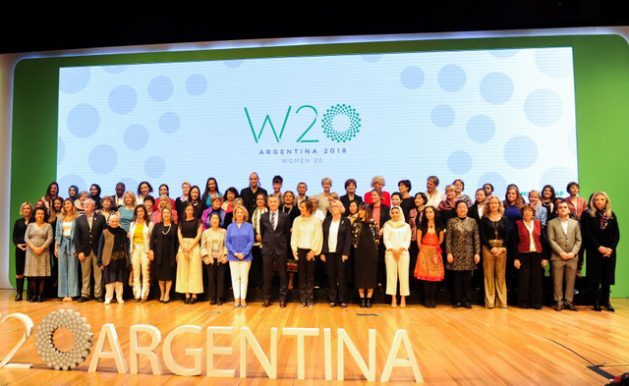
Group photo of the delegates who participated in the Women 20 Summit in Buenos Aires, after delivering their document of recommendations to Argentine President, Mauricio Macri (C). The proposals will form part of the agenda of the Group of 20 (G20) summit, to be held Nov. 30- Dec. 1 in the Argentine capital. Credit: G20
BUENOS AIRES, Oct 5 2018 (IPS) - Rural women play a key role in food production, but face discrimination when it comes to access to land or are subjected to child marriage, the so-called affinity group on gender parity within the G20 concluded during a meeting in the Argentine capital.
The situation of rural women was one of the four themes of the Women 20 Summit (W20). Women 20 is one of the seven sectors of civil society operating in the context of the G20 (Group of 20), which brings together industrialised and emerging countries and which this year is chaired by Argentina.
The mission of these affinity groups is to make recommendations to the main world leaders, who will meet in Buenos Aires for their annual summit from Nov. 30-Dec. 1.
“Rural women produce more than half of the world food production but they are at disadvantage in access to land, credit, productive resources and education...If rural women had the same rights as men, there would be less hunger in the world” -- Lilianne Ploumen
However, in a day of private meetings and two days of public exhibitions on women’s rights and gender issues, held Oct. 1- 3, peasant and indigenous women were conspicuously absent, during debates on the invisibility of rural women and their role in development.
The summit’s panels, held in the majestic former Argentine Post Office, were dominated by politicians, representatives of NGOs, officials of international organisations and managers and CEOs of companies.
The closing address at the summit was given by Argentine President Mauricio Macri, who received the document of W20 recommendations, debated over the space of seven months by 155 delegates of the different countries, which identifies the major challenges that must be addressed for their strategic value as a motor for sustainable development.
The event in Buenos Aires was not free from controversy, since a group of Argentine organisations, some of which participated in the discussion of the document, questioned in a statement that “55 percent of the people who made up the panels belong to international corporations or related foundations.”
“The W20 summit exhibit programme did not represent the diversity of the women’s group that discussed the statement,” said Natalia Gherardi, executive director of the Latin American Team for Justice and Gender (ELA) and one of nine Argentine delegates who participated in the debate.
“Evidently it had more to do with giving a place to the heads of the companies that financed the workshops,” she told IPS.
Simultaneously, a group of women members of the so-called Feminist Forum against the G20 demonstrated nearby “against the neoliberalism of the W20 businesswomen”.
The summit was held at a complex time for Argentina, with social problems arising from the recent strong devaluation of the local currency that accelerated inflation.
One of the panels of the Women 20 summit in the Argentine capital, which called for fighting the invisibility of rural women, as a prerequisite for advancing toward sustainable development. But the G20 summit itself was criticised by civil society because representatives of corporations dominanted the panels and peasant and indigenous women were conspicuously absent. Credit: Daniel Gutman/IPS
To overcome the crisis, Macri sought the help of the International Monetary Fund (IMF), which imposed a drastic austerity programme to reduce public spending and the government itself admitted that poverty has grown in recent months and will continue to do so.
“These meetings are to raise awareness about issues that could later become public policies. It’s very important to talk, because before it wasn’t talked about,” María Noel Vaeza, director of the U.N. Women’s Programme Division, told IPS.
Vaeza, who is a Uruguayan lawyer, said that “there are still 52 countries where legislative changes are needed to allow rural women to inherit land when they become widows.”
In the case of Latin America, the greatest urgency is to “eliminate child marriage. In rural areas there are girls who are married at age 12 and then drop out of school because they have to take care of their children,” said the official of the United Nations agency that promotes gender equality.
The situation of rural women and girls was also the focus of this year’s 62nd session of the United Nations Commission on the Status of Women, held in March in New York.
The conclusions of that assembly urged governments to “pass legislation to promote the registration of women’s lands and the certification of their land titles, irrespective of their marital status.”
In the case of the W20 document, it called for the promotion of economic participation and inclusion of rural women in decision-making, through the allocation of funds to strengthen cooperatives and enterprises and promote access to credit.
In addition to rural development, the other three themes of the W20 were labour, digital and financial inclusion.
“The world leaders should look at the policies of their own countries and see the ones that are needed to be changed,” said Lilianne Ploumen, a Dutch politician of the Labour Party and member of their country’s parliament.
Ploumen, who founded She Decides, a women’s rights movement, told IPS that “Rural women produce more than half of the world food production but they are at disadvantage in access to land, credit, productive resources and education.”
“If rural women had the same rights as men, there would be less hunger in the world,” she said.
Edith Obstchatko, a policy specialist at the Inter-American Institute for Cooperation on Agriculture (IICA), told IPS that “all the indicators show us that rural women are at a disadvantage compared to rural men and urban women.”
“The lack of infrastructure in rural areas affects them disproportionately. And new problems, such as climate change, affect them more, because they are more vulnerable,” said the expert of IICA, an organ of the Organisation of American States (OAS).
According to data released by the W20, rural women make up more than one-third of the world’s population and 43 percent of the agricultural workforce.
Most of them work in family-owned enterprises and do not receive any payment for their work. When they receive it, the amount is on average 25 per cent lower than what men are paid.
One of the central issues is education, and it was recognised that approximately two-thirds of the world’s illiterate people are women living in rural areas.
The issue of land ownership was also brought up, because globally women own less than 30 per cent of the land, although the situation varies greatly from country to country.
Another critical point is access to sexual and reproductive rights: the pregnancy rates among young women living in rural areas are three times higher than those living in cities.

Mitra-mandal Privacy Policy

This privacy policy has been compiled to better serve those who are concerned with how their  'Personally Identifiable Inform...