MITRA MANDAL GLOBAL NEWS

BRITISH NEO-NAZIS ARE ON THE RISE — AND THEY’RE BECOMING MORE ORGANIZED AND VIOLENT

Authentic news,No fake news.




59
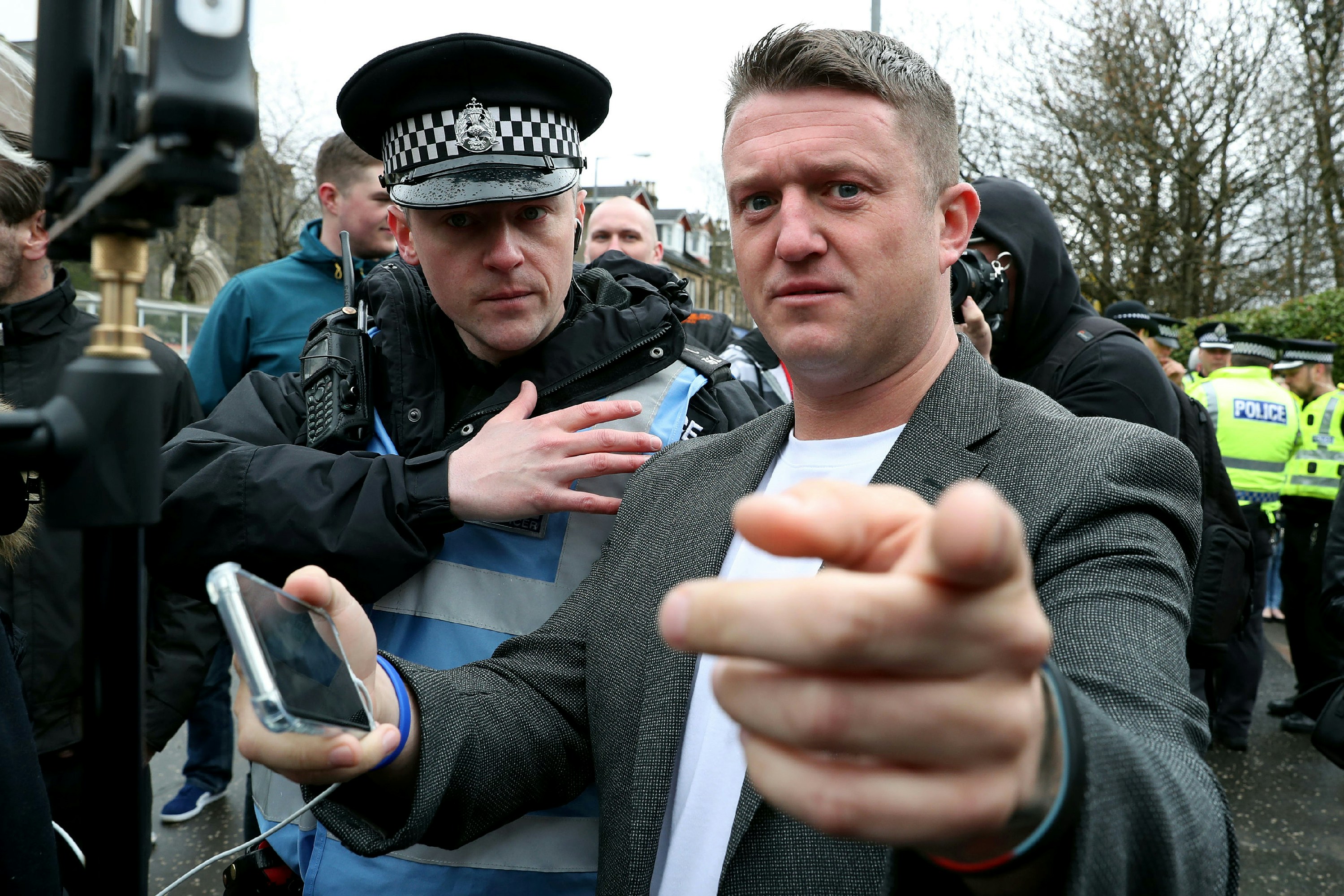
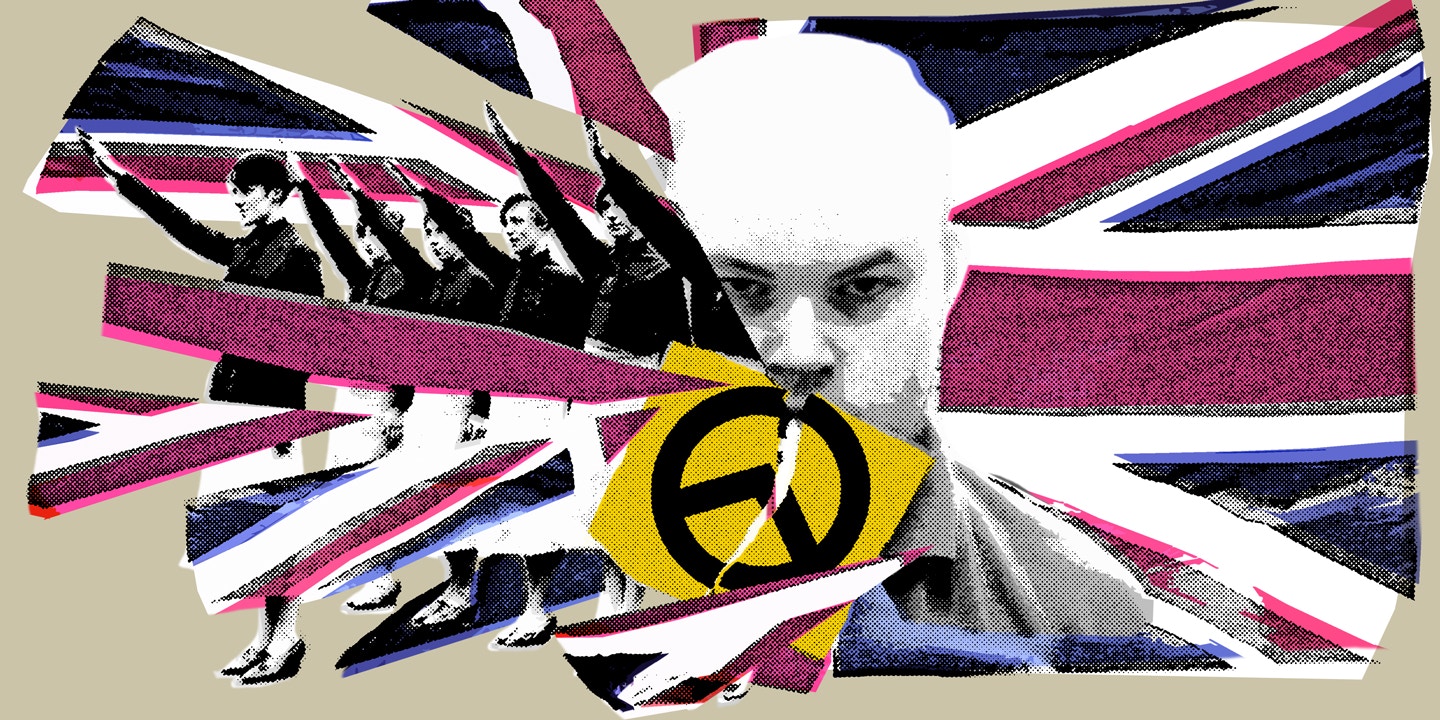
Illustration: Adam Maida for The Intercept/Police Scotland/Getty Images


THE TOWN OF Banff on the northeastern coast of Scotland is a peaceful place, with just 4,000 residents and a picturesque bay that flows into the open sea. Fifty miles from the nearest big city, the air is fresh and the pace of life is slow. But for one young man, the town’s seaside location offered no contentment. He was stockpiling weapons and planning an act of terrorism.
Connor Ward lived in a gray, semi-detached apartment building a short walk from Banff’s marina, where dozens of small boats are docked and fishermen depart each day on a hunt for mackerel or sea trout. Inside his home, 25-year-old Ward was plugged into a different kind of world. He was reading neo-Nazi propaganda on the internet about an imminent race war.
Ward began preparing for the conflict. He purchased knives, swastika flags, knuckle-dusters, batons, a stun gun, and a cellphone signal jammer. He obtained deactivated bullets and scoured Google for information about how to reactivate them. From his Banff home, he purchased hundreds of steel ball bearings and researched bomb-making methods. He wrote a note addressed to Muslims that stated: “You will all soon suffer your demise.” Then he compiled a map showing the locations of mosques in the nearest city – Aberdeen – that he appeared intent on attacking.

connor-ward-scottish-police-released-02-1525282950
Connor Ward, who was found guilty in March of plotting a terrorist attack targeting Muslims.
Photo: Police Scotland
In April, a judge sentenced Ward to life in prison after concluding that he had been planning a “catastrophic” terrorist attack and was “deeply committed to neo-Nazi ideology.” During his week-long trial in Edinburgh, Scotland’s capital city, it emerged that police had uncovered his plot by chance, after receiving a tip that he was trying to import weapons from the United States. Officers searched his home – and the home of his mother – and discovered his large armory, as well as a stash of 131 documents about Nazism, terrorism, and manufacturing explosives.
Ward is just one individual, but his actions reflect a broader trend. British authorities say they are currently facing a growing terrorist threat from right-wing extremists, whose numbers have increased in recent years. Rooted in the notion that white European people are facing extinction, the extremists’ ideas have gained currency following a spate of Islamist attacks in Europe and a refugee crisis that has seen millions of migrants travel to the continent from war-torn Afghanistan and Syria.
In Austria, Germany, Poland, the Czech Republic, Slovakia, France, Sweden, Hungary, and the Netherlands, far-right ideas have also surged in popularity. The same is true in the United States, where Donald Trump’s presidency has energized white supremacists. Far-right politicians and activists have successfully tapped into concerns about economic uncertainty, unemployment, and globalization. But they have built most of their support base around the issues of immigration and terrorism.
In June 2016, an act of brutal violence highlighted the burgeoning danger in the United Kingdom. In broad daylight in a small village in the north of England, 52-year-old white supremacist Thomas Mair pulled out a homemade rifle and shot dead Jo Cox, a member of Parliament. Mair saw Cox as a “traitor” to white people due to her pro-immigration politics. Six months later, for the first time in U.K. history, a far-right group was banned as a terrorist organization, alongside the likes of Al Qaeda and Al Shabaab. Since then, the problem has continued to spiral.
British police say they have thwarted four far-right terrorist plots in the last year. In a speech in London in late February, the U.K.’s counter-terrorism police chief, Mark Rowley, cautioned that far-right groups were “reaching into our communities through sophisticated propaganda and subversive strategies, creating and exploiting vulnerabilities that can ultimately lead to acts of violence and terrorism.” Police were monitoring far-right extremists among a group of some 3,000 “subjects of interest,” Rowley said, adding: “The threat is considerable at this time.”

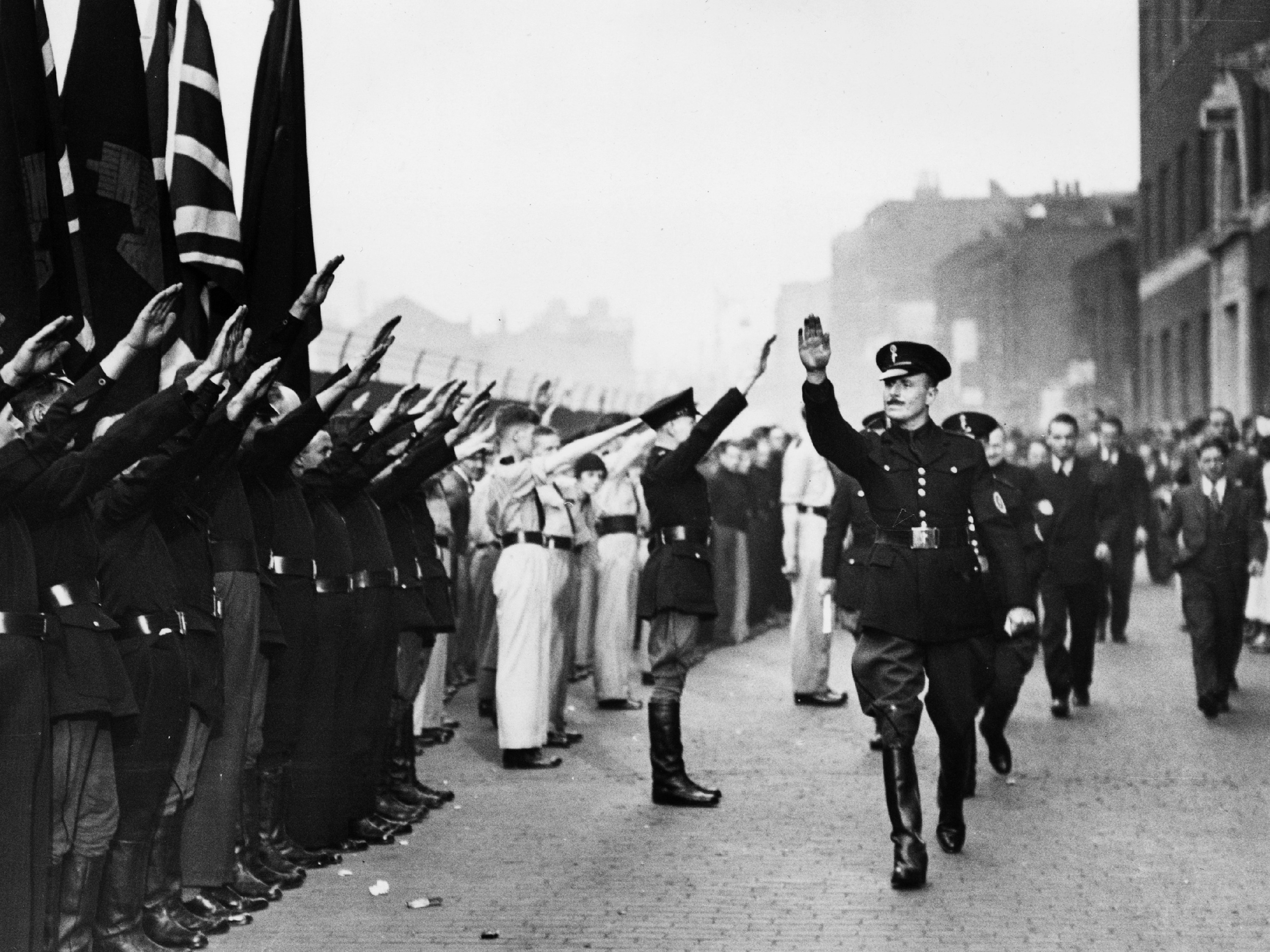
4th October 1936:  British politician Sir Oswald Ernald Mosley (1896 - 1980) inspects members of his British Union of Fascists in Royal Mint Street, London. Their presence sparked a riot which became known as the Battle of Cable Street. (Photo by Central Press/Getty Images)
British politician Sir Oswald Mosley inspects members of his British Union of Fascists in Royal Mint Street, London, on Oct. 4, 1936. Their presence sparked a riot which became known as the Battle of Cable Street.
 
Photo: Central Press/Getty Images

FAR-RIGHT EXTREMISTS have been active in the U.K. for most of the last century. In the 1930s, Oswald Mosley took inspiration from Italian dictator Benito Mussolini and launched the British Fascist Union, otherwise known as the Blackshirts. In bombastic speeches to audiences across England, Mosley ranted about “the organized corruption of press, cinema, and Parliament,” which he blamed on “alien Jewish finance.” Mosley campaigned against the U.K. going to war with Adolf Hitler on the grounds that “Jewish interests” were pushing for the conflict; instead, he advocated isolationist, “Britain first” policies. During the same period, groups such as the Nordic League and the Imperial Fascist League overtly supported Nazism. Like Mosley, they were anti-Semitic, but they went further, embracing Adolf Hitler’s concept of an “Aryan race.” The Nordic League rallied against what it called a “Jewish reign of terror.” The Fascist League’s emblem was the British Union Jack flag with a black swastika in the center.
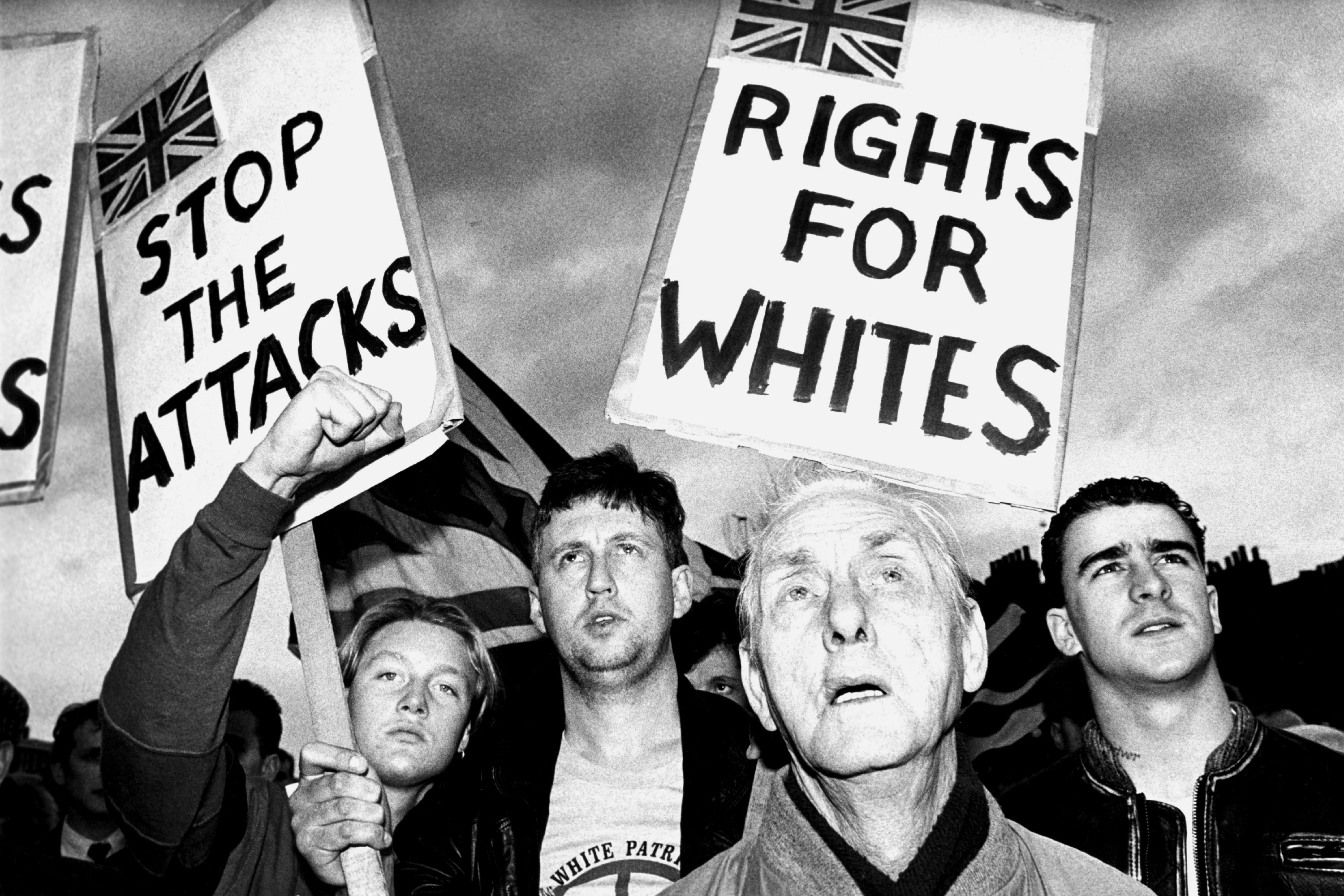
The defeat of Hitler, however, did not mark the end for the U.K.’s extreme right. Through the 1950s and 1960s, groups like the White Defence League and the Racial Preservation Society continued to espouse a bigoted ideology, spreading anti-Semitic conspiracy theories and demanding the curtailment of immigration. Between the 1970s and 1990s, the National Front and the British National Party carried on the trend, organizing demonstrations and campaigns that championed the idea that all non-white immigrants should be deported from the U.K.
Among the British National Party’s members was David Copeland, who worked as an engineer’s assistant on the London Underground. Copeland had grown up fantasizing about being a Nazi officer. By the time he was 22, he was teaching himself to design bombs. In April 1999, Copeland launched a series of attacks in London, placing sports bags packed with explosives and four-inch nails in three areas of the city where there were black, Asian, and gay communities. The devices caused carnage, killing three and injuring 140. Copeland later told police that he had intended to “spread fear, resentment, and hatred throughout this country; it was to cause a racial war.”

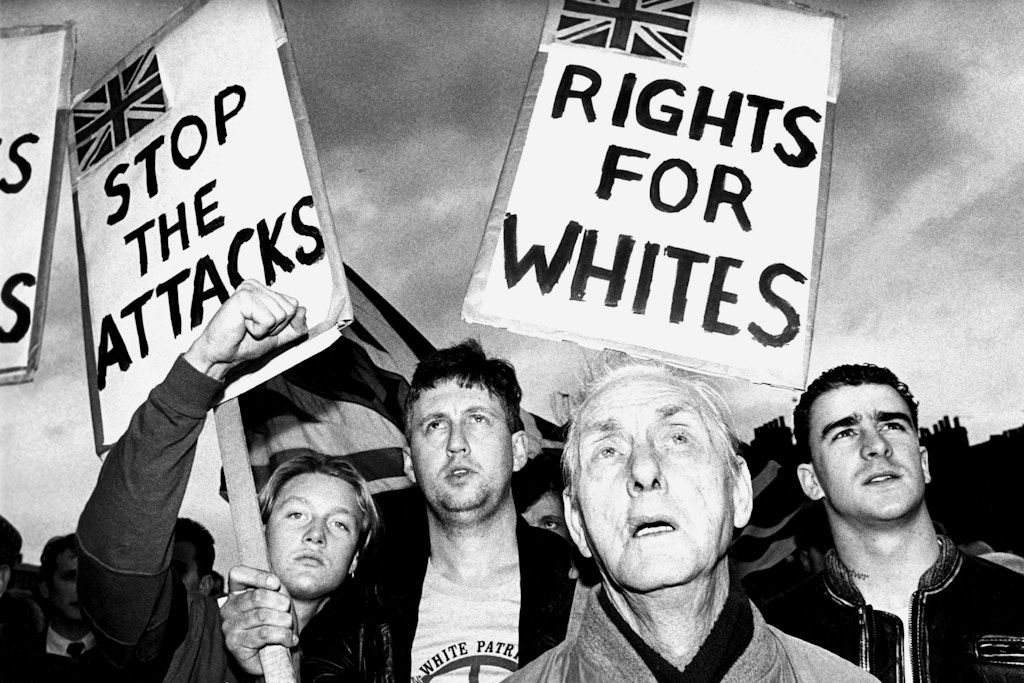
British National Party 'Rights for Whites' demo in East London 1990. (Photo by: PYMCA/UIG via Getty Images)
The British National Party “Rights for Whites” demonstration in East London in 1990.
 
Photo: PYMCA/UIG via Getty Images
Today, the National Front and the British National Party still exist as political entities. But like most older far-right groups, they do not wield the influence they once did. Their membership has diminished, mostly due to a lack of leadership and internal conflict. Now a newer band of far-right extremists is replacing them. These newcomers share many of the same values as their predecessors, but a desire for violence is more widespread among them, which worries British police and intelligence agencies.
The group that was banned in 2016 as a terrorist organization – National Action – has advocated murdering politicians. In October 2017, an unnamed member of the organization was accused of plotting to assassinate Rosie Cooper, a 67-year-old Labour member of Parliament. The planned execution was allegedly sanctioned by National Action’s leader, 31-year-old Christopher Lythgoe. Two years earlier, in January 2015, one of National Action’s supporters attempted to behead an Asian man in a supermarket in the north of Wales, shouting “white power” during a frenzied assault with a machete.

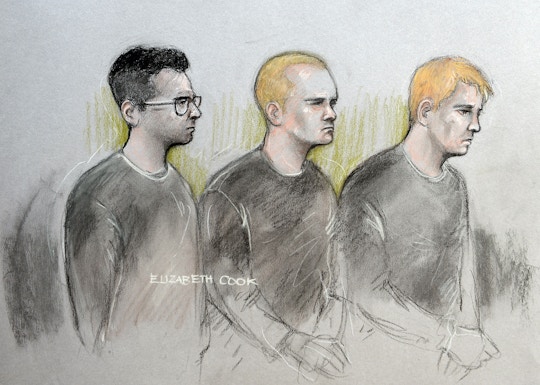
National Action court case. File court artist sketch dated 12/09/2017 by Elizabeth Cook of (from the left) Alexander Deakin, 22, Mikko Vehvilainen, 32, and Mark Barrett, 24, who will appear before the Old Bailey later accused of being part of the proscribed organisation National Action. Issue date: Thursday September 21, 2017. See PA story COURTS NationalAction. Photo credit should read: Elizabeth Cook/PA Wire URN:32930838
From left Alexander Deakin, 22, Mikko Vehvilainen, 32, and Mark Barrett, 24, who were accused of being part of the organization National Action in Sept. 2017.
 
Image: Elizabeth Cook/PA Wire via AP
Because National Action is now outlawed as a terrorist group, being a member of the organization is punishable by up to 10 years in prison. At least 14 people in the U.K. have so far faced terrorism charges connected to their alleged association with the group. Among them are two British Army soldiers, including 33-year-old Lance Corporal Mikko Vehvilainen, who was accused of being a National Action recruiter. Prosecutors said Vehvilainen commented regularly on a white supremacist internet forum where, under the name “NicoChristian,” he railed against black people, whom he referred to as “beasts.” In online posts reviewed by The Intercept, NicoChristian wrote that white people “shouldn’t even be on the same planet” as black people, and added: “The sooner they’re eliminated, the better.”
When police searched Vehvilainen’s quarters at an army camp in Wales in September 2017, they found Nazi flags, body armor, and a stash of weapons, including a shotgun, a rifle, a crossbow, arrows, knuckle-dusters, machetes, and daggers. The soldier also had a copy of the manifesto written by far-right terrorist Anders Breivik, who in July 2011 murdered 77 people in Norway. When police turned up at Vehvilainen’s home to take him into custody, he reportedly told his wife: “I’m being arrested for being a patriot.”
Last month, a jury at a court in Birmingham found Vehvilainen not guilty of stirring up racial hatred and possessing a terrorism manual. But he received an eight-year prison sentence for a separate offense: illegally possessing tear gas.

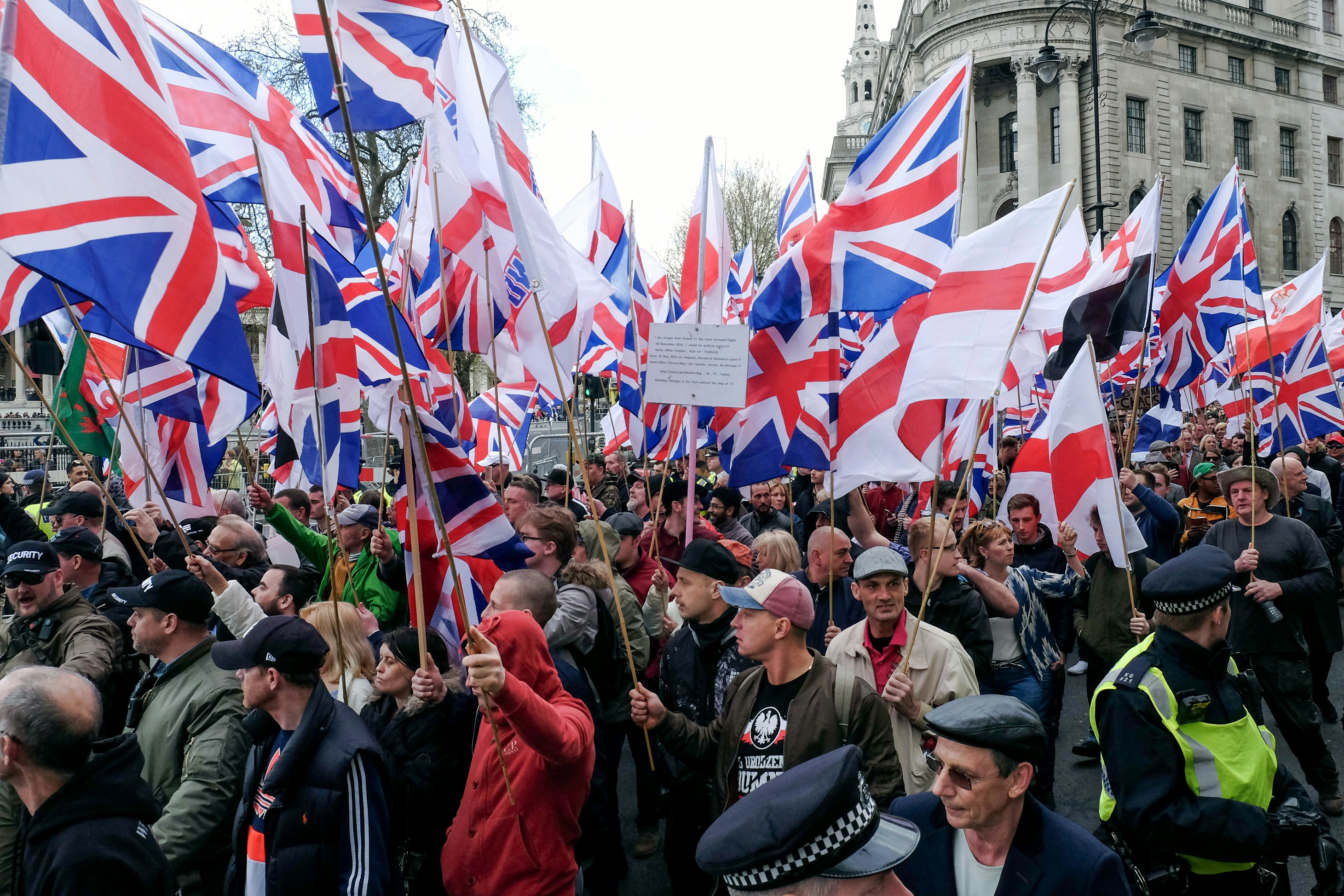
Protesters hold placards and British Union Jack flags during a protest titled 'London march against terrorism' in response to the March 22 Westminster terror attack on April 1, 2017 in London, England. The march has been organised by far-right groups English Defence League and Britain First, which also sees a counter-protest held by group 'Unite Against Fascism'. (Photo by Jay Shaw Baker/NurPhoto) *** Please Use Credit from Credit Field ***(Sipa via AP Images)
Protesters hold placards and British Union Jack flags during a protest on April 1, 2017, in London. The march was organized by far-right groups English Defence League and Britain First in response to the Westminster terror attack earlier that year.
 
Photo: Jay Shaw Baker/NurPhoto/AP

AT THE EXTREME ENDS of the political spectrum, there is always a violent fringe. However, “there is clearly an increase in activity on the extreme right wing and you can see that from anecdotal evidence – the sort of incidents we’ve seen take place,” says Raffaello Pantucci, director of international security studies at the Royal United Services Institute in London. “It has always existed in the U.K. … but it’s always tended to be scattered and disorganized. What is worrying recently is we have seen it get more organized.”
The British government operates a counterterrorism program called Prevent, one strand of which identifies people deemed to be at risk of being drawn into terrorism, usually because they have been reported to police for expressing extremist views. Since 2007, according to police and government statistics about the program, the number of people at risk of becoming involved in right-wing terrorism has increased each year. In the five years between 2007 and 2012, concerns were raised about 177 people on the far-right spectrum. Between 2012 and 2017, 2,489 individuals were added to the list. The spike in far-right extremism paralleled a surge in Islamist extremism. Between 2007 and 2012, 1,560 people were identified as vulnerable to becoming drawn into Islamist terrorism, according to police and government reports. Between 2012 and 2017, that number increased to 11,624.
It is unclear whether all of the people the Prevent program identifies pose a real threat, but the numbers do seem to reflect a broader phenomenon. “There is a sense that a culture war is happening,” says Pantucci. “We are seeing greater polarization in our public debate … We are seeing xenophobic views become mainstream. And that means the unacceptable edge, the violent edge, is getting pulled toward the center as well.”
“There is a sense that a culture war is happening.”
Since 2013, the rise of the Islamic State – paired with a wave of predominantly Muslim refugees traveling to Europe and North America due to the conflicts in Syria, Iraq, and Afghanistan – has galvanized the far right. In the U.K., ISIS-inspired terrorist attacks exacerbated ethnic divisions within communities and led to more reported cases of Islamophobic verbal and physical assaults. And when the U.K. voted in June 2016 to leave the European Union – in part due to concerns about immigration – that decision further emboldened the far right and triggered an upsurge in racially tinged hate crimes. All of these factors combined have created a fertile environment in which extremism has thrived.
For ISIS, the internet proved to be a vital recruiting tool. It helped the group spread its extremist messages to a global audience and enabled its supporters to connect with one another, even if they were thousands of miles apart. The same has been true for the far-right. The internet has fueled a new breed of “self-radicalizers” – people with no real-world connection to any extremist group, who instead consume online propaganda and decide to carry out a terrorist plot on their own.
“It is easier than ever before for people to access far-right content that ranges from moderate to the very radicalizing, extreme end,” says Joe Mulhall, a senior researcher with the London-based group Hope Not Hate, which studies the far-right. “The days of having to be involved in an organization to find the information are long gone. You can get it now with a few clicks wherever you are in the world.”
The extremist narratives peddled in terrorist propaganda are particularly potent for people who have experienced emotional trauma and substance abuse, research indicates. The case of Connor Ward, the young man from Banff in Scotland, is a possible illustration of that.
Ward was diagnosed with a personality disorder and he had a troubled family life. His father, Alexander Ward, is a convicted sex offender who impregnated Connor’s ex-girlfriend, according to court records. Ward despised his father for this and, in 2012, tried to build a bomb to kill him. Ward’s plot was discovered by his mother, who reported him to police. He was sent to jail for three years, but was released after about 18 months. During the same period, he developed an infatuation with Nazism and began planning his mosque attacks. His terrorism plan appears to have been driven at least in part by the far-right race war theories he discovered online.
Other cases bear similar hallmarks. Last year, 48-year-old Darren Osborne became radicalized after he watched a television program about a Pakistani child sex trafficking gang that had operated in the north of England. Within a few weeks, according to Sarah Andrews, Osborne’s former girlfriend, he became “obsessed with Muslims, accusing them all of being rapists and being part of pedophile gangs.” Andrews said Osborne began reading the social media posts of Tommy Robinson, a prominent figure on the British far right, who campaigns against what he calls the “Islamization” of the U.K. On June 19, 2017, Osborne hired a white Citroën van and drove it 150 miles from his home in Cardiff to Finsbury Park mosque in north London. He waited until local worshipers left the mosque after an evening prayer, then rammed his van into the crowd, killing 51-year-old Makram Ali and wounding 10 others. He left a note in his van that decried “feral inbred, raping Muslim men, hunting in packs, preying on our children.” According to Osborne’s sister, he was taking antidepressants at the time and had tried to kill himself weeks earlier.
A few days after Osborne’s attack, Ethan Stables, an unemployed 20-year-old from a small town in the north of England, was preparing to launch his own atrocity at an LGBT club night. Stables posted comments on a far-right Facebook group saying that he was planning to “slaughter every single one of the gay bastards.” Stables’s comments were reported to police, and when they searched his home they found a machete, an axe, and a bomb-making manual. He was convicted of plotting a terrorist attack. It emerged during his trial that Stables had been diagnosed with Asperger’s syndrome as a child, and in September 2016, had become obsessed with Nazism. He used the internet to communicate with other extremists and researched how to prepare for a race war. He was unemployed and blamed immigrants for his problems. “My country is being raped,” he wrote in one WhatsApp message. “I might just become a skinhead and kill people.”

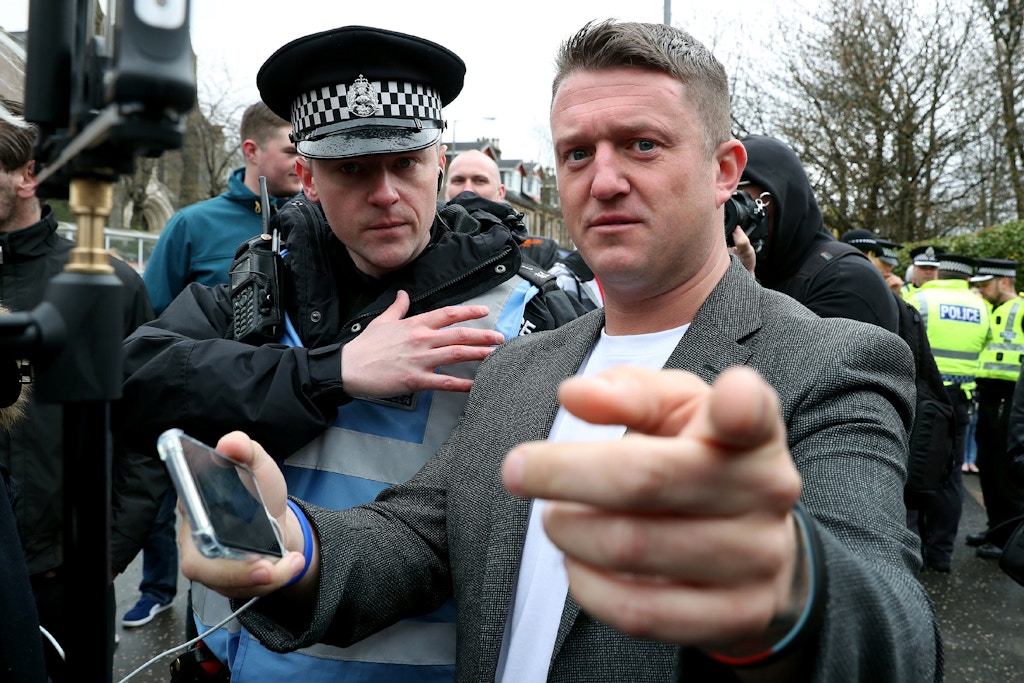
Mark Meechan court case. Former English Defence League leader Tommy Robinson outside Airdrie Sheriff Court after Mark Meechan was fined £800 for an offence under the Communications Act for posting a YouTube video of a dog giving Nazi salutes. Picture date: Monday April 23, 2018. See PA story COURTS Dog. Photo credit should read: Andrew Milligan/PA Wire URN:36143385
Former English Defence League leader Tommy Robinson, right, attends a court hearing in Scotland on April 23, 2018.
 
Photo: Andrew Milligan/PA Wire via AP

TOMMY ROBINSON, WHOSE online posts were read by the London mosque attacker, was recently banned from Twitter for breaching its “hateful conduct policies,” but he remains on Facebook and YouTube, where he reaches a combined audience of more than 900,000 people. Robinson rose to prominence as the leader of a group called the English Defence League, a far-right organization that said it was concerned about “how non-Muslims are being marginalized” in British society.
In 2013, Robinson stepped down as the English Defence League’s leader, saying that he was concerned about the “dangers of far-right extremism.” However, he has since continued to campaign on the same issues as a solo operator. His Twitter page, before it was suspended, offered a steady stream of posts that presented Muslims and Islam as existential threats to British and European society.
Rowley, the U.K.’s counterterrorism police chief, said Robinson was guilty of spreading “dangerous disinformation and propaganda” and claimed he was the right-wing equivalent of a British Islamist preacher named Anjem Choudary, who was jailed in 2016 for encouraging support for ISIS. During his February speech in London, Rowley said that Robinson was using his platform to “attack the whole religion of Islam by conflating acts of terrorism with the faith.”
Robinson did not respond to a request for comment; he has previously refuted allegations that his rhetoric could inspire right-wing terrorism.
In recent months, Robinson has established an informal alliance with a new group calling itself Generation Identity, which is actively trying to recruit members in the U.K. Generation Identity, a far-right youth movement that originated in France, campaigns against what it calls the “great replacement” – a theory that white European countries are going to be taken over by Muslim migrants. According to the group, “Islamic parallel societies” and mass immigration will lead to “the almost complete destruction of European societies within just a few decades if no countermeasures are taken.”
The image-conscious group has a slick website, publishes professionally produced videos, runs military-style training camps, and instructs its supporters that they must have a “well-groomed appearance.” Those who sign up to participate in its activities are personally vetted, and must fill out an application form that asks them to explain their political background and five favorite social media personalities. Prospective members of the secretive organization must sign a disclaimer stating that they are “not a journalist, activist, or informant meaning to record audio/video.”
The group insists that it is not extremist or racist. Instead, it claims it merely wants to preserve European national identity and calls itself “identitarian.” But beyond the glossy branding and semantics, Generation Identity is ideologically aligned with the far right. Its belief that migrants are going to extinguish white Europeans – unless white Europeans fight back – is reminiscent of the far right’s longstanding narrative about an impending race war. Unlike older far-right groups, however, which targeted Jews and black people, Generation Identity focuses its ire predominantly on Muslims.
“The ideology of Generation Identity is actually very extreme,” says Mulhall, the Hope Not Hate researcher. “They have been very clever in terms of their lexicon and language; they are trying to package extreme ideas in ways that are appealing to young people. So far, it is a strategy that has been successful for them, and that is worrying.”
Martin Sellner is the 29-year-old European spokesperson for Generation Identity. An Austrian who studies law at the University of Vienna, Sellner told The Intercept that “a combination of massive immigration, a low birth rate, and the politics of multiculturalism” were endangering European democracies. “The Muslim population will change the legislation, it will change the culture, and in the end will destroy the identity and the freedom we have in Europe,” Sellner said. He denied that he was a white supremacist, a racist, or an extremist, and said he disavowed violence. “I am just delivering a message,” he said. “I am just saying publicly what most people are afraid to say.”
On March 9, Sellner tried to enter the U.K. to give a speech in London, where a small group of Generation Identity members have been attempting to recruit. When Sellner arrived at England’s Luton Airport, however, he and his traveling companion, the American right-wing internet personality Brittany Pettibone, were not permitted to enter the country. Sellner was detained under the U.K.’s Terrorism Act and deported back to Vienna. Police told Sellner that his presence in the U.K. was “not conducive to the public good” because his planned public appearance would incite community divisions.
A week later, in the northeastern corner of Hyde Park in central London, about 400 people gathered for a demonstration. Robinson, the former English Defence League leader, had announced that he would give the speech that Sellner had been prevented from delivering. Among the crowd were men and women aged between their early 20s and late 50s, some of whom were rowdy and carrying Union Jack flags and placards with slogans like “Censor Islam Not Free Speech” and “I Will Hate What I Want.”
A police officer was struck in the face, either with a fist or an object. Blood streamed down his cheek.
Robinson arrived in a white van, flanked by several burly men wearing black jackets with “SECURITY” emblazoned on the back. The crowd began chanting Robinson’s name as he moved toward the park through a crush of bodies, a short distance from London’s famous Marble Arch.
Within a couple of minutes, there were screams and a flurry of pushing and shoving. A group of protesters – some of them shouting “Allahu akbar” – had faced off with Robinson’s supporters, and fighting broke out. Amid the melee, a police officer was struck in the face, either with a fist or an object. Blood streamed down his cheek. Barely able to maintain his balance and looking dazed, the officer was hauled out of the throng of bodies by one of his colleagues and placed into the back of a silver police van, where he slouched against a seat and held a thick white bandage across his face to soak up the blood.
Before Robinson was able to speak, a middle-aged man wearing a dark green hat and a white shirt attempted to stand on a box to declare his opposition to the former English Defence League leader. The crowd, which moments earlier had been chanting “free speech,” hurled abuse at the man, launched cans of beer at him, and pulled his hat from his head. There were shouts of “shut your face!” and “fuck off!” while the man, looking flustered, was pushed off the box and shoved back into the crowd.
Robinson, wearing blue jeans and a black jacket, handed out paper copies of his speech and then began reading it aloud. “No to Islamization!” he shouted to cheers. “No to mass immigration and the great replacement!”
“Tyranny has locked you in since the days of your childhood,” he said. “I ask you, I command you: Break free! Patriots of the U.K., come out of the closet. Make your dissent visible by acts of resistance that inspire others!”
Robinson concluded with a warning for the British government, saying that it could “ban the speaker but it cannot ban the speech.” By blocking Sellner and other far-right activists from entering the country, he said, the government had “relit the fire and the fight of the British people.”
Robinson pushed his way through the crowd, back to the sanctuary of his white van. Some of his supporters stayed behind at Speakers’ Corner. Generation Identity activists handed out leaflets that explained their support for the “preservation of the ethno-cultural identity.” Near a fence at the perimeter of the park, several young Arab men gathered behind a small stall, where they were giving out information about the Quran. A group of men who had attended Robinson’s speech approached them.
“That so many crimes have been committed by Muslims is proof that you are causing disproportionate harm to our society,” shouted one of the men, a 26-year-old named Jamie, who was wearing black-framed glasses, a black jacket, and blue jeans. “Your religion is not good for Britain.”
“Well, we’re still here and we’re not going nowhere,” replied Asem, a 29-year-old Muslim man, who said he’d been born and brought up in north London. He had a trimmed beard and was wearing a gray tracksuit and a green baseball cap. “So what are you going to do about me? I haven’t got anything on my [criminal] record,” he said. “For you to generalize [about] us as a religion is bullshit.”
The argument continued for about 10 minutes until neither side had anything left to say.
“I don’t have no time for this,” said Asem. He turned and walked away, followed by a group of about six of his friends.
“Yeah, go home!” said one of the young Robinson supporters, who walked off in the opposite direction.
The scene was a portrait of the deep divisions that exist in this disunited kingdom. As the sun went down over Hyde Park, snow began to fall. The crowds dispersed, trampling over the broken glass and discarded placards strewn across the ground.


Marx at 200

Authentic news,No fake news.


The ideas of Karl Marx are still relevant two centuries after his birth—both for his insight into the rent-seeking that bedevils capitalism, and for his failure to understand how capitalism can reform

A GOOD subtitle for a biography of Karl Marx would be “a study in failure”. Marx claimed that the point of philosophy was not just to understand the world but to improve it. Yet his philosophy changed it largely for the worst: the 40% of humanity who lived under Marxist regimes for much of the 20th century endured famines, gulags and party dictatorships. Marx thought his new dialectical science would allow him to predict the future as well as understand the present. Yet he failed to anticipate two of the biggest developments of the 20th century—the rise of fascism and the welfare state—and wrongly believed communism would take root in the most advanced economies. Today’s only successful self-styled Marxist regime is an enthusiastic practitioner of capitalism (or “socialism with Chinese characteristics”).
Yet for all his oversights, Marx remains a monumental figure. At the 200th anniversary of his birth, which falls on May 5th, interest in him is as lively as ever. Jean-Claude Juncker, the president of the European Commission, is visiting Trier, Marx’s birthplace, where a statue of Marx donated by the Chinese government will be unveiled. The British Library, where he did the research for “Das Kapital”, is putting on a series of exhibitions and talks. And publishers are producing a cascade of books on his life and thought, from “Das Kapital”-sized doorstops (Sven-Eric Liedman’s “A World to Win: The Life and Works of Karl Marx”), to Communist Manifesto-slim pamphlets (a second edition of Peter Singer’s “Marx: A Very Short Introduction”).
None of these bicentennial books is outstanding. The best short introduction is still Isaiah Berlin’s “Karl Marx”, which was published in 1939. But the sheer volume of commentary is evidence of something important. Why does the world remain fixated on the ideas of a man who helped to produce so much suffering?
The point of madness
The obvious reason is the sheer power of those ideas. Marx may not have been the scientist that he thought he was. But he was a brilliant thinker: he developed a theory of society driven forward by economic forces—not just by the means of production but by the relationship between owners and workers—and destined to pass through certain developmental stages. He was also a brilliant writer. Who can forget his observation that history repeats itself, “the first time as tragedy, the second as farce”? His ideas were as much religious as scientific—you might even call them religion repackaged for a secular age. He was a latter-day prophet describing the march of God on Earth. The fall from grace is embodied in capitalism; man is redeemed as the proletariat rises up against its exploiters and creates a communist utopia.
A second reason is the power of his personality. Marx was in many ways an awful human being. He spent his life sponging off Friedrich Engels. He was such an inveterate racist, including about his own group, the Jews, that even in the 1910s, when tolerance for such prejudices was higher, the editors of his letters felt obliged to censor them. He got his maid pregnant and dispatched the child to foster parents. Mikhail Bakunin described him as “ambitious and vain, quarrelsome, intolerant and absolute…vengeful to the point of madness”.
But combine egomania with genius and you have a formidable force. He believed absolutely that he was right; that he had discovered a key to history that had eluded earlier philosophers. He insisted on promoting his beliefs whatever obstacles fate (or the authorities) put in his way. His notion of happiness was “to fight”; his concept of misery was “to submit”, a trait he shared with Friedrich Nietzsche.
The third reason is a paradox: the very failure of his ideas to change the world for the better is ensuring them a new lease of life. After Marx’s death in 1883 his followers—particularly Engels—worked hard to turn his theories into a closed system. The pursuit of purity involved vicious factional fights as “real” Marxists drove out renegades, revisionists and heretics. It eventually led to the monstrosity of Marxism-Leninism, with its pretensions to infallibility (“scientific socialism”), its delight in obfuscation (“dialectical materialism”) and its cult of personality (those giant statues of Marx and Lenin).
The collapse of this petrified orthodoxy has revealed that Marx was a much more interesting man than his interpreters have implied. His grand certainties were a response to grand doubts. His sweeping theories were the result of endless reversals. Toward the end of his life he questioned many of his central convictions. He worried that he might have been wrong about the tendency of the rate of profit to fall. He puzzled over the fact that, far from immiserating the poor, Victorian England was providing them with growing prosperity.
The chief reason for the continuing interest in Marx, however, is that his ideas are more relevant than they have been for decades. The post-war consensus that shifted power from capital to labour and produced a “great compression” in living standards is fading. Globalisation and the rise of a virtual economy are producing a version of capitalism that once more seems to be out of control. The backwards flow of power from labour to capital is finally beginning to produce a popular—and often populist—reaction. No wonder the most successful economics book of recent years, Thomas Piketty’s “Capital in the Twenty-First Century”, echoes the title of Marx’s most important work and his preoccupation with inequality.
The prophet of Davos
Marx argued that capitalism is in essence a system of rent-seeking: rather than creating wealth from nothing, as they like to imagine, capitalists are in the business of expropriating the wealth of others. Marx was wrong about capitalism in the raw: great entrepreneurs do amass fortunes by dreaming up new products or new ways of organising production. But he had a point about capitalism in its bureaucratic form. A depressing number of today’s bosses are corporate bureaucrats rather than wealth-creators, who use convenient formulae to make sure their salaries go ever upwards. They work hand in glove with a growing crowd of other rent-seekers, such as management consultants (who dream up new excuses for rent-seeking), professional board members (who get where they are by not rocking the boat) and retired politicians (who spend their twilight years sponging off firms they once regulated).
Capitalism, Marx maintained, is by its nature a global system: “It must nestle everywhere, settle everywhere, establish connections everywhere.” That is as true today as it was in the Victorian era. The two most striking developments of the past 30 years are the progressive dismantling of barriers to the free movement of the factors of production—goods, capital and to some extent people—and the rise of the emerging world. Global firms plant their flags wherever it is most convenient. Borderless CEOs shuttle from one country to another in pursuit of efficiencies. The World Economic Forum’s annual jamboree in Davos, Switzerland, might well be retitled “Marx was right”.
He thought capitalism had a tendency towards monopoly, as successful capitalists drive their weaker rivals out of business in a prelude to extracting monopoly rents. Again this seems to be a reasonable description of the commercial world that is being shaped by globalisation and the internet. The world’s biggest companies are not only getting bigger in absolute terms but are also turning huge numbers of smaller companies into mere appendages. New-economy behemoths are exercising a market dominance not seen since America’s robber barons. Facebook and Google suck up two-thirds of America’s online ad revenues. Amazon controls more than 40% of the country’s booming online-shopping market. In some countries Google processes over 90% of web searches. Not only is the medium the message but the platform is also the market.
In Marx’s view capitalism yielded an army of casual labourers who existed from one job to the other. During the long post-war boom this seemed like a nonsense. Far from having nothing to lose but their chains, the workers of the world—at least the rich world—had secure jobs, houses in the suburbs and a cornucopia of possessions. Marxists such as Herbert Marcuse were forced to denounce capitalism on the grounds that it produced too much wealth for the workers rather than too little.
Yet once again Marx’s argument is gaining urgency. The gig economy is assembling a reserve force of atomised labourers who wait to be summoned, via electronic foremen, to deliver people’s food, clean their houses or act as their chauffeurs. In Britain house prices are so high that people under 45 have little hope of buying them. Most American workers say they have just a few hundred dollars in the bank. Marx’s proletariat is being reborn as the precariat.
Still, the rehabilitation ought not to go too far. Marx’s errors far outnumbered his insights. His insistence that capitalism drives workers’ living standards to subsistence level is absurd. The genius of capitalism is that it relentlessly reduces the price of regular consumer items: today’s workers have easy access to goods once considered the luxuries of monarchs. The World Bank calculates that the number of people in “extreme poverty” has declined from 1.85bn in 1990 to 767m in 2013, a figure that puts the regrettable stagnation of living standards for Western workers in perspective. Marx’s vision of a post-capitalist future is both banal and dangerous: banal because it presents a picture of people essentially loafing about (hunting in the morning, fishing in the afternoon, raising cattle in the evening and criticising after dinner); dangerous because it provides a licence for the self-anointed vanguard to impose its vision on the masses.
Marx’s greatest failure, however, was that he underestimated the power of reform—the ability of people to solve the evident problems of capitalism through rational discussion and compromise. He believed history was a chariot thundering to a predetermined end and that the best that the charioteers can do is hang on. Liberal reformers, including his near contemporary William Gladstone, have repeatedly proved him wrong. They have not only saved capitalism from itself by introducing far-reaching reforms but have done so through the power of persuasion. The “superstructure” has triumphed over the “base”, “parliamentary cretinism” over the “dictatorship of the proletariat”.
Nothing but their chains
The great theme of history in the advanced world since Marx’s death has been reform rather than revolution. Enlightened politicians extended the franchise so working-class people had a stake in the political system. They renewed the regulatory system so that great economic concentrations were broken up or regulated. They reformed economic management so economic cycles could be smoothed and panics contained. The only countries where Marx’s ideas took hold were backward autocracies such as Russia and China.
Today’s great question is whether those achievements can be repeated. The backlash against capitalism is mounting—if more often in the form of populist anger than of proletarian solidarity. So far liberal reformers are proving sadly inferior to their predecessors in terms of both their grasp of the crisis and their ability to generate solutions. They should use the 200th anniversary of Marx’s birth to reacquaint themselves with the great man—not only to understand the serious faults that he brilliantly identified in the system, but to remind themselves of the disaster that awaits if they fail to confront them.

This article appeared in the Books and arts section of the print edition under the headline "Second time, farce"

Iran expects U.S. to walk away from nuclear deal

Authentic news,No fake news.


An Iranian government spokesman said Tehran is examining its budget as it expects the United States to walk away from the U.N.-backed nuclear agreement next week. File Photo by Maryam Rahmanian/UPI 
License Photo
May 2 (UPI) -- Saying the United States is likely to walk away from a U.N.-backed nuclear agreement next week, OPEC-member Iran said it was making budget preparations.
U.S. President Donald Trump needs to decide by May 12 whether to issue sanctions waivers to Iran. If he doesn't, it would counter the U.N.-backed nuclear agreement that opens trade doors with one of the Organization of Petroleum Exporting Countries' biggest producers.
Trump in April suggested to OPEC the price of oil was too high. Reneging on the deal, however, would sideline hundreds of thousands of Iranian barrels of oil in an already-tightened market and cause the price of oil to move even higher.
For Iran, the loss of those additional barrels would mean a loss of upwards of $700 million per day at today's prices. Iranian government spokesman Mohammad-Baqer Nobakht was quoted by the official Islamic Republic News Agency as saying that Tehran was already busy with budgetary accommodations.
"We have paved the way and prepared necessary budget for that era," he said.
Iran is the third largest oil producer in the Organization of Petroleum Exporting Countries. Campaigning for a second term in office last year, Iranian President Hassan Rouhani said easing international sanctions and addressing a high rate of inflation were national priorities. For a two-month period in March, the Central Bank of Iran reported inflation at 9.6 percent, down from the 10 percent reported during the two-month period ending in January.
The Iranian economy is expected to stabilize at around 4.5 percent over the medium-term. The International Monetary Fund, in a 2017 assessment, said gross domestic product swelled by as much as 6.6 percent, but should moderate at around 3.3 percent this year.
Last year, the IMF said unemployment in Iran was high, job creation was slow and per capita income was unchanged from a decade ago.
"More recently, renewed uncertainty regarding sanctions is dampening sentiment," the report read.
Iran's Central Bank said earlier this year, however, that the economy created 650,000 new jobs in the past fiscal year. Growth for 2018, however, will depend largely on non-oil sectors of the Iranian economy.

Internet Freedom Rapidly Degrading in Southeast Asia

Authentic news,No fake news.

Facebook, Twitter, Instagram, Line, WhatsApp and WeChat are the most popular social media sites in Southeast Asia, but their power to spread free speech is declining. Credit: ITU/R.Farrell
PHNOM PENH, Feb 15 2018 (IPS) - Researchers recently evaluated 65 countries which represent 87 percent of internet users globally. Half of them experienced a decline of internet freedom. China, Syria and Ethiopia are the least free. Estonia, Iceland and Canada enjoy the most freedom online.
The most remarkable evolution comes from Southeast Asia. A few years ago, this was a promising region. The economy was growing, democracy was on the rise. Malaysia had free elections, Indonesia started an anti-corruption campaign and the social rights of Cambodian garment workers were improving.
"A few years ago, social media were safe havens for activists. But today these media companies are too cooperative with the autocratic regimes." --Ed Legaspi of the Southeast Asian Press Alliance
“Internet helped these movements grow,” says Madeline Earp, Asia research analyst with Freedom House. “All kinds of organisations and media started using internet more and more. That was hopeful.”
Today, democratisation has faltered. A military coup in Thailand and the dissolution of an opposition party in Cambodia are just two examples of autocratic governments resisting change.

Censorship, arrests and violence
According to the report, seven of the eight Southeast Asian countries researched have become less free in the last year.
“Censorship is on the rise and internet freedom is declining,” Earp says. “Myanmar and Cambodia were the biggest disappointments.”
Recently, journalists were arrested in Myanmar. Fake news spreads hate speech and incites violence against Muslims. Today, Myanmar has more journalists in prison then in the last years of the military regime.
In Cambodia, an independent newspaper was shut down. Activists who denounce illegal activities of companies are being arrested. In Thailan,d the strict lese-majeste law is used to silence opponents. The Philippines has a growing number of ‘opinion shapers’ to push pro-government propaganda.
The only country that has improved its score is Malaysia. But Freedom House says that is mostly because of increasing internet use. Repression is not keeping up with the rapid growth. This shows that Malaysia is following a trend in Southeast Asia. The restriction on freedom of speech starts when internet use goes up.
“The Malaysian government has censored news websites. At least one Malaysian has been sentenced for a post on Facebook,” Earp adds.

The Chinese example
Part of the cause is to be found in China. The influential country has the world’s least free internet for three years, according to the Freedom House report. It uses a sophisticated surveillance system, known as the ‘Great Firewall’. An army of supervisors check on the internet use of the Chinese, from messaging apps to traffic cameras.
Undesirable messages are being deleted by Chinese censors. Sometimes that can lead to absurd situations. A newly discovered beetle was named after President Xi Jinping. But messages about this event were deleted because the predatory nature of the beetle could be insulting to the leader.
These practices play an important role in the decline of democracy in Southeast Asia. “Vietnam is copying the techniques of China,” says researcher Madeline Earp. “More bloggers and activists are being arrested because of their social media use.”

Fake news
Not only censorship is an issue. In Southeast Asia, fake news is being used to eliminate opponents or to manipulate public opinion. This is what Ed Legaspi, director of the Southeast Asian Press Alliance, explains in The Bulletin.
“Worryingly, many governments have taken advantage of existing mechanisms in social media to spread rumours and combat critical voices,” says Legaspi. “Thailand’s lese majeste law, Malaysian’s sedition act and Indonesia’s blasphemy law have all been used to curtail online speech.”
In Myanmar, inflammatory and racist language against Muslims provokes violent outbreaks regularly. Fake news sites spread rumours about a Buddhist woman who supposedly was raped by a Muslim. This contributed to the violence towards the Rohingya, a Muslim minority. And it helps the army to get support from a large part of the public.
The role of social media cannot be underestimated. Facebook, Twitter, Instagram, Line, WhatsApp and WeChat are the most popular in Southeast Asia, but their initial power to spread free speech is declining.
“A few years ago, social media were safe havens for activists. But today these media companies are too cooperative with the autocratic regimes,” says Legaspi. “They do nothing to protect their users.”

Manipulated elections
Various countries are organising elections this year. How these governments will deal with these moments of tension will determine the evolution of internet freedom.
Cambodia has elections with no opposition, Malaysia’s polls are heavily manipulated. Not much positive news is expected there. In Indonesia, the regional elections in June will be the first test since a fake news campaign against Jakarta’s once popular governor, Basuki ‘Ahok’ Tjahaja Purnama. He was convicted of blasphemy and jailed.
The growing knowhow of those in power is being used to improve their fortunes when elections come. Some of them already control internet use and silence activists, a sad evolution in a region that only recently seemed to be making progress.

World Press Freedom Day 2018

Authentic news,No fake news.

ROME, Apr 25 2018 (IPS) - The theme for the 25th celebration of World Press Freedom Day is “Keeping Power in Check: Media, Justice and The Rule of Law,” focussing on the importance of an enabling legal environment for press freedom, and gives attention to the role of an independent judiciary in ensuring legal guarantees for press freedom and prosecution of crimes against journalists..
Only 13% of the world population enjoys a free press, where coverage of politics is robust, the safety of journalists is guarateed, and state intrusion in media affairs is minimal. A partly free press to 42% of the world population. The remaining 45% lives in countries where a free press is non-existent (“New Report: Freedom of the Press 2017”). Political and economic transformations of some countries alongside their technological developments place new restrictions on press freedom.


Governments of these countries tend to implement restrictive laws and censorship on freedom of press, usually justifying these actions as a necessary tool for national security against terrorism. Apart from violating the right of freedom of expression, these restrictions place higher risks of violence, harassment and death on journalists.
Since the year 2000, annual incarceration of journalists has continued to increase globally, with many of them never seeing the inside of a courtroom.  In 2017, 81 journalists died whilst committed to their jobs – 66% of them were murdered.
According to the 2017 World Press Freedom Index, violence and restrictions against media freedom has risen by 14% in the time period of 2012-2017. At the same time, since 2016, media freedom in countries where it was ranked as “good” decreased by 2.3%.
Among the countries that suffered the largest declines on the report’s 100-point scale in 2016 were Poland (6 points), Turkey (5), Burundi (5), Hungary (4), Bolivia (4), Serbia (4), and the Democratic Republic of Congo (4).
The world’s 10 worst-rated countries and territories were Azerbaijan, Crimea, Cuba, Equatorial Guinea, Eritrea, Iran, North Korea, Syria and Turkmenistan.

“Fake News” a Growing New Threat to Press Freedom

Authentic news,No fake news.

This article is part of a series of stories and op-eds launched by IPS on the occasion of World Press Freedom Day on May 3.
US president Donald Trump addressing the UN General Assembly in September 2017. Credit: UN Photo/Cia Pak
UNITED NATIONS, Apr 26 2018 (IPS) - When a Malaysian politician of a bygone era was asked about the “leading newspapers” in his country, he shot back: “We don’t have any leading newspapers in our country because all our newspapers are misleading.”
But that comment, perhaps uttered half-jokingly about two decades ago, underwent a reality check recently when the Malaysian government passed legislation to impose prison sentences up to six years in jail if journalists are found guilty of spreading “fake news”.
The bill defines fake news as “any news, information, data and reports which is, or are, wholly or partly false, whether in the form of features, visuals or audio recordings, or in any other form, capable of suggesting words or ideas.”
And ever since President Donald Trump repeatedly used the term last year – more so to deny even the most verifiable facts and figures— some of the developing nations have followed in his jackbooted footsteps trying to muzzle the press, primarily on negative stories.
A president in perpetual denial, Trump has been described as a “serial liar” by his former Director of the Federal Bureau of Investigations (FBI) James Comey – and some of the lying is meant to denigrate journalists whose stories and exposes are dismissed as “fake news.”
Steven Butler, Asia Program Coordinator for the Committee to Protect Journalists (CPJ) told IPS: “Many Asian governments – including Malaysia, Singapore, and the Philippines – have jumped on the “fake news” bandwagon started by President Trump.”
But more broadly, he pointed out, the lack of a strong U.S. voice promoting the basic value press freedom at the heart of the U.S. constitution has emboldened governments – from China to Pakistan.
“Governments that wish to suppress freedom of expression know that the U.S. President will give them a free pass, something they could not count on in the past. Citizens of these countries need to find their own way to struggle for press freedom,” declared Butler.
In early April, India threatened to penalize journalists for spreading “fake news”. But in less than 48 hours the government had second thoughts and annulled the announcement without an explanation.
Norman Solomon. executive director of the Washington-based Institute for Public Accuracy and co-founder and coordinator of RootsAction.org, told IPS powerful demagogues in many parts of the world hate a free press and want to curb or crush whatever independent media outlets might get in the way of power.
“Trump’s denunciations of “fake news” amount to a new rhetorical wrinkle in centuries-old techniques of blaming the messengers for unwanted news,” he added.
Governments, like large corporations, are in the business of news management, Solomon said, pointing out that “they use powerful megaphones and an array of leverage to gain favorable media coverage and suppress or discredit unfavorable coverage.”
In some societies, he noted, the repression takes the form of threats, raids, prosecution and imprisonment. In more democratic societies, the repression is apt to take the form of “soft power” inducements, economic carrots and sticks, massive public-relations campaigns and nonstop floods of propaganda.
In the midst of all this, journalists constantly face a challenge of pursuing facts and underlying truths no matter where they might lead, he argued.
In some countries, the obstacles induce fear of imprisonment or even death, while in other countries the fears are along the lines of stalled careers and loss of employment, said Solomon, author of “War Made Easy: How Presidents and Pundits Keep Spinning Us to Death”
In an oped piece titled “Mr. Trump’s War on the Truth”, the New York Times said in early April that when Trump calls every piece of information he does not like “fake news”, he also encourages politicians in other countries, who are not constrained by constitutional free speech protections or independent judiciaries, to more aggressively squelch the press.
“They know that there will be little international condemnation of their actions because one of the most important standard bearers for a free press – the American government—is led by a man trying to discredit the free press.”
Ian Williams, author of “UNtold: The Real Story of the United Nations in Peace and War*, told IPS that to some extent all news is “fake” but some are flakier than others. But there are degrees of objectivity.
“Fake News” is a real problem – more as an accusation that kills serious debate than as a category of news in itself. Ideologues of both right and left use it to block acceptance of inconvenient information. The main stream media (“MSM”) are particularly reviled, he added.
As Pontius Pilate said, “What is truth?”
“I have a hierarchy of veracity. I would rather believe my own lying eyes than any media source! I watched the planes hit the WTC for example. Do I trust the MSM? Not much, and I would examine its content critically.”
In general, Williams said, the MSM is more conspicuous for what it ignores than for its lies, and it often reveals its biases. In particular the American media depends on government sources and is often naively trusting of them although Trump’s behaviour might be altering that.
For all its faults, he said, the MSM has competition and the fear that it might be scooped by rivals. On the other hand that means it has a herd mentality, so it collectively and uncritically bought into the Iraq WMDs and spurious scandal of “Oil for Food”, said Williams, a senior analyst who has written for newspapers and magazines around the world, including the Australian, The Independent, New York Observer, The Financial Times and The Guardian.
“But I would trust them before Fox, Murdoch tabloids and Breitbart, and above all before authoritarian state news agencies where an editor would lose his or her job and possibly head for not toeing the line”.
He pointed out that the BBC sometimes criticises its government. SANA and Russia Today never!
“And I also mistrust “Independent” journalists, who have permission and help to enter totalitarian states so they can tell the “truth” and expose MSM lies, sometimes at government organised press conferences. I scour their work assiduously but vainly for any hint of criticism of their hosts!”
Is the UN reliable?, he asked.
“Largely so, because it is so leaky that when reports are doctored, word leaks out and there are 193 missions checking for bias and rushing in with corrections”, said Williams, a former UN correspondent for The Nation, and author of Rum: A Social and Sociable History of the Real Spirit of 1776; The Deserter: Bush’s War on Military Families, Veterans and His Past; The Alms Trade; and The UN For Beginners.
Solomon, of the Institute for Public Accuracy, told IPS that in every society, there is a vital need for ongoing truth-telling that can make democracy real as the informed consent of the governed.
Right now, in the United States, Russia and China, and scores of other nations, people at the top of the governmental and economic power structures are eager to gain and maintain the uninformed acquiescence of the ruled.
“No matter how different the social, political and media systems may be, journalists face the challenge of overcoming the overt or tacit censorship efforts by government, corporate owners or wealthy individuals. The imperative goal is to make good on the potential of press freedom,” declared Solomon.
Meanwhile, a Joint Declaration by the UN Special Rapporteur on Freedom of Opinion and Expression, David Kaye, along with his counterparts from the Organization for Security and Co-operation in Europe (OSCE), the Organization of American States (OAS), and the African Commission on Human and Peoples’ Rights (ACHPR), reads: “Fake news” has emerged as a global topic of concern and there is a risk that efforts to counter it could lead to censorship, the suppression of critical thinking and other approaches contrary to human rights law.”
“In this Joint Declaration, we identify general principles that should apply to any efforts to deal with these issues,” said a statement released in March.
The Declaration identifies the applicable human rights standards, encourages the promotion of diversity and plurality in the media, and emphasizes the particular roles played by digital intermediaries, as well as journalists and media outlets.
The writer can be contacted at thalifdeen@ips.org

Why are tens of thousands of Americans still driving around with explosive devices in their cars?

Authentic news,No fake news.


Jewel Brangman was killed by shrapnel from a Takata air bag in this crash in Los Angeles. She was driving the rear vehicle, a Honda Civic. (Family photo)
  
Alexander Brangman finds comfort in remembering how long his daughter lived — 26 years, 11 months, 9 hours and 15 minutes — rather than the horrible and needless way she died.
Jewel Brangman, an academic all-American in high school, about to pursue a PhD at Stanford, had no need to know much about the rental car she drove north toward Los Angeles on a sunny September Sunday almost four years ago.
Then came a relatively minor crash — she rear-ended a minivan — and her air bag exploded with a spray of razor-sharp metal shards that severed her carotid artery.
Ten years after the biggest safety recall in U.S. history began, Honda says there are more than 60,000 vehicles on the nation’s roads equipped with what experts have called a “ticking time bomb” — defective air bags like the one that killed Brangman. The air bags, which sit about a foot from a driver’s chest, have a 50-50 chance of exploding in a fender bender.
 3:38
Father of woman killed in car crash by Takata air bag becomes safety advocate
They are the most deadly air bags remaining in the recall involving more than 37 million vehicles built by 19 automakers. At least 22 people worldwide have been killed and hundreds more permanently disfigured when the air bags that deployed to protect them instead exploded and sprayed shrapnel.
The worst among the bad bags are known as Alphas, driver-side air bags installed in Hondas that have up to a 50 percent chance they will explode on impact. The 62,307 people still driving with them, many in older-model cars that may have changed hands several times, either have ignored the recall warnings or never received them, Honda said.
With the number of deaths and disfigurements continuing to climb — the last fatality was in January — automakers and federal regulators have rewritten the rule book in their outreach efforts, including deploying teams to knock on doors of Honda owners who have not responded to recall notices.
“We’re good at repairing vehicles,” said Rick Schostek, executive vice president of Honda North America, “but finding and convincing customers of older model vehicles to complete recalls, now that has proved a difficult challenge.”
The 2001 Honda Civic that Brangman was driving came from Sunset Car Rentals, a small agency that had bought the vehicle at auction almost three years earlier, after it had been involved in a crash and was issued a salvage title. Though it had been under recall since 2009, Honda said it had mailed four recall notices without getting any response.
Brangman’s crash was the epitome of a fender bender: She struck a minivan from behind, damaging its bumper and that of the car she was driving, and buckling the hood of her car.
“There was minimal damage,” her father said. “It was highly questionable if the air bag should have deployed at all. It was something Jewel should have walked away from.”
Instead, “I walked in the USC trauma unit and what I saw was horrific: Here’s the beautiful, angelic human being that was my daughter hooked up to this monstrous life support system,” Brangman said.
The doctors told him she was brain dead.
Brangman later learned that for three weeks his daughter had been driving a rental car with a factory-equipped air bag that during the recall would come to be known as the Alpha model. A quirk in the manufacturing process caused the Alpha inflaters to be the most deadly of the lot.
The massive recall of air bag inflaters made by Takata — which allegedly suppressed tests revealing the flaw and where three key executives are under federal indictment — is well known to Congress and millions of Americans who have been touched by it. But tens of thousands of drivers most at risk remain oblivious to the efforts of automakers and the National Highway Traffic Safety Administration.
“Our last hearing on the ongoing Takata fiasco is just further evidence that NHTSA is just rudderless,” said Sen. Bill Nelson (Fla.), ranking Democrat on the Committee on Commerce, Science and Transportation. “The latest data the committee has received from the automakers shows that individual automaker recall completion rates are all over the place — and millions are still waiting for replacement air bags.”
NHTSA has been without an administrator in the 15 months since Donald Trump entered the White House. The president recently proposed elevating acting director Heidi King to lead the agency. King, whose nomination will require Senate confirmation, told the Commerce Committee last month that car companies have “made progress” on the Takata recall.
“But the progress is uneven,” she said. “Overall completion rates are not where we want them to be.”
Takata air-bag inflaters degrade over time as they are exposed to humidity and repeated wide fluctuation in the daily temperature. That a car may change hands three or four times during a 10-year period has made the recall more difficult, with notices from the car dealer or automaker discarded by people who sold the vehicle years earlier.
While most Takata inflaters go bad over time when exposed to temperature changes and humidity, the Alpha inflaters experienced high humidity at a Takata factory in Monclova, Mexico, before they were installed.
In a 2015 response to Congress marked “confidential,” Takata acknowledged that the propellant that triggers the air bags had “been left in work stations during a prolonged shutdown of the assembly line, exposing them to humidity inside the plant.”
The Alpha bags were installed in more than 1 million Honda and Acura cars between 2001 and 2003. They caused 11 of the 15 U.S. fatalities when their Takata inflaters ruptured.
Although there had been inklings that Takata air bags could be deadly — with fatal explosions in 2003 and 2004 — the first U.S. recall was initiated by Honda in 2008.
The 10 years that followed have been replete with allegations that Takata cut corners in a rush to fill orders and that the company sought to cover up tests that revealed the severity of the problem.
The genesis of the massive recall came when Takata, then a seat-belt supplier but a minor player in the air-bag industry, came up with a cost-cutting way to make air bags. Just a few years after the 1995 Oklahoma City bombing, they used the same material that caused that explosion — ammonium nitrate — to trigger the air-bag inflaters when vehicles collide.
Ammonium nitrate — unlike the relatively stable chemical tetrazole used by other manufacturers — can become unstable, particularly when it is exposed to moisture.
Takata found a ready market for its cheaper air bags, expanding rapidly to meet the demand of newly enticed automakers, including General Motors.
GM’s air-bag supplier had been the Swedish company Autoliv, but Autoliv dropped out of the competition presented by Takata because it declined to use the volatile ammonium nitrate.
Autoliv’s decision to abandon the GM contract was first reported by the New York Times, as was the scenario that ultimately led to the charges filled against three Takata executives.
After a 2002 Honda Accord air bag exploded in Alabama in 2004, Takata assured Honda that the incident was an anomaly. But at the same time Takata began testing 50 air-bag inflaters it had collected from junkyards. Even though two of them malfunctioned, Takata shut down the testing and told technicians to wipe the data from their computers, the New York Times reported. The company denied to Congress that it had ever done the testing.
Years later, NHTSA said Takata was not “being forthcoming with information” or cooperating with the “investigation of a potentially serious safety defect.”
The Justice Department fined Takata $1 billion for that failure.
“Takata has admitted to a scheme to defraud its customers by manipulating test data regarding the performance of its air-bag inflaters,” Barbara McQuade, U.S. attorney for the Eastern District of Michigan, said in announcing the fine last year. “They falsified and manipulated data because they wanted to make profits.”
McQuade also unsealed indictments against three Takata executives who were charged with manipulating test data to deceive the automakers they supplied about the safety of their air bags. The indictment said the three had known as early as 2000 that their air bags could explode.
All three of the men indicted — Shinichi Tanaka, 59; Hideo Nakajima, 65; and Tsuneo Chikaraishi, 61 — are Japanese citizens and have not been extradited to the United States. Faced with spiraling debts estimated at more than $9 billion as a result of the air-bag scandal, Takata declared bankruptcy last year.
Under a consent order signed by Takata and NHTSA, John D. Buretta, a former Justice Department prosecutor, was named to prod the recall process. Buretta’s report last November described the Alpha bag as a grenade that could devastate a car — and its occupants — as if a bomb had exploded inside it.
“There has been, I’m glad to say, marked improvement,” he told the Senate Commerce Committee last month. “There is still much room for improvement . . . and much work to be done.”
Alexander Brangman flew to Washington last month for the committee hearing.
“Jewel was the eighth victim at the time; now worldwide there’s 22,” Brangman said afterward. “Not prohibiting ammonium nitrate being used in these bags is sinful. Unethical behavior is the underlying theme. For a life to be taken when something is preventable is unconscionable to me. They should find a way to stop using these vehicles, period.
Source-

Mitra-mandal Privacy Policy

This privacy policy has been compiled to better serve those who are concerned with how their  'Personally Identifiable Inform...