NEW DELHI (Reuters) - India needs to do more to attract foreign investment in technologies that can cut emissions from burning coal, a global coal trade association said on Friday, given that the fuel will be a main source of electricity in the country for decades.
FILE PHOTO: Labourers load coal onto a supply truck on the outskirts of Jammu April 6, 2017. REUTERS/Mukesh Gupta/File Photo
India, the world’s second-biggest greenhouse gas emitter, has set ambitious targets to raise the contribution of solar and wind power to its energy mix, though it has also said coal will maintain its dominance for at least the next 30 years due to its abundance and cost advantage.
“India needs to step up and say we need support here,” Benjamin Sporton, chief executive at World Coal Association, told reporters in New Delhi.
“We would like to see the government potentially say, ‘Look coal is going to be an important part of the economy for decades, and we need support to be reasonably self sufficient but also to get support for low emission coal technology that we need to use,'” Sporton said.
India has already sought foreign funds to move towards "clean coal" - which can cut greenhouse gases emitted from burning coal by up to 30 percent - and Sporton said given India's resurgent demand for coal imports after two years of decline it needs to ask for financial support. (reut.rs/2EMFfo2)
Earlier this week, the chief coal analyst at Noble Resources, a unit of commodities trader Noble Group, said global thermal coal demand will outpace supply in 2018, leading to a strong market driven by rising consumption from top buyers India and China.
Coal India, the world’s largest coal miner, plans to increase its production to about one billion tonnes by 2022, but it has fallen short of its annual targets leading to higher imports by the country.
Sporton said it was unclear whether the government’s push for solar energy would result in sustainable projects given sharp falls in power tariffs.
“It’s now getting to the point where it’s quite difficult to make money out of investing in solar,” Sporton said.
Prime Minister Narendra Modi’s government aims to raise solar power generation capacity nearly 30 times to 100 gigawatts (GW) by 2022. India will need at least $125 billion to fund its plan to increase the share of renewable power supply in the energy mix, which is proving to be challenging.
A coal ministry spokesperson was not immediately available for comment.
NEW DELHI/MUMBAI (Reuters) - Investors may have been shocked when one of India's biggest banks disclosed a $1.77 billion fraud by billionaire jeweller Nirav Modi, but the central bank has recorded data that shows the problem runs far deeper and wider.
FILE PHOTO: People walk past a barricade inside the Reserve Bank of India (RBI) headquarters in Mumbai, India June 7, 2017. REUTERS/Shailesh Andrade/File photo
Reserve Bank of India (RBI) data, which a Reuters reporter obtained through a right-to-information request, shows state-run banks have reported 8,670 “loan fraud” cases totalling 612.6 billion rupees ($9.58 billion) over the last five financial years up to March 31, 2017.
In India, loan frauds typically refer to cases where the borrower intentionally tries to deceive the lending bank and does not repay the loan.
The figures expose the magnitude of the problem in a banking sector already under pressure after years of poor lending practices. Bad loans surged to a record peak of nearly $149 billion last year.
Bank loan frauds have steadily increased as well, reaching 176.34 billion rupees in the latest financial year from 63.57 billion rupees in 2012-13, according to the data, which doesn’t include the PNB case.
Punjab National Bank (PNBK.NS), India's second-largest state lender, said on Wednesday two junior officers at a single branch had illegally steered $1.77 billion in fraudulent loans to companies, most of them controlled by billionaire jeweller Nirav Modi. It was India's biggest fraud ever.
“This might be the tip of the iceberg or the middle, and that is the worry,” said Pratibha Jain, partner at law firm Nishith Desai Associates, who advises on bankruptcy cases.
“The fact is we don’t know what else is out there.”
BANK DISCLOSURES
The RBI did not immediately respond to a request for comment. But in June 2017 the central bank, in its Financial Stability Report, called frauds in banks and financial institutions “one of the emerging risks to the financial sector”.
“In a number of large value frauds, serious gaps in credit underwriting standards were evident,” the RBI said, adding that some of the gaps include lack of continuous monitoring of cash flows and cash profits, diversion of funds, double financing and general credit governance issues in banks.
The RBI has been commended for forcing Indian banks to fully disclose its bad loans, speed up their recovery, and stop hiding fraud cases as non-performing assets.
Yet to some critics, the RBI has, at the same time, been too guarded about publicly sharing data on loan defaults or fraudulent loans. This is partly due to legal constraints on disclosing individual cases and worries investors would pummel the affected banks, making loan recovery even harder.
Slideshow (2 Images)
In fact, the numbers of loan fraud cases across India could be even higher since they only include cases reported to the RBI, which involve only loans of 100,000 rupees or more.
In its right-to-information request, Reuters sought data from 20 of India’s 21 state-run lenders and obtained 15 replies.
PNB topped the list with 389 cases totalling 65.62 billion rupees ($1.03 billion) over the last five financial years, in terms of the total amounts involved.
Reuters was unable to obtain a detailed breakdown on the exact nature and method of the loan frauds the banks reported to RBI over the last five financial years.
After PNB, Bank of Baroda (BOB.NS) had the highest amount of loan fraud reported, with 44.73 billion rupees from 389 cases and Bank of India (BOI.NS) ranked third, with loan frauds totalling 40.5 billion rupees from 231 cases over the same period, the data shows.
India’s biggest lender, State Bank of India reported 1,069 loan fraud cases in the last five financial years but did not disclose the amount.
It was also unclear how much has been recovered by the banks over the years.
WHOLESALE REFORMS
The magnitude of the bad debt in India forced the government last year to bail out the sector by pledging to inject $32 billion over this financial year and next.
Yet analysts and credit rating agencies have long warned that solving the bad debt at India’s banking sector needs to also involve wholesale reforms of the lending practices that led to the surge in bad loans.
Bankers have been blamed for steering funds to politically connected business tycoons, such as Vijay Mallya, without due diligence, or after being pressed by government officials to steer funds to sectors it wanted to promote, such as infrastructure.
Mallya stands accused in India of fraudulently palming off losses from his now defunct Kingfisher Airlines onto banks by taking out loans he had no intention of repaying, an allegation he denies.
Nirav Modi, the jeweller accused in the PNB fraud case, posed for pictures with Indian Prime Minister Narendra Modi at the World Economic Forum in Davos, Switzerland, where he was part of India’s delegation of corporate leaders.
The ruling Bharatiya Janata Party has denied any link with Nirav Modi, who is not related to India’s Prime Minister.
LAGOS, Feb. 16 (Xinhua) -- Nigerian President Muhammadu Buhari will seek re-election in 2019, a top aide said on Friday.
Speaking in Abuja, Nigeria's capital, at a rally, Boss Mustapha, secretary to the Government of the Federation, said Buhari has transformed and changed the image of leadership of the country both locally and internationally.
Mustapha, who became the presidency's top official to speak on Buhari and 2019, told the rally that other aspirants showing interest in the job have nothing to offer.
Buhari has not officially announced his interest in contesting again, but several groups have been urging him to run.
Former president Olusegun Obasanjo, in a special press statement last month, advised Buhari not to run.
Obasanjo has since been galvanizing the Coalition of Nigeria Movement, which is expected to transform into a party before the elections.
Minister of Communications Adebayo Shittu, after a meeting with Buhari on Jan. 3, said he was sure Buhari would run.
Nigeria is scheduled to hold general elections in February 2019.
NEW DELHI, Feb. 16 (Xinhua) -- India will launch its second lunar mission in April this year, the country's Space Minister Jitendra Singh said Friday.
"India is going to launch Chandrayaan-2 in April. It is under Chandrayaan-1 mission that the ISRO (Indian Space Reaserch Organisation) spotted water on the moon. Chandrayaan-2 is a further extension of the project and it is as good as landing a man on the moon," Singh told the media.
Under Chandrayaan-2, state-owned ISRO will try to land a rover on the moon's south pole.
India successfully launched its first mission, Chandrayaan-1, to the moon in 2008. It was launched on Oct. 22, 2008, and included a probe, impactor and orbiter. Its moon impact probe crash-landed on the lunar surface on Nov. 14, 2008.
The first lunar mission in India costed about 60 million U.S. dollars.
U.S. oil is still finding its way to the open market even as the discount for West Texas Intermediate, the U.S. benchmark for the price of oil, shrinks. File photo by William S. Stevens/U.S. Navy/UPI
| License Photo
Feb. 16 (UPI) -- U.S. shale oil barrels that find their way on the international market could have the Organization of Petroleum Exporting Countries to thank, analysis suggests.
The United States is now rivaling Saudi Arabia, and could soon dethrone Russia, in terms of production with output at an average of 10 million barrels per day. A ban on oil exports from the United States ended in 2015, just as the shale oil boom was hitting its stride and, with production accelerating, more U.S. barrels are on the open market.
For the week ending Feb. 9, total U.S. crude oil exports averaged 1.3 million barrels per day. The four-week moving average for exports is more than double the rate from the same period last year, federal data show.
U.S. oil exports are supported in part by the spread, or difference, between the price for Brent crude oil, the global benchmark, and West Texas Intermediate, the U.S. benchmark. As of early Friday morning, Brent was about $3 per barrel more than WTI, meaning its cheaper to buy for foreign clients with an appetite for the lighter U.S. type of oil. That spread was closer to $6 per barrel during the last four months of 2017, but that hasn't yet put a damper on the appetite for U.S. crude.
Sandy Fielden, the director for oil and products research at Morningstar, said localized differences in the price of oil matters for exporters and the market remains ripe for U.S. exports so long as demand holds up.
"In this market battle, shale exporters are supported by the OPEC/non-OPEC producer agreement to cut production, which hands them market share while the cartel protects higher prices," he said in an emailed market report.
OPEC a few years ago was defending a market share with robust production, which tilted the market heavily toward the supply side and left the price of crude oil around $30 per barrel.
OPEC, with support from non-member state producers like Russia, is now in the second year of an effort to balance an oversupplied market with production cuts. The balancing act helped set a floor under the price of crude oil at around $50 per barrel, which is enough to stimulate more U.S. shale oil production, a sector that's been more resilient to historically low crude oil prices than expected.
Recent rhetoric on extended and expanded support for OPEC's market stance led some analysts to speculate a supply deficit was the new target, along with even higher crude oil prices.
Global demand expectations, fueled in part by optimism over the acceleration in the world's economy, helped push crude oil prices to multi-year records last month. Separate analysis emailed from UBS found demand, meanwhile, could be even more robust than initially projected.
"Future energy demand growth will be derived from emerging markets, where some have laid out ambitious economic development plans," the report read. "As such, global energy demand growth will shift further from developed to emerging economies, where gross domestic product and population growth outpaces the developed world."
Researchers at McGill University in Canada found those suffering from anosognosia, a form of memory lapse that can make people unaware of their health condition, had impaired brain metabolic function and higher rates of amyloid deposition. Photo by sfam_photo/Shutterstock
Feb. 15 (UPI) -- Individuals who are not aware of their own memory problems are nearly three times more likely to develop some form of dementia, including Alzheimer's disease, within two years, according to research at McGill University in Montreal.
In a study published Thursday in the journal Neurology, a team from McGill's Translational Neuroimaging Laboratory studied individuals who experience memory lapses. The study was led by Dr. Pedro Rosa-Neto, co-senior author of the study and clinician scientist and director of the McGill Center for Studies in Aging.
"This study could provide clinicians with insights regarding clinical progression to dementia," Rosa-Neto said in a press release.
Anosognosia, frequently referred to as a lack of insight, is a common symptom of certain mental illnesses -- including 50 percent of people with schizophrenia and 40 percent of people with bipolar disorder -- according to the Treatment Advocacy Center. The condition is also often linked to Alzheimer's disease, researchers say.
Patients, the Center said, appear to be rational in refusing treatment and totally unaware of their condition, regardless of how obvious it is to people around them.
Joseph Therriault, a master's student in McGill's Integrated Program in Neuroscience and lead author of the paper, studied data from the Alzheimer's Disease Neuroimaging Initiative, a global research effort in which patients complete a variety of imaging and clinical assessments.
He studied 450 patients with mild memory deficits but who were still able to take care of themselves. Close relatives of the participants were also asked to fill out similar surveys.
If a patient reported no cognitive problems but the family member reported significant difficulties, the person was determined to have poor awareness of illness. Then researchers compared the poor awareness group to the ones with no awareness problems.
They found those suffering from anosognosia had impaired brain metabolic function and higher rates of amyloid deposition. This protein builds up in the brains of Alzheimer's disease patients.
"This highlights the importance of assessing awareness of cognitive decline in the clinical evaluation and management of individuals with amnestic mild cognitive impairment," researchers wrote in the paper.
In a followup study two years later, patients unaware of their memory problems were found to be more likely to have developed dementia regardless of genetic risk, age, gender and education. The researchers say they found this increased progression to dementia was similar to increased brain metabolic dysfunction in regions vulnerable to Alzheimer's disease.
"This has practical applications for clinicians: people with mild memory complaints should have an assessment that takes into account information gathered from reliable informants, such as family members or close friends," said Dr. Serge Gauthier, co-senior author of the paper and professor of Neurology & Neurosurgery, Psychiatry and Medicine at McGill.
University scientists plan to further explore how awareness of illness changes across the full spectrum of Alzheimer's disease.
Crude oil prices reverse course as traders shift their focus toward steady gains in U.S. crude oil production. File photo by Brian Kersey/UPI
| License Photo
Feb. 15 (UPI) -- Crude oil prices declined Thursday as steady gains in U.S. crude oil production offset Saudi comments during the previous session on cuts.
Oil producers from the Organization of Petroleum Exporting Countries stood firm to their commitment to balance an oversupplied market with coordinated production cuts during meetings this week in Riyadh. Saudi Arabian Energy Minister Khalid al-Falih fueled a rally Wednesday when he said producers were firmly committed to a balanced market.
"In other words, OPEC wants to get us into a daily supply deficit and cause a spike in prices," Phil Flynn, the senior market analyst for the PRICE Futures Group in Chicago, said in market commentary emailed to UPI.
The OPEC effort has set a floor under the price of crude oil at around $50 per barrel, which is enough to stimulate more U.S. shale oil production, a sector that's been more resilient to historically low crude oil prices than expected.
Federal data show total U.S. crude oil production increased 20,000 barrels per day last week to 10.3 million barrels per day. That's more than Saudi Arabia and a level that's offsetting OPEC's efforts to some degree.
Wednesday's rally was fueled further by data from the U.S. Energy Information Administration showing crude oil inventories gained less than analysts had expected. Geoffrey Craig, the oil futures editor for Platts, said in an emailed market report that inventories are still "bloated' when compared to pre-2015 levels.
The price for Brent crude oil was down 1.1 percent as of 9:22 a.m. EST to $63.66 per barrel. West Texas Intermediate, the U.S. benchmark for the price of oil, was down 0.73 percent to $60.16 per barrel.
Oil prices topped $70 per barrel in January, but have seen spillover pressure from the slump in the equities market, a downturn driven by inflationary fears.
"Like stocks, the correction in oil was overdue, healthy and does not change the bullish fundamental outlook for this market," Flynn added.
Elsewhere, the U.S. Labor Department reported first-time claims for unemployment for the week ending Feb. 10 increased 7,000 from last week. The less-volatile four-week moving average increased by 3,500.
Norwegian energy company Statoil said its floating wind farm off the Scottish coast holds promise for future deepwater installations. Photo courtesy of Statoil
Feb. 15 (UPI) -- Put to the test with high winds and strong seas, Norway's Statoil said a floating wind farm in Scottish waters shows promise for deepwater installations.
During its first three months in service, the company's Hywind Scotland floating wind farm, the first of its kind, was put to the test and performed better than expected. Hurricane Ophelia in October pummeled the wind farm with 80 mile-per-hour winds and 100 mph winds were recorded two months later during Storm Caroline, which added to the test for the wind farm with 26 foot waves.
Statoil said Hywind closes down during the worst of the weather, but can automatically come back on stream when conditions improve. Special motion control systems, meanwhile, turn the turbine blades to counter potential wind stress.
The company said the design showed it could handle harsh weather conditions, but its actual performance was impressive. Operating at about 65 percent of total design capacity, Statoil said Hywind performed better than its anchored counterparts.
"Knowing that up to 80 percent of the offshore wind resources globally are in deep waters where traditional bottom fixed installations are not suitable, we see great potential for floating offshore wind, in Asia, on the west coast of North America and in Europe," Irene Rummelhoff, executive vice president for New Energy Solutions in Statoil, said in a statement.
Statoil said it's planning a battery system that will "learn" to store electricity to compensate for calm conditions at Hywind.
With renewable resources like solar and wind deemed variable because of the nature of their power origins, storage may be a critical issue for future deployments.
For Statoil, the battery component for wind energy adds support to its efforts to complement its oil and gas portfolio with "profitable renewable energy."
Hywind has a design capacity of 30 megawatts. It's located about 15 miles off the Scottish coast and can produce enough energy to service 20,000 average households.
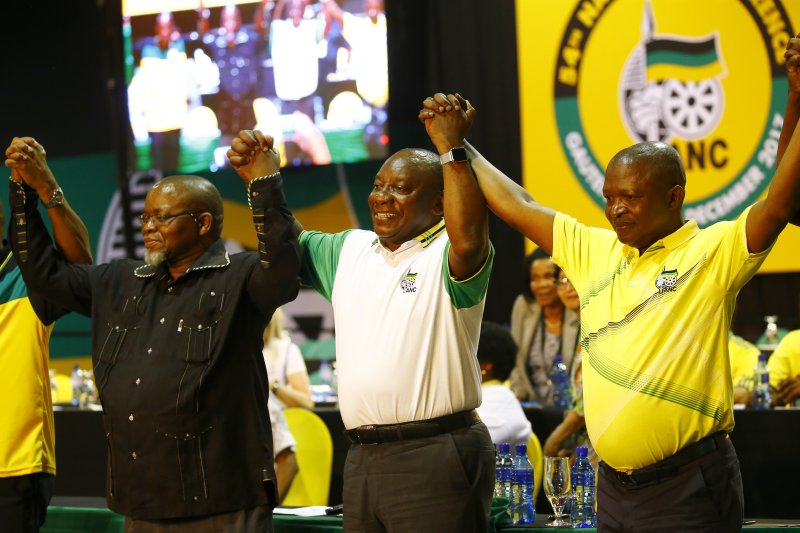
South African Deputy President Cyril Ramaphosa (C) will be nominated Thursday to succeed Jacob Zuma as president of South Africa. Zuma resigned Wednesday. File Photo by Kim Ludbrook/EPA-EFE
Feb. 15 (UPI) -- Cyril Ramaphosa was elected as South Africa's new president Thursday after the departure of embattled leader Jacob Zuma.
The announcement of Ramaphosa, the only candidate nominated in South African Parliament Thursday, was met with singing in the National Assembly.
In December, Ramaphosa was elected leader of the African National Congress. Zuma resigned Wednesday following pressure from the ANC, which said if Zuma didn't resign by the end of the day, proceedings would begin to force him out.
Ramaphosa, 65, drew international acclaim for steering talks that ended apartheid, a system of institutionalized racial segregation, and produced South Africa's first democratic constitution. He has served as country's deputy president since 2014.
The new leader, one of South Africa's richest businessmen, was also chairman of the committee that prepared former President Nelson Mandelafor release from prison in 1990.
As deputy president, Ramaphosa will assume the role of acting president when Zuma steps down. He said his priority is to revive the country's economy, which will be a tough task with South African unemployment at about 30 percent, and nearly 40 percent for young people.
Addressing government corruption is a step that could improve investor confidence and spark more jobs.
Zuma, South Africa's president since 2009, faces nearly 800 corruption allegations stemming from an arms deal from the 1990s. In 2016, he was ordered by South Africa's top court to repay part of $15 million in public funds it said he misappropriated to upgrade his private home.
On Wednesday, eight members of the powerful and wealthy Gupta family were arrested and accused of fraud and money laundering. The Guptas have been accused of using their friendship with Zuma to gain political influence.
Aljona Savchenko and Bruno Massot of Germany collapse to the ice after a nearly flawless performance in the Pairs Figure Skating Free Skating Program during the Pyeongchang 2018 Winter Olympics Thursday at the Gangneung Ice Arena in Gangneung, South Korea. Photo by Richard Ellis/UPI
| License Photo
Feb. 15 (UPI) -- German figure skaters Aljona Savchenko and Bruno Massot claimed the mixed pairs event title Thursday at the Pyeongchang Olympics with a personal best 235.90 points.
Savchenko and Massot won the gold medal in front of more than 5,000 spectators in the sold-out Gangneung Ice Arena. They did so with a flawless routine, featuring a combination of airy triple Salchow plus two double toeloop jumps.
Sui Wenjing and Han Cong won China's second silver medal, with 235.47 points after free skating, 0.43 points away from the top of the podium.
The silver came after Liu Jiayu snatched the silver medal of the women's snowboard halfpipe for China on Tuesday and became the first Chinese snowboard Olympic medalist.
Savchenko and Massot finish in fourth place in the short program.
Skating to Turandot by Giacomo Puccini, Sui/Han received a long-lasting applause and cheers after an infectious program.
However, Han under-rotated a double toeloop jump in the same combination jumps of the German duo's, and then Sui landed unsteady after a side-by-side triple salchow jump at the beginning of the routine, which cost them the championship in the end.
Team gold medallists Meagan Duhamel/Eric Radford of Canada took the bronze medal home with 230.15 points. The only scar of the powerful routine in Adele's Hometown Glory came when Duhamel stumbled on a triple Lutz jump and had her hand touch the ice.
Another Chinese combination, Yu Xiaoyu/Zhang Hao, who have paired up for less than two years, finished 8th with 204.10 points. The first-time Olympian Yu, 22, succumbed to nerve and landed onto the ice after a triple Salchow jump and a throw triple Salchow.
For the host South Korean spectators, their hearts went for Ryom Tae-ok/Kim Ju-sik from the Democratic People's Republic of Korea (DPRK). The confident pair stunned the world in their Olympic debut on Wednesday with a composed routine to finish 11th in the 22-pair short program competition.
Despite an unsynchronized side-by-side double Axel and Ryom's hand touch-landing after a throw triple loop in the long program, the DPRK pair refreshed their personal best with 193.63 points before a loud, adoring DPRK female cheer squad, to finish the 13th out of 16 pairs.
In the team event competition on Monday, Canada won the gold medal, with the OAR claiming the silver and the United States the bronze