MITRA MANDAL GLOBAL NEWS

What Do You Really Eat

Authentic news,No fake news.

Cattle is by far the most susceptible livestock to Bovine TB (animal tuberculosis). Credit: FAO
ROME, Oct 18 2017 (IPS) - The world is running out of antibiotics to combat the growing threat of antimicrobial resistance, the UN World Health Organization (WHO) warned while announcing the World Antibiotic Awareness Week on 13-19 November.
The reason, according to WHO, is that most of the drugs currently in the clinical pipeline are modifications of existing classes of antibiotics and are only short-term solutions. See: The World Is Running Out of Much Needed New Antibiotics
Maria Helena Semedo, Deputy Director-General of the Food and Agriculture Organization of the United Nations(FAO), on 20 September said on Antimicrobial Resistance (AMR), “A stronger global effort, including larger investments and improved surveillance measures, is required to ensure that antimicrobials are used responsibly and in ways that do not threaten public health and food production.”
What is it?


Antimicrobial resistance (AMR) is a major global threat of increasing concern to human and animal health.

It also has implications for both food safety and food security and the economic wellbeing of millions of farming households--FAO

AMR refers to when micro-organisms – bacteria, fungi, viruses, and parasites – evolve resistance to antimicrobial substances, like antibiotics.

This can occur naturally through adaption to the environment, the pace of AMR's spread is now on the uptick due to inappropriate and excessive use of antimicrobials.

Various factors are at play:

• Lack of regulation and oversight of use
• Lack of awareness in best practices that leads to excessive or inappropriate use
• The use of antibiotics not as medicines but as growth promoters in animals
• Over-the-counter or internet sales that make antimicrobial drugs readily availability common
• Availability of counterfeit or poor-quality antimicrobials

As a result of AMR, medicines that were once effective treatments for disease become less so – or even useless, leading to a reduced ability to successfully treat infections, increased mortality; more severe or prolonged illnesses; production losses in agriculture; and reduced livelihoods and food security.

The health consequences and economic costs of AMR are respectively estimated at 10 million human fatalities a year and a 2 to 3.5 percent decrease in global Gross Domestic Product (GDP), amounting to US$ 100 trillion by 2050. However, the full impact remains hard to estimate.

SOURCE: FAO 
“We need surveillance on antimicrobial use and the spread of AMR – not only through hospitals, but throughout the food chain, including horticulture and the environment for more comprehensive risk assessments.”
This was not the first time UN agencies have sounded the alarm about the misuse and abuse of antibiotics both in humans and animals. To learn more, IPS interviewed Dr. Juan Lubroth, Coordinator on AMR and Chief Veterinary Officer at FAO.
Dr Juan Lubroth. Credit: FAO

So, what do you really eat when you order a steak, fish or chicken filet? IPS asked.
“Meat! Meat, and other foods of animal origin are high quality nutritious products that are very important, not least for women and growing children, and especially in the developing world or wherever under- and mal-nutrition are rampant,” Lubroth answers.
There is a widespread misunderstanding that food may contain hazardous antimicrobial residues if an animal was previously treated with these medicines, he said.
“This is not the case if farmers and other producers comply with the rules in respecting the withdrawal periods. These withdrawal periods ensure that the antimicrobial in question has been eliminated from the system of the animal so that the meat, the milk or eggs are fit for human consumption.”
According to Lubroth, the problem with antimicrobial resistance in farming lies in poor management systems where antimicrobials are given routinely and in excessive amounts which in turn drives development of antimicrobial resistance.
“As a consumer, you have the power to make a difference by choosing animal products from sustainable farming systems operated responsibly.”
A farmer and her cattle in Cambodia, which is sharing with other countries its successful experience in dealing with AMR. Credit: FAO

Meantime, farmers need more tools in their toolbox to produce food more sustainably to feed a growing global population expected to reach 10 billion by 2050, said the FAO Chief Veterinary Officer.
“More affordable vaccines and portable diagnostic tests for vets – or physicians, dentists, pharmacists – to accurately diagnose causes of disease will help to reduce reliance on antimicrobials. Innovations in alternatives to antimicrobials such as probiotics are promising too.”

Bacteria, Not Humans, But…
Antibiotics are medicines used to prevent and treat bacterial infections. Antibiotic resistance occurs when bacteria change in response to the use of these medicines.
WHO notes that bacteria, not humans or animals, become antibiotic-resistant. However, these bacteria may infect humans and animals – terrestrial or aquatic – and the infections they cause are harder to treat than those caused by non-resistant bacteria.
The UN estimates that around 700,000 human deaths each year are estimated to be related to antimicrobial resistant infections. Across the globe, AMR further poses a major “threat to food safety and security, livelihoods, animal health and welfare, economic and agricultural development.”
And FAO reports that the intensification of agricultural production has led to an increasing use of antimicrobials – a use that is expected to increase by 67 per cent by 2030.
IPS asked Lubroth how to reconcile the need for antibiotics in food and agricultural production with ensuring human and animal health?
How to balance intensive and extensive production to meet the needs of a growing world population is a difficult and equally important question, he said. “Livestock, aquaculture and crop production needs to be guided by the right policies, ss do the human health sector and the environment sector.”
According to Lubroth, changes needed include better tracking of animals from primary production areas on farms to the market, and products to consumers, as well as regulation of antibiotic use through the approval of a licenced veterinarian, and better hygiene on farms to prevent infections.

Antibiotic resistance is one of the biggest threats to global health today. It poses a major challenge http://www.fao.org/antimicrobial-resi…
“Antimicrobials are essential to ensure animal health and for animal welfare. Sick animals under human care have a right to treatment, however, the routine use of antibiotics for growth promotion must be phased out.”
Lubroth emphasises that a sustainable agriculture sector is essential to safeguard food security and nutrition, development of countries and gender equality around the world, and that food security is a significant factor to achieve stability and peace.
“Optimising production practices such that we can minimize the need for antimicrobials requires investment. In this we all have a role to play, from government policies and investment in the food and agriculture sector, to the producers implementing the necessary practices, and the retailers and consumers where there needs to be a recognition that this does come at a cost and will impact the price of food.”
This is observed in some markets where meat produced “antibiotic-free” retails at a higher price, he said.
According to Lubroth, the best way to assist developing countries is have the enabling conditions for them to produce their own food and to take responsibility for their own national development.
Healthy Animals
The single most important action to create this balance is education – in all sectors, he said. For the food and agriculture sector, it is education about good management practices based on hygiene and care on the farm, which reduce the need to treat livestock or the growing fish. Herd, flock and aquaculture health is key.
“Healthy animals provide food and livelihoods and they do not need antimicrobials… We also need affordable and quick diagnostic tools to be used on the site to get the right treatment for the corresponding disease.”
How? FAO formed an inter-departmental working group on AMR, bringing together multidisciplinary experts. And it supports the agriculture sector to move towards responsible use of antimicrobials, and towards sustainable food production systems, and it is present in the rural communities and in constant dialogue with the farmers on site as well as in the halls of government ministries.

“In the end, this is where the change starts – in the meetings and communications between professionals and farmers.”
FAO is currently active on the ground in more than 25 countries to engage the food and agriculture sector in addressing AMR and provide them with support for implementation.
“But what we can invest is a tiny portion of what is needed by countries, as countries are developing their national action plans they are now starting to also cost their implementation and realise that this is a multimillion dollar investment.”
However, Lubroth explains, the benefit of such investment is multiple as many aspects such as improving biosecurity, implementing good hygiene practices among others can reduce the burden of disease in the production system and also improve the safety of the food produced. In this context it is a worthwhile investment, with great dividends in health.
The Business Sector
The business sector has been signalled as one of the major causes leading to the excessive use and misuse of antibiotics in the food and agriculture and animal production chains.
What is this sector’s response to the world efforts to reduce the misuse and abuse of antibiotics? IPS asked Lubroth.
The business sector is a very important stakeholder in this matter, he answers. They are in close contact with consumer demands and consumer behaviour patterns.
“They are often multinational companies with great potential to put demands on suppliers. And that is what is happening now – we see major food companies putting demands for improved policies on antimicrobial use in the supply chain.”

The Consumers
According to Lubroth, we also see that there are over 6 billion of consumers – their voice can be very powerful and can change industrial or commercial or marketing policies.
“We need to be careful though, so that animal welfare or health are not jeopardized by too strict policies. Sick animals will always need adequate treatment.”

May summit-bound with promise for EU citizens in Britain

Authentic news,No fake news.


BRUSSELS (AP) — Prime Minister Theresa May is heading to a European Union summit Thursday with a solemn pledge to treat EU residents well once Britain leaves the bloc — the latest attempt to reinvigorate the lifeless divorce negotiations.


At EU headquarters in Brussels, May will face 27 EU counterparts who could block her goal of quickly wrapping up the first phase of Brexit talks. The negotiations so far have been limited to the terms of Britain's departure.
May initially hoped that post-divorce issues such as future trade relations could be on the table starting next week. The talks launched earlier this year have stalled over several issues, including the future status of the 3 million EU citizens living in Britain and the 1 million Britons living elsewhere in the bloc. Some of those concerned about what Brexit will mean for them have accused politicians of using them as pawns in the deal-making.
May said in an open letter to EU nationals published Wednesday that "nothing could have been further from the truth." Britain and the EU are in "touching distance" on a deal on citizens' rights deal, the British leader said.
"EU citizens who have made their lives in the U.K. have made a huge contribution to our country," May wrote. "We want them and their families to stay. I couldn't be clearer." May said a "streamlined digital process" overseen by European nationals would be created for EU citizens to register as U.K. residents.
EU leaders such as European Council President Donald Tusk have been waiting for the British government to provide such details. Tusk said on the eve of the summit that for the two sides to meet the goal of completing the first phase of talks by year's end, May must translate her government's intentions into negotiating positions.
Tusk said he was "absolutely sure it is still possible to achieve this final first phase in December but for this we need more concrete proposals from the British side, to be honest." The EU to discuss future relations with Britain until there is "sufficient progress" on three issues: citizens' rights, a transparent Irish border and Britain's exit tab.
The outstanding costs Britain needs to pay for commitments it made as an EU member remains an obstacle. Britain has floated a bill of 20 billion euros ($23.6 billion.) The starting price for the rest of EU is 50 billion euros ($60 billion.)
Asked whether 20 billion euros was "peanuts" compared to what Britain owes, Tusk said, "I have never seen 20 billion peanuts in my life." May and EU Commission President Jean-Claude Juncker committed to "accelerate" the talks this week. Tusk said he would tell leaders of the other EU countries that even December is a tight deadline for getting the three preliminary issues resolved.
"I don't expect any kind of breakthrough" at the summit, Tusk said. "We have to work really hard between October and December to finalize this so-called first phase," he said. While the June 2016 referendum that called for Britain to pull out of the EU has created political chaos in London, the other EU nations have recovered from the initial shock and stood side by side throughout the negotiations.
May has personally lobbied German Chancellor Angela Merkel and French President Emmanuel Macron to side with Britain on jump-starting the talks to encompass a future relationship. The other 27 leaders instead are expected to huddle over strategy for staying united during talks on post-Brexit trade that could start in late December.
Officials say the negotiations should conclude by November 2018 at the latest to finish off the complicated approval process by March 29, 2019, when Britain is supposed to leave.
Lawless reported from London

Bank under obligation to protect consumers interests: Forum

Authentic news,No fake news.

Bank under obligation to protect consumers interests: Forum

The Mumbai Consumer Redressal Forum has directed the Punjab National Bank not to close the account of a lawyer over alleged rude behaviour.
It also asked the lawyer, a senior citizen, to maintain cordial relations with the bank.
“The opponent bank is not entitled to close account of complainant,” the forum ruled after Harish Bhatia approached it, saying the bank had threatened to close his account of 30 years.
Bhatia said during a visit to the Kandivli branch of the bank in May 2011 he saw an unknown person giving orders to customers. He said when he complained about it to the authorities concerned, he found their approach very casual.
Bhatia told the forum that there was exchange of letters between him and the bank, and later he was threatened with closure of the account.
He had approached the forum seeking a direction to the bank not to discontinue his account and seeking a compensation of Rs 25,000.
The bank denied all the allegations before the forum and said Bhatia, a practising lawyer, behaved in an uncivilised manner.
“We have carefully perused the documents filed on record. The letter sent by the bank to the complainant (about closing his account) is not justified.
“There is no evidence on record to justify the said notice. The single instance which occurred due to provocation is not sufficient for parting relationship as consumer,” observed the bench of forum president SD Madake and member SV Kalal.
The relation between the complainant and the bank is based on trust. The bank is under an obligation to protect the interests of consumers and render all possible help when he enters in the bank premises, the forum said.
“Bhatia being an old customer of bank and an experienced lawyer was under an obligation to promote fair and cordial relationship with the bank,” the forum observed.
“We are of the view that Bhatia failed to have patience at the relevant time as a result of which the relations came under strain. The bank is entitled to take reasonable steps as per law, if aggrieved by conduct of the complainant, but complainant cannot be denied his right to operate his account,” it said.

Metal-Eating Bacteria Could Have Left their “Fingerprints” on Mars, Proving it Once Hosted Life

Authentic news,No fake news.


Matt Williams à¤¦्वारा
Today, there are multiple lines of evidence that indicate that during the Noachian period (ca. 4.1 to 3.7 billion years ago), microorganisms could have existed on the surface of Mars. These include evidence of past water flows, rivers and lakebeds, as well as atmospheric models that indicate that Mars once had a denser atmosphere. All of this adds up to Mars having once been a warmer and wetter place than it is today.
However, to date, no evidence has been found that life ever existed on Mars. As a result, scientists have been trying to determine how and where they should look for signs of past life. According to a new study by a team of European researchers, extreme lifeforms that are capable of metabolizing metals could have existed on Mars in the past. The "fingerprints" of their existence could be found by looking at samples of Mars' red sands.
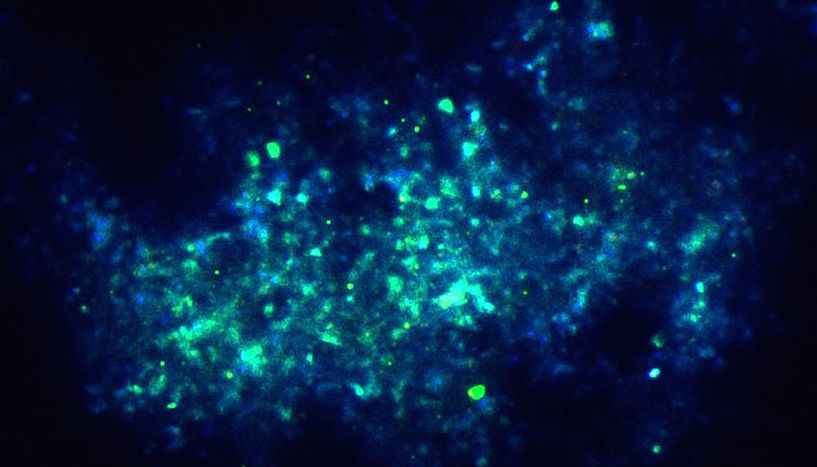
For the sake of their study, which recently appeared in the scientific journal Frontiers of Microbiology, the team created a "Mars Farm" to see how a form of extreme bacteria might fare in an ancient Martian environment. This environment was characterized by a comparatively thin atmosphere composed of mainly of carbon dioxide, as well as simulated samples of Martian regolith.
Metallosphaera sedula grown on synthetic Martian Regolith. The microbes are specifically stained by Fluorescence-In-Situ-Hybridization (FISH). Credit: Tetyana Milojevic
They then introduced a strain of bacteria known as Metallosphaera sedula, which thrives in hot, acidic environments. In fact, the bacteria's optimal conditions are those where temperatures reach 347.1 K (74 °C; 165 °F)  and pH levels are 2.0 (between lemon juice and vinegar). Such bacteria are classified as chemolithotrophs, which means that they are able to metabolize inogranic metals - like iron, sulfur and even uranium.
These stains of bacteria were then added to the samples of regolith that were designed to mimic conditions in different locations and historical periods on Mars. First, there was sample MRS07/22, which consisted of a highly-porous type of rock that is rich in silicates and iron compounds. This sample simulated the kinds of sediments found on the surface of Mars.
Then there was P-MRS, a sample that was rich in hydrated minerals, and the sulfate-rich S-MRS sample, which mimic Martian regolith that was created under acidic conditions. Lastly, there was the sample of JSC 1A, which was largely composed of the volcanic rock known as palagonite. With these samples, the team was able to see exactly how the presence of extreme bacteria would leave biosignatures that could be found today.
As Tetyana Milojevic - an Elise Richter Fellow with the Extremophiles Group at the University of Vienna and a co-author on the paper - explained in a University of Vienna press release:
"We were able to show that due to its metal oxidizing metabolic activity, when given an access to these Martian regolith simulants, M. sedula actively colonizes them, releases soluble metal ions into the leachate solution and alters their mineral surface leaving behind specific signatures of life, a 'fingerprint', so to say."
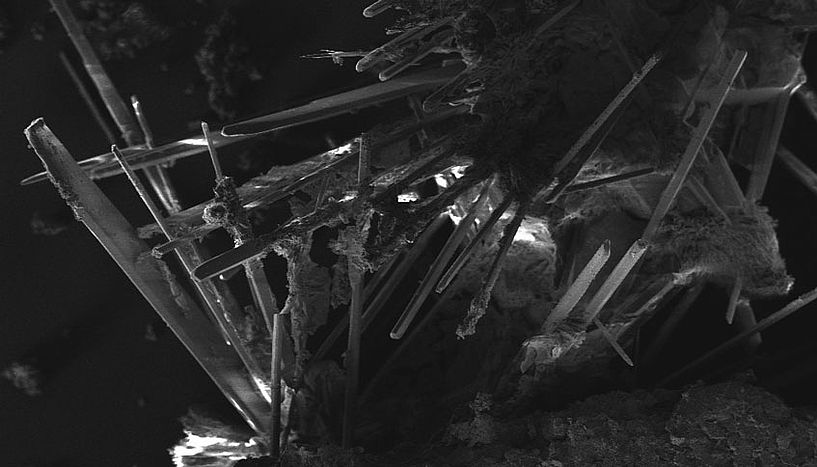
Microspheroids containing mostly aluminium and chlorine overgrow the mineral surface of synthetic Mars regolith. These microspheroids can only be observed after cultivation of Metallosphaera sedula Credit: Tetyana Milojevic
The team then examined the samples of regolith to see if they had undergone any bioprocessing, which was possible thanks to the assistance of Veronika Somoza - a chemist from the University of Vienna's Department of Physiological Chemistry and a co-author on the study. Using an electron microscope, combined with analytical spectroscopy technique, the team sought to determine if metals with the samples had been consumed.
In the end, the sets of microbiological and mineralogical data they obtained showed signs of free soluble metals, which indicated that the bacteria had effectively colonized the regolith samples and metabolized some of the metallic minerals within. As Milojevic indicated:
"The obtained results expand our knowledge of biogeochemical processes of possible life beyond Earth, and provide specific indications for detection of biosignatures on extraterrestrial material - a step further to prove potential extra-terrestrial life."
In effect, this means that extreme bacteria could have existed on Mars billions of years ago. And thanks to the state of Mars today - with its thin atmosphere and lack of precipitation - the biosignatures they left behind (i.e. traces of free soluble metals) could be preserved within Martian regolith. These biosignatures could therefore be detected by upcoming sample-return missions, such as the Mars 2020 rover.
Biotransformed synthetic Martian Regolith after Metallosphaera sedula cultivation. Credit: Tetyana Milojevic
In addition to pointing the way towards possible indications of past life on Mars, this study is also significant as far as the hunt for life on other planets and star systems is concerned. In the future, when we are able to study extra-solar planets directly, scientists will likely be looking for signs of biominerals. Among other things, these "fingerprints" would be a powerful indicator of the existence of extra-terrestrial life (past or present).
Studies of extreme lifeforms and the role they play in the geological history of Mars and other planets is also helpful in advancing our understanding of how life emerged in the early Solar System. On Earth too, extreme bacteria played an important role in turning the primordial Earth into a habitable environment, and play an important role in geological processes today.
Last, but not least, studies of this nature could also pave the way for biomining, a technique where strains of bacteria extract metals from ores. Such a process could be used for the sake of space exploration and resource exploitation, where colonies of bacteria are sent out to mine asteroids, meteors and other celestial bodies.

All Jobs | Entrance Exams | Notifications

Authentic news,No fake news.

Posted: 17 Oct 2017 11:11 PM PDT
ONGC Agartala Recruitment Oil and Natural Gas Corporation Limited has announced a new notification of jobs to appoint applicants on vacant 187 vacancies for the post of apprentices. To clutch this opportunity of career deserving and optimistic job seekers should go to till last word and apply in offline way on or before dead line. Honest and humble contenders are required to go through the
Posted: 17 Oct 2017 09:53 PM PDT
Bank Jobs Bank Jobs Notification for Upcoming Exams will be issued as soon as we will get information from any bank which is running in our country Indian. A very clear step is moving forward by all banks that are Online Application Forms have been started because in offline process several forms could not reach to office of organization and it is true. Bank Jobs Latest Updates District
Posted: 17 Oct 2017 09:49 PM PDT
District Cooperative Bank Recruitment Right now duly filled Online Application Form is invited from all capable and willing applicants by District Cooperative Bank Thane for a notification of jobs to fill various 205 vacancies for the posts of General Manager, Senior Banking Assistant, Peon/Sipahi, Junior Banking Assistant and Watchman. To select the appliers there will be conducted written
Posted: 18 Oct 2017 06:35 AM PDT
JSSC Syllabus An advertisement of JSSC Syllabus PDF has released by Jharkhand Staff Selection Commission for all job seekers who have applied  for revenue employee/ SI/ constable position. Curious and capable job finders are now at right site to get proper syllabus easily. On this web page we are also publishing new details regarding syllabus for revenue employee/ SI/ constable exam so that
Posted: 18 Oct 2017 06:28 AM PDT
VITEEE Study Material Hello and welcome all appliers who are looking for VITEEE Study Material so that they may Download it easily to start the Preparation for exam. Form this post, students can also get the Model Papers to know the types of the upcoming as well as asked questions.  Vellore Institute of Technology Engineering Entrance Exam will be commenced as per schedule on 1st week of April
Posted: 18 Oct 2017 06:29 AM PDT
CAT Exam Eligibility Criteria By watching the compititon and necessity of the time this year some changes are also done in CAT Exam Eligibility Criteria so that excited applicants may take part in this competitive exam. Such appliers who are fully ready to appear in the Common Aptitude Test they are suggested to match their Age, Qualification Details with the asked eligibilities. To apply for
Posted: 18 Oct 2017 05:20 AM PDT
DHFWS Recruitment District Health & Family Welfare Society (DHFWS), West Bengal has provided a new notification of careers to fill up of latest 216 vacancies for the posts of ASHA Worker (Only Female). Eligible and home state resident ladies job are suggested to cash this chance by sending application with all documents on or before last date. Keen desired and minimum educated applicants who
Posted: 18 Oct 2017 05:47 AM PDT
AIIMS Raipur Syllabus AIIMS Raipur Syllabus is declared in easy view on this article by All India Institute of Medical Sciences for those candidates, who have applied for any of the offered such as Technical Officer, JRO, MCWO, Technician and other. Exam Pattern is required to check by all such willing candidates, who are excited to appear in recruitment exam for various posts. Those job
Posted: 18 Oct 2017 05:43 AM PDT
Sainik School Satara Admission Sainik School Satara needs the news students for available therefore an updated notification of admission is released just now. Now willing participants who are young they are suggested to suibmit Rewa Admission Form either online or offline latest by final date. Deserving appliers who will get high marks in the test they can get Admission in Class VI and IX
Posted: 18 Oct 2017 05:30 AM PDT
Sainik School Korukonda Admission Sainik School Korukonda has circulated a new advertisement before commence All India entrance examination for an opportunity of admission to dedicated appliers in either in Class VI or class IX. First of all aspirants will have to submit VI & IX AISSSE Form then start preparation for competitive exam. Online Application form is invited from capable applicants
Posted: 18 Oct 2017 05:09 AM PDT
ONGC Vadodara Apprentice Recruitment Recently Oil And Natural Gas Corporation Limited (ONGC) is back again with an updated announcement of jobs for filling up of several 275 vacancies for the Posts of Laboratory Assistant (Chemical Plant), Accountant, Computer Operator and Programming Assistant, Draughtsman (Civil), Welder (Gas & Electric), Store Keeper and others. Online as well as offline
Posted: 18 Oct 2017 04:50 AM PDT
ONGC Ankleshwar Recruitment Oil And Natural Gas Corporation Limited (ONGC) Gujarat has delivered a new notification of employment for filling up of vacant 486 vacancies for the Posts of Accountant, Computer Operator and Programming Assistant, Draughtsman (Civil), Welder (Gas & Electric), Store Keeper and others. Online application form is invited from motivated and best fit appliers on or
Posted: 17 Oct 2017 10:38 PM PDT
GPCB Recruitment Gujarat Pollution Control Board (GPCB has brought up a new notification of jobs to fill up latest 101 vacancies for the posts of Scientific officer, Asst. Environment Engineer, Junior Officer, Public Relations Officer, Senior Scientific Assistant and Senior Clerk. Experienced and motivated job grabbers must apply online before last date. Keen desired and energetic applicants
Posted: 18 Oct 2017 05:21 AM PDT
Medical Jobs Those candidates who are looking to get a medical job but do not have any knowledge about it such people are advised to read this webpage very carefully because here in this webpage our experts will you the details regarding medical job for fresher in government department or in private sector. Candidates who fulfills the basic eligibility criteria to get a medical job will surely
Posted: 17 Oct 2017 09:54 PM PDT
Jobs in Mumbai Candidates who are looking to get a job in Mumbai have reached on a perfect website because here in this webpage our experts will guide you towards your success. There many opportunities in Mumbai in both government sector as well as in private sector. Every year huge number of people come in Mumbai in search of a good job and many of them get success but many of them do not get
Posted: 18 Oct 2017 05:08 AM PDT
Jobs in Gujarat Those who are eager to work in one of the most beautiful state of India i.e. Gujarat should read this webpage. Here our experts will give you all the details related to getting jobs in Gujarat. We have received huge number of demand for making the webpage for jobs in Gujarat. That is why we will inform you each and every step of getting job in Gujarat in both the sectors.
Posted: 18 Oct 2017 05:21 AM PDT
10th 12th Jobs Hello and welcome to all the candidates who have just qualify 10th 12th classes with good marks. Dear aspirants as present the time require skilled and energetic guys for any job but for a lot of posts simple educate applicants are also required. In the same way we brought 25000+ Jobs Opportunities for class Xth/ XIIth pass outs. These chances of jobs are available eithe

Up to 100 Million Girls Vulnerable to Child Marriage

Authentic news,No fake news.

Rashmi Hamal is a local heroine who helped to save her friend from an early marriage. She campaigns actively against child marriages in the Far Western Region of Nepal. Credit: Naresh Newar/IPS
UNITED NATIONS, Oct 12 2017 (IPS) - Over 20,000 girls are married before the age of 18 every day around the world as countries continue to lack legal protections, according to a new study.
Concerned over the lack of progress, Save the Children and the World Bank teamed up to research child marriage laws around the world and found a dismal picture.
Globally, even in countries that restrict the practice, almost 8 million girls are married illegally under the age of 18 each year, making up 60 percent of child marriages.
“It is such a critical issue for young girls around the world…but also for her future family and health of her children later as well,” President and CEO of Save the Children Carolyn Miles told IPS.
Marriage often has irreversible impacts on child brides who are at greater risk of poor health outcomes, living in poverty, and dropping out of school.
In fact, loss of access to education appears to be both a cause and consequence of child marriage.
Around the world, 32 million primary school and 29 million lower-secondary school-aged girls are out of school. Such girls are more likely to be married as children, Miles noted.
“For girls, being in school is a protective mechanism really,” she said.
Girls who marry also often forced to leave school, and many find it difficult to return after marriage due to social pressure, domestic responsibilities, and even government policies.
In Tanzania, schools are allowed to expel or exclude students who are married or become pregnant.
By undermining their basic rights to education, girls’ life opportunities become limited, creating a domino effect that impacts the well-being of societies at large.
Some nations have made progress towards ending child marriage, including Mexico, Nepal, and Zimbabwe, all of which either raised the minimum age for marriage or eliminated exceptions to the practice.
However, many countries still allow girls to be married before 18 with parental or judicial consent while others still retain a lower legal age for marriage.
Bangladesh, for example, recently passed a law to allow girls below 18 to be married in “special cases,” setting back progress towards ending child marriage.
While stories of child marriage are commonly associated with the Global South, countries like the United States are also guilty of the practice.
Across all 50 states, marriage before the age of 18 has remained legal as some lack any minimum marital age while others allow exceptions such as parental and judicial consent.
Most recently, New Hampshire rejected a bill to increase the age of marriage from 13 to 18 while New Jersey vetoed a ban on marriage under the age of 18.
When considering parental and judicial exceptions, Save the Children and the World Bank found that close to 100 million girls around the world are not legally protected against child marriage.
The organizations also found that two-thirds of all child marriages take place even in countries where the practice is banned, indicating a lack of enforcement of marriage laws.
Bangladesh, despite having set a minimum age of 18, has one of the highest rates of child marriage in the world with 65 percent of girls married before the age of 18.
West and Central Africa sees 1.7 million illegal child marriages every year, making it one of the highest proportions globally.
Legal reforms alone are therefore not enough to end the harmful practice, Miles said.
“It’s about trying to change the local customs or belief that it’s okay for a girl to be married,” she told IPS.
“Yes, we need laws and yes, we need laws that aren’t going to be circumvented, but we also need to change beliefs and these underlying issues,” Miles continued.
Among such laws is a legal age of 18 for marriage and the elimination of parental and judicial exceptions.
The report also highlighted the need for countries to adopt clear interventions to delay marriage and to increase investment in the poorest and most marginalized girls in areas such as safe, accessible, affordable, and quality education.
Efforts are also needed to address discrimination and social norms that prevent girls from attending school and limit their future opportunities.
“Investing in such interventions, documenting their impacts, and implementing a broad range of gender transformative policies will all be key to ensuring a better future both for girls and countries as a whole,” the report concludes.
The globally adopted Sustainable Development Goals (SDGs) recognizes the harmful practice and includes a target to eliminate child marriage by 2030.
The report was launched ahead of an African-led High Level Meeting on Ending Child Marriage where there are high hopes that it could be a turning point to move the continent away from the practice.

Mitra-mandal Privacy Policy

This privacy policy has been compiled to better serve those who are concerned with how their  'Personally Identifiable Inform...