MITRA MANDAL GLOBAL NEWS

Ending Poverty Means Boosting Resilience Now

Authentic news,No fake news.

Dominica, 2 October Devastation after Hurricane Maria. Credit: Ian King/UNDP
UNITED NATIONS, Oct 17 2017 (IPS) - This month the world marks two key International Days: for the Eradication of Poverty on 17 October and for Disaster Reduction, four days earlier. It is no coincidence that they are profoundly connected.
Reducing risks related to disasters has never been so urgent—and the Latin America and the Caribbean region bears witness to this. Seven hurricanes have hit the Caribbean in the past five months, two of them as category 5, causing catastrophic damage, including in island nations that were barely recovering from another massive hurricane that struck one year ago.
Also, two earthquakes rocked Mexico in September—with almost 5.000 aftershocks—while another powerful quake struck Ecuador in April 2016. In addition, both Colombia and Peru suffered major landslides in the past eight months.
The number of children, women and men killed is deeply saddening, especially in an era in which we have the knowledge to minimize loss of lives due to natural events. Yet, we keep experiencing tragedies.
The fact is that natural disasters do not exist. Such phenomena become disasters when people, communities and societies are vulnerable to them. This, in turn, translates into losses—of lives and assets. And the poorest are the hardest hit.
On the one hand, poverty reduces people’s capacity to face and recover from disasters; on the other hand, disasters also hinder people’s ability to leave poverty behind.
That’s why if the world is to end poverty in all its forms by 2030 we must also boost resilience—in all its forms. This means the capacity to cope with shocks without major economic, social and environmental setbacks.
A disaster of natural causes, a financial crisis, an economic slowdown or a health problem in the family can all causepeople to fall into poverty—especially those who barely managed to leave it behind, as one of our recent UNDP report shows; unless a ‘cushion’ is in place to help absorb the impact, such as social protection systems or physical assets.
In this particular moment, it is crucial to take special notice of what the Caribbean is experiencing. Two back-to-back hurricanes, Irma and Maria, were the most powerful ever recorded over the Atlantic. They forced—for the first time ever—the island of Barbuda to evacuate its entire population.
These colossal phenomena battered several Caribbean countries with deadly waves and maximum sustained winds of nearly 300 km/h for up to three full days. They decimated Barbuda, Dominica and Saint Maarten, also impacting some of the region´s disaster-preparedness champions, like Cuba and the Dominican Republic.
What we have just witnessed is a game changer. And it will likely be the new norm. That’s why we need urgent action.
It’s a fact. Climate change—and all natural hazards—hit Small Island Developing States (SIDS) hard, even though these countries haven’t historically contributed to the problem. Having lived and worked in four Caribbean countries I have witnessed firsthand how such nations are extremely vulnerable to multiple challenges ranging from debt and unemployment to climate change and sea level rise.
Clearly, if countries do not reduce their vulnerabilities and strengthen their resilience—not only to natural disasters but also to any shock—we won’t be able to guarantee, let alone expand, progress in the social, economic and environmental realms.
Since the hurricanes hit we have been working on the ground in affected Caribbean countries supporting Governments to build back better—with more resilient communities—so they are prepared for the next hurricane season only eight months ahead. This is essential: international cooperation and the private sector play a key role with investments in resilient infrastructure.
If Caribbean countries are to achieve the Sustainable Development Goals in 13 years they need urgent accessing to financing—including for climate change adaptation. However, the vast majority of Caribbean SIDS are ranked as middle-income countries—with per capita income levels above the international financial eligibility benchmark—and are shunned from receiving financing for development.
In view of such urgent needs, our Caribbean Human Development Report “Multidimensional Progress: human resilience beyond income”, launched a year ago, called for improved standards that take into account multiple indicators, or well-being measurements beyond income alone.
Now is the moment to act on climate change, support countries as they build back better and rethink traditional development ranking methods based on monetary aspects alone.
If the world has vowed to eradicate poverty by 2030 we need to invest in boosting communities’, countries’ and entire regions’ resilience in the social, economic and environmental fronts. Reducing vulnerabilities—in its multiple aspects—is a crucial path to leave no one behind.

Afghanistan: Taliban kill 71 people in attacks

Authentic news,No fake news.


KABUL, Afghanistan (AP) — The Latest on developments in Afghanistan where the Taliban have staged several attacks targeting police across the country (all times local): 6:10 p.m. Afghanistan's deputy interior minister says the Taliban have killed 71 people in attacks in Ghazni and Paktia province.


The official, Murad Ali Murad, told a press conference in Kabul that the attacks on Tuesday were the "biggest terrorist attack this year." He says in one of the attacks, in southern Paktia province, 41 people — 21 policemen and 20 civilians — were killed when the Taliban targeted a police compound in the provincial capital of Gardez with two suicide car bombs. Scores were also wounded — 48 policemen and 110.
The provincial police chief was among those killed in the Paktia attack. Murad says that in the attack in Andar district in Ghazni province, 25 policemen were killed and also five civilians. At least 15 people were wounded, including 10 policemen.
Despite the staggering numbers, Murad said Afghan forces are confident in their "readiness to fight terrorists and eliminate them from Afghanistan.
5:30 p.m.
An Afghan official has raised the death toll from a Taliban attack in the country's south, saying 15 policemen and five civilians were killed in Ghazni province.
The insurgents stormed a security compound in Andar district, using a suicide car on Tuesday.
Arif Noori, spokesman for the provincial, says the attack lasted nine hours and also left 24 policemen and 20 civilians wounded. Noori says that by the time the attack was repelled, there were 13 bodies of Taliban fighters on the ground.
It was one in a wave of attacks by the Taliban that targeted police across Afghanistan on Tuesday.
3:15 p.m.
Afghanistan's Ministry of Interior says a Taliban attack on a police compound in eastern Paktia province that began earlier in the day is over.
The statement says Tuesday's attack began with two suicide car bombings. The vehicles were packed with explosives when the Taliban targeted the facility in Gardez, the Paktia provincial capital.
It says that after the two cars blew up, five attackers with suicide belts tried to storm the compound. Afghan security forces "killed all five terrorist."
The statement also says the attack killed the provincial chief of police, Toryalai Abdyani, and killed and wounded a number of others. It says detailed casualty figures would be released later.
1:45 p.m.
An Afghan health official says a Taliban attack on a police training center in the country's eastern Paktia province has killed at least 14 people, including civilians.
Health Ministry spokesman Waheed Majroo says that dozens were also wounded in the attack on Tuesday in Gardez, the provincial capital. He says the city hospital reported receiving 130 wounded in the attack, which included a suicide bombing.
Hamza Aqmhal, a student at the Paktia University, told The Associated Press that he heard a very powerful blast. He says it shattered glass and broke all the windows at the building he was in. He says the university is about 2 kilometers (1.25 miles) from the training academy.
Aqmhal says he was slightly injured by the glass.
A lawmaker from Paktia, Mujeeb Rahman Chamkni, says the provincial chief police, Toryalai Abdyani, and several of his staff were among those killed in the attack.
He says most of the casualties are civilians who had come to the center, which also serves a government passport department.
Reports from Gardez say the attack there is still underway.
11 a.m.
Afghan officials say Taliban attacks in the country's south, west and east have killed at least 10 policemen.
In southern Ghazni province, the insurgents stormed a security compound, using a suicide car, and killed at least seven policemen. Provincial chief police, Mohammad Zaman, says the attack in Andar district early on Tuesday morning triggered several hours of heavy fighting until the attackers were repelled.
Zaman says the district compound has been destroyed.
In western Farah province, police chief Abdul Maruf Fulad says the Taliban attacked a government compound in Shibkho district, killing three policemen.
The Interior Ministry says a militant attack, including a suicide car bombing is underway in eastern Paktia province's capital, Gardez, where insurgents targeted a police training center.
The Taliban have claimed responsibility for all three attacks.

Tuesday News Briefing

Authentic news,No fake news.


logo-reuters-news-now

Tuesday, October 17, 2017

A firefighter is seen near flames from a forest fire in Cabanoes, near Lousa, Portugal, October 16, 2017. REUTERS/Pedro Nunes


Washington

Like the deal-maker he says he is, U.S. President Donald Trump appears to be keeping his options open as his Republican Party threatens to erupt into full-scale war. Former strategist SteveBannon, who helped mastermind Trump’s election campaign but left the White House in August, appeared at a gathering of conservative activists and declared: “Right now, it’s a season of war against a GOP establishment.” 

Trump declared Obamacare “dead” and “gone,” but urged Republicans and Democrats in Congress to craft a short-term fix of healthcare markets under the 7-year-old law that critics say he has effectively sabotaged. 

Senate Republicans gained crucial support for a vote on a budget resolution that is vital to Trump’s hopes of signing sweeping tax reform legislation into law before January.

A judge questioned attorneys defending the Trump administration about a classified report the government is using to justify its latest ban on citizens of some countries from entering the United States. 

Reuters TV: Trump and McConnell try to bury their feud.


Business

World equity markets held close to all-time highs, as investors latched on to rising bets on higher borrowing costs in the U.S. and Britain. 

Airbus has agreed to buy a majority stake in Bombardier CSeriesjetliner program, giving a powerful boost to the Canadian plane and train maker in its costly trade dispute with Boeing. The deal, which would come at no cost for Europe’s largest aerospace group, would give Airbus a 50.01 percent interest in CSeries Aircraft Limited Partnership, which manufactures and sells the jets, the companies said. 

Trade ministers from the United States, Canada and Mexico wrap up a contentious round of NAFTA trade talks marked by aggressive U.S. demands that have left the future of the 23-year-old free trade pact in doubt. The proposals to drastically reshape the North American Free Trade Agreement to help shrink U.S. trade deficits have cast a pall over the modernization talks, leaving some participants and analysts wondering how the NAFTA partners can avoid an impasse.

Netflix added more subscribers than expected around the world in the third quarter and projected growth in line with Wall Street forecasts, saying it had a head start on rivals as internet television explodes globally.

Embattled Kobe Steel said the U.S. Justice Department is asking the steelmaker to provide documents related to its data falsification scandal. That came after a source with knowledge of the matter told Reuters that data tampering on products went on for more than a decade, deepening the crisis that has sliced off about $1.6 billion off its market value in just over a week. 


World

Iraqi forces completed an operation to take control of all oil fieldsoperated by state-owned North Oil Company in the Kirkuk region, a senior military officer said. 

U.S.-backed militias have completely taken Syria’s Raqqa from Islamic State, the Syrian Observatory for Human Rights said. The fall of Raqqa city, where Islamic State staged euphoric parades after its string of lightning victories in 2014, is a potent symbol of the jihadist movement’s collapsing fortunes. 

Hate crimes in Britain surged by the highest amount on record last year, official figures showed, with the vote to leave the European Union a significant factor.


The sun is seen after the Met Office reported that storm Ophelia has drawn dust north from the Sahara, near Exeter, Britain, October 16, 2017. REUTERS/Toby Melville


Philippine President Rodrigo Duterte declared the southern city of Marawi liberated from pro-Islamic State militants, although the military said 20-30 rebels were holding about 20 hostages and still fighting it out. 

Taliban suicide car bombers and gunmen attacked a provincial Afghan police headquarters, killing at least 33 people, including the police chief, and wounding 160, in the deadliest of a series of attacks across the country, officials and militants said. 

The son of Malta’s best-known investigative journalist said his mother was killed by a car bomb because of her work exposing political corruption. Daphne Caruana Galizia, who wrote about graft across Malta’s political divides on her blog, was murdered on Monday soon after she left her home in the north of the island.


China

China’s official Xinhua news agency attacked Western democracyas divisive and confrontational, praising on the eve of a key Communist Party Congress the harmony and cooperative nature of the Chinese system. 

Nothing will concentrate the minds of North Korean leaders more than a Chinese oil embargo. Nearly 90 percent of the country’s petroleum comes across the border, giving Beijing enormous  leverage. Read more with Breakingviews.


North Korea

The United States is not ruling out the eventual possibility of direct talks with North Korea, Deputy Secretary of State John J. Sullivan said, hours after Pyongyang warned nuclear war might break out at any moment. 

North Korea warned countries at the United Nations in a statement: don’t join the United States in military action against the Asian state and you will be safe from retaliation.

Cyber-security firm BAE Systems said it believes the North Korean Lazarus hacking group is likely responsible for a recent cyber heist in Taiwan, the latest in a string of hacks targeting the global SWIFT messaging system. 


Cyber

Microsoft’s secret internal database for tracking bugs in its own software was broken into by a highly sophisticated hacking groupmore than four years ago, according to five former employees, in only the second known breach of such a corporate database. 


Commentary: China’s ‘Big Brother’ tech gives surveillance new reach

China’s President Xi Jinping and those around him are using technological breakthroughs to cement their power and increase mass surveillance of their citizens, writes columnist Peter Apps. Chinese researchers have developed programs that can identify people simply by their walking styles; CCTV feeds are often broadcast live online and authorities are developing a data-gathering plan to allocate a "social credit score" designed to predict who might be a disruptive influence. "This push for loyalty will form a quiet backdrop to proceedings at the 19th National Congress of the Communist Party in Beijing this week," says Apps.

Ending Hunger by 2030? This is Possible

Authentic news,No fake news.

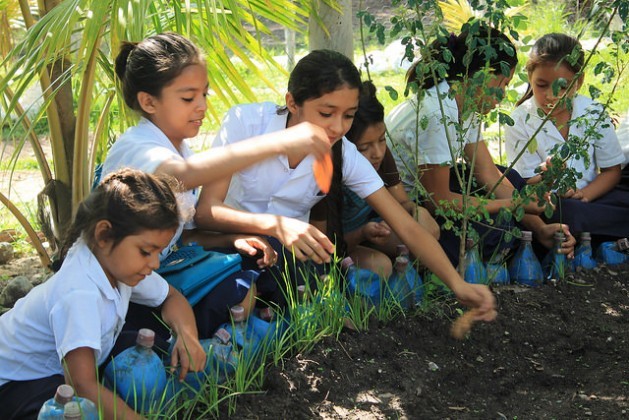
World Food Day - Students at a school in an indigenous village in western Honduras work in the school garden, where they learn about nutrition and healthy eating. Since 2016 Honduras has a law regulating a new generation oschool meals programme, which focuses on a healthy diet and serves fresh food from local family farmers and school gardens. Credit: Thelma Mejía/IPS
Students at a school in an indigenous village in western Honduras work in the school garden, where they learn about nutrition and healthy eating. Since 2016 Honduras has a law regulating a new generation of school meals programme, which focuses on a healthy diet and serves fresh food from local family farmers and school gardens. Credit: Thelma Mejía/IPS
RALEIGH, NORTH CAROLINA, Oct 11 2017 (IPS) - The Food and Agriculture Organization (FAO) recently announced that the number of hungry people in the world has increased by 38 million in the past year due to climate change, conflict and slow economic growth. Given this setback, can we, in fact, end hunger in our lifetime? The answer is a resounding, Yes, we can. The first step is simply wrapping our minds around the reality that—yes—ending hunger is possible.
Tremendous strides have been made over the last two decades as the percentage of the world’s population suffering from hunger has decreased from 24 percent to 11 percent. We are on such a trajectory to end hunger that the United Nations established Sustainable Development Goal #2 – to achieve food security and improved nutrition, and promote sustainable agriculture in our lifetime—by the year 2030.
Clearly, we have work to do to achieve this ambitious goal, which is not in some far distant future. Complacency and business as usual will not get the job done. To be successful, we must not perceive an end to hunger as one large and daunting task. Hunger should be examined as a group of problems that—when viewed as separate, smaller issues—can be tackled through multiple, obtainable goals.
The journey out of poverty and hunger for millions of people can come to a long-awaited end if we create the political and moral will to do so and we act strategically by nourishing lives, empowering communities, providing emergency relief during crisis and growing the movement to end hunger.
Nutrition serves as an incentive for parents in poverty stricken areas to send their children to school. For many kids, humanitarian meals become a physical symbol of hope.
One of the most effective ways to break the cycle of poverty is through school feeding programs. Hunger is a barrier to education, which is in turn a barrier to steady employment, health, infrastructure and economic growth. A school principal in Kenya summarized this best during a visit in his community: without the meals provided by organizations like Rise Against Hunger, kids don’t come to school.
If they fail to come to school, there is no education. Without education, there’s no hope for transformation, and the cycle of poverty continues. Nutrition serves as an incentive for parents in poverty stricken areas to send their children to school. For many kids, humanitarian meals become a physical symbol of hope.
We know that through providing nutrition today, we can change lives and build strong communities for tomorrow. We do so by empowering these communities to become self-sufficient, to learn sustainable farming practices and by stimulating economic growth that improves their resilience during times of strife.
Putting all these pieces into practice may seem staggering, but that’s why organizations like the UN and World Food Programme (WFP) are in place, to provide the data, science and international infrastructure needed to tackle this problem. But, I’m telling you—the ways to end hunger are scalable and it starts with each of us. There’s no need to purchase a plane ticket or even leave your hometown to participate in ending world hunger.
Local meal packaging events are the first step to providing nutrition to the world’s most vulnerable people. Your age, gender, faith, political affiliations—none of these preclude you from taking a small action—that when multiplied by individuals and communities around the world, will help feed the 815 million people who do not have enough food to live a healthy, productive life.
As October 16— World Food Day —approaches, let us be reminded of what we can achieve through working together, by becoming educated, participatory advocates for the world’s hungry. The world has enough production potential. Ending hunger by 2030 is at your fingertips. This is possible.
This article is part of a series of stories and op-eds launched by IPS on the occasion of this year’s World Food Day on October 16.

Teenager becomes UK's youngest millionaire

Authentic news,No fake news.


London, Oct 16 (PTI)
 An Indian-origin teenager has become one of Britain's youngest millionaires after his online estate agency business got valued at 12 million pounds in just over a year.

Akshay Ruparelia, at just 19 years of age, juggled his school work with negotiating property deals for his no-frills business that offers to sell properties for a fraction of the cost charged by established high street estate agents.

This week "doorsteps.co.uk" became the 18th biggest estate agency in the UK just 16 months after the website went live.

Ruparelia claims to have already sold 100 million pounds worth of properties since he set up his business.

"I got the website up and running and after a couple of weeks a man in Sussex asked me to sell his home and a separate chunk of land he owned beside it.

"I had to pay my sister's boyfriend 40 pounds to drive me to Sussex to take photographs of the house, as I hadn't passed my driving test and didn't have a car," he recalls.

The north London-based schoolboy was able to sell the property and land within three weeks, which set the ball rolling.

He started his company with 7,000 pounds, borrowed from relatives and now employs 12 people.

In the initial stages of his business, he hired a call centre to answer calls coming in to his work while he was at school and would return the calls after his classes.

His model is based on hiring an ever-expanding network of self-employed mothers across the UK, who show clients around the properties he has been asked to sell.

The teenage tycoon believes his model is set to turn the property selling market away from agents in flashy suits.

"Quite rightly people trust mums. Every mum who works for me will be honest and tell the truth. It is important. For the majority of people selling their home is the biggest financial transaction of their lives," he told the 'Daily Mirror'.

Ruparelia attributes the idea to set up a small business to reading the biography of no-frills airline Ryanair founder Michael O Leary.

"Mr O Leary began by selling flights for just 4.99 pounds. His point was that if you can offer customers something at a price they can't believe and you deliver what you say you will, you hook people in and your business will work," he said.

The schoolboy is now well on his way to support his two deaf parents, who he says are very proud of him.

His father, 57-year-old Kaushik, is a care worker and mother, 51-year-old Renuka, is a teaching assistant for deaf children and a support worker for deaf children with Camden Council in London.

Ruparelia has got an offer to study economics and mathematics at Oxford University but has decided to put that on hold to grow his business.

He began by paying himself 500 pounds a month from the profits, which he has increased to 1,000 pounds a month and is saving up to buy his first car.

FIFA: Indian school teacher and her son to attend 2018 World Cup opener in Moscow for free

Authentic news,No fake news.

MOSCOW, October 16. /TASS/. A schoolteacher from India and her son won FIFA’s ‘Bring Someone Special’ campaign to earn free travel and tickets for the opening match of the 2018 FIFA World Cup in the Russian capital of Moscow, the world’s governing football body announced in its statement on Monday.
FIFA’s ‘Bring Someone Special’ campaign was launched during the 2017 Confederations Cup and encouraged football fans around the globe to share stories online, using 350 characters only, about who would they like to bring along to the opening match of the next year’s championship in Moscow and why.
The idea of the campaign was that football fans would share their emotions and feelings about the sport of football and have a chance of winning not only free tickets for the opening match, but travel and accommodation as well.
According to the FIFA statement on Monday, "The campaign generated more than 24 million impressions across all digital touchpoints and over 13,000 submissions were received from a total of 158 countries across the globe, from which the best two stories would be chosen."
While the winners of the second best story are yet to be announced, the first winner is Adityanshu, a boy from India’s northeastern Muzaffarpur district, who wanted to come for the opening match of the world’s main football event with his mother.
In his submission as part of the FIFA campaign, Adityanshu wrote that "I would bring my mother along. She has been championing the spirit of sports and how it improves life skills in kids during her long teaching career spanning 33 years and counting."
"She has thousands of kids come out and express themselves through sports. And she will be very happy and proud to be a part of the biggest sporting spectacle on Earth," Adityanshu concluded.
After reading a message from Adityanshu, FIFA managed to get in touch and speak with the boy’s mother, whose name is Devashree, and concluded in the statement on Monday, that as a passionate fan of football she "has always recognized the true spirit and meaning of sport and the power it has in transmitting life values."
"In spite of the challenges of being the only female teacher at the time in her school, Devashree founded the first sports program in which she made it her mission to utilize football and sport as a tool to teach her students skills that they could use in all other aspects of their lives," according to the statement.
Moreover, FIFA also stated that "Inspired by his mother, Adityanshu has not only grown up as a passionate fan of the game, but now also works with an NGO called ‘Just for Kicks’ whose mission is to teach life skills through football to underprivileged kids in India."
"Currently operating in five cities, the ripple effect of his mother’s inspiration is now touching the lives of around 3,000 kids through football," the statement from FIFA added.
After successfully hosting the FIFA Confederations Cup this summer, Russia is now in full-swing preparations to host the 2018 FIFA World Cup.
Last week on Thursday, FIFA announced that almost 3.5 million ticket requests were submitted worldwide for matches of the 2018 FIFA World Cup in Russia as national football teams booked all but nine spots in the upcoming world’s flagship football championship.
The country selected 11 host cities to be the venues for the matches of the 2018 World Cup and they are Moscow, St. Petersburg, Sochi, Kazan, Saransk, Kaliningrad, Volgograd, Rostov-on-Don, Nizhny Novgorod, Yekaterinburg and Samara.
The matches of the 2018 World Cup will be held between June 14 and July 15 at 12 stadiums located in the 11 mentioned above cities across Russia. Two of the stadiums are located in the Russian capital.
The teams, which already qualified for the next year’s championship are hosts Russia, Brazil, Iran, Japan, Mexico, Belgium, Korea Republic, Saudi Arabia, Germany, England, Spain, Nigeria, Costa Rica, Poland, Egypt, Iceland, Serbia, France, Portugal, Panama, Uruguay, Colombia and Argentina.


More:
http://tass.com/sport/971010

Genome of a 40,000-year-old man in China reveals region's complex human history

Authentic news,No fake news.

Researchers recovered genetic remains from a 40,000-year-old man in Tianyuan Cave near Beijing. Photo by Chinese Academy of Sciences
Oct. 16 (UPI) -- As genomic analysis technology advances, and as new genetic samples are surveyed, the human story grows ever more complicated.
Now, yet another complex human history has been revealed by the genetic remains of a 40,000-year-old man from China. The man's DNA -- recovered from remains in Tianyuan Cave near Beijing -- was so well-preserved that it allowed scientists to sequence the full human genome.
Scientists have sequenced the genomes of ancient humans in Europe and Siberia, uncovering complex migrational histories. But the history of human movement throughout East Asia remains less understood.
The Tianyuan man's genome was first sequenced in 2013, but was sequenced again more recently -- and more comprehensively -- using new genomic analysis techniques. The new analysis confirms that Tianyuan man is most closely related to modern Asians, and that modern Asians are more closely related to Tianyuan man than modern and ancient Europeans -- evidence that human history in East Asia is indeed ancient, extending back at least 40,000 years.
Perhaps more surprisingly, researchers found significant genomic similarities between the Tianyuan man and GoyetQ116-1, an ancient human discovered in Belgium. The discovery suggest the two share ancestry from a sub-population living in Eurasia prior to the European-Asian separation.
What's more, the new study -- published in the journal Current Biology -- revealed a genetic link between Tianyuan man and ancient South American populations
The revelation confirms previous studies that suggested the migration of South Asian peoples -- including Melanesian Papuan and the Andamanese Onge -- to South America some 20,000 years ago featured lineages tracing back to mainland Asia. Now, scientists can confirm those lineages trace back 40,000 years.
"Our study of the Tianyuan individual highlights the complex migration and subdivision of early human populations in Eurasia," researchers with the Chinese Academy of Sciences wrote.
These migrations and subdivisions are only just now being highlighted by modern genomic science, and there are many more discoveries to be made.
"There are many unanswered questions about the past populations of Asia, and ancient DNA will be the key solving those questions," researchers concluded.

Moon, Trump to hold bilateral summit in Seoul on Nov. 7: Cheong Wa Dae

Authentic news,No fake news.

SEOUL/WASHINGTON, Oct. 16 (Yonhap) -- South Korean President Moon Jae-in and U.S. President Donald Trump will hold a bilateral summit in Seoul next month for discussions on ways to strengthen the countries' alliance and joint efforts to resolve the North Korean nuclear issue, South Korea's presidential office Cheong Wa Dae said Monday.
The U.S. president will arrive here on Nov. 7, becoming the first foreign leader to visit South Korea since Moon took office in May, according to Cheong Wa Dae.
"Following an official welcoming ceremony, President Moon will hold bilateral talks and a joint press event with President Trump and host a state dinner for President Trump and his wife on Nov. 7," it said in a press release.
Trump will also be the first U.S. president to make a state visit to South Korea in 25 years, it added.
"At their upcoming summit, the two leaders are scheduled to discuss ways to strengthen the Korea-U.S. alliance, enhance their cooperation to resolve the North Korean nuclear issue, establish peace and stability in Northeast Asia and enhance their countries' practical cooperation."

   Earlier, the White House said the U.S. president will also offer a speech at the South Korean National parliament during his visit here.
"The president will speak at the National Assembly, where he will celebrate the enduring alliance and friendship between the United States and the Republic of Korea, and call on the international community to join together in maximizing pressure on North Korea," the White House said in a released statement.
The file photo, taken Sept. 22, 2017, shows South Korean President Moon Jae-in (L) and his U.S. counterpart Donald Trump in a bilateral summit held on the sidelines of the United Nations General Assembly in New York. (Yonhap)The file photo, taken Sept. 22, 2017, shows South Korean President Moon Jae-in (L) and his U.S. counterpart Donald Trump in a bilateral summit held on the sidelines of the United Nations General Assembly in New York. (Yonhap)
The Moon-Trump meeting will mark the second of its kind since Pyongyang staged its latest and sixth nuclear test on Sept. 3.
The two met last month on the sidelines of the United Nations General Assembly in New York where they underscored the need to put additional pressure on the communist North so the country will have no choice but to come to the dialogue table on ending its nuclear ambition.
North Korea has refrained from making any provocations since its last missile launch on Sept. 15, but many believe the country may be poised to stage an additional missile test in the near future. Pyongyang continues to remain silent over Seoul's proposal to resume inter-Korean dialogue.
Trump's trip to South Korea will follow his visit to Japan that will begin Nov. 5, according to the White House. He will leave Seoul for Beijing on Nov. 8 for a "series of bilateral, commercial and cultural events, including meetings with his Chinese counterpart Xi Jinping," it said.
Trump's visit to Seoul will be part of his 12-day Asia trip that will first take him to Hawaii and then later to Da Nang, Vietnam, for the annual Asia-Pacific Economic Cooperation summit that will also involve the South Korean president.
Moon is scheduled to arrive in the Vietnamese city on Nov. 10 following a three-day visit to Jakarta, Indonesia, the presidential office Cheong Wa Dae said earlier.
Both Moon and Trump will arrive in Manila on Nov. 12 for the East Asian Summit and meetings with the Association of Southeast Asian Nations (ASEAN).
Moon will return home on Nov. 15

Mitra-mandal Privacy Policy

This privacy policy has been compiled to better serve those who are concerned with how their  'Personally Identifiable Inform...