MITRA MANDAL GLOBAL NEWS

China is winning the future

Authentic news,No fake news.

THE WASHINGTON POST
A model stands next to the all-electric I-Car. (Ng Han Guan/Associated Press)
 Opinion writer
This week, the front page of the New York Times described the Trump administration’s repeal of the Clean Power Plan, the Obama administration’s attempt to slash carbon emissions from coal-fired power plants. “The war on coal is over,” declared Environmental Protection Agency Administrator Scott Pruitt. Right under that article was an article from halfway around the world detailing China’s massive new investment in electric vehicles, part of Beijing’s determination to dominate the era of clean-energy technology. It is a tale of two strategies.
The Trump administration has decided to move into a new century: the 19th century. Coal has been in decline for at least seven decades. In 1950, it accounted for half of all U.S. electricity generation. It is now down to a third. Additionally, massive automation of mining has meant that the jobs in the industry are disappearing, down from 176,000 in 1985 to 50,000 in 2017. Machines and software are replacing coal miners just as surely as in other industries. Demand for coal is weak because of alternatives, chiefly natural gas. In the past couple of years, many of the top American coal companies have been forced to declare bankruptcy, including the largest, Peabody Energy.
Despite President Trump’s policy shift, these trends are unlikely to change. Reuters found that, of 32 utilities in the 26 states that filed lawsuits over the Clean Power Plan, “the bulk of them have no plans to alter their multi-billion dollar, years-long shift away from coal.” The reason utilities are shedding coal is economics — the price of natural gas has plummeted in recent years, and its share of U.S. electricity generation has nearly tripled since 1990. In addition, costs are falling dramatically for wind and solar energy.

And, of course, coal is the dirtiest form of energy in use. Coal-fired power plants are one of the nation’s leading sources of carbon-dioxide emissions, and most scientists agree those emissions lead to global warming. They also cause terrible air pollution, with all its attendant health problems and costs.
That’s one of the reasons China, which suffers more than a million deaths a year because of poor air quality, is making huge investments in clean energy. The country has become one of the world’s leading producers of wind turbines and solar panels, with government subsidies enabling its companies to become cost-efficient and global in their aspirations. In 2015, China was home to the world’s top wind-turbine maker and the top two solar-panel manufacturers. According to a recent report from the United Nations, China invested $78.3 billion in renewable energy last year — almost twice as much as the United States.
 Play Video 2:18
How will electric cars impact oil companies?
Industry experts differ in their opinions on how electric cars will impact oil demand in the coming decades. (Reuters)
Now Beijing is making a push into electric cars, hoping to dominate what it believes will be the transport industry of the future. Already China has taken a large lead in electric cars. In 2016, more than twice as many were sold in China as in the United States, an astonishing catch-up for a country that had almost no such technologies 10 years ago. China’s leaders have let it be known that by 2025 they want 20 percent of all new cars sold in China to be powered by alternative fuels. All of this has already translated into jobs, “big league” as President Trump might say: 3.6 million people are already working in the renewable-energy sector in China, compared with 777,000 in the United States.
China is still heavily reliant on coal, which it has in plentiful supply, and it has tried to find steady sources of other fossil fuels. It went on a shopping spree over the past two decades, making deals for natural resources and energy around the world, often paying at the peak of the commodities bubble in the mid-2000s. But over time, it recognized that this mercantilism was a bad strategy, tying Beijing up with expensive projects in unstable countries in Africa. Instead, it watched and learned from the United States as technological revolutions dramatically increased the supply and lowered the cost of natural gas and solar energy. China has now decided to put a much larger emphasis on this route to energy security, one that also ensures it will be the world’s leading producer of clean energy.
Trump has often talked about how China is “killing us ” and that he’s tired of hearing about China’s huge growth numbers. He should notice that Beijing is getting its growth by focusing on the future, the next areas of growth in economics and technology. The United States under Trump will be engaged in a futile and quixotic quest to revive the industries of the past. Who do you think will win?

Ancient Hydrothermal Vents Found on Mars, Could Have Been a Cradle for Life

Authentic news,No fake news.


Matt Williams द्वारा
It is now a well-understood fact that Mars once had quite a bit of liquid water on its surface. In fact, according to a recent estimate, a large sea in Mars' southern hemisphere once held almost 10 times as much water as all of North America's Great Lakes combined. This sea existed roughly 3.7 billion years ago, and was located in the region known today as the Eridania basin.
However, a new study based on data from NASA's Mars Reconnaissance Orbiter (MRO) detected vast mineral deposits at the bottom of this basin, which could be seen as evidence of ancient hot springs. Since this type of hydrothermal activity is believed to be responsible for the emergence of life on Earth, these results could indicate that this basin once hosted life as well.
The study, titled "Ancient Hydrothermal Seafloor Deposits in Eridania Basin on Mars", recently appeared in the scientific journal Nature Communications. The study was led by Joseph Michalski of the Department of Earth Sciences and Laboratory for Space Research at the University of Hong Kong, along with researchers from the Planetary Science Institute, the Natural History Museum in London, and NASA's Johnson Space Center.
The Eridania basin of southern Mars is believed to have held a sea about 3.7 billion years ago, with seafloor deposits likely resulting from underwater hydrothermal activity. Credit: NASA
Together, this international team used data obtained by the MRO's Compact Reconnaissance Spectrometer for Mars (CRISM). Since the MRO reached Mars in 2006, this instrument has been used extensively to search for evidence of mineral residues that form in the presence of water. In this respect, CRISM was essential for documenting how lakes, ponds and rivers once existed on the surface of Mars.
In this case, it identified massive mineral deposits within Mars' Eridania basin, which lies in a region that has some of the Red Planet's most ancient exposed crust. The discovery is expected to be a major focal point for scientists seeking to characterize Mars' once-warm and wet environment. As Paul Niles of NASA's Johnson Space Center said in a recent NASA press statement:
"Even if we never find evidence that there's been life on Mars, this site can tell us about the type of environment where life may have begun on Earth. Volcanic activity combined with standing water provided conditions that were likely similar to conditions that existed on Earth at about the same time -- when early life was evolving here."
Today, Mars is a cold, dry place that experiences no volcanic activity. But roughly 3.7 billion years ago, the situation was vastly different. At that time, Mars boasted both flowing and standing bodies of water, which are evidenced by vast fluvial deposits and sedimentary basins. The Gale Crater is a perfect example of this since it was once a major lake bed, which is why it was selected as the landing sight for the Curiosity rover in 2012.
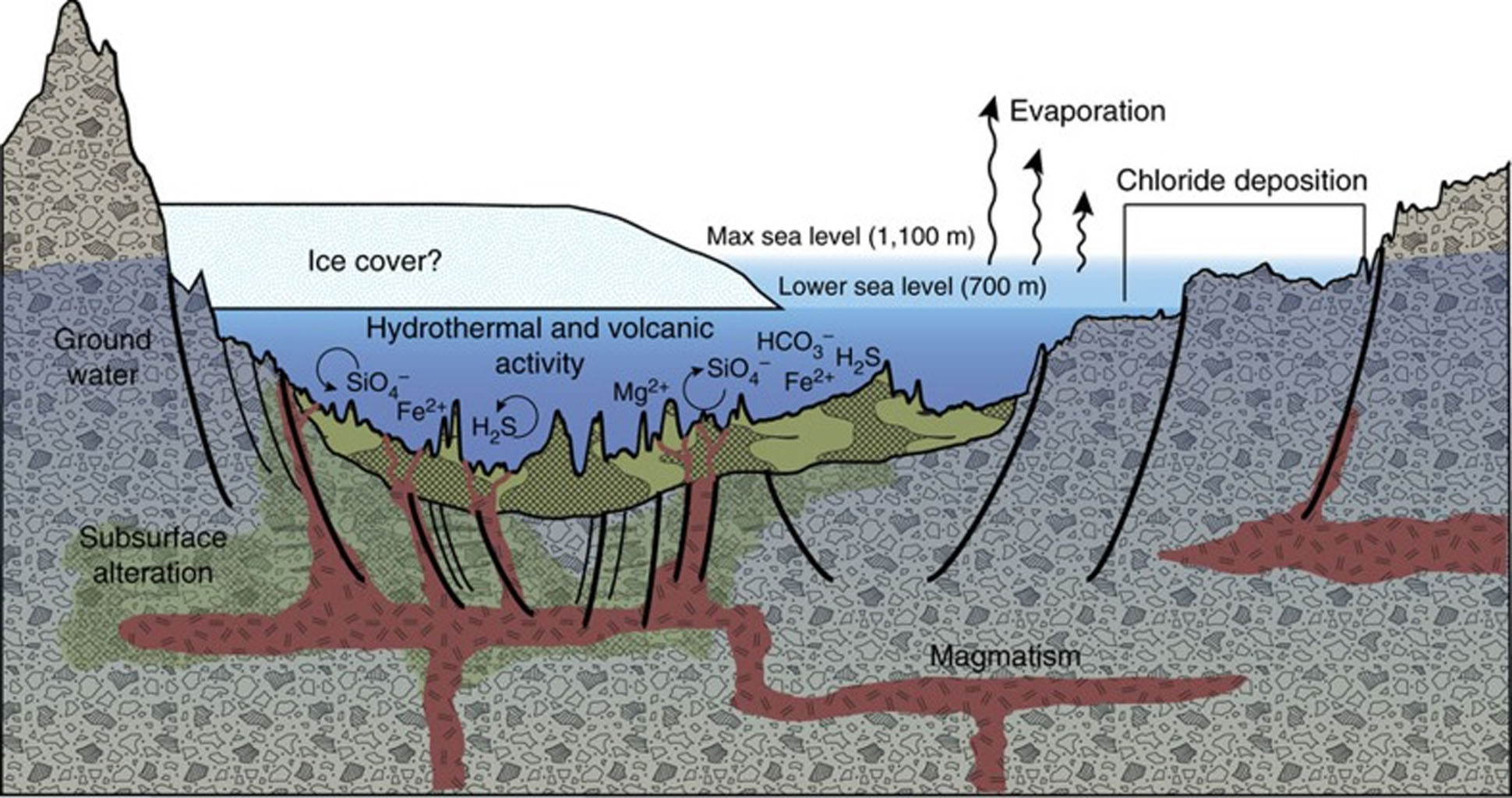
Illustrates showing the origin of some deposits in the Eridania basin of southern Mars resulting from seafloor hydrothermal activity more than 3 billion years ago. Credit: NASA
Since Mars had both surface water and volcanic activity during this time, it would have also experienced hydrothermal activity. This occurs when volcanic vents open into standing bodies of water, filling them with hydrated minerals and heat. On Earth, which still has an active crust, evidence of past hydrothermal activity cannot be preserved. But on Mars, where the crust is solid and erosion is minimal, the evidence has been preserved.
"This site gives us a compelling story for a deep, long-lived sea and a deep-sea hydrothermal environment," Niles said. "It is evocative of the deep-sea hydrothermal environments on Earth, similar to environments where life might be found on other worlds -- life that doesn't need a nice atmosphere or temperate surface, but just rocks, heat and water."
Based on their study, the researchers estimate that the Eridania basin once held about 210,000 cubic km (50,000 cubic mi) of water. Not only is this nine times more water than all of the Great Lakes combined, it is as much as all the other lakes and seas on ancient Mars combined. In addition, the region also experienced lava flows that existed  after the sea is believed to have disappeared.
From the CRISM's spectrometer data, the team identified deposits of serpentine, talc and carbonate. Combined with the shape and texture of the bedrock layers, they concluded that the sea floor was open to volcanic fissures. Beyond indicating that this region could have once hosted life, this study also adds to the diversity of the wet environments which are once believed to have existed on Mars.
Artist rendering showing an interior cross-section of the crust of Enceladus, which shows how hydrothermal activity may be causing the plumes of water at the moon’s surface. Credits: NASA-GSFC/SVS, NASA/JPL-Caltech/Southwest Research Institute
Between evidence of ancient lakes, rivers, groundwater, deltas, seas, and volcanic eruptions beneath ice, scientists now have evidence of volcanic activity that occurred beneath a standing body of water (aka. hot springs) on Mars. This also represents a new category for astrobiological research, and a possible destination for future missions to the Martian surface.
The study of hydrothermal activity is also significant as far as finding sources of extra-terrestrial, like on the moons of Europa, Enceladus, Titan, and elsewhere. In the future, robotic missions are expected to travel to these worlds in order to peak beneath their icy surfacesinvestigate their plumes, or venture into their seas (in Titan's case) to look for the telltale traces of basic life forms.
The study also has significance beyond Mars and could aid in the study of how life began here on Earth. At present, the earliest evidence of terrestrial life comes from seafloor deposits that are similar in origin and age to those found in the Eridania basin. But since the geological record of this period on Earth is poorly preserved, it has been impossible to determine exactly what conditions were like at this time.
Given Mars' similarities with Earth, and the fact that its geological record has been well-preserved over the past 3 billion years, scientists can look to mineral deposits and other evidence to gauge how natural processes here on Earth allowed for life to form and evolve over time. It could also advance our understanding of how all the terrestrial planets of the Solar System evolved over billions of years.
Further Reading: NASA

Trump, Korea, the Ban, & Where Hope Lies

Authentic news,No fake news.

Dr. Joseph Gerson* is Director of the American Friends Service Committee’s Peace and Economic Security Program, Executive Director of the Campaign for Peace, Disarmament and Common Security, and Co-Convener of the Peace and Planet International Network
NEW YORK, Oct 12 2017 (IPS) - There is much to celebrate in the Nobel Peace Prize Committee’s decision to award this year’s prize to the International Campaign to Abolish Nuclear Weapons (ICAN).
Sculpture depicting St. George slaying the dragon. The dragon is created from fragments of Soviet SS-20 and United States Pershing nuclear missiles. Credit: UN Photo/Milton Grant
If the chilling threats of nuclear war being tossed around by Donald Trump and Kim Jung-un weren’t enough to raise concerns about nuclear weapons, press reports of ICAN being awarded the Prize have reminded people that the threat of nuclear war didn’t end with the collapse of the Soviet Union, and that there remains hope for a nuclear weapons-free future.
While the negotiation of the Nuclear Weapons Prohibition Treaty has raised hopes around the world, Donald Trump (it is painful to refer to him as president) and his “madman” approach to North Korea give lie to the myth that the P-5’s nuclear arsenals are in “safe hands.”
With his denunciation of diplomacy, and simulated nuclear bomber attacks and tweets asserting that North Korea understands only one thing, Trump has returned humanity to the brink of nuclear catastrophe on the fifty-fifth anniversary of the Cuban Missile Crisis.
The ten months since Trump’s inauguration have almost inured us to surprise, but this week midst Trumpian chaos we learned that in July Trump urged a ten-fold increase in the size of the U.S. nuclear arsenal, and that this may have been the outrage that led Secretary of State Tillerson to describe his boss as a “f…..g moron.”
The reality of the “moron” having his finger on the nuclear trigger is indeed sobering and is the reason legislation has been introduced in Congress to prevent Trump from launching a nuclear war on his own authority.
Time dulls memory and sensibilities. Recall that a year ago Trump didn’t know what the nuclear triad was and suggested that Japan and South Korea should become nuclear powers. He asked why we can’t use nuclear weapons and threatened to use them against “terrorists” (likely including Kim Jung-un. He has also said “I can’t take anything off the table.”
In his first conversation with Vladimir Putin, before labeling the New START treaty a “bad deal”, he had to ask his advisors what it was. Since then, he has pledged to “greatly strengthen and expand” the U.S. nuclear arsenal, called for a nuclear arms race, and launched a Nuclear Policy Review targeted against Russia, China, North Korea and Iran, while Congressional forces press for deployment of land-based nuclear armed cruise missiles in Europe that would sink the INF Treaty.
Compounding these dangers Trump humiliated his Secretary of State’s efforts to pursue diplomacy with North Korea, even when the “Freeze for Freeze” option provides the obvious path back from the nuclear brink. With its B-1 bomber simulated nuclear attacks on North Korea, increased tempo of U.S. so-called “freedom of navigation” naval exercises in the South China, as well as others in Black and Baltic Seas, Trump and the Pentagon have increased the danger that unintended incidents or miscalculations could escalate beyond control.
Midst it all, we have the Ban Treaty. As we see with the announcement of the Nobel Peace Prize, the Treaty further stigmatizes nuclear weapons as it seeks to outlaw their use, threatened use, development, testing, production, manufacture, acquisition, possession or stockpiling of nuclear weapons, or their transfer and deployment.
The Treaty’s greatest potential appears to be in Europe. I hope that I am wrong, but my fear is that, like the Nuclear Nonproliferation Treaty, the Ban Treaty will give us one more agreement that the nuclear powers refuse to respect.
Two trains are running in opposite directions. One, with the support of most of the world’s governments and international civil society, is racing toward a nuclear weapons-free world. The other, with the additional fuel of North Korea’s nuclear arsenal and Trump at the helm in Washington, is burning unimaginable fortunes as it speeds toward nuclear Armageddon.
In addition to further stigmatizing nuclear weapons, the Treaty’s most important contributions may be reminding people around the world of the imperative of nuclear weapons abolition, and the encouragement it gives to people and governments who are working for nuclear disarmament.
That said, the Treaty will be recognized as international law by only those states that sign and ratify it. All the nuclear powers boycotted the ban treaty negotiations. The US, UK, France, and Russia denounced it, falsely claiming that nuclear deterrence kept the peace for 70 years. (Ask the Vietnamese, Iraqis, Syrians, Yemenis, Congolese and so many others about that!) Led by the US, each of the nuclear powers is upgrading and/or expanding its nuclear arsenal. With NATO’s expansion to Russia’s borders, its nuclear weapons, and with the West’s conventional, high-tech and space weapons superiority, Moscow is “modernizing” its nuclear arsenal.
With increased Japanese and South Korean anxieties resulting from Pyongyang’s nuclear threats and growing doubts about reliability of the U.S, “nuclear umbrella,” there are mounting calls from sectors of their elites for their governments to become nuclear powers. We thus could be entering an era of nuclear weapons proliferation, not abolition.
Our future depends on how people and governments respond, and it dictates a global division of labor among nuclear weapons abolitionists. States that negotiated the ban treaty obviously must sign and ratify it as quickly as possible. And, they can do more.
As Professor Zia Mian reminds us, Article 12 requires states parties to make their treaty commitments “part of their political engagement with the nuclear weapon states.” They can dispatch delegations to encourage others to join the treaty, and they can initiate sanctions and boycotts to pressure the nuclear powers.
But winning nuclear weapons abolition still requires building mass movements within the nuclear weapons and “umbrella” states. These nations and our disarmament movements still lie at the crux of the struggle.
The Ban Treaty certainly reinforces popular understanding of the righteousness of Jeremy Corbyn’s and our movements’ commitments to a nuclear weapons free world. Imagine the global reverberations of Britain, led by Prime Minister Corbyn, deciding not to fund Trident replacement. And, across the channel, if just one or two NATO or other umbrella states are led by their people reject the strictures of their nuclear alliances, they could begin to unravel world’s nuclear architecture and unleash a global disarmament dynamic.
For those of us in the world’s nuclear weapons states, the imperative of resistance remains. This includes doing all that we can to prevent war with North Korea and steadfast education about the human costs, preparations for, and dangers of nuclear war that can be brought on by miscalculation and accident, as well as intentionally. We need to highlight the deceit and deficiencies of “deterrence,” and teach about the forces that led to and won the ban treaty.
But good ideas and truth rarely prevail on their own. Frederick Douglass, the 19th century U.S. anti-slavery abolitionist, was right: “Power concedes nothing without a demand. It never did and it never will.”
More recently, on the eve of the 2010 Nuclear Nonproliferation Treaty Review Conference, then U.N. Secretary General Ban Ki-moon advised that governments alone will not deliver us into a nuclear weapons-free world. We can only reach that promised land with massive popular pressure from below, from international civil society.
For the moment, our best near-term hope may lie in Jeremy Corbyn and the possible Scottish succession from what was once Great Britain. Corbyn has said he will not push the nuclear button, and he has long opposed nuclear weapons and understands the need to invest in social uplift.
The loss of the Faslane on the Scottish coast could leave London without a nuclear weapons base. What the British movement does will thus be critical for human survival and to our struggles in the other nuclear weapons and umbrella states.
ICAN is not the first advocate of a nuclear weapons-free world to receive Nobel Peace Laureate. It was proceeded by the Quaker American Friends Service Committee which protested the A-bombings of Hiroshima and Nagasaki within days of the nuclear attacks; by Joseph Rotblat, the only Manhattan Project senior scientist who resigned because of his moral considerations, and by Mohamed ElBaradei of the IAEA who denounced nuclear double standards.
Years ago, speaking in Hiroshima, Robblat cut to the quick when he said that humanity faces a stark choice. We can either eliminate nuclear weapons, or we will see their global proliferation and the nuclear wars that will follow. Why? Because no nation will tolerate what it experiences as an unjust hierarchy of power, in this case nuclear terror.
*Dr. Joseph Gerson is author of Empire and the Bomb: How the US Uses Nuclear Weapons to Dominate the World, and With Hiroshima Eyes: Atomic War, Nuclear Extortion and Moral Imagination.

High court rejects challenge to status of UK press regulator

Authentic news,No fake news.


The UK’s officially recognised press regulator, Impress, has fought off a high court challenge over its status.
The News Media Association (NMA), which represents publishers, said the Press Recognition Panel (PRP), which was set up under a royal charter after the Leveson inquiry, should not have given Impress formal approval a year ago.
The NMA said the PRP had misinterpreted and misapplied the charter, but Lady Justice Rafferty and Mr Justice Popplewell, sitting in London, rejected its case on Thursday.
The chairman of Impress, Walter Merricks, said: “This judgment shows that the system of externally verified self-regulation, recommended by Sir Brian Leveson, is fully functional. 
“We can now get on with the important job of upholding high standards of journalism. 
“At a time when the news publishing industry is under massive pressure, Impress is uniquely able to reduce publishers’ legal risks and enhance their standing in the eyes of audiences and advertisers. 
“We are grateful for the ongoing support of the NUJ, Sir Harry Evans and many others in and around the industry, and sorry that the NMA have wasted so much time attacking Impress, which meets the standards that they refuse to meet.” 
Impress’s dependence on third-party funding from the former motor sport mogul Max Mosley was one of the reasons why it should not have been recognised, the NMA said. 
Lord Pannick QC argued that, while Impress was dependent on Mosley - “a proponent of strict regulation of the press” - it did not matter where the money came from. What mattered was that it must not come from the funds of those being regulated.
Ben Jaffey QC, for the PRP, said the decision to grant recognition, which the judges refused to quash, was “unimpugnable”. It was taken after three rounds of open consultation during which NMA more than once advanced its views.
Impress was an independent self-regulatory body and its funding was settled in agreement with the industry within the meaning of the charter, he added. There was no requirement that funding be provided from the industry or from anywhere in particular. 
The Leveson report recognised that there was no objection in principle to funding, especially in the startup phase of a regulator’s existence, being provided by third parties, and did not suggest that such funding was inappropriate. 
Jaffey said that Impress’s funding, which derived from the Alexander Mosley Charitable Trust, was provided under a grant agreement with the Independent Press Regulation Trust, a separate charity with different trustees. 
The funding was, in the lawful judgment of the panel, sufficiently secure from withdrawal. 
Most national newspapers have signed up to the Independent Press Standards Organisation (Ipso), a voluntary independent body not backed by the government. 
They fear that the recognition of Impress could trigger legislation forcing newspapers to pay the costs of libel or privacy actions against them, even if they win their cases.

Rohingya Refugee Women Bring Stories of Unspeakable Violence

Authentic news,No fake news.

Women and children who escaped the brutal violence in Myanmar wait for aid at a camp in Bangladesh. Credit: Parvez Ahmad Faysal/IPS
COX'S BAZAR, Bangladesh, Oct 10 2017 (IPS) - Yasmin, 26, holds her 10-day-old baby, who she gave birth to in a crowded refugee camp in Cox’s Bazar, a southeastern district bordering Myanmar.
Three weeks ago, when she was still in her home in Hpaung Taw Pyin village in Myanmar, she was raped by a group of soldiers as houses burned, people fled and gunfire shattered the air.
“I have been working as a human rights activist for the last 20 years but never heard of such an extreme level of violence." --Bimol Chandra Dey Sarker, Chief Executive of the aid organisation Mukti
With sunken eyes, Yasmin told IPS how she was beaten and raped in her ninth month of pregnancy by Myanmar soldiers. Yasmin’s village was almost empty when she and many of her neighbours were violated. Only a few dozen women and children remained after the men had fled in fear of being tortured or killed.
“On that dreadful evening an army truck stopped in our neighbourhood, and then came the soldiers raiding homes. I was alone in my home and one of the soldiers entering my thatched house shouted to invite a few others to join him in raping me.”
“I dare not resist. They had guns pointed at me while they stripped me to take turns one by one. I don’t remember how many of them raped me but at one stage I had lost consciousness from my fading screams,” she said, visibly exhausted and traumatized by the horrific ordeal.
Yasmin’s husband was killed by the Myanmar army on September 4 during one of the frequent raids, allegedly by state-sponsored Buddhist mobs against the Muslim minority in their ancestral home in Rakhine state.
Bandarban, a hilly district, and Cox’s Bazaar, a coastal district, both some 350 km southeast of Bangladesh’s capital Dhaka, are hosting the overcrowded Rohingya camps. The locals here are no strangers to influxes of refugees. Rohingyas have been forced out of Myanmar since 1992, and Bangladesh, as a neighbor, has sheltered many of them on humanitarian grounds.
However, the latest Rohingya exodus, following a massive government crackdown that began last August, has shaken the world. The magnitude of the atrocities carried out by the military junta this time is beyond imagination. Some describe the persecution as ‘genocide,’ which Myanmar’s rulers deny.
To add to the communal violence, dubbed ‘ethnic cleansing’ by Zeid Ra’ad Al Hussein, the United Nations high commissioner for human rights, the military junta intensified physical assaults and soldiers have been sexually harassing innocent, unarmed Rohingya women alongside the regular killings of men.
The reasoning is obvious: no one should dare to stay in their homes. Many believe it’s a pre-planned operation to clear Rakhine state of the Rohingya population, who Myanmar does not recognize as citizens.
One Rohingya man, who managed to reach the Bangladesh border in mid-September, told IPS, “They have indeed successfully forced the Rohingya men out while the remaining unprotected women were a headache for the military junta, as killing the unarmed women would expose them to international criticism. So they chose a strategy of frightening the women and children – apply physical assault and sexual abuse, which worked so well.”
Newly arrived Rohingya refugees enter Teknaf from Shah Parir Dwip after being ferried from Myanmar across the Naf River. Credit: Farid Ahmed/ IPS
IPS spoke with many of the agencies, including the United Nations and local NGOs, working on the ground to provide emergency services such as food distribution, erecting shelters, organizing a safe water supply and hygienic latrines and, of course, healthcare.
Everyone who spoke to this correspondent said literally every woman, except the very old and young, has had experiences of either being molested or experiencing an extreme level of abuse like gang rape.
Survivors and witnesses shared brutal stories of women and young girls being raped in front of their family members. They described how cruel the soldiers were. They said the soldiers showed no mercy, not even for the innocent children who watched the killings and burning of their homes.
Bimol Chandra Dey Sarker, Chief Executive of Mukti, a local NGO in Cox’s Bazaar, told IPS, “I have been working as a human rights activist for the last 20 years but never heard of such an extreme level of violence. Many of the women who are now sheltered in camps shared their agonizing tales of sexual abuse. It’s like in a movie.”
Kaniz Fatema, a focal person for CODEC, a leading NGO in coastal Cox’s Bazaar, told IPS, “Stories of sexual abuse of Rohingya women keep pouring in. I heard women describing horrific incidents which they say are everyday nightmares. How can such violence occur in this civilized world today?”
“Although women are shy and traumatized, they speak up. Here (in Bangladesh) they feel safer and so the stories of abuses are being submitted from every corner of the camps,” she said.
The chief health officer of Cox’s Bazar 500-bed district hospital, where most of the wounded are being treated, told IPS, “At the beginning we were providing emergency treatment for many Rohingya refugees with bullet wounds. Now, we are facing a new crisis of treating so many pregnant women. We are registering pregnant women and admitting them almost every day despite shortages of beds. Many of these women complain of being sexually harassed.”
An attending nurse at the hospital who regularly treats the sexually abused women, said, “Many women still bear marks of wounds during rape encounters. It’s amazing that these women are so tough. Even after so many days of suffering, they keep silent about the agonies and don’t complain.”
The UNFPA is offering emergency reproductive healthcare services in Bandarban and Cox’s Bazaar, where aid workers shared similar tales from women who suffered torture and gang rape at gunpoint.
“It is so horrifying,” said a field worker serving in Ukhia upazila in Bandarban, adding, “I heard of a young girl being raped in front of her father, mother and brother. Then the soldiers took the men out in the courtyard and shot them.”
Faisal Mahmud, a senior reporter who recently returned to the capital from Rohingya camps, also said he spoke to many victims of rape. “Most of them I spoke to were so traumatised they were hardly able to narrate the brutality. I could see the fear in their faces. Although I hardly understand their dialect, a translator helped me to understand the terrifying tales of being stripped naked and gang raped.”
Mohammad Jamil Hossain trekked through the deep forests, evading mines and Myanmar border guards who look for men to catch and take back.
“The systematic cleansing will not end until every member of Rohingya population is evicted and forced out of the country,” he said. “The whole world is watching and yet doing nothing to stop the killings.”
Shireen Huq, founder member of Naripokkho, Bangladesh’s leading NGO fighting for women’s rights, told IPS, “I was shocked and overwhelmed by the sheer numbers of people, mostly women and children, fleeing Myanmar and entering Bangladesh. The media had reported widespread atrocities, mass rape, murder, arson and brutality in the state of Rakhain.”
“Women arriving at Nayapara through Shah Porir Dwip were in a state of shock and fatigue. Many of them were candid about the julum (a word used to mean both torture and rape) they had undergone, about being raped by several military,” she said.
“We must ensure appropriate and adequate care for the refugees, especially all those who have suffered sexual violence. They need medical care, psycho-social counseling and abortion services.”
“Agencies working in the Rohingya refugee camps estimate that 50,000 women are pregnant. Several hundred deliveries have already taken place. Round the clock emergency health services must be made available to deal with the situation,” Shireen said.
More than 501,800 Rohingya have fled the Buddhist-majority country and crossed into Bangladesh since August 25. Densely populated refugee settlements have mushroomed around road from Teknaf to Cox’s Bazar district that borders Myanmar divided by Naf river. About 2,000 of the refugees are flooding into the camps every day, according to the International Organisation for Migration (IOM).
IOM has appealed to the international community for 120 million dollars between now and February 2018 to begin to address the humanitarian crisis.
“The refugees who fled Rakhine did so in the belief that they would find safety and protection in Cox’s Bazar,” said William Lacy Swing, IOM’s Director General, in a statement on October 4. “It is our responsibility to ensure that the suffering and trauma that they have experienced on the way must end.”
Meanwhile, witnesses say there are still thousands of refugees in the forest waiting to cross over the Bangladesh border, which has now been officially opened. Many can be seen from distant hilltops, walking with whatever belongings they could take.
“I was really struck by the fear that these people carry with themselves, what they have gone through and seen back in Myanmar,” the United Nations High Commissioner for Refugees, Filippo Grandi, told Reuters in a camp recently, where refugees live under thousands of tarpaulins covering the hills and rice paddies.
“Parents killed, families divided, wounds inflicted, rapes perpetrated on women. There’s a lot of terrible violence that has occurred and it will take a long time for people to heal their wounds, longer than satisfying their basic needs,” Grandi said.

White House to order health care alternatives

Authentic news,No fake news.

White House to order health care alternatives

WASHINGTON (AP) — The White House is finalizing an executive order that would expand health plans offered by associations to allow individuals to pool together and buy insurance outside their states, a unilateral move that follows failed efforts by Congress to overhaul the health care system.
President Donald Trump has long asserted that selling insurance across state lines would trigger competition that brings down premiums for people buying their own policies. Experts say that’s not guaranteed, partly because health insurance reflects local medical costs, which vary widely around the country.
Moreover, White House actions may come too late to have much impact on premiums for 2018.
Trump was expected to sign the executive order this week, likely on Thursday, a senior administration official said Sunday.
Under the president’s executive action, membership groups could sponsor insurance plans that cost less because — for example — they wouldn’t have to offer the full menu of benefits required under the Affordable Care Act, also called “Obamacare.” It’s unclear how the White House plans to overcome opposition from state insurance regulators, who see that as an end-run to avoid standards.
“There are likely to be legal challenges that could slow this effort down,” said Larry Levitt of the nonpartisan Kaiser Family Foundation.
Similar alternatives have been promoted by Kentucky Sen. Rand Paul, a Republican holdout during the health care debate. Senate leaders didn’t bring the latest GOP health care bill to a vote because they lacked the votes to pass it.
Association plans “kind of went away with the ACA, and now the idea seems to be to re-create them,” said Jeff Smedsrud, a health insurance marketing entrepreneur. “It’s not clear what they would really look like.”
Smedsrud said a different option also under consideration by the White House, to loosen restrictions on “short term” insurance plans, could be a safety valve for some consumers.
Those plans generally have limited benefits and remain in force for less than a year. During the Obama administration, the availability of short-term coverage was restricted. One of Smedsrud’s companies sells short-term plans.
Others warned that over time the White House order could undermine state insurance markets created under Obama’s law, by siphoning off healthy people to plans with lower premiums and skinnier benefits.
The order was being drafted as Trump expressed his willingness to work with Democrats on health care after Republicans were unable to approve legislation that would have repealed and replaced “Obamacare.”
The president said Saturday that he had spoken to Senate Democratic leader Chuck Schumer of New York to see if Democrats would want to collaborate with him on improving health care. He told reporters before departing for a North Carolina fundraiser that he was willing to consider a “temporary deal” and referred to a popular Republican proposal that would have the federal government turn over money for health care directly to states in the form of block grants.
Schumer said through a spokesman Saturday that Trump “wanted to make another run at ‘repeal and replace’ and I told the president that’s off the table.” Schumer said if Trump “wants to work together to improve the existing health care system, we Democrats are open to his suggestions.”
It was unclear if the expected White House order could lead to changes sweeping enough and quick enough to help several million consumers exposed to higher premiums next year for their individual health insurance plans.
It typically takes government agencies several months to carry out presidential directives, since they generally must follow a notice-and-comment process. Sign-up season for individual health insurance starts Nov. 1 and ends Dec. 15.
“Whether this executive order could impact the 2018 market is yet to be seen, since the health plans have created and priced their 2018 products already, and open enrollment begins in just three weeks,” said health industry consultant Robert Laszewski.
While nearly 9 million consumers who receive tax credits under the Obama-era law are protected from higher premiums, about 6.7 million other customers with individual coverage get no subsidies and will bear the full brunt of cost increases that reach well into the double digits in many states.
Many in this group are solid middle-class, including self-employed business people and early retirees. Cutting premiums for them has been a longstanding Republican political promise.
“If the question is, is the president interested in working with Democrats to repeal and replace — that would be our language — the answer is yes,” White House budget director Mick Mulvaney said during an interview with NBC’s “Meet the Press.” ″The Democrats would use a different word for that, but the president wants to get something done.”

Where is the ball? UK and EU exchange volleys over Brexit

Authentic news,No fake news.

LONDON (AP) — Prime Minister Theresa May said Monday there is a positive “new dynamic” in Brexit talks, with Britain and the European Union nearing agreement on the rights of 4 million citizens whose lives will be affected by the split.
May urged European Union officials to show “leadership and flexibility” in negotiations on Britain’s exit, saying “the ball is in their court.”
The EU, however, lobbed the ball straight back. European Commission spokesman Margaritis Schinas said the responsibility for progress is “entirely in the U.K. court.”
More than a year has passed since Britain voted to leave the EU, and six months since Britain triggered the two-year countdown to its EU exit. A fifth round of divorce negotiations opened Monday in Brussels, with both sides frustrated by the lack of progress.
May told British lawmakers that “there is a new dynamic in the negotiations” since her major Brexit speech in Florence, Italy, last month.
In the Florence speech, May said Britain would be willing to abide by EU rules and pay into its coffers during a transition period of about two years after Brexit in 2019.
She also signaled Britain would pay what it owes to settle financial commitments it has made to the bloc, but without naming a figure.
EU leaders have called her suggestions positive but asked for more details. Few were forthcoming in May’s statement on Monday, though she did say that Britain might accept the jurisdiction of the European Court of Justice during the transition period — an idea that infuriates many pro-Brexit members of her Conservative Party.
The U.K is increasingly anxious to move talks on to discussing future trade relations, but so far the EU says there hasn’t been “sufficient progress” on the major divorce terms — the size of the Brexit bill, the status of the border between Ireland and Northern Ireland and the rights of 3 million EU citizens living in Britain and 1 million Britons in other member states.
May said progress was being made on all three, and “there is considerable agreement” between the U.K. and the bloc on citizens’ rights.
“So I hope our negotiating teams can now reach full agreement quickly,” she said.
Schinas, the EU spokesman, said “there has been so far no solution found on step one, which is the divorce proceedings.”
“So the ball is entirely in the U.K. court for the rest to happen,” he said.
Danish Foreign Minister Kristian Jensen, however, called for compromise, saying “this will never be a 100 percent win for one side or the other side.”
Jensen said the sides “are now on the same page” and “it is rather important we get on to a more close and more speedy process of concluding some of the issues.”
May told lawmakers she believed the negotiators would “prove the doomsayers wrong,” but also said Britain was planning for the possibility of leaving the EU without a deal.
Critics have accused the government of failing to prepare for a “no deal” Brexit, which would mean an end to tariff-free trade with the EU.
On Monday the government published papers on trade and customs which May said would pave the way for Britain to “achieve the greatest possible tariff and barrier-free trade” after Brexit, even if there is no trade deal with Brussels.
May addressed Parliament on its first day back since her disastrous speech to the Conservative conference last week, which saw her bedeviled by a prankster, a sore throat and a malfunctioning set.
The debacle intensified debate about whether May can unite her fractious government — divided between Brexit enthusiasts and more reluctant leavers — and how long she can survive as prime minister.
Labour Party leader Jeremy Corbyn accused the government of making a mess of the Brexit negotiations.
“Fifteen months on from the referendum, we’re still no clearer what the future of this country will look like,” he said.

Mitra-mandal Privacy Policy

This privacy policy has been compiled to better serve those who are concerned with how their  'Personally Identifiable Inform...