MITRA MANDAL GLOBAL NEWS

Ghana Aims to Regain Top Spot in Cocoa Production

Authentic news,No fake news.

Professor of Food Science and Technology at the University of Ghana, Emmanuel Afoakwa, and other researchers at a cocoa farm. Credit: Kwaku Botwe/IPS
ACCRA, Oct 5 2017 (IPS) - Ghana is home to the world’s favourite cocoa beans. They’re bigger in size, have a higher butter content and superior flavour – all qualities which make Ghana’s cocoa the world standard against which all cocoa is measured.
But while cocoa used to be the biggest foreign exchange earner for the West African country, contributing about 45 percent of the total foreign exchange earnings, now the commodity barely provides 25 percent.
“They [farmers who sell their lands] don’t know what they are doing because cocoa is a legacy that can be left to children, unlike one-time cash.” --Nana Kwasi Ofori of the Cocoa Farmers Association
Farmers in Ghana follow a strict routine in the planting, harvesting and drying of cocoa, supported and monitored by the government regulator, the Ghana Cocoa Board.
They employ natural drying of the beans in the sun (instead of heating), turning the beans at regular intervals for not less than a week. This natural and painstaking means of drying ensures the beans turn out their characteristic golden brown. The layers of monitoring at the time of purchase are all part of government’s intervention.
The country is the second biggest supplier of cocoa worldwide, beaten only by its West African neighbour, Cote D’Ivoire. But Ghana was once the world champion. It lost the first spot to its neighbour in the 1970s after government reduced the price given to farmers, thereby discouraging many from going into the venture.
Exchanging Golden Pods for Golden Nuggets
Several factors have contributed to the shortfall. Distribution of free or subsidized farm inputs such as fertilizers or chemicals have been fraught with several challenges.
“Not all of us were given the free fertilizers. And they were politicizing it. Someone with a small farm of four acres could be given 50 bags of fertilizer while others with very big farms were given less,” Abusuapanyin Kwabena Amankwaa, a cocoa farmer, told IPS.
Central Regional Chief Cocoa Farmer Nana Kwasi Ofori also said that “farmers who are not cultivating cocoa were given some of the inputs”.
CEO of the Cocoa Board Joseph Baidoo has said his interactions with farmers revealed that Ghana’s fertilizers – which are not supposed to be for sale – were in fact being sold in Nigeria, Gabon and other neighbouring African countries, adding that this meant the free fertilizers were given to political party loyalists who were not cocoa farmers.
Diseases such as black pod, swollen shoot, and capsids have had a field day as a result.
The new government decided to discontinue the free fertilizer programme following what it says were complaints from farmers. Instead, it wants to sell the fertilizer at subsidized prices.
Ghana has an annual cocoa production target of one million tonnes. That target was achieved in 2011. Since then government has struggled to maintain the target, with annual production hovering around 800,000 tonnes.
In previous years, government decided to absorb the cost and technical assistance needed to apply the right chemicals and fertilizers to cocoa farms nationwide – initiatives called the Mass Spraying Exercise and the Hi-tech Programme, respectively.
Government also created the Rehabilitation Programme where old, less productive trees were felled and replaced with new, more-yielding hybrid seedlings for free. This saw a big dividend in cocoa bean output, with the country recording its highest cocoa output of over 1 million tonnes in 2011. But government has not been able to sustain the programme.
Probably the biggest threat to hit the cocoa industry in recent times is illegal mining, locally called galamsey. The upsurge in the search for gold between 2012 and 2016 has threatened the livelihoods of several cocoa farmers as galamsey takes over cocoa farms.
“Some chiefs are part of the problem which we are facing. They sell the land to the miners and collect the money so sometimes farmers are not even compensated,” said Nana Kwasi Ofori, an executive member of the Cocoa Farmers Association.
Most farmers are tenant farmers who work on lands owned by chiefs or families. Fifty-three-year-old Adwoa Oforiwaa, a cocoa farmer in the Central Region, says she was only given 500 cedis (about 112 dollars) as compensation when galamsey operators took over a good part of her farm.
“When they [galamsey operators] come, they tell you they have orders from the chiefs or even government, and they start the destruction,” she added.
A journalist in the Western Region – the leading cocoa-producing region in Ghana – Yaw Obrempong says some farmers willingly sell off their cocoa farms for ready cash.
“If the galamsey operator is here with a bag full of cash, why won’t I sell my land instead of staying in a queue for over two weeks only to be given a bag of fertilizer?” Obrempong noted.
He says some farmers claim they had to pay bribes in order to get farm inputs from the government. Other farmers sold their lands when the much-needed labour to work on the cocoa farms shifted into illegal mining.
But Nana Kwasi Ofori says, “They [farmers who sell their lands] don’t know what they are doing because cocoa is a legacy that can be left to children, unlike one-time cash.”
The galamsey invasion has affected a good part of the 1.7 million hectares of cocoa farms in the country.  The Government has launched an anti-galamsey crusade to flush out illegal miners. With the help of a taskforce including the military, several arrests and confiscation of galamsey equipment have been carried out.
The launch of the Media Coalition against Galamsey has also given government a shot in the arm. Government has moved the crusade a notch higher with the announcement by the Ministry of Lands and Natural Resources of its intention to procure drones at the cost of 3 million dollars for surveillance.
Guaranteed Pricing
Nonetheless, cocoa remains the most important economic crop for Ghana, raking in about 2 billion dollars annually, contributing to some 4.22 percent of the country’s GDP.  Such a feat has been achieved through government interventions such as price stability. For instance, the world price of cocoa beans has plummeted from about 3,122 dollars per tonne last year to about 1,900 dollars this year, yet the Cocoa Board maintained s producer price of 7,600 cedis per tonne (1,700 dollars).
The Board is able to cushion farmers with a Stabilization Fund established some ten years ago, as well as other sources of funds. This presents a big advantage for cocoa farmers in Ghana over other cocoa-producing countries on the continent this year.
For instance, the Ivorian government has slashed the prices of cocoa almost by a third, to 700 CFA per kg (about 1,300 dollars per tonne). Some Ghanaians have expressed concern that the development is likely to reverse the dreaded cross-border smuggling of cocoa (Ghana has in the past seen a lot of its cocoa smuggled to their neighbor countries because of price differences).
But professor of Food Science and Technology at the University of Ghana, Emmanuel Afoakwa says “it is not likely because Ghana is bent on protecting its premium quality and so there is tight security to ensure cocoa does not move from Cote D’Ivoire and other countries into the country”.
He adds that “farmers must cherish that government is interested in their welfare because government now loses about 500 dollars on every tonne of cocoa bought from them”.
The Ghana Cocoa Board also has an arrangement to pay for the felling and replanting of old and diseased cocoa trees. The board has announced that it will be giving away about 60 million seedlings to farmers for replanting. The exercise, called rehabilitation, is meant to boost output.
The Government also has a programme to woo youth into the sector to replace aging cocoa farmers. The Board is providing support for all young cocoa farmers by giving them hybrid pods, improved seedlings, free fertilizer and inputs, a farmer business school programme, as well as extension support to boost cocoa production. Cocoa farmers are also pushing for a Cocoa Farmers Pension Scheme which they believe will help attract the youth.
Cocoa Processing
To maximize revenue from cocoa, the government has its eyes on adding value to the cocoa it exports. The global cocoa market has an estimated value of 9 billion dollars for unprocessed cocoa beans, about 28 billion dollars for semi-processed/intermediate products and a whopping 87 billion dollars for fully processed/final products. In an attempt to get its share of the 87-billion-dollar cake, government has set a target of processing 50 percent of its exported cocoa.
Currently, the seven processing companies operating at various levels of value-addition process about 25 percent of the county’s exported cocoa. But most of the processed cocoa are exported in semi-processed form of cocoa paste.
Prof. Afoakwa says the huge capital requirement involved in processing cocoa into finished products fit for export could be a big hurdle for Ghana. Moreover, there are high tariff walls with regards to the export of processed products. For example, the European Union levies no duties on the import of raw cocoa beans, but levies a 7.7 percent and 15 percent duty on cocoa powder and cocoa cake, respectively.
He believes heightening the campaign on the consumption of cocoa products would be one way of tackling the issue.
“I’m working with Ghana Cocoa Board to conduct the cocoa product processing competition and we are bringing together ten different polytechnic institutions to develop new products using cocoa. We are going to invite high schools to come witness it. What we are trying to do is to advocate for higher consumption of cocoa products and this can be done when we know the kind of different products that we can make out of cocoa,” he added.

'Kleptocracy Tour' Spotlights Nigerian Corrupt Money Funneled Through Britain

Authentic news,No fake news.


Anti-corruption activists hoping to shine a light on the hundreds of millions of dollars funneled through London every year are organizing tours of properties allegedly bought with dishonest money.
The "Kleptocracy Tour" is billed as a journey to the dark side of globalization. This is the first such tour which focuses on Nigeria.
"The international community, specifically the United Kingdom, the United States, other financial centers, are playing a huge role in facilitating elite corruption in Nigeria, through offshore corporate tax havens, lax banking and property laws," said tour guide Matthew Page, a former U.S. State Department Nigeria analyst, now with Transparency International.
The tour's first stop is the capital's wealthy Belgravia district. Tax papers leaked from the Panama-based law firm Mossack Fonseca suggest two multi-million dollar properties are linked to Nigerian Senate President Bukola Saraki. He has denied the allegations.
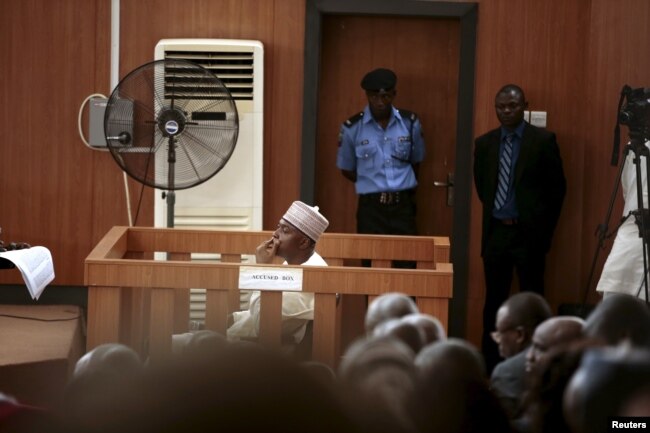
FILE - Nigeria's Senate President Bukola Saraki looks from the dock at the Code of Conduct Tribunal at Darki Biu, Jabi Abuja, Nigeria, Sept. 22, 2015.
Also among the several tour stops are lavish properties that have been subjected to asset forfeiture proceedings by a court in Houston, Texas. The U.S. Department of Justice is investigating allegations they were received as bribes by Diezani Alison-Madueke, the former Nigerian Oil Minister and OPEC Secretary.
Nigeria analyst Clementine Wallop says Nigeria's president is following through, though slowly, on pledges to crack down on corruption.
"It contributes to poverty. It contributes to poor education. It contributes to terrorism," Wallop said of corruption. "You have communities where the young men are compelled to or driven into the arms of organizations like Boko Haram as a result of the depravation which results from corruption."
Nigeria's Information Minister, Lai Mohammed, told VOA the West must do more to help repatriate corrupt money.
"The government will not relent in pursuing these people," Mohammed said. "But we also need the cooperation of many foreign countries, because sometimes we are hampered by the foreign jurisdictions."
An estimated $100 billion of corrupt money passes through London each year. Activists say fears over the economy in a post-Brexit world are stalling government efforts to clamp down on global corruption, an industry with the British capital at its core.

Large Numbers of Opposition MPs Fly out of Cambodia

Authentic news,No fake news.

logo


If there is no democracy and if there is only intimidation and arrest, I think we must find alternative means to push, to promote, and to save democracy in our country”
Almost half of Cambodia’s opposition lawmakers have left the country or are in jail, including most of its leadership, as proceedings to dissolve the party move forward.
It was no longer possible to “save democracy” from inside Cambodia, said Cambodia National Rescue Party (CNRP) leader Mu Sochua — who fled on Tuesday saying she’d been tipped off her arrest was imminent.
“If there is no democracy and if there is only intimidation and arrest, I think we must find alternative means to push, to promote, and to save democracy in our country,” she said from an undisclosed location abroad.
Opposition on the run
It was better to advocate outside the country than be jailed under a co-opted legal system, said Sochua, who has called for targeted international sanctions on ruling party leaders.
A complaint requesting the dissolution of her party was filed by the Cambodian Youth Party yesterday - citing the widely decried “treason” charge CNRP leader Kem Sokha was arrested on in September.
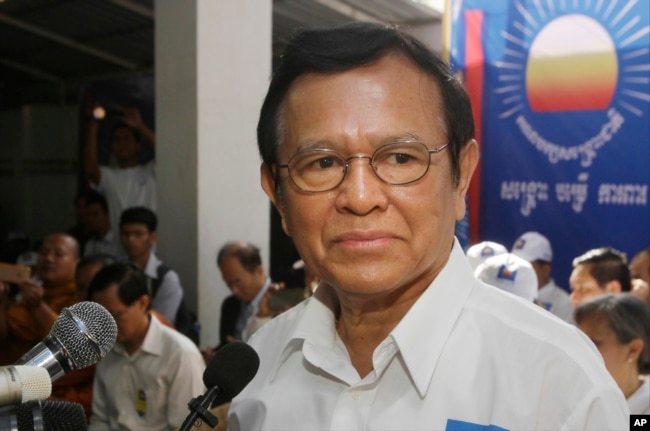
FILE - Opposition party Cambodia National Rescue Party (CNRP) President Kem Sokha addresses party supporters during the party's political congress in Phnom Penh, Cambodia, March 2, 2017.
A controversial recent legislative amendment allows the dissolution of a party found to undermine the security of the nation.
Treason charges
On Monday, Prime Minister Hun Sen warned the treason case against Sokha would be extended, potentially resulting in the arrest of other opposition lawmakers.
“We are conducting further activities. [I] want to send a message that it will not just be done with the arrest of only one person… because this is a preparation and a systematic act,” he said.
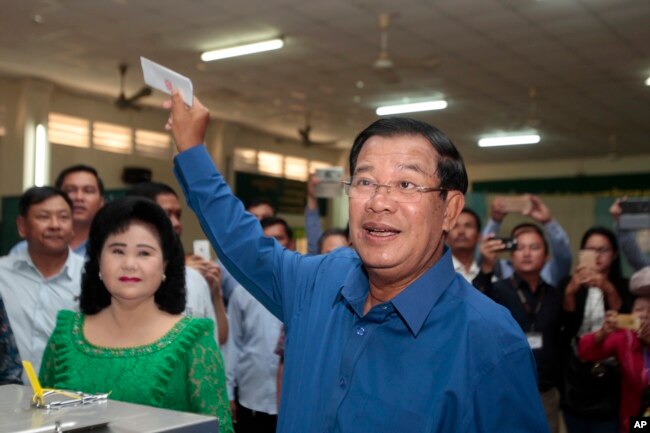
FILE - Prime Minister Hun Sen of the Cambodian People's Party shows off his ballot paper before voting in local elections at Takhmau polling station in Kandal province, southeast of Phnom Penh, June 4, 2017.
“So, I just said this, and other people can understand and they have been conducting rude activities in the three-province already,” he said, referring to Kampong Thom, Preah Vihear, and Siem Reap, all of which Mu Sochua had recently visited.
CNRP chief whip Son Chhay, who is one of the last remaining party leaders in the country, told VOA last week prior to Sochua’s departure that 22 opposition lawmakers had flown to different countries to brief their overseas constituents on the present crisis.
“I think it is beyond what we call the red line. But I know that the alternative for the future of Cambodia must lay in the election, must hang on the practice of democracy,” he said.
“Inside we feel that it’s unacceptable. This crisis is serious against the democracy in our country,” he said, adding the party would continue to wait and observe rather than pull out of the elections completely yet.
At the time he said he was confident many of the lawmakers oversees would come back in October.
Opposition leaders have left country
Those abroad include deputy party president Eng Chhay Eang, spokesman Yim Sovann, deputy public affairs head Kem Monovithya (a daughter of Kem Sokha), spokesman Yem Ponhearith and president of the party’s youth wing, Hing Soksan.
Kong Sophea and Nhay Chamroeun, who were brutally assaulted by members of Prime Minister Hun Sen’s Bodyguard Unit outside the National Assembly in 2015, are also outside the country.
Pol Ham, who is also one of the few remaining senior CNRP leaders left in Cambodia, declined to comment yesterday.
Mao Monyvann, who also sits high in the party hierarchy, said the party would stay strong at the grassroots level even in the absence of many leaders.
“To me, I decided already that I continue to stay with the men and women activists, particularly the 5,007 commune councilors and other leaders. The important thing is that the party president is placed in jail. So, I continue to lead and maintain the sustainability of the party,” he said.
He added that no matter how tense the political situation got, there would eventually be a compromise between the opposition and ruling parties with international pressure just one factor in that process.
Khieu Sopheak, spokesman for the Ministry of Interior, told VOA Wednesday that no new arrest warrants had been issued in connection with Kim Sokha’s treason case, although he alleged Mu Sochua had broken the law by installing banners calling for her party leader’s release.
Sochua, is among at least seven lawmakers who are still under criminal prosecution for their role in a violent demonstration that took place in July 2014.
CNRP Senator Hong Sok Hour is serving seven years and lawmaker Un Sam An faces up to five for charges related to statements or postings they have made about Cambodia’s contentious border with Vietnam.
China backs the government
Sebastian Strangio, author of "Hun Sen’s Cambodia," said trying to ramp up international pressure against Hun Sen from abroad was unlikely to prove an effective strategy for CNRP leaders while the prime minister enjoyed such strong support from China.
“This, of course, is precisely Hun Sen’s aim. With most of its senior leaders now exiled, in hiding, or behind bars, it is hard to see how the party can mount an effective campaign at the 2018 election,” he wrote in an email.
“CNRP leaders would obviously be better off campaigning from within Cambodia, but the government’s repression is making that nearly impossible for the time being. Given recent events, it is unclear whether the CNRP will even exist by the time of the election,” he added.
David Boyle contributed to this report.

All Jobs | Entrance Exams | Notifications

Authentic news,No fake news.

Posted: 05 Oct 2017 12:09 AM PDT
MPSC Recruitment Maharashtra Public Service Commission (MPSC) has issued a fresh notification of jobs to filling up latest 650 vacancies for the posts of Police Sub Inspector (PSI). well build up and sensible applicants are said to read this article till end then apply online on or before dead line to appoint. To have dream to job do in police department; educated aspirants must fill the
Posted: 04 Oct 2017 11:36 PM PDT
IRCON Recruitment IRCON International Limited has provided a new notification of recruitment to fill 146 vacancies for the posts of Work Engineer and Site Supervisor in several trades to place them in applied post. Experienced and engineering job grabbers must apply on or before last date to recruit. Participants who are energetic and excited they must submit online Application Form by
Posted: 04 Oct 2017 10:38 PM PDT
Bihar Vikas Mission Recruitment For an opportunity of better job, only online application form is invited by Bihar Vikas Mission (BVM) from all the eligibility having applicants for the posts of phase IV on vacant openings not later than dead line. Illness free and eligible aspirants are suggested to fill application through online way by using website of Bihar Vikas Mission. To get success
Posted: 04 Oct 2017 10:35 PM PDT
NCAOR Recruitment National Centre for Antarctic and Ocean Research (NCAOR) is back again with a fresh notification of jobs for filling up of various 45 vacancies for the posts of Project Scientist B/C. High qualified and fully passionate appliers will be allow now to apply online not more than final date to cash this chance of recruitment. Candidates who possess related master degree they
Posted: 04 Oct 2017 09:40 PM PDT
Gujarat Metro Rail Recruitment Gujarat Metro Rail (Metro-Link Express for Gandhinagar and Ahmedabad Company Limited) is back again with a fresh advertisement of employment for filling up of vacant 07 vacancies of Assistant Manager and Manager Posts in several disciplines. Experienced and excited appliers who are absolutely fit for this chance they are suggested to apply by sending mail
Posted: 04 Oct 2017 09:37 PM PDT
Punjab Legal Service Authority Recruitment Duly filled Application Form is invited now by unjab State Legal Services Authority for available 916 vacancies for the posts of Para Legal Volunteer (PLV). Educated and excited job seekers must apply as soon as possible to cash this opportunity because place of posting are also shown as per the openings. Complete eligibility criteria consisting
Posted: 05 Oct 2017 06:06 AM PDT
AP Career Advancement Scheme Dear students if you are searching career in medical field specially in Andhra Pradesh state then you are suggested to stay tuned on this web page where details are brought up by ejobhub team for the announcement of AP Career Advancement Scheme Online Form. By filling this Registration form candidates can easily apply for a better career scheme (Yojna). Now time
Posted: 05 Oct 2017 06:01 AM PDT
Lok Sabha Junior Clerk Admit Card Lok Sabha Secretariat is going to commence Junior Clerk examination to fill available 31 openings. Such appliers who are willing to appear in the exam they should have this paper document for available positions of central government. As per the schedule the organization suitable appliers may be shortlisted for this chance of career. Objective type written
Posted: 05 Oct 2017 02:38 AM PDT
AP NTR Housing Scheme Dear applicants if you had deposit the AP NTR Housing Scheme Registration Form then you are suggested to check the District Wise Beneficiaries List of those persons who will get the house by government. Recently State legislature of Andhra Prahesh has allotted the rundown of its NTR lodging plan recipients on the official site of the plan. Around 1 Lakh participants would
Posted: 05 Oct 2017 01:58 AM PDT
GAIL Recruitment Gas Authority of India Limited (GAIL) has broadcasted a new advertisement of jobs for fill up 08 vacancies for the posts of Part Time Visiting Consultant Doctor (Ayurveda, Homeopathy), Part Time Visiting Specialist Doctor (Ent, Orthopaedic, Opthalmology, Sonologist) and Super Specialist Doctor (Cardiologist, Endocrinologist). Applicants should send offline application with
Posted: 05 Oct 2017 01:50 AM PDT
BHEL Tiruchirappalli Recruitment Only error free and correctly filled Online Application Form is invited by Bharat Heavy Electricals Limited, Tiruchirappalli for an advertisement of careers to fill up 554 openings for the posts of Trade Apprentices for the trades Fitter, Electrician, Machinist, Turner, Welder and other on or before closing date. As per selected post relevant trade acquired job
Posted: 05 Oct 2017 12:02 AM PDT
KIIT Fee Structure Kalinga Institute of Industrial Technology is circulated the notification of KIIT Fee Structure to those students who want to take admission in Law/Medical/Engineering/Management course. Willing and capable students are advised to check KIIT Fee Structure and check the status of their financial conditions sop that fee can be as paid as per desired course. Courses wise KIIT
Posted: 04 Oct 2017 11:54 PM PDT
KVS Primary Teacher Syllabus Kendriya Vidyalaya Sangathan has declared an employment advertisement for appointment of suitable applicants on PRT/TGT/PGT position. To get this opportunity of teaching job various aspirants have applied for this advertisement. Now Kendriya Vidyalaya Sangathan has decided to operate written exam. To crack this recruitment exam latest syllabi subject topics are
Posted: 04 Oct 2017 11:47 PM PDT
NIOT Recruitment National Institute of Ocean Technology, Chennai has broadcasted a new notification of job for fill up 203 Vacancy of Project Scientist, Asst and Technician. Those capable and energetic job seeker who are dreaming to join National Institute of Ocean Technology, Chennai they are suggested to submit online applications on or before closing date to show eligibility in selection
Posted: 04 Oct 2017 09:56 PM PDT
Telangana Subsidy Scheme Online Form Hello and welcome to the candidates who want to know Telangana Subsidy Scheme Online Form. In the below section all the aspirants will be able to know the all Benefits Details which will be provided to the Farmers of Telangana as subsidy. Telangana Chief Minister on Sunday (01st October 2017) has ordered to the administration to soon dispatch a plan for the
Posted: 04 Oct 2017 09:43 PM PDT
NIOS D.EL.ED Admission National Institute of Open schooling has announced a new notification for those students who want to become teacher with complete eligibility.  Teachers online Registration for the NIOS D.EL.ED Admission procedure has been start for all willing participants. Such deserving job grabbers who want to achieve Diploma In Elementary Education they are suggested to at first do
Posted: 05 Oct 2017 02:00 AM PDT
Medical Jobs Those candidates who are looking to get a medical job but do not have any knowledge about it such people are advised to read this webpage very carefully because here in this webpage our experts will you the details regarding medical job for fresher in government department or in private sector. Candidates who fulfills the basic eligibility criteria to get a medical job will surely
Posted: 05 Oct 2017 02:00 AM PDT
MBBS Jobs Guys if you have completed MBBS and now looking for a good job then you have visited a perfect website because in this webpage our experts will give the important tips which will help you in developing your career in the field of medical line. In the current world there is very much need of doctors. As we know that disease are continuously increasing in our country that is why need

ENERGY NEWS-Oil prices in mixed territory amid OPEC waiting game

Authentic news,No fake news.


Is the United States ready to destroy North Korea?

Authentic news,No fake news.


That may have been the question on the minds of many world leaders who were convening in New York for the United Nations General Assembly, following remarks from U.S. President Donald Trump regarding the Kim Jong Un regime.

Trump said if the United States is "forced to defend itself and its allies, we will have no choice but to totally destroy North Korea."

"Rocket man" Kim is "on a suicide mission,†Trump added.

Trump’s unprecedented verbal attack of Kim before a live audience may have had heads spinning.

Following the speech, U.N. Secretary-General António Guterres disputed the viability of a military option and said, “We must not sleepwalk our way into war.†

In a rare move, the North Korean leader issued a statement in response to Trump’s speech, condemning Trump for assembling a string of “eccentric words†that insulted Kim’s dignity and his country of 25 million people.

"Whatever Trump might have expected, he will face results beyond his expectation. I will surely and definitely tame the mentally deranged U.S. dotard with fire," Kim said Friday.

Staunch U.S. allies South Korea and Japan, meanwhile, cautiously supported Trump’s statement, with South Korean President Moon Jae-in urging North Korea to “stand on the right side of history.†

But amid North Korean comparisons of Trump’s speech to the sound of â€œdogs barking,†or the sudden angry departure of a North Korean diplomat before Trump took to the podium at the U.N., was the question of ordinary North Koreans who, according to rights groups, suffer serious abuses.

Defectors who spoke to South Korean media this week provided graphic details of conditions in political prison camps, where, according to their testimonies, women are executed following rape and unwanted pregnancy, and prisoners are stoned to death.

But all may not be doom and gloom.

Kang Chol-hwan, a defector in Seoul who grew up in a North Korean prison camp, told UPI changes in the country are giving more power to the North Korean people, and the United States must pay more attention to the population and not the regime.

Kang also told UPI that better policy would require some counterintuitive thinking, including on sanctions, and allowing, for example, North Korea to send out its “guest workers,†a move that ultimately exposes them to the outside world

"Then they become 300,000 defectors," Kang said, referring to their growing numbers in countries like China and Russia.

Why Won't American Media Tell the Truth About What's Happening in Venezuela?

Authentic news,No fake news.


Photo Credit: GMEVIPHOTO/Shutterstock
Earlier this week, Donald Trump stood before the U.N. and called for the restoration of "political freedoms" to a South American nation in the thoes of an economic crisis. The country in question was Venezuela, but he could have just as easily been describing Argentina, whose right-wing government imprisoned indigenous politician Milagro Sala, has run inflation into the double digits and is in the process of re-imposing the sort of austerity policies that triggered a popular revolt and debt default in 2001.
The description also fits Brazil, where President Michel Temer has been caught on tape discussing bribes, his former cabinet member's apartment recently raided to the tune of 51 million reais ($16 million). Temer, who assumed office only after leading the impeachment of his predecessor, Dilma Rousseff, has also run an aggressive program of austerity, dissolving the programs that lifted tens of millions of Brazilians out of poverty and into the middle class.
In both countries, right-wing forces have taken power and undermined fragile democratic norms with the objective of reversing the modest redistribution of wealth achieved under left-wing administrations over the past 15 years. Backed by a United States government with a long history of subverting leftist movements in the region, and a mainstream media that's all too eager to carry its water, the right is now attempting the same feat in Venezuela.
How the opposition fights a popular government
Unlike Brazil and Argentina, Venezuela has been victimized by a number of factors outside of its control, but especially a precipitous drop in the price of oil, the country's main source of revenue.
The oil price drop of 2015 was a global phenomenon. Since the formation of OPEC in the 1970s, the Saudi Kingdom has been able to use its immense reserves to undermine other oil-producing countries' attempts to maintain a high and stable price for petroleum. Even if all these nations were to ally, the Saudi Kingdom can turn the tap up or down and change the entire global economy to benefit its own geopolitical agenda and that of its U.S. patron. It did so in the late 1970s to offset lowered production in Iran after the 1979 revolution. And it did so again in 2015, partly in response to the success of the Iran-U.S. nuclear deal. It's not a perfect mechanism; the price drop hurt the Saudi economy before prices slowly climbed anew. But the most severe effects were felt by the United States' designated enemies: Russia, Iran and Venezuela.
Since 1999, the Venezuelan government has experimented with a process of social and economic reform using constitutional and electoral means. The president who initiated the experiment, Hugo Chavez, called it the "Bolivarian Revolution,” but for the most part it is now simply called Chavismo.
Chavez held power from 1999 until his death in 2013, interrupted by a three-day coup in 2002. During his presidency, the country saw a referendum on a constitutional assembly, the election of that assembly, a referendum to ratify the new constitution, a new election under that constitution, an attempt to use a provision in the constitution to recall Chavez, and two additional presidential elections, all of which were won by Chavez's government. To say that Chavismo's popularity and that of Chavez himself has been tested at the polls is an understatement.
While Chavez was alive, no politician could rival him for the presidency. This was true despite the 24-hour demonization of him in the country's private media and the systematically negative coverage of his government across Western news outlets. As often occurs whenever a country runs afoul of the U.S., Chavez was presented as a dictator, despite his numerous electoral victories. So popular was he that when opposition leaders seized power for 72 hours in 2002, one of their first orders of business was to shut down the government's TV channel. As the 2003 documentary, The Revolution Will Not Be Televised, reveals, the coup was ultimately defeated when officials managed to get back onto the airwaves.
Phases of economic warfare
When coup and media campaigns failed to upend the government or silence its mouthpiece, the opposition resorted to economic warfare. This war has had several phases: a national strike in 2002-2003 brought Venezuela's state-run oil company, PDVSA, to a halt, denying the government its main source of revenue. But despite their personal suffering, the company's lower-ranking officials remained loyal to Chavez (as did many of the middle ranks), stepping up to replace the striking managers and engineers in order to get the oil flowing again.
A more recent phase around 2014 saw smugglers take huge quantities of subsidized fuel, food and staples across the border to Colombia to sell or simply dump, denying poor Venezuelans essential goods as a means of exerting pressure on the federal government. The Maduro administration has been able to mitigate some of these losses by carefully controlling the distribution of subsidized staples.
Ultimately, the greatest source of Venezuela's economic woes has been its own currency, the bolívar. Global markets can wreak havoc on governments by making runs on their currency, and Venezuela has attempted to immunize itself against this by imposing a fixed exchange rate. Any fixed exchange rate invites a black market, but the fixed rate in Venezuela is so far off the black market rate that anyone who obtains U.S. dollars stands to profit handsomely. Dollars can only legally be obtained through the sale of oil, so the black marketeers' gains are the government's losses. 
Two decades of relentless critcism from the right has created an unforgiving environment for mistakes. And mistakes have been made. Over the long term, the Venezuelan revolution has not been able to surmount the country's dependency on the extractive industry generally or petroleum specifically, which had always been one of its goals. Nor has it been able to dislodge entrenched bureaucracies or elite corruption, persistent problems that would be faced by any progressive government or movement. More recently, sensible economic proposals like those of UNASUR have been ignored, or even dismissed as capitulations to neoliberalism, when they likely would have strengthened the Chavista project. Without real changes to its economic policy, Venezuela will continue to lurch from one crisis to another.
The opposition's politics of rejection and the threat of U.S. military intervention
If the opposition has succeeded in sabotaging the economy over the past couple of years, it has also benefited from Chavez's death. The Democratic Unity Roundtable (MUD) may have lost the presidential election to Chavez's successor, Nicolas Maduro, but it captured the National Assembly.
No sooner did MUD assume its new seat of power than it immediately declared it would not work with Maduro. Rather than help solve the country's economic crisis, it has celebrated it, hoping it will finally topple the governing United Socialist Party of Venezuela (PSUV). Its aims are entirely negative: MUD has no positive economic or political program of which to speak. It wants only regime change, if necessary through another military coup or a U.S. intervention, which some officials have openly pined for.
If the opposition does ultimately capture the presidency, the best-case scenario is that Venezuela adopts the ruinous austerity policies of Macri's Argentina or Temer's Brazil. The worst-case scenario could look something like the U.S.-led occupation of Haiti, with the country's oil industry turned over to the multinationals, like Iraq's was more than a decade ago.
How the opposition might rule is a matter of less speculation. During its three-day coup in 2002, it annulled the constitution and immediately began persecuting Chavistas. Older Venezuelans remember the years before 1999, when austerity policies were enforced with torture, disappearances and even massacres like the Caracazo of 1989.
Violent threats have always been leveled against Chavismo, mainly through paramilitary incursions from Colombia. At the moment, the Venezuelan opposition is conducting a small-scale urban insurgency against the government. Abby Martin's July program on TeleSUR, "Empire Files," offers a flavor of what this looks like: the assassination of Chavistas, the intimidation of Chavista voters and the destruction of government buildings and warehouses (including those for subsidized food).
The insurgency has put the government in an impossible position: If it represses these protests, it risks providing a pretext for a U.S. intervention or another coup. If it does not, a relatively small and unpopular opposition could impose minority rule. Meanwhile, the opposition adds fuel to the flames by refusing the government's attempts at dialogue (which the Pope has offered to mediate).
The Venezuelan government recently tried to bring its opponents back into the fold by calling for a new constitutional assembly, whose members were elected in July 2017 and which is currently in session. Its reward? Another boycott, and the rejection of all constitutional changes the elected assembly makes as illegitimate.
The coup playbook
These methods—foreign incursions, sabotage and violent demonstrations, combined with a refusal to negotiate—were part of the Haitian opposition's playbook in the years preceding the 2004 overthrow of Haiti's elected government. Despite the mass anti-war protests of that period, the Haitian coup was met with surprisingly little international resistance, which helps explain why Venezuela finds itself in such a precarious position. What in the early aughts looked like the birth of a new Latin American sovereignty has been rolled back: coups have overthrown governments in Honduras (2009), Paraguay (2012) and arguably Brazil (2016).
As the U.S. steps up its regime change efforts in Caracas, many leftists in progressive and social media have expressed confusion or equivocation. Their difficulty in distinguishing between an embattled social democracy and a violent, right-wing rejectionist opposition is a testament to the weakness of anti-imperialism in Western politics at the moment. Progressives should have no such difficulty. Chavismo is an incomplete, flawed, ongoing democratic experiment. The alternatives on display are clear: terror, occupation and austerity.

Mitra-mandal Privacy Policy

This privacy policy has been compiled to better serve those who are concerned with how their  'Personally Identifiable Inform...