MITRA MANDAL GLOBAL NEWS

Science News-Air Pollution May Have Damaging Effects on the Kidneys

Authentic news,No fake news.

Medical News


Air Pollution May Have Damaging Effects on the Kidneys
• In a study of US veterans, researchers found a linear relationship between air pollution levels and risk of experiencing kidney function decline and of developing kidney disease or kidney failure.
– American Society of Nephrology (ASN)
Journal of the American Society of Nephrology (JASN)
Embargo expired on 21-Sep-2017 at 17:00 ET


Study Reveals High Rates of Opioid Prescriptions and Excessive Dosing in Dialysis Patients
• From 2006 to 2010, almost two thirds of US dialysis patients received at least one opioid prescription every year and >20% received chronic prescriptions. • More than 25% of dialysis patients using opioids received doses exceeding recommendati...
– American Society of Nephrology (ASN)
Journal of the American Society of Nephrology (JASN)
Embargo expired on 21-Sep-2017 at 17:00 ET


Locking Down the Big Bang of Immune Cells
Scientists have found that ignored pieces of DNA play a critical role in the development of immune cells (T cells). These areas activate a change in the structure of DNA that brings together crucial elements necessary for T cell formation. This “bi...
– University of California San Diego
Cell, Sep-2017
Embargo expired on 21-Sep-2017 at 12:00 ET


Being Active Saves Lives Whether a Gym Workout, Walking to Work or Washing the Floor
The Prospective Urban Rural Epidemiology (PURE) study, led by the Population Health Research Institute of McMaster University and Hamilton Health Sciences, shows any activity is good for people to meet the current guideline of 30 minutes of activity ...
– McMaster University
The Lancet
Embargo expired on 21-Sep-2017 at 18:30 ET


Targeting a Binding Protein in Mutated p53 Could Yield New Cancer Treatment Strategies
Research by Rutgers Cancer Institute of New Jersey investigators shows the targeting of a binding protein of mutant p53 known as Rac1 could lead to new therapeutic strategies for patients whose cancer carries mutations in the p53 gene.
– Rutgers Cancer Institute of New Jersey
Genes & Development, Sept-2017
Embargo expired on 21-Sep-2017 at 17:00 ET


Fitbits Could Lead to Negative Impact on Pupils’ Well-Being, Study Finds
Pupils in secondary schools are reluctant to see fitness and health tracking devices such as Fitbits introduced into Physical Exercise lessons in schools and the device could potentially cause a negative impact on students’ overall well-being, rese...
– University of Birmingham
Sport, Education and Society, Sept-2017
Embargo expired on 21-Sep-2017 at 19:05 ET


EMBARGOED AJPH Research: Sugar-Sweetened Soda and Weight, Gun Retailers as Partners for Suicide Prevention, Twitter as Predictor of Health Outcomes, Changing Nutrition Patterns in Chinese Social Classes
In this month’s release, find new embargoed research on sugar-sweetened soda and weight, gun retailers and suicide prevention, Twitter as predictor of health outcomes and changing nutrition patterns in China
– American Public Health Association (APHA)
American Journal of Public Health AJPH
Embargo expired on 21-Sep-2017 at 16:00 ET


Breathing Dirty Air May Harm Kidneys
Outdoor air pollution may increase the risk of chronic kidney disease and contribute to kidney failure, Washington University School of Medicine in St. Louis and the Veterans Affairs (VA) St. Louis Health Care System. Scientists culled national VA da...
– Washington University in St. Louis
Journal of the American Society of Nephrology


Implant-Specific Blood Metal Ion Levels Can Effectively Identify Patients at Low Risk of Adverse Reactions after 'Metal on Metal' Hip Replacement
Patients with "metal on metal" (MoM) artificial hips are at risk of complications caused by adverse reactions to metal debris (ARMD). A study in the September 20, 2017 issue of The Journal of Bone & Joint Surgery confirms that blood metal .
– Wolters Kluwer Health: Lippincott Williams and Wilkins
The Journal of Bone & Joint Surgery


Flu Vaccine Used in Elderly May Benefit Middle-Aged Adults with Chronic Conditions
Expanding the high-dose influenza vaccine recommendation to include middle-aged adults with chronic health conditions may make economic sense and save lives. The findings may justify for clinical trials of the high-dose and new recombinant trivalent ...
– Health Sciences at the University of Pittsburgh
VaccineR01GM111121


Scientists Restore Tumor-Fighting Structure to Mutated Breast Cancer Proteins
Scientists at the Virginia Tech Carilion Research Institute have successfully determined the full architecture of the breast cancer susceptibility protein (BRCA1) for the first time. This three-dimensional information provides a potential pathway to ...
– Virginia Tech
Science Advances


New Yorkers Worried About Health Care Costs, Less About Quality of Care
High cost is by far the most important health care issue for New Yorkers, and their concern about it is growing. In a recent survey of a representative sample of New York state residents, 58 percent said the high cost of health care is their biggest ...
– Cornell University
Cornell Institute for Healthy Futures


Drug Combination May Improve Impact of Immunotherapy in Head and Neck Cancer
Checkpoint inhibitor-based immunotherapy has been shown to be very effective in recurrent and metastatic head and neck cancer but only in a minority of patients. University of California San Diego School of Medicine researchers may have found a way t...
– University of California San Diego Health
JCI Insights


Investigators May Unlock Mystery of How Staph Cells Dodge the Body’s Immune System, Allowing Patients to Be Infected Again and Again
For years, medical investigators have tried and failed to develop vaccines for a type of staph bacteria associated with the deadly superbug MRSA. But a new study by Cedars-Sinai investigators shows how staph cells evade the body’s immune system, o...
– Cedars-Sinai
Cell Host & Microbe


Studies Inconsistent on When Concussed Students Should Return to Learn, Policies and Protocols May Be Needed
Reintegration into school has been a noticeably neglected area of focus in concussion research, particularly in comparison to research on return-to-play. When and how a student should be fully integrated into the classroom are just two questions UAB ...
– University of Alabama at Birmingham
Rehabilitation Psychology, Sept-2017


Study Shows Diet and Exercise Improve Treatment Outcomes for Obese Pediatric Cancer Patients
Diet and exercise may improve treatment outcomes in pediatric cancer patients, according to a study at The University of Texas MD Anderson Cancer Center.
– University of Texas M. D. Anderson Cancer Center
Pediatrics Research


Exosomes are the Missing Link to Insulin Resistance in Diabetes
Chronic tissue inflammation resulting from obesity is an underlying cause of insulin resistance and type 2 diabetes. But the mechanism by which this occurs has remained cloaked, until now. In a paper, University of California San Diego School of Medi...
– University of California San Diego Health
Cell


New Wayne State Research Findings Offers Hope to People with Fibromyalgia
A novel psychological therapy that encourages addressing emotional experiences related to trauma, conflict and relationship problems has been found helpful for people with the chronic pain condition fibromyalgia. A research team led by Mark A. Lumley...
– Wayne State University Division of Research
Pain, Sept-2017


Unique Gene Therapy Prevents, Reverses Multiple Sclerosis in Animal Model
Multiple sclerosis can be inhibited or reversed using a novel gene therapy technique that stops the disease’s immune response in mouse models, University of Florida Health researchers have found.
– University of Florida
Molecular Therapy, Sept-2017


Find the Expert You Need in the Newswise Expert Directory
Need an expert in a hurry? Need to pitch an expert in a hurry? Find experts and manage your experts in the Newswise Expert Directory. Our database of experts is growing daily. Search by institution, name, subject, keywords, and place.
– Newswise


When Good Immune Cells Turn Bad
Investigators at CHLA have identified the molecular pathway used to foster neuroblastoma and demonstrated use of a clinically available agent, ruxolitinib, to block the pathway.
– Children's Hospital Los Angeles Saban Research Institute
Oncotarget, September 2017CDMRP10669916W81XWH-12-1-05715U54CA163117


Trusted Messages Key to Counter Community Concerns During Disease Outbreak
Utilizing messages focused on images created by local artists and written information communicated through local dialects proved essential to counter misperceptions during the Ebola epidemic in Sierra Leone, according to a study conducted in part by ...
– University of Louisville
PLOS Neglected Tropical Diseases


Personality Changes Don't Precede Clinical Onset of Alzheimer's
Findings of a new and comprehensive study from FSU College of Medicine Associate Professor Antonio Terracciano and colleagues, published today in the journal JAMA Psychiatry, has found no evidence to support the idea that personality changes begin be...
– Florida State University
JAMA Psychiatry


Researchers Find Flint’s Water Crisis Led to Fewer Babies and Higher Fetal Death Rates
An estimated 275 fewer children were born in Flint, Michigan, while the city was using lead-contaminated water from the Flint River, according to findings by researchers from West Virginia University and the University of Kansas.
– West Virginia University
Working Paper


Can Gardening Prevent Cancer?
Public health researchers, armed with a $1 million American Cancer Society grant, have launched one of the first randomized controlled trials ever to study the physical and psychological benefits of community gardening.
– University of Colorado Boulder


Importance of Lifetime Care for Adult Congenital Heart Disease Patients
Alabama Adult Congenital Heart Disease Director Mark Cribbs, M.D.In the last decade, the number of adults living with congenital heart disease began exceeding the number of children living with congenital heart disease, even as treatments improved....
– University of Alabama at Birmingham


Science and Health News Tips from Johns Hopkins
These news tips, from stories in the fall 2017 issue of Johns Hopkins Magazine, include an engineer/fisherman's idea for a "smart" lure and the need for a really high SPF sunscreen for a new solar probe.
– Johns Hopkins University


Novel Knee Surgery Utilizes Patient’s Regrown Cartilage Cells
Vanderbilt’s Scott Arthur, M.D., recently performed the state’s first knee surgery using a newly approved implant containing a patient’s regrown cartilage cells.
– Vanderbilt University Medical Center


Effective Help Is Available for Migraine Sufferers
Although it’s the third most prevalent illness in the world, migraine is widely misunderstood and frequently undiagnosed. Until quite recently a common “remedy” for migraine was to lie in a dark room and wait for the pain to pass. But today the...
Expert Available
– Wake Forest Baptist Medical Center


Tri-Regulator Collaborative Releases Position Statements Addressing Electronic Health Records, Practitioner Burnout
The Tri-Regulator Collaborative, which represents the governing boards of the three organizations representing the state boards that license physicians, physician assistants, nurses, and pharmacists – the Federation of State Medical Boards (FSMB), ...
– Federation of State Medical Boards (FSMB)


Penn First in World to Treat Patient with New Radiation Technology
Doctors at Penn Medicine have become the first in the world to treat a patient with a new treatment platform designed to streamline the way therapeutic radiation is delivered to cancer patients.
– Perelman School of Medicine at the University of Pennsylvania


Mount Sinai Queens Opens a Satellite of the Head and Neck and Thyroid Institute
Patients in Queens now have access to high quality, advanced medical care for a wide range of ear, nose, and throat (ENT) conditions at Mount Sinai Doctors Queens
– Mount Sinai Health System


A Dedicated Epilepsy Unit Opens at NYU Langone Hospital – Brooklyn
NYU Langone Hospital – Brooklyn has opened a new state-of-the-art Epilepsy Unit to address the immense community need for epilepsy care.
– NYU Langone Hospital - Brooklyn

Science News


Scientists Sequence Asexual Tiny Worm—Whose Lineage Stretches Back 18 Million Years
A team of scientists has sequenced, for the first time, a tiny worm that belongs to a group of exclusively asexual species that originated approximately 18 million years ago—making it one of the oldest living lineages of asexual animals known.
– New York University
Current Biology
Embargo expired on 21-Sep-2017 at 12:00 ET


Detecting Cosmic Rays from a Galaxy Far, Far Away
Where do cosmic rays come from? Solving a 50-year old mystery, a collaboration of researchers has discovered it's much farther than the Milky Way.
– Michigan Technological University
Science, September 21, 2017Information on funding
Embargo expired on 21-Sep-2017 at 14:00 ET


Signs of Sleep Seen in Jellyfish
The upside-down jellyfish Cassiopea demonstrates the three hallmarks of sleep and represents the first example of sleep in animals without a brain, HHMI researchers report.
– Howard Hughes Medical Institute (HHMI)
Current Biology
Embargo expired on 21-Sep-2017 at 12:00 ET


Overcoming Obstacles to Measure Nitrous Oxide Emissions
“Indirect” emissions of nitrous oxide (N2O) represent a large and very uncertain component of the greenhouse gas budget of agricultural cropping systems, but quantifying and reducing indirect N2O emissions have proven to be very challenging. The ...
– American Society of Agronomy (ASA), Crop Science Society of America (CSSA), Soil Science Society of America (SSSA)
Embargo expired on 22-Sep-2017 at 09:00 ET


Spider Silk, Sea Cucumber Skin, Squid Beak and Pine Cones as Models For "Soft-Sided" Robots?
With a new $5.5 million, five-year federal grant, a Case Western Reserve University researcher is leading an international team to develop functional materials inspired by some of the most desirable substances found in nature. The bioinspired materia...
– Case Western Reserve University
Embargo expired on 21-Sep-2017 at 09:30 ET


Biomass-Produced Electricity in the US Possible, but It’ll Cost
If the U.S. wants to start using wood pellets to produce energy, either the government or power customers will have to pay an extra cost, a new University of Georgia study has found.
– University of Georgia
Energy Economics


Dino-Killing Asteroid's Impact on Bird Evolution
Human activities could change the pace of evolution, similar to what occurred 66 million years ago when a giant asteroid wiped out the dinosaurs, leaving modern birds as their only descendants. That's one conclusion drawn by the authors of a new stud...
– Cornell University
Systematic Biology, July 2017


High-Speed Movie Aids Scientists Who Design Glowing Molecules
In a recent experiment conducted at the Department of Energy’s SLAC National Accelerator Laboratory, a research team used bright, ultrafast X-ray pulses from SLAC’s X-ray free-electron laser to create a high-speed movie of a fluorescent protein i...
– SLAC National Accelerator Laboratory
Nature Chemistry, 11 September 2017 (10.1038/nchem.2853)


Tackling Air Pollution in Sub-Saharan Africa
The University of Portsmouth is helping to tackle air pollution and its harmful effects in Sub-Saharan Africa.
– University of Portsmouth


Pew! Pew! Curiosity’s ChemCam Zaps a Half Million Martian Rocks
Late Tuesday, the ChemCam instrument that sits atop NASA’s Mars Curiosity rover fired its 500,000th shot at a Martian rock.
– Los Alamos National Laboratory


Sensing Their Way to the Future
The Northwestern Institute of Science and Engineering this summer offered its inaugural summer research program for 12 undergraduate science and engineering majors. During the 10-week program, the students worked on projects of mutual strategic impor...
– Argonne National Laboratory


From Self-Folding Robots to Computer Vision
From self-folding robots, to robotic endoscopes, to better methods for computer vision and object detection, researchers at the University of California San Diego have a wide range of papers and workshop presentations at the International Conference ...
– University of California San Diego


From Science to Finance: SLAC Summer Interns Forge New Paths in STEM
Internships at SLAC National Accelerator Laboratory have a way of opening surprising doors to the future.
– SLAC National Accelerator Laboratory


Missouri S&T Receives Federal Support for Early-Stage Research Into Tapping “Citizen Scientists” to Collect Water Quality Data
Picture teams of smartphone-toting citizen scientists, poised to collect water samples and test for contaminants thanks to a user-friendly app that can crowdsource rapid responders to mobilize the next time a public water system is at risk. Resear...
– Missouri University of Science and Technology


Scott Montgomery Makes Case for Nuclear Power in New Book 'Seeing the Light'
Nuclear power is not merely an energy option for the future, geoscientist Scott L. Montgomery writes in his new book, it is a life-saving and essential way for the world to provide energy and avoid "carbon and climate failure."
– University of Washington


Los Alamos Gains Role in High-Performance Computing for Materials Program
A new high-performance computing initiative announced this week by the U.S. Department of Energy will help U.S. industry accelerate the development of new or improved materials for use in severe environments.
– Los Alamos National Laboratory


PPPL Physicist Francesca Poli Named ITER Scientist Fellow
Article describes new ITER Scientist Fellow.
– Princeton Plasma Physics Laboratory

Lifestyle & Social Sciences


In the Middle East, Two-Thirds Get News on Social Media; Less Than Half Trust it
Trust in the news media is high across the Middle East, but significantly less so on social media, according to the fifth annual survey of media use and public opinion by Northwestern University in Qatar (NU-Q).
– Northwestern University
Full Report


UChicago Medicine research finds gaps in measures screening for hunger in hospitals
American Academy of Pediatrics (AAP) guidelines for screening hospital patients or their caregivers to see if they have enough food missed a quarter of people living in “food insecure” households, according to research by the University of Chicag...
– University of Chicago Medical Center


Standing Tall: UVA Darden First Year Launches Mission-Driven Sock Business
Dan and Mike Friedman launched their business, Tall Order, which offers fashionable socks for plus-sized feet. The other, more somber impetus behind the launch is the desire to commemorate the legacy of their father, Andrew, who was working at the Wo...
– University of Virginia Darden School of Business


Texas Tech University Research Facility Going to the Dogs
The Canine Olfaction Laboratory at the Texas Tech research farm near New Deal gives professors and students hands-on opportunities working with pooches
– Texas Tech University


Law School Podcast: Cannabis and the Law
In the 14th episode of Northwestern Pritzker School of Law’s Planet Lex podcast series, host Dean Daniel Rodriguez talks to Charlie Bachtell, CEO of Cresco Labs, and Northwestern Law alumna Dina Rollman, chief counsel at Green Thumb Industries (GTI...
Expert Available
– Northwestern University


National Endowment for Humanities Awards Professor Laurie Arnold $138,662 Grant
SPOKANE, Wash. – The National Endowment for the Humanities has awarded Laurie Arnold, assistant professor of history and director of Gonzaga University’s Native American Studies program, a $138,662 grant to host a Summer Institute for faculty dev...
– Gonzaga University


Showcasing Innovative Architectural Design
New work from the Rensselaer Polytechnic Institute School of Architecture that explores sustainable building practices, new design and fabrication strategies, architectural acoustics, and the integration of new technologies will be showcased at the W...
– Rensselaer Polytechnic Institute (RPI)

Business News


Smart Staffers: Why Educated Areas Are Good for Business
The key to a thriving business may be the educational level of non-executive employees, according to new University of Georgia research.
– University of Georgia
Journal of Accounting and Economics


UPMC Invests in Private Rome Hospital, Plans Expansion of Specialized Services
UPMC has taken a 50 percent stake in Salvator Mundi International Hospital and will expand specialized services.
– Health Sciences at the University of Pittsburgh

President Trump at the UN: a Reaction

Authentic news,No fake news.

UNITED NATIONS, Sep 20 2017 (IPS) - On September 18 and 19, US President Donald Trump addressed world leaders at the opening of the 72nd Session of the General Assembly in New York.

Jessica Stern
Time and time again, President Trump has threatened to curtail the United States’ obligations to the international human rights system and to the United Nations itself. In his remarks, the word he said most often – “sovereignty” – underscored that his political agenda promotes political isolationism and undermines the global cooperation that protects vulnerable people from natural disasters, corrupt governments, and civil war.
As an organization that serves as a watchdog on the UN, we know that sovereignty is a term loaded with negative meaning. Sovereignty is often an excuse for States to ignore their obligation to protect the human rights of individuals, especially those that are most marginalized and vulnerable.
Reform in President Trump’s words is code for stripping the human rights system of much-needed resources. We believe the only reform that is truly needed puts LGBTIQ people and all vulnerable groups at the center of UN governance, human rights, and programs. The reform and resources we need would elevate the rights of the world’s most marginalized, open space for meaningful civil society participation, and invest in climate justice.
OutRight addressed the kinds of reform that would advance human rights and strengthen the UN today.
Reallocation of resources
The world’s most vulnerable and marginalized people shoulder the burden of poverty and discrimination, yet the UN currently fails to adequately address the needs of these populations. For example, UN Women, the lead agency addressing gender-based violence and gender justice, has one of the smallest budgets of all UN agencies. The UNDP proposed LGBTI Inclusion Index would aggregate global data about LGBTI people aligned with the Sustainable Development Goals, but it remains woefully underfunded.
Increased investment in UN programs that work with marginalized and vulnerable populations is essential if the sexual and reproductive health and rights of women, girls and LGBTI people are to be protected. Adequate funding is required to protect and promote the human rights of all women and girls, people of diverse sexual orientations, gender identities and expressions, and sex characteristics, indigenous, migrant, rural, and elderly people, as well as people with disabilities, and people living with HIV/AIDS.
Access for civil society
Civil society access across the UN system is shrinking. In the last year alone, arbitrary and onerous restrictions on human rights defenders and organizations trying to utilize the UN have increased exponentially. Under these circumstances, civil society is unable to raise vital issues and act as a watchdog on States and UN officials, and the result is that transparency and accountability have been undermined. The very voices and people the United National claims to protect and serve are increasingly excluded from participating.
The reform needed would enable civil society to participate meaningfully in decision-making and for human rights defenders working at the international level to be protected from reprisals.
Greater investment in human rights and climate justice
Investment in security alone is not sufficient to protect human lives. Peace and security are achieved through the protection and promotion of human rights and climate justice. Every day, people’s fundamental rights are egregiously and persistently violated in ways that shock the conscience. Often the only recourse and access to justice for individuals’ whose rights are being undermined and disregarded at the country level are international rights structures. Global migration and food scarcity will only be exacerbated if the world does not put issues of climate change front and center in policymaking.
We call on UN Member States to increase commitment to the Office of Human Rights, the Human Rights Council, treaty bodies and special mechanisms. We call on Member States to fully ratify the Paris Agreement, uphold the “Call to Action” of the Oceans Conference, and support the Kyoto Protocols.

Bangladesh Needs to Shore up Its Flood Defence

Authentic news,No fake news.

The premises of a school inundated by floodwater. Shibaloy in Manikganj district, Bangladesh. Credit: Farid Ahmed/ IPS
DHAKA, Sep 20 2017 (IPS) - Bangladesh is a disaster-prone country with floods hitting almost every year, leaving a trail of destruction despite having early warning systems. Now experts say it is time for the delta nation to think more seriously about how to deal with the recurring onslaughts of floods more effectively by strengthening its flood defence.
The recent severe floods in the country have killed over 140 people and displaced nearly 8 million and damaged some 100,000 houses. It also caused colossal damages to crops, forcing the government to go for the import of huge rice. Many flood-affected families in temporary shelters in the country’s northwest are still hesitating to return to their homes as hunger looms large.
On August 28 last, the Food Minister Quamrul Islam informed the country’s cabinet that 2 million tonnes of rice and wheat need to be imported to keep the market stable until January next year as the same amount of rice has been damaged by the floods in haor areas, creating an ‘unusual situation’ in the rice market.
The government has already started importing rice. Over 600,000 metric tonnes (mts) of rice have been imported from India under private arrangement, 250,000 mts from Vietnam. Besides, a process is underway to import 250,000 mts from Cambodia.
More than 5.7 million people in 27 districts have been affected while crops on 468,000 hectares damaged in the floods, according to government data.
The United Nations has said long-term food supplies are at risk in Bangladesh with so much farmland now ruined by floods.
Now experts say Bangladesh must take the flood issue more seriously as it is affected by climate change.
While talking to IPS, AKM Saiful Islam, a professor of the Institute of Water and Flood Management (IWFM) at Bangladesh University of Engineering and Technology (Buet), said, “As a flood vulnerable country, Bangladesh should take this issue much more seriously than the past. Due to global warming and climate change, flood peak magnitude will be much higher in the future (at the end of the century) with respect the historic peak floods.”
These humble homes, located on a ‘char’ in northern Bangladesh, were half-submerged by severe floods in August that left many river island-dwellers homeless. Credit: Naimul Haq/IPS

He says human interventions in natural river systems, and the changes in the land-use pattern of their catchments make the hill slope steeper, and Bangladesh rivers are now carrying large amounts of sediments than ever before, causing frequent and destructive floods. “Urbanisation generates more runoff while encroachment of wetlands and embankment confine flood water inside the river channel which raises the flood peak. Moreover, excess sediments raise the bed level and further exacerbate the flood conditions,” Saiful added.
Citing a recent study of Buet conducted under a collaborative research project entitled ‘High-End Climate Impact and Extremes (HELIX)’ funded by the European Union under the Seventh Framework Programme FP7/2007-2013, he says the floods in the Brahmaputra river basin of having 100-year return periods will carry more than 10%, 17%, and 24% more discharge during the 2020s (2011-2040), 2050s (2041-2070) and 2080s (2071-2100) than the pre-industrial periods (1851-1880).
“We’ve already observed that the 2017 floods broke the historic record crossing the danger levels in several stations of many tributaries of the Brahmaputra-Jamuna river systems such as Bahdurabad in Jamuna, Mohadevepur in Atrai, Badarganj in Jamuneswari, Kurigram in Dharala and Dalia in the Teesta. Due to sea level rise, the flood conditions might be prolonged in the future. As the water holding capacity of the atmosphere will be increasing with the rise of temperature, it is expected that more intense rainfall and flooding will be observed in the South Asia in the future under the changing climate,” he said.
Bangladesh has its own flood forecasting system. At present, Flood Forecasting and Warning Center (FFWC) of Bangladesh Water Development Board providing five days’ deterministic flood forecast and early warnings. Early warning messages were delivered by FFWC through email, SMS, website, fax to the concerned Ministries and government organizations like the Department of Disaster Management (DDM), Deputy Commissioners offices and Department of Agricultural Extensions. DDM has a role to disseminate flood warnings to the district, upazila (sub-district) and union levels through the heads of respective disaster management committees.
The current forecasting system is helpful in some ways, said Prof Saiful. He, however, stated that there is scope to improve this system and make the early warning user-friendly to the flood vulnerable communities.
The flood forecasting and early warning, he said, can be improved in a number of ways:
Establishing a High Computing National Centers like National Center for Atmospheric Research (NCAR) in the USA composed of both meteorologist and hydrologist as an Independent Entity of the government; the signing of hydro-met data sharing protocol during flood season with neighboring countries; developing basin-wise flood forecast modeling including China, India, Nepal, and Bhutan; and developing a community-based early warning system in which warnings will be provided in a language which local people can understand.
Echoing Prof Islam, Mohammad Harun Ar Rashid, Deputy Secretary, Management and Information Monitoring (MIM) said, “Bangladesh has to think seriously about the long-term strategy regarding floods. Its flood control programme has been so far dominated by the embankment approach. According to this approach, it’s necessary to cordon off areas in order to protect them from flooding. Therefore, under this approach, the goal of flood control gets transmitted into that of flood-prevention.”
A classic example of this approach, he said, the Dhaka, Narayanganj, and Demra project, popularly known as DND project. Under this project, a tract of flood plain with Dhaka, Narayanganj, and Demra has been cordoned off from the adjoining Buriganga and Shitalkhya rivers by constructing embankments.
Aiming to deal with the worsening situation, the government in collaboration with the International Fund for Agricultural Development (IFAD) has chalked out a six-year Climate Resilient Community Development (CRCD) project in the country’s northwest region with a greater focus on building flood defences for rural communities.
The potential range of interventions of the project include early warning about floods; strengthening community preparedness about floods and climate change by providing information; temporary floods shelter for people and livestock during severe floods, improving productivity and diversity of crops within the limits of quality of soil.
The project also looks for the construction of pre-fabricated modular houses so that they can easily be disassembled and transported; other public structure such as schools and markets can be built in similar fashion, construction of climate resilient rural roads both all-weather and submersible depending on specific locations; developing planned markets, providing irrigation services; promoting public-private investment when issues of natural disasters and connectivity issues are resolved.
With 230 rivers flowing over the country into the Bay of Bengal, Bangladesh is a delta of about 144,000 sq. km. of area and most part of which is low-lying plain land made up of alluvial soil with hills in the southeastern and northeastern parts. Its main rivers are the Padma, the Brahmaputra and the Meghna.
As a world leader in adapting to living with floods, it is time for Bangladesh also explore some newer technologies developed in other parts of the world to shore up their flood defences. “There is a need to think about a long-term solution to it for building a more resilient Bangladesh,” says Prof Saiful.

Mexico’s Disaster Response System Severely Stretched by Quake

Authentic news,No fake news.

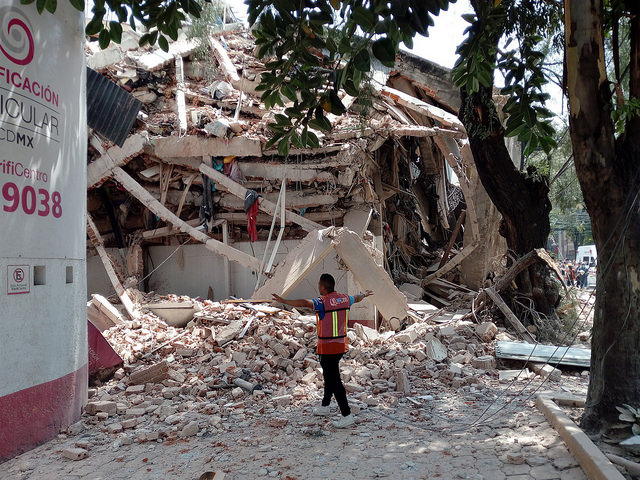
The Sept. 19, 2017 earthquake toppled nearly 50 buildings in Mexico City, and left many uninhabitable. Fire fighters carry out an inspection the day after in an apartment building that is still standing but will have to be demolished, in a neighbourhood in the centre of Mexico City. Credit: Emilio Godoy/IPS
MEXICO CITY, Sep 20 2017 (IPS) - Central Mexico faced Wednesday the challenge of putting itself back together after the powerful 7.1-magnitude quake that devastated the capital and the neighbouring states of Mexico, Morelos and Puebla the day before.
In Mexico City the air smells of dust, destruction, death, panic and hope, brought by the quake, whose epicenter was in Morelos, 120 km to the south of the capital. So far the official death toll is 230, with hundreds of people injured and 44 collapsed buildings in Mexico City.
“Everything is cracked, everything’s about to fall down. Now I don’t know what I’m going to do,” Verónica, who lived in a new building on the verge of collapse on the south side of the capital, told IPS with tears in her eyes.
The mother of three, who preferred not to give her last name, was living alone for the last two years. She managed to salvage a few important things, like documents, jewelry and a TV set. She is now staying with one of her daughters in another part of greater Mexico City, which has a population of nearly 22 million people.
In Mexico City, the municipalities of Benito Juárez and Cuauhtémoc – two of the 16 “delegations” into which the city is divided and which together are home to nearly one million people – were hit hardest, along with parts of the states of Morelos and Puebla.
The capital is built on a dried-up ancient lakebed, which makes it more susceptible to earthquake damage.
On Tuesday, the interior ministry declared a state of disaster in the capital and 150 municipalities in Guerrero, Morelos and Puebla that were affected by the quake, to free up funds from the National Fund for Natural Disasters (FONDEN).
Berenice Rivera works as a seamstress, and she and her co-workers were evacuated from the building as soon as the first tremors were felt. “I ran to pick my kids up at school and went home to check if everything was ok,” the mother of two told IPS.
Given the structural damage to a tall nearby building, Rivera does not believe she can continue to live in the housing complex where she lives along with some 80 neighbours. “We’re going to pull things out and see where we can move to, what else can we do?” she sighed.
Construction workers were among the first to get involved in the effort to rescue survivors, leaving the buildings where they were working and using their hands to remove rubble to find people who might be trapped underneath. It was the start of a wave of citizen solidarity and support that continues to grow along the streets and avenues of the city.
A rescue worker attempts to secure the perimeter of a building toppled by the Sept. 19, 2017 earthquake, to keep former residents from trying to get inside – something that has happened in many buildings knocked down or badly damaged by the quake in Mexico City. Credit: Emilio Gody/IPS
Just like after the 8.0-magnitude quake that left 25,000 people dead in Mexico City – according to unofficial figures – on Sept. 19, 1985, people mobilised en masse to remove rubble in the search for survivors, in a brave and often disorganised show of solidarity.
Although basic public services have been restored, economic, commercial and educational activities have come to a halt. The work is focused on finding survivors under the rubble, assessing the damage to buildings, and depending on the result, demolishing them and relocating the residents while planning the reconstruction effort.
But more buildings are at risk of collapse because of the damage suffered. In addition, the quake – which happened on the 32nd anniversary of the worst quake in the history of Mexico, during a drill on how to deal with a disaster of this kind – will have environmental and health effects.
“The situation is very difficult,” Mexican-American Juan Cota, who has been living in the capital since 2011 and works in the financial sector, told IPS. “There are damaged buildings that could collapse.”
Cota was in a café on the south-central side of the city when the quake began. His apartment survived, but some of his neighbours were not so lucky.
The Mexico City government has opened at least 41 shelters for survivors throughout the capital.
Mexico’s foreign minister, Luis Videgaray, tweeted that the United Nations would head the rescue and aid efforts.
According to its model for estimating earthquake damage, the United States Geological Survey (USGS) predicted up to 1,000 fatalities and economic losses between 100 million and one billion dollars.
The USGS stated that “Extensive damage is probable and the disaster is likely widespread. Estimated economic losses are less than 1% of GDP of Mexico. Past events with this alert level have required a national or international level response.”
The quake has further stretched the country’s disaster response system, already overwhelmed by the 8.1-magnitude quake that hit on Sept. 7, with an epicenter off the coast of the southern state of Chiapas, and which also affected the state of Oaxaca and Mexico City.
Over two million people were affected by that quake, including some 90 people who were killed, according to government statistics.
In August, the World Bank Group issued its largest ever catastrophe bond to Mexico.
The bonds are divided into three categories of insurance: Atlantic Ocean hurricanes, Pacific Ocean hurricanes and earthquakes, providing Mexico with financial protection of up to 360 million dollars against losses.
Similar bonds were issued in 2006, 2009 and 2012.
Each year, this Latin American country dedicates some 1.5 billion dollars to the reconstruction of public infrastructure and social housing affected by natural disasters. Between 2014 and 2015, FONDEN disbursed 137 million dollars to address the damage caused by hurricanes, heavy rains and flooding.
The earthquake has fanned the flames of the debate about the construction standards in force in Mexico City, which were upgraded after the 1985 tragedy. “They say they’re stricter, but look at that building. It’s new and it’s about to come down,” said Verónica.
Cota believes the standards are not always enforced, mainly because of corruption. “They ignore them…they have to be revised and enforced, because the earth will continue to shake and there will be more damage,” he said.
Tuesday’s earthquake occurred near the area where the Cocos Plate, off Mexico’s Pacific coast, is pushing underneath the North American Plate – a phenomenon that points to further quakes.

In Myanmar, Conspiracy Theories Hound Rohingya Crisis Coverage

Authentic news,No fake news.


Conspiracy theories have hounded media coverage of the Rohingya crisis in Myanmar, which many view as biased against the largely Buddhist country.
These include allegations that Muslims have undue influence at the BBC and that the Organization of Islamic Cooperation is paying foreign journalists to produce the stories they want.

The complaints stem from a genuine concern that the media has focused a disproportionate amount of attention on the more than 400,000 Rohingya who have fled violence in Myanmar and the allegations of extrajudicial killings and massacres that they have brought with them.
Their plight has reached the highest levels of global power, with U.S. Vice President Mike Pence on Wednesday referring to the developments as a "great tragedy unfolding."
By contrast, many here argue, journalists - and then the leaders who read the stories - ignore or fail to mention the Arakan Rohingya Salvation Army attacks that sparked the military crackdown, the tens of thousands of non-Muslim civilians who have fled their homes, and the deaths of Buddhists, Hindus and members of ethnic minorities caught up in the conflict.

WATCH: Reporting Difficult in Troubled Rakhine State
Aung San Suu Kyi speech
Myanmar’s de facto leader Aung San Suu Kyi reinforced this sentiment in a little-cited part of her first speech on the crisis on Tuesday, saying, “those who have had to flee their homes are many. Not just Muslims and [Buddhist] Rakhines but also small minority groups such as Daing-net, Mro, Thet, Mramagyi and Hindus, of whose presence most of the world is totally unaware.”
A week before her speech, an op-ed writer in state media observed, “the reports written by a handful of respected journalists and scholars from the international community who reported on the actual events, nearly disappeared under the overwhelming and powerful influence of foreign media."
But how does a perhaps expected feeling of international bias sprout into more far-fetched theories?
Richard Horsey, an independent Myanmar analyst, said in an email that while the Arakan Rohingya Salvation Army has received funding from outside the country, both from the diaspora and non-Rohingya donors, the outside media support contentions which may date back to deeper, historical grievances.
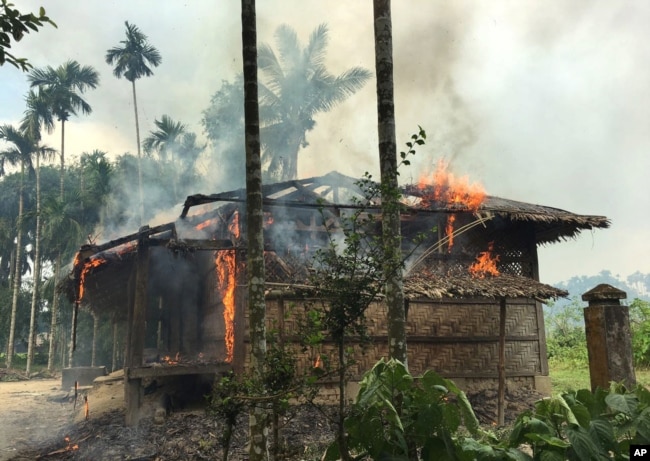
FILE - Flames engulf a house in Gawdu Zara village, northern Rakhine state, Myanmar, Sept. 7, 2017. In a video, widely circulated in Myanmar, a respected Buddhist monk blamed arson incidents in Rakhine state on Muslim extremists.
“The question of the funding of the ‘Muslim media’ probably relates to old views within Myanmar of Muslim wealth, which is a common refrain and linked historically to the fact that under colonial rule much of the business class in the country ended up being Muslims from South Asia,” he said, adding that it probably has less to do with media organizations with perceived biases, such as Qatar-based Al-Jazeera, but that such outlets “may provide contemporary validation of their views.”
This kind of thinking is not limited to the fringes of society.
Buddhist video
In a September 8 video circulating online in Myanmar, a prominent and respected Buddhist monk seemed to legitimize the view.
“Thirty-two villages were destroyed. Muslim extremists did it. Fifty-one villages were burned. But international media do not write about it. Instead they write and highlight what the Muslims are feeling because of military attacks," the monk said. "The media are biased and corrupt. Even the U.N. seems to be have been bought off by Muslims. It's like we are going to follow what the Muslims are doing. Muslims have bought off the BBC already.”
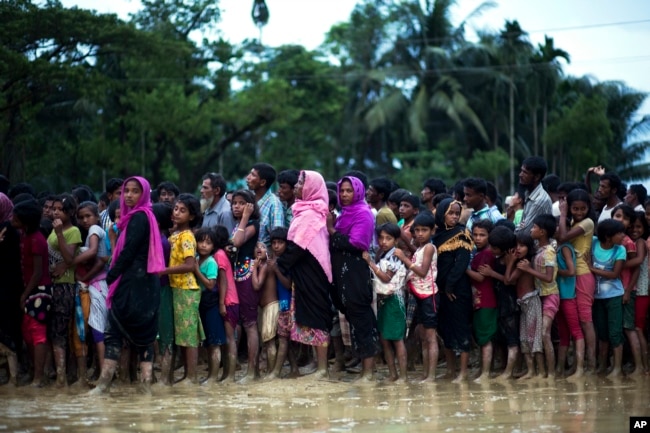
FILE - Rohingya Muslims, who crossed over recently from Myanmar into Bangladesh, wait to receive food being distributed near Balukhali refugee camp in Cox's Bazar, Bangladesh, Sept. 19, 2017. In a speech Tuesday, Myanmar's de facto leader, Aung San Suu Kyi, claimed that "the world is totally unaware" that not just Muslims but also Buddhists and members of various minority sects have had to flee the violence in Rakhine state.
The video has been viewed 1.2 million times on Facebook.
Pressure from the international community and critical coverage of Myanmar is, of course, nothing new. The pro-democracy struggle, the Saffron Revolution in 2007, Cyclone Nargis in 2008. All led to coverage that the then-junta despised.

But Myanmar’s political and economic reforms, launched in 2011 and culminating with the election of Aung San Suu Kyi’s party in 2015, changed the landscape.

Aye Chan Naing, the Yangon-bureau chief of the Democratic Voice of Burma, said the accusations of funding by the Organization of Islamic Cooperation have been “floating around” since inter-communal violence erupted in Rakhine state in 2012, and are easily distributed with wider Internet access.
Limited media familiarity with Rakhine state
One of the problems is limited media access to northern Rakhine state where the conflict is centered. Most of the media visits have been via guided press trips. The vacuum creates fertile ground for rumors.

“Even though the media were brought in – I mean selected media, not even every media – selected media were brought in, they were not allowed to go [around] freely. So that’s the whole problem,” he said. If you let the media in, “all the rumors or everything will disappear.”

Accusations of bias also feed into other aspects of the crisis, such as aid from international NGOs, which local Rakhine have long accused of favoring the Rohingya.

On Wednesday, security forces in the Rakhine state capital of Sittwe had to break up a mob that gathered in an attempt to disrupt a shipment of aid.

Angola opposition parties to take seats in parliament

Authentic news,No fake news.

LUANDA, Sept. 21 (Xinhua) -- Four Angola opposition parties decided on Thursday to take their seats in the National Assembly to play the democratic game.
It was announced in a joint statement by the National Union for the Total Independence of Angola (UNITA), the Broad Convergence for the Salvation of Angola - Electoral Coalition (CASA-CE), Social Renewal Party (PRS) and National Front for the Liberation of Angola (FNLA).
Angola's opposition had previously challenged results of the August 23 elections, in which the ruling People's Movement for the Liberation of Angola (MPLA) won 61 percent of the votes.
According to the FNLA president, Lucas Ngonda, who read the joint statement regarding the outcome of the electoral process, the parties recognized the good performance of the voters and called for confidence and certainty in the future of the country.
The four parties considered, in the statement, that there are reasons for them to remain in the democratic struggle with renewed methods, inside and outside the institutions.
In the framework of this year's general elections, the elected MPs will be inaugurated and take the oath at the National Assembly on September 28.
The legislature will count on 150 MPs from MPLA, 51 from UNITA, 16 from the CASA-CE coalition, two from the PRS and one from the FNLA, for a total of 220 parliamentarians.
Joao Lourenco was elected President of Angola and will be inaugurated on September 26

Oil settles flat as unease builds ahead of OPEC meeting

Authentic news,No fake news.


NEW YORK (Reuters) - Oil prices settled nearly flat on Thursday, the eve of a meeting of major oil-producing countries in Vienna to discuss whether they will extend production limits that have helped reduce the global crude glut.
Ministers from the Organization of the Petroleum Exporting Countries, Russia and other producers meet on Friday. They will discuss a possible extension of 1.8 million barrels per day (bpd) of supply cuts to support prices and will consider monitoring exports to assess compliance.
While many analysts expect extension of the deal beyond next March, many also said prices have risen high enough to tempt countries to boost production beyond agreed levels.
“Compliance looks to be a bit of an issue” if prices rise much from current levels, said John Kilduff, partner at Again Capital LLC in New York.
U.S. crude futures dipped 14 cents, or 0.3 percent, to settle at $50.55 a barrel. Brent crude futures rose 14 cents, or 0.3 percent, to end at $56.43 a barrel.
Kilduff noted that oil prices have surged more than 15 percent over the last three months as the production cuts, along with strong growth in energy demand, have tightened the global crude market.
“I don’t think it’s a sure thing they extend the deal at this meeting anyway,” Kilduff said.
The Philadelphia Energy Solutions oil refinery owned by The Carlyle Group is seen at sunset in Philadelphia March 26, 2014. Picture taken March 26, 2014. REUTERS/David M. Parrott/File Photo
“Russia took a very long time to get to the compliance levels they were supposed to get to” in the output cut agreement, said Tariq Zahir, a trader with Tyche Capital Advisors in New York. “It wouldn’t surprise me to see them cheat a little bit as we get to the fourth quarter.”
He said OPEC’s output cuts have boosted prices enough to encourage higher production elsewhere. U.S. shale production, especially, has been growing to record highs.
Hurricanes in the Gulf of Mexico have pushed up crude inventories as some U.S. refineries have been shut by flooding.
U.S. crude production reached 9.51 million bpd last week, up from 8.78 million bpd after Hurricane Harvey hit the U.S. Gulf late August. C-OUT-T-EIA
Rising U.S. production is “a reminder to the market that OPEC has a significant problem on its hands from the continued rise in shale output,” Again Capital’s Kilduff said.
Front-month Brent futures have risen sharply in recent months, much more than forward prices. This has pushed the price curve for oil futures from contango, signifying an oversupplied market, to backwardation, where the back months are cheaper than the front month contract, indicating a tighter market.<0#LCO:>
Brent’s backwardation, initially confined to the contracts nearest expiry, now extends throughout the whole of next year.

Mitra-mandal Privacy Policy

This privacy policy has been compiled to better serve those who are concerned with how their  'Personally Identifiable Inform...