MITRA MANDAL GLOBAL NEWS

Small Entrepreneurs Emerge as Backbone of Bangladesh’s Rural Economy

Authentic news,No fake news.
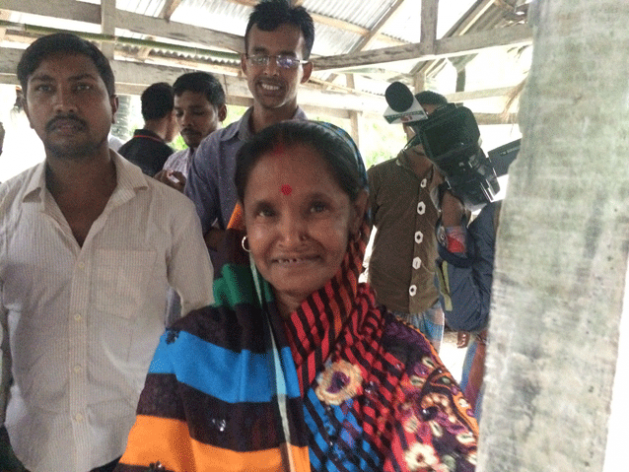


Shahndah Rani. Credit: Shahiduzzaman
Banaripara (Barisal), Sep 4 2017 (IPS) - She was born in the early 1950’s to an ultra-poor family in Kundihar, a remote village of Banaripara of Barisal division in Bangladesh. She was a beautiful baby and her father named her ‘Shahndah Rani’ which means ‘Queen of Evenings’. But in reality her life was far from that of a queen.
Born into acute poverty, there were days when she went without any food. Rani’s parents could not afford any schooling and gave her away in marriage at age 16 to relieve some of the pressures on them. She was married off to Monoranjan Dhar, who despite being poor himself, cared for Rani.
Soon after she moved in with her husband, Rani started working to produce lime from snail shells in the traditional way, by hand. Lime is one of the ingredients used in the consumption of betel leaf. Many people in Bangladesh and other South Asian countries are dependent on betel leaf or ‘paan’ chewing, which also includes other ingredients such as areca nut and often tobacco. It is chewed for its stimulant effects. Historians claim that betel leaf chewing has been part of South Asian culture for hundreds of years.
Rani’s struggle for survival began at the time of Bangladesh’s independence in 1971. She managed to save a capital fund of just 65 dollars, which she used to buy firewood and for collecting snail shells from ponds, marshland and swampland around her village. On the very first day of her business venture, she produced one kilogram of lime, which she was able to sell in a nearby rural market for about one US dollar.
Rani quickly realized that she was on the right track and understood the market value and demand. She’s never looked back.
Her husband Monoranjan proudly says, “Rani is energetic and she can think well. She gives me the courage and confidence to face the challenges of poverty together.”

Shanda Rani and her family with IFAD team members. Credit: Shahiduzzaman

Following four decades of hard work, Shandha Rani is now an icon for rural entrepreneurs in her village and community. Her husband and three adult sons work with her. She has also created jobs for three more people.
Several other women and men are following Rani’s footsteps. Dipali Rani is one of them, who also started producing lime. The local people have renamed the village Lime Para (village).
“It is good. Traders are now directly coming to us to buy our product. It also reduces our worries about marketing the product,” said Manaranjan.
Rani is eager to expand her network and business into neighbouring districts, so she is negotiating with financial institutions for loans to invest. She has successfully set up a small workshop with an electric moulding machine, a fireplace to burn snail shells and storage space. Rani is the proud owner of a motorboat for easy transportation of her product and raw materials. Her family home is now a tin-roofed, brick-walled house with a toilet on her own land. At present she has a running capital of about 10,000 dollars, with the capacity to produce 800 kg lime per day. However, lime from snail shells can’t be produced year-round because of non-availability of the shells, particularly in dry or winter seasons.
“If initiatives are taken to cultivate snail shells, it will be a big push for lime production. It has a potential market in the country. Snail shells without flesh are the key raw material for lime production. Besides, their flesh has huge demand in fish cultivation farms as feed. Such initiatives will also create more job opportunities in rural areas,” said James P. Biswas, Deputy Executive Director of the Bangladesh Development Society (BDS).
Rani’s story is one of the success stories of BDS, an NGO based in Barisal working to support development of rural entrepreneurs with assistance from the Palli Karma-Sahayak Foundation (PKSF) and the International Fund for Agricultural Development (IFAD), a United Nations specialized agency.
Since 2000, BDS has been supporting Rani. She was able to take loans 16 times and each of these loans was repaid on time. The loan amounts vary between 200 and 6,000 dollars.
“The organization has provided loans for various purposes to dozens of families in this sub-district and there has been remarkable progress. In most cases, beneficiaries have overcome poverty while at the same time creating jobs. With such success, BDS in partnership with the IFAD and PKSF is planning to increase the loan amount and help expand areas of activities,” Biswas added.
Benoit Thierry, Country Program Manager in the Asia and the Pacific Division of IFAD, who recently visited the Kundihar village along with PKSF officials, met up with several beneficiaries including Shahndah Rani to assess the impact of IFAD support in this area. Over four decades, the Fund has been providing grants and loans to Bangladesh, with the aim of enabling poor people in vulnerable areas to adapt the pattern of their livelihoods to climate change; help small producers and entrepreneurs benefit from improved value chains and greater market access and economically and socially empower marginalized groups, especially poor rural women.
Currently, the Government of Bangladesh and IFAD are negotiating to undertake another six-year project, starting in 2018, to increase farmer incomes and livelihood resilience through demand-led productivity growth, diversification and marketing in changing climatic conditions.
The proposed 111-million-dollar programme is expected to directly benefit at least 250,000 rural households in eleven districts of the country’s southern divisions of Chittagong and Barisal.
PKSF General Manager Akond Md. Rafiqul Islam said, “For many years, access to credit, cooperation, technical support and technology transfer to the poor were limited. Since its inception in 1990, PKSF has been working exclusively for their development in collaboration with 250 NGOs. In this context IFAD’s continuous assistance makes it easier to address effectively the needs of moderate and ultra-poor people. Now you will find thousands of success and trend setting entrepreneurs like Shahndah Rani all over the country.”
Things are moving and changing fast in Bangladesh. In a very real sense, these small rural entrepreneurs are strengthening the rural economy and creating huge job opportunities, Islam added. At present, PKSF is supporting more than 10 million poor people in the country, 90 percent of them women.
Israt Jahan, the top government official of Banaripara Upazilla, lauded IFAD, PKSF and NGO initiatives.
“Their activities are supplementing the government programmes, particularly in poverty alleviation, strengthening rural economy, empowerment of women and their participation in socio-economic development and cultural activities,” Jahan said.
She added that, “The Bangladesh government has made remarkable progress on poverty alleviation. While connectivity between rural areas and cities are well established, we still need to do more and welcome any support from IFAD and PKSF for programmes undertaken to benefit rural people.”

Vaaldiam Mining earns millions in royalties from mines years after exiting

Authentic news,No fake news.


  NAIROBI, KENYA: Canadian firm, Vaaldiam Mining Inc, earned a tidy Sh310 million during the year to June 2017 from the Kwale mineral sands project operated by Australian miner —Base Resources. While Vaaldiam might be unknown to many Kenyans, its predecessor Tiomin Resources is familiar to many and particularly to coastal residents. For more than a decade, the firm struggled to move the titanium mines of Kwale to production. Acquired rights Its efforts amounted to nil on the back of a push and pull with locals, lobby groups and Government agencies. Despite what can be termed huge failure during Vaaldiam’s stay in Kenya, it still earns a tidy sum from the mines that it had been sitting on for about 15 years without any tangible development. The Sh310 million ($3.1 million) payment is in royalties came from Base Resources, which in 2010 acquired the rights to the Kwale mineral sands project. Tiomin, which was in 2012 renamed Vaaldiam Mining Inc after acquiring Vaaldiam, entered Kenya in the mid-1990s with plans to prospect and eventually mine titanium in Kwale County. It was, however, unable to make any meaningful progress through the years and sold its rights to Base Resources of Australia in 2010. While the Australian firm in its disclosure in 2010 while selling the Kwale Mineral Sands mines to Base Resources said it had invested over Sh6 billion and might dispute being labelled a speculator, Vaaldiam had nothing much to show for the investment and the time spent at the Kenyan Coast. In fact, a firm that had earlier expressed interest to buy into the project pulled out of the deal, citing suspect disclosures on the activities undertaken at the mines. Base Resources, which took over the mineral sands mines in 2010, said it paid out Sh300 million to Vaaldiam as royalties during the financial year to June 30 this year. This is slightly lower than the Sh400 million Kenya Government was paid. The dismal disparity in pay between Tiomin and the Government is despite the company having put in little or no tangible investments in the Kwale mines while the Government owns the resource, on behalf of Kenyans. The royalties are part of the sale agreement that Base Resources signed with Vaaldiam, which were to be paid at a rate of 1.5 per cent of revenues. This is slightly lower than what the Governments gets - at 2.5 per cent but is being relooked, with a view of pushing it to about five per cent. “Royalty paid to the Government of Kenya in the 2017 financial (at 2.5 per cent) amounted to $4 million (about Sh400 million). The equivalent amount has also been expensed in the accounts as an accrual to bring the total (representing five per cent royalty) to $8 million (Sh800 million),” said Base Resources in a statement. “A further $3.1 million (Sh310 million) was paid to Tiomin/Vaaldiam as part of the ongoing acquisition cost of the project as agreed in 2010 - totaling to $11.1 million (Sh1.11 billion).” “Royalty costs are provided for and expensed on the basis of a five per cent royalty rate being payable to the Government of Kenya, whereas the royalty rate applicable under the terms of the special mining lease, and currently being paid, is 2.5 per cent.” Base in three years was able to do what Tiomin could not do in more than a decade, having moved into the mines in 2011, by being able to export the first cargo of mineral sands from the Kwale project in 2014. Tiomin discovered the mineral sands in Kwale in 1995 but faced hurdles, with the monumental one being getting a buy-in from the community. Meagre compensation Until the time of selling to Base Resources, the firm had not been able to move out locals to allow commencement of mining owing to meagre compensation it was offering. The resistance by locals who also raised concerns that the project would affect the environment and their sources of livelihood. It was reinforced by lobby groups that had argued Tiomin had bypassed the law in implementing the project. The firm also faced regulatory challenges through the years, with Government agencies turning down its applications. Tiomin was also broke, with the titanium discovery in Kwale being its only active project at the time and the lenders advanced credit to the firm on the basis of the viability of the mines. Other than credit from banks, the firm had been able to rope in a Chinese firm that had initially bought a 20 per cent stake but in 2009 said it was willing to up this to 70 per cent and move the mines to production. The deal, however, fell through within two months. Jinchuan Group of China, which was to pay Tiomin Sh2.5 billion ($25 million) and invest a further Sh1.8 billion in developing the project, opted out of the deal before it was concluded, arguing that it was ‘not satisfied with the disclosure schedule’ presented by Tiomin. Sitting on potential mines or oil fields with the hope of a big pay day through sale of rights is not unique to Tiomin. Many mineral and oil exploration and production firms have entered Kenya with a plan of sitting on extractive licences with expectations of being bought out by industry majors. Companies are currently holding licences to explore for minerals, oil and gas, but have undertaken minimum work obligations on the fields. They avoid being kicked out of the licence areas by the State but are always keen to renew their licences to keep their speculative tendencies alive. The Ministry of Mining in 2013 and later in 2015 revoked dozens of licences that had been issued to exploratory and mining companies. The then Cabinet Secretary Najib Balala (now in Tourism) argued that the firms had no capacity or intentions of undertaking meaningful work and were just speculating, shopping for buyers of part or all of their rights. A similar scenario has unfolded in the upstream oil sector, which just like mining has garnered interest in the recent past, where many companies licensed to explore for oil have not been meeting certain obligations stipulated under their licences. The Ministry of Energy has been forgiving and has so far not taken any drastic measures to end such speculations. It has only penalised one firm, despite  issuing dozens of licences to inactive companies, with the only visible activity being in the Turkana blocks. The Ministry has in the past said failure by firms to meet their contractual obligations - including minimum investments in actual exploration works as well as investments in the community - has been due to factors that are beyond their control.  Vaaldiam is one such firm that had nothing much to show for the investments and the time spent at the Coast.
Read more at: https://www.standardmedia.co.ke/business/article/2001253634/canadian-company-earns-millions-in-royalties-from-mines-years-after-exiting

British schools Nos. 1 and 2 in World University Rankings

Authentic news,No fake news.


Oxford University took the top spot in Times Higher Education's World University Rankings for 2017 -- for the second year in a row. File Photo by Andy Rain/EPA
Sept. 5 (UPI) -- For the first time in its 14-year history, two British universities hold the top two spots in Times Higher Education's annual World University Rankings.
Oxford and Cambridge claim the top two slots in the rankings -- with Oxford holding onto its number one position for the second year in a row, and Cambridge climbing up to take over the California Institute of Technology at No. 2.
"To be judged the best university in the world for the second successive year, against a backdrop in which Britain's role in the world is uncertain and the place of universities in society open to question, will be a great source of pride for everyone at Oxford, and, I hope, for the whole country," Oxford's vice-chancellor, Louise Richardson, said.
This rise could be due to Oxford and Cambridge both seeing increases in total institutional income up 24 percent and 11 percent respectively. U.S. universities that share the third spot, Caltech and Stanford, saw institutional income drop by 23 percent and 24 percent, respectively.
However, the underlying risk of Brexit may have major consequences on Oxford and Cambridge's funding. A key factor in funding institutions is the monetary support they receive from the European Union.
The European Union has provided many research grants to the universities. A quarter of Cambridge's research income and a fifth of Oxford's come in the form of EU grants. This could be potentially problematic for the future global performance of both colleges once Brexit is fully implemented.
The rankings director, Phil Baty, warns that Britain shouldn't jeopardize the quality of its institutions.
"They are a huge national asset and one that the country can ill-afford to undermine at a time when its place in the global order is under intense scrutiny," said Baty.

Norway plans tax breaks for remotest Arctic oilfields

Authentic news,No fake news.


OSLO (Reuters) - Norway’s government plans to make taxpayers rather than oil companies pay special U.N. fees for any offshore production from remote Arctic regions, according to letters sent to oil firms and seen by Reuters.
The plan could serve as an example for other nations looking to fund exploration of the seabed ever further from land.
It was criticized by opposition parties that want tighter limits on exploration in the fragile Arctic environment, days before an election in which the future of Norway’s big offshore oil and gas sector is a major issue.
Opinion polls show a neck-and-neck race between Conservative Prime Minister Erna Solberg’s center-right block and center-left parties headed by Labour leader Jonas Gahr Stoere.
“There is too little risk on the companies, and too much risk on the people of Norway,” said Ola Elvestuen, the head of parliament’s Energy and Environment committee and a member of the small Liberal Party.
“Neither me, nor the committee were informed about this,” he said of the plans, outlined in letters provided to Reuters by the Oil and Energy Ministry, for implementing a dormant provision of the 1982 U.N. Convention on the Law of the Sea.
Under Article 82 of the treaty, rich nations are due to pay up to 7 percent a year of the value of any production -- of oil, gas or other minerals -- from their continental shelves more than 200 nautical miles (370 km) from land to a fund to help developing nations.
The money would be channeled to poor nations via the United Nations’ International Seabed Authority in Jamaica. The mechanism is untested as there is no production so far offshore.
The Oil and Energy Ministry included a warning about Article 82 when it offered parts of the Arctic Barents Sea, more than 200 nautical miles from land, for exploration in the latest licensing round awarded in 2016.
“The licensees could be required to cover certain costs in this connection,” it wrote in the letters to oil companies. “Any such cost will be deductible in the calculation of the petroleum tax.”

DRILLING

The ministry viewed the deductions as matching Norwegian petroleum policy, which includes a principle that “an investment project that is profitable before tax is also profitable after tax,” an official source said.
Last month, Statoil and partners Chevron, ConocoPhillips, Lundin Petroleum, and Petoro drilled the first well in the Arctic Korpfjell prospect, 410 km from the nearest land.
They found only small, non-commercial quantities of natural gas, but Statoil plans more drilling in the area in 2018.
The government has also offered three additional blocks behind the 200 nautical miles threshold in upcoming licensing rounds, with awards expected in 2018.
Of the 166 nations that have ratified the Law of the Sea, Norway has apparently gone furthest in outlining how it would apply Article 82, legal experts said.
The United States, which has not signed up, tells bidders for oil and gas leases far offshore in the Gulf of Mexico that they might be at risk of extra charges if Washington were to join.
“Norway and the United States are the only two countries that have spent any time talking about Article 82,” said Wylie Spicer, a Canadian legal expert who has written reviews of Article 82 for the United Nations.
John Norton Moore, a law professor at the University of Virginia who helped draft Article 82, said Oslo was trying to balance the interests of its citizens, oil companies and developing nations.
“This strikes me as a sound decision by Norway. It recognizes that it is an obligation of the state” to pay any charges under Article 82, he said.
He said it was reasonable to give oil companies tax breaks for taking on the risks of operating so far from land. Article 82 makes states responsible for payments but lets them decide how to raise the cash.

OPPOSITION CRITICISM

Rasmus Hansson, the only member of parliament for the opposition Green Party and a member of the Energy and Environment Committee, criticized the government plan.
“This is yet another round of subsidizing Norway’s future contributions to global warming with taxpayers’ money,” he said.
Environmental group Greenpeace also criticized the plan, saying that oil and gas in the high north was simply too risky. “There is no anchor in the democratic process,” said Truls Gulowsen, leader of Greenpeace Norway.
Legal scholars say Article 82 is based on the idea that the high seas, owned by no nation, usually start 200 nautical miles offshore, the limit of each country’s exclusive economic zone (EEZ).
Article 82 lets rich nations exploit resources beyond their EEZs in offshore areas where, such as in Arctic Norway, a shallow continental shelf extends beyond 200 nautical miles.
Under Article 82, countries will have to start paying 1 percent of the value or volume of any production after five years, with the annual rate rising to a plateau of 7 percent after 12 years.
Norway’s parliament debated and ratified the Law of the Sea in 1996, and included an assessment that any application of Article 82 was unlikely to have a big economic impact.
Editing by Timothy Heritage
Our Standards:The Thomson Reuters Trust Principles.

ENERGY NEWS-Oil prices increase as Texas refineries start returning to normal

Authentic news,No fake news.


Moon calls for improved ties with Russia, joint efforts to denuclearize N. Korea

Authentic news,No fake news.


SEOUL, Sept. 5 (Yonhap) -- South Korean President Moon Jae-in called for stepped up efforts to further improve his country's relationship with Russia on Tuesday, also expressing hope for the countries to sign a free trade agreement to enhance their economic ties.
Moon insisted increased cooperation between the two countries may be crucial to establishing lasting peace in the region.
"Since the establishment of diplomatic ties in September 1990, South Korea and Russia have continued to expand their cooperation in various areas, such as the economic, diplomatic and cultural sectors. Trade between the two countries has enjoyed astonishing growth," the South Korean president said in a written interview with TASS Russian News Agency.
The new South Korean president is scheduled to head to Russia's Vladivostok on Wednesday for a regional forum known as the Eastern Economic Forum. He is also set to hold bilateral talks with his Russian counterpart Vladimir Putin.
Moon noted bilateral trade between Seoul and Moscow has jumped more than 135 times from US$190 million in 1992 to $25.8 billion in 2014, while the exchange of people between the two spiked from around 30,000 in 1990 to 440,000 last year.
"I believe our two nations must move forward from now to have a much greater dream. We must seek cooperation projects aimed at ensuring peace and prosperity not only on the Korean Peninsula and the Far East, but also in Northeast Asia and Eurasia," he said, according to a copy of the written interview released by his presidential office Cheong Wa Dae.
The South Korean leader proposed the joint development of new shipping routes through the Arctic, and connecting the countries' railways to connect South and North Korea to Russia and Europe.
"It may take time, with many problems, such as the North Korean nuclear issue, that need to be resolved, but it is a path we must take, and I am convinced it will be a path that will serve the interests of not only South Korea and Russia, but also the world," he said.
Moon's trip to Russia follows North Korea's latest and sixth nuclear test staged Sunday.
He said the nuclear test was a serious violation of U.N. Security Council resolutions, but reaffirmed his commitment to the peaceful resolution of the issue.
"The situation is frustrating and difficult, but our government will consistently move forward its policy of realizing peace and prosperity on the Korean Peninsula with patience and a long-term perspective."

   "We do not seek to topple the North Korean regime or seek unification by absorption. We seek to form an economic community where the South and the North will co-prosper and this will also contribute to the development of the Russian Far East," he said.

N. Korea vows to respond with 'counteroffensive' to fresh sanctions

Authentic news,No fake news.


SEOUL, Sept. 6 (Yonhap) -- North Korea said Tuesday it will "respond with our own mode of counteroffensive" to any fresh sanctions that may be put in place following Pyongyang's latest nuclear test.
In a Q&A session with the state-run Korean Central News Agency, the North Korean foreign ministry spokesman blasted the United States for leading international efforts to adopt a fresh sanctions resolution.
Last Sunday, North Korea conducted its sixth and most powerful nuclear test. Pyongyang claimed it was a successful test of an H-bomb that can be mounted on a long-range missile.
"The U.S. is running amuck to defame the DPRK, taking issue with our measures to bolster the self-defensive nuclear force," the spokesman said, referring to North Korea by its full name, the Democratic People's Republic of Korea.
"But this is only a sophistry to hide true colors of the U.S. as the main culprit for escalated tension and nuclear threat," he added. "No one has the right to make a fuss about our test of H-bomb for ICBM as it is a routine and indispensable process for the implementation of the strategic line that we have chosen for ourselves, the line of simultaneously developing the two fronts."

   The spokesman then threatened that the North will fight back with force if new sanctions are put into place.
"We will respond to the heinous sanctions and pressure of the U.S. with our own mode of counteroffensive and the U.S. shall be held totally responsible for all catastrophic consequences to follow," he said. "The U.S. should not forget even for a moment about the presence of the DPRK, the full-fledged nuclear power in possession of ICBM as well as A-bomb and H-bomb."

36 Terms Every Email User Should Know

Authentic news,No fake news.

Lifewire | Tech Today
How to Leave an Annoying Group Text
Ever had family or friends create a group text for a specific purpose, but the chatter never dies down from there? Here’s how you can get out, without letting anyone know you did.
READ NOW  
READ THESE NEXT
10 Things You Didn’t Know You Could Do With Google Hangouts
36 Terms Every Email User Should Know
Why You Need a ‘Disposable’ Email Account
What Is a Software Patch, Exactly?

Reuters launches grant program to develop the next generation of photojournalists

Authentic news,No fake news.

Reuters launches grant program to develop the next generation of photojournalists

Photojournalism grants seek to develop a diverse new generation of photojournalists to tell original human stories from around the world.


PERPIGNAN – Reuters, the world’s largest international multimedia news provider, today announced the launch of a photojournalism grant program which seeks to recruit and develop a diverse new generation of young photojournalists.
Reuters Pictures is offering up to eight $5,000 USD grants to passionate photojournalists or students of photojournalism who are interested in working on photo assignments and projects to advance their abilities and tell new stories.
Pictures taken by grant recipients will be distributed globally on Reuters platforms. Yannis Behrakis, Reuters photojournalist and senior editor, special projects, will advise recipients with their assignments and projects, providing advice or planning assistance. Yannis is well known for his coverage of the European migrant crisis and was part of a team of Reuters Pictures photographers awarded the Pulitzer Prize for Breaking News Photography for their coverage of the crisis in 2016.
Candidates do not need to be professional photojournalists, but must demonstrate an ability to successfully conceive and complete their grant project.
“Reuters is keen to recruit diverse candidates from all backgrounds and we are excited to work with emerging talents who can tell human stories from new perspectives.”, said Reuters Global Editor of Video and Pictures John Pullman. “We look forward to reviewing the submitted applications.”
The photojournalism grants are being launched on the first day of the Visa pour l’Imageinternational festival of photojournalism, taking place in Perpignan, France. Aspiring photojournalists attending the festival will be able to visit the Reuters stand, located in stand 23-24 on the second floor of the Palais des Congrès, where The Wider Imageeditors Gabrielle Fonseca Johnson and Marika Kochiashvili, as well as Yannis Behrakis, will be available to provide portfolio reviews and advice.
Other Reuters activities at this major photo industry event include:
  • Reuters Pictures photographers and senior editors will be providing portfolio reviews for photographers seeking feedback on their work. Taking part in the portfolio reviews are Rickey Rogers, Global Editor, Reuters Pictures, Yannis Behrakis and Reuters Pictures photographers Goran Tomasevic and Damir Sagolj.
  • Veteran Reuters Pictures photographer Zohra Bensemra’s work will be exhibited in Lives on a Wire, an exhibiton exploring the human cost of war, based on her work in Libya, Syria, Iraq, Afghanistan, Sudan, Egypt and Somalia. Zohra will also be taking part in the festival’s education programme, presenting her exhibition to local schoolchildren.
  • Damir Sagolj’s images of the war on drugs in the Philippines will feature in a screening at the Campo Santo in Perpignan on September 8th.
Reuters
Reuters, the news and media division of Thomson Reuters, is the world’s largest international multimedia news provider reaching more than one billion people every day. Reuters provides trusted business, financial, national and international news to professionals via Thomson Reuters desktops, the world's media organizations and directly to consumers at Reuters.com and via Reuters TV. Follow news about Reuters at @ReutersPR.
Notes to Editors
Photojournalism Grants
Application requirements
Applicants must submit a CV and a 35-50 picture portfolio (JPEG format) of both single images and multi-image stories. Applicants must also submit a detailed cover letter explaining a project or idea to use the grant. A focused project about a subject in a community or location close to you that you can reasonably complete in a few weeks or months is advisable.
Application and grant period
Application period: September 10, 2017 to December 10, 2017.
Grant period: January 1, 2018 to December 31, 2018.
How to apply
Share a Dropbox folder or other download link with ReutersPhotoGrant@thomsonreuters.com
Successful candidates will be contacted by Yannis Behrakis.
Visa pour l’Image
Biographies of Reuters Pictures editors and photographers taking part in portfolio reviews
  • Rickey Rogers, Global Editor, Reuters Pictures. Rickey was appointed Global Editor in January 2017, and was formerly Editor, Americas Pictures.
  • Yannis Behrakis, Reuters Pictures photojournalist and senior editor, special projects. Yannis was part of the Reuters team who won the 2015 Pulitzer Prize for Breaking News Photography.
  • Goran Tomasevic, Reuters Pictures photojournalist known for his coverage of conflicts around the world.
  • Damir Sagolj, Reuters Pictures photojournalist based in Beijing whose recent work includes images from China, North Korea and Mongolia as well as the war on drugs in the Philippines.
Zohra Bensemra
Born in Algiers, Zohra Bensemra has worked as a photojournalist since 1990. She started her career at El Watan newspaper as Algeria’s first female photojournalist and joined Reuters in 1997 documenting the Algerian civil war. Among her first international assignments was the 2000 conflict in Macedonia and the 2003 Iraq war. Since then she has worked across the Middle-East and Africa, covering the referendum in Sudan, the Tunisian uprising and the revolution in Libya, as well as Afghanistan, Syria, Darfur and Somalia. From 2012 to 2014, Bensemra was Reuters Chief Photographer for Pakistan, based in Islamabad, before moving back to Algiers where she continues to cover breaking news in the Middle-East and Africa. Over the last year, she has travelled several times to Iraq documenting the frontline battle against Islamic State militants in Mosul as well as the humanitarian impact of the conflict. In 2005, Zohra won the European Union prize for the best African photographer.
CONTACT
Pete Biggs
PR Manager, Reuters
+44 (0) 207 7542 4214
pete.biggs@tr.com

**************

Xi calls for synergizing development strategies among BRICS countries

Authentic news,No fake news.

XIAMEN, Sept. 4 (Xinhua) -- Chinese President Xi Jinping on Monday called on
 BRICS countries to synergize their development strategies to stimulate growth potential.
Xi made the remarks while addressing the ninth BRICS summit in the southeastern
 Chinese city of Xiamen, which was also attended by leaders of Brazil, Russia,
 India and South Africa.
The five countries should find areas where their respective development
 policies and priorities converge, and work to build a big market for trade
 and investment, achieve smooth flow of currency and finance, and realize
 infrastructure connectivity, Xi said.
"Despite our differences in national conditions, our five countries are in a
 similar stage of development and share the same development goals.
 We all face an arduous task in growing the economy," Xi noted.
He said strengthening the complementarity of their development
 strategies will bring out their comparative strengths in resources,
 market and labor force, release the growth potential of the five
 countries and the creativity of their 3 billion people, and open up
 huge space for development. P Xi said the five countries need to
 plan well at the macro level and take concrete actions in key areas.
"With a focus on structural reform and sustainable development, we need
 to expand our converging interests and share experience on innovation,
 entrepreneurship, industrial development and production capacity to boost
 our economic development," said Xi.
He said it is important to strike a balance between the speed of growth
 and the quality and efficiency of growth.
By implementing the 2030 Sustainable Development Agenda, BRICS
 countries have the opportunity to achieve balanced economic, social
 and environmental progress, and bring about interconnected and
 inclusive development, said Xi.

Mitra-mandal Privacy Policy

This privacy policy has been compiled to better serve those who are concerned with how their  'Personally Identifiable Inform...