A global mining giant seeking public funds to develop one of the world’s largest coal mines in Australia has been accused of fraudulently siphoning hundreds of millions of dollars of borrowed money into overseas tax havens.
Indian conglomerate the Adani Group is expecting a legal decision in the “near future” in connection with allegations it inflated invoices for an electricity project in India to shift huge sums of money into offshore bank accounts.
Details of the alleged 15bn rupee (US$235m) fraud are contained in an Indian customs intelligence notice obtained by the Guardian, excerpts of which are published for the first time here.
The directorate of revenue intelligence (DRI) file, compiled in 2014, maps out a complex money trail from India through South Korea and Dubai, and eventually to an offshore company in Mauritius allegedly controlled by Vinod Shantilal Adani, the older brother of the billionaire Adani Group chief executive, Gautam Adani.
Vinod Adani is the director of four companies proposing to build a railway line and expand a coal port attached to Queensland’s vast Carmichael mine project.
The proposed mine, which would be Australia’s largest, has been the source of years of intense controversy, legal challenges and protests over its possible environmental impact.
Abbot Point, surrounded by wetlands and coral reefs, is set to become the world’s largest coal port should the proposed Adani expansion go ahead. Photograph: Tom Jefferson / Greenpeace
Expanding the coal port to accommodate the mine will require dredging an estimated 1.1m cubic metres of spoil near the Great Barrier Reef marine park. Coal from the mine will also produce annual emissions equivalent to those of Malaysia or Austria according to one study.
One of the few remaining hurdles for the Adani Group is to raise finance to build the mine as well as a railway line to transport coal from the site to a port at Abbot Point on the Queensland coast.
To finance the railway Adani hopes to persuade the Northern Australia Infrastructure Facility (Naif), an Australian government-backed investment fund, to loan the Adani Group or a related entity about US$700m (A$900m) in public money.
While it awaits the decision on the loan, in Delhi the company is also expecting the judgment of a legal authority appointed under Indian financial crime laws in connection to allegations it siphoned borrowed money overseas.
The Adani Group fully denies the accusations, which it has challenged in submissions to the authority.
The investigation
News of the investigation was first reported in India three years ago, but the full customs intelligence document reveals forensic details of the workings of the alleged fraud which have not been publicly revealed.
The 97-page file accuses the Adani Group of ordering hundreds of millions of dollars’ worth of equipment for an electricity project in western India’s Maharashtra state using a front company in Dubai.
The Dubai company allegedly sold the exact same equipment back to Adani Group-controlled businesses in India at massively inflated prices, in some instances said to be eight times the sale price.
According to the allegations in the file, the effect of these transactions was that the Adani Group spent an average 400% more for the materials. That money was allegedly paid to a company Indian authorities allege was owned through a series of shell companies leading to a Mauritius trust controlled by Vinod Adani.
If true, one effect of the alleged scheme would have been to move vast sums of money from the Adani Group’s domestic accounts into offshore bank accounts where it could no longer be taxed or accounted for.
Because tariffs for using electricity transmission networks are determined partly by what they cost to build, if the DRI’s accusations are correct, the overvaluation of capital goods would have been likely to have led to higher power prices for Indian consumers.
Adani Power company thermal power plant at Mundra, India. Photograph: Sam Panthaky/AFP/Getty Images
A significant proportion of the money the Adani Group allegedly siphoned out of India was provided by taxpayers in the form of loans from the publicly-owned State Bank of India and ICICI, a private bank. There is no suggestion either bank was aware of or involved in any illegal activity.
‘We are cooperating with investigating agencies’
The Adani Group said in a statement to the Guardian on behalf of itself, its subsidiaries, and Vinod Adani that it “strongly denies the allegations of overvaluation”.
“It is a standard procedure for the group to follow international competitive bidding route for major capital expenditures to ensure transparency and competitiveness in the process. All our transactions are always conducted within the framework of extant regulatory guidelines and provisions,” it said.
“The fact that our projects have incurred the lowest cost across central, state and private utility players has gone to establish the robustness of the processes followed by our group.
“It may be noted that Mr Vinod Adani who is the elder brother of Mr Gautam Adani has been a non-resident Indian for about 30 years and has his own established business interests outside India,” the statement said.
“Adani Group is aware of the investigations being conducted by the DRI, and has fully cooperated, and shall continue to cooperate with the investigating agencies.”
The Australian loan
The Adani Group, or a linked entity, has reportedly been granted “conditional approval” for the US$700m (AU$900m) concessional loan from Naif, the Australian government investment fund.
But due to secrecy around the operation of the investment fund, it is not clear whether the loan application discloses the existence of the DRI notice or the ongoing legal proceedings, or whether the applicant is required to do so under the Naif’s anti-money laundering provisions.
Adani Group chairman Gautam Adani meets with Queensland premier Annastacia Palaszczuk in 2016. Photograph: Cameron Laird/AAP
Adani Group did not clarify whether it had informed Naif about the allegations when asked by the Guardian.
Naif’s investment mandate includes a clause preventing it from “act[ing] in a way that is likely to cause damage to the commonwealth government’s reputation, or that of a relevant state or territory government”.
Vinod Adani is currently listed as the sole director of four Singapore-based companies which, through their Australian subsidiaries, are proposing to build the railway line using the government loan. The companies also control a project to expand the Abbot Point port.
All four entities are ultimately owned by Atulya Resources Limited, an Adani-controlled company in the Cayman Islands.
Status of the Indian investigation
The Guardian understands the allegations of over-invoicing have been passed from the DRI to the Enforcement Directorate (ED), an Indian agency tasked with investigating financial crimes.
The Adani Group says the case is currently before a legal authority, the Adjudicating Authority, indicating that Indian officials are pressing either to seize assets they regard as being connected to money laundering or to levy a fine up to three times the sum allegedly siphoned overseas.
The company declined requests to clarify what if any penalty the authorities are seeking, but a spokesman said a decision was expected shortly. “We follow the process of corporate governance and comply with the applicable laws,” he said.
“All our transactions are always conducted within the framework of law. We have already submitted our detailed reply. Adjudication process on the subject is going on and we expect the order in near future.”
The Guardian is publishing excerpts from the DRI file in the interests of ensuring Naif, as well as the public, have access to as much relevant information as possible in assessing whether Adani or linked companies would be suitable recipients of public money.
In a separate case last year, six Adani subsidiaries were listed among 40 other companies being investigated for allegedly running a similar price-inflation scheme. The companies are accused of inflating the price of coal imports from Indonesia to hide profits in overseas tax havens.
The DRI and the ED did not respond to a request to clarify the status of the investigations.
The alleged money trail
India is electricity-starved. More than 240 million Indians – enough people to form the fifth-largest country on Earth – lack access to regular power.
In the early 1990s, to encourage power companies to build electrical infrastructure, the Indian government eliminated import tariffs on technical equipment such as reactors and transformers. Profit margins on these projects increased overnight.
Adani saw the business opportunity. In 2010, the Maharashtra Eastern Grid Power Transmission Company Limited (MEGPTCL), a wholly owned subsidiary of Adani Enterprises, was granted a license to develop two electricity transmission networks in the north-east of the state.
The company used another Adani subsidiary, PMC Projects, to source the equipment it would need to build the networks. In turn, PMC, subcontracted the work to a company in Dubai.
According to the investigators’ report, bank records suggest that that company, Electrogen Infra FZE (EIF), charged significant – and to Indian authorities, suspicious – markups on the equipment it sold to PMC.
In one of the 57 invoices cited in the report, EIF is alleged to have ordered equipment from Hyundai Heavy Industries in South Korea. Bank records allegedly show the company paid Hyundai about US$65m.
According to the DRI, it sold the same equipment to PMC for about US$260m – a mark-up of nearly 400%.
Extract from page 14-15 of the Directorate of Revenue Intelligence file on Adani Group. Photograph: The Guardian
“[This] appears to be an abnormal and gross inflation, contrary to ordinary economic logic and prudence,” investigators concluded.
In total, the report alleges EIF made about 26 orders from Hyundai Heavy Industries and sold them onto PMC for an average mark-up of more than 400%, making a profit margin of US$189m.
There is no suggestion Hyundai Heavy Industries or any other supplier was aware of or involved in any illegality.
Extract page 19-20 of the DRI file, section 4.1.16. Photograph: The Guardian
EIF allegedly purchased another 25 shipments of equipment from three companies in China. According to the report, these were sold to the Adani Group for an average markup of about 860%.
Investigators calculated the total assessable value of the allegedly marked-up invoices to be nearly 15bn rupees.
Extract from page 78-79 of the DRI file, section 15.4. Photograph: The Guardian
“Given the scale and extent of invoice inflation, it is apparent that it [was done] with fraudulent intent of siphoning money from India,” the DRI said.
Who controls the companies?
Key to the alleged fraud, according to investigators, is that EIF, the company subcontracted to purchase the equipment from manufacturers in South Korea and China, was directly controlled by the Adani Group and its associates.
Investigators claim EIF was partly staffed by ex-Adani Group employees who had recently left the company.
According to a letter from the company to an Indian bank that is cited in the notice, EIF was owned by another company called Electrogen Infra Holding Pvt Ltd (EIH). The trail of ownership eventually leads to a trust based in Mauritius – headed by Vinod Adani.
Extract from page 21-22 of the DRI file, section 4.2.3. Photograph: The Guardian
Investigators concluded: “From the above information given to the bank by EIF, it appears that Vinod Adani had a direct control over the activities of EIF through the Asankhya Resources Family Trust.”
Vinod Adani is also listed as having been the director of EIH between January 2010 and May 2011, though the notice states he told investigators he had no involvement in the day-to-day running of the company.
Investigators also claim to have discovered that an employee of the Adani Group subsidiary PMC had been granted permission by EIF staff to sign multimillion-dollar supply contracts on its behalf.
“All these go to show that there is no distinction between PMC and EIF, they are only working for common interest as part of a large modus-operandi for siphoning off money from India by invoice inflation,” investigators concluded.
The DRI and the ED were both contacted for comment. Attempts were made to contact EIF but the company could not be reached on its listed email or phone number.
Hyundai Heavy Industries did not respond to a request for comment.
It is unclear when the allegations of invoice inflation will be resolved in Delhi other than the Adani spokesman saying that they expected an order “in near future.” In Queensland, Naif’s decision on whether to grant Adani the nearly A$1bn loan is expected by the end of this year.
The observable Universe is an extremely big place, measuring an estimated 91 billion light-years in diameter. As a result, astronomers are forced to rely on powerful instruments to see faraway objects. But even these are sometimes limited, and must be paired with a technique known as gravitational lensing. This involves relying on a large distribution of matter (a galaxy or star) to magnify the light coming from a distant object.
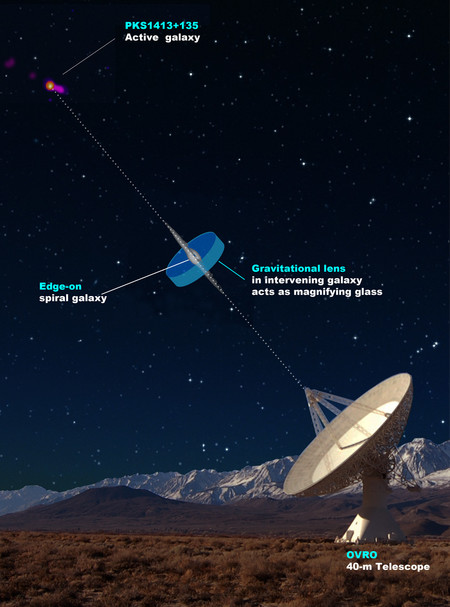
Using this technique, an international team led by researchers from the California Institute of Technology's (Caltech) Owens Valley Radio Observatory (OVRO) were able to observe jets of hot gas spewing from a supermassive black hole in a distant galaxy (known as PKS 1413 + 135). The discovery provided the best view to date of the types of hot gas that are often detected coming from the centers of supermassive black holes (SMBH).
The research findings were described in twostudies that were published in the August 15th issue of The Astrophysical Journal. Both were led by Harish Vedantham, a Caltech Millikan Postdoctoral Scholar, and were part of an international project led by Anthony Readhead - the Robinson Professor of Astronomy, Emeritus, and director of the OVRO.
The Owens Valley Radio Observatory (OVRO) - located near Bishop, California - is one of the largest university-operated radio observatories in the world. Credit: ovro.caltech.edu
This OVRO project has been active since 2008, conducting twice-weekly observations of some 1,800 active SMBHs and their respective galaxies using its 40-meter telescope. These observations have been conducted in support of NASA's Fermi Gamma-ray Space Telescope, which has be conducting similar studies of these galaxies and their SMBHs during the same period.
As the team indicated in their two studies, these observations have provided new insight into the clumps of matter that are periodically ejected from supermassive black holes, as well as opening up new possibilities for gravitational lensing research. As Dr. Vedantham indicated in a recent Caltech press statement:
"We have known about the existence of these clumps of material streaming along black hole jets, and that they move close to the speed of light, but not much is known about their internal structure or how they are launched. With lensing systems like this one, we can see the clumps closer to the central engine of the black hole and in much more detail than before."
While all large galaxies are believed to have an SMBH at the center of their galaxy, not all have jets of hot gas accompanying them. The presence of such jets are associated with what is known as an Active Galactic Nucleus (AGN), a compact region at the center of a galaxy that is especially bright in many wavelengths - including radio, microwave, infrared, optical, ultra-violet, X-ray and gamma ray radiation.
Illustration showing the likely configuration of a gravitational lensing system discovered by OVRO. Credit: Anthony Readhead/Caltech/MOJAVE
These jets are the result of material that is being pulled towards an SMBH, some of which ends up being ejected in the form of hot gas. Material in these streams travels at close to the speed of light, and the streams are active for periods ranging from 1 to 10 million years. Whereas most of the time, the jets are relatively consistent, every few years, they spit out additional clumps of hot matter.
Back in 2010, the OVRO researchers noticed that PKS 1413 + 135's radio emissions had brightened, faded and then brightened again over the course of a year. In 2015, they noticed the same behavior and conducted a detailed analysis. After ruling out other possible explanations, they concluded that the overall brightening was likely caused by two high-speed clumps of material being ejected from the black hole.
These clumps traveled along the jet and became magnified when they passed behind the gravitational lens they were using for their observations. This discovery was quite fortuitous, and was the result of many years of astronomical study. As Timothy Pearson, a senior research scientist at Caltech and a co-author on the paper, explained:
"It has taken observations of a huge number of galaxies to find this one object with the symmetrical dips in brightness that point to the presence of a gravitational lens. We are now looking hard at all our other data to try to find similar objects that can give a magnified view of galactic nuclei."
Artist's representation of an active galactic nucleus (AGN) at the center of a galaxy. Credit: NASA/CXC/M.Weiss
What was also exciting about the international team's observations was the nature of the "lens" they used. In the past, scientists have relied on massive lenses (i.e. entire galaxies) or micro lenses that consisted of single stars. However, the team led by Dr. Vedantham and Dr. Readhead relied on an what they describe as a "milli-lens" of about 10,000 solar masses.
This could be the first study in history that relied on an intermediate-sized lens, which they believe is most likely a star cluster. One of the advantages of a milli-sized lens is that it is not large enough to block out the entire source of light, making it easier to spot smaller objects. With this new gravitational lensing system, it is estimated that astronomers will be able to observe clumps at scales about 100 times smaller than before. As Readhead explained:
"The clumps we're seeing are very close to the central black hole and are tiny - only a few light-days across. We think these tiny components moving at close to the speed of light are being magnified by a gravitational lens in the foreground spiral galaxy. This provides exquisite resolution of a millionth of a second of arc, which is equivalent to viewing a grain of salt on the moon from Earth."
What's more, the researchers indicate that the lens itself is of scientific interest, for the simple reason that not much is known about objects in this mass range. This potential star cluster could therefore act as a sort of laboratory, giving researchers a chance to study gravitational milli-lensing while also providing a clear view of the nuclear jets streaming from active galactic nuclei.
Image of the 40-meter telescope of the Owens Valley Radio Observatory (OVRO), located near Bishop, California. Credit: Anthony Readhead/Caltech
Looking ahead, the team hopes to confirm the results of their studies using another technique known as Very-Long Baseline Interferometry (VLBI). This will involve radio telescopes from around the world taking detailed images of PKS 1413 + 135 and the SMBH at its center. Given what they have observed so far, it is likely that this SMBH will spit out another clump of matter in a few years time (by 2020).
Vedantham, Readhead and their colleagues plan to be ready for this event. Spotting this next clump would not only validate their recent studies, it would also validate the milli-lens technique they used to conduct their observations. As Readhead indicated, "We couldn't do studies like these without a university observatory like the Owens Valley Radio Observatory, where we have the time to dedicate a large telescope exclusively to a single program."