MITRA MANDAL GLOBAL NEWS

ETEnergyworld- Governments $3 billion demand premature: Reliance Industries Ltd, Shell India

Authentic news,No fake news.



Top Stories
Governments $3 billion demand premature: Reliance Industries Ltd, Shell India
Cabinet may take up sale of HPCL to ONGC on Wednesday
UP, Gujarat top the list of states with highest petrol pump chip sales fraud
GST is negative for Oil & Gas, broadly neutral for Electric Utilities: Fitch Ratings
First Australian Uranium shipment is on its way to India: Julie Bishop
Ashok Leyland announces strategic partnership with Sun Mobility for electric mobility
How a single sentence from the Essar verdict can ruin Urjit Patel's war against loan defaulters
Oil & Gas
Assam government dissatisfied with non-availability of ONGC gas
Oil India submits report to Centre for gas pipeline to Assam
HPCL, ONGC merger would not bring synergy: Ambit Capital
GAIL shares fall on another probe regarding GSA
ExxonMobil says will not continue discussions over East Natuna gas field in Indonesia
Oil steadies as ample supply meets firm demand
Rick Perry touts energy exports, awaits study on electricity grid
BHP Billiton to ramp up US shale rigs despite divestment calls
RIL m-cap slips below Rs 5 lakh crore mark
Porsche may ditch diesel engines: CEO Oliver Blume Business Standard
Renewable
ReNew eyes Orange's portfolio in $950 million deal to bulk up before IPO
IFC plans $6 billion investment in India
Delhiites wants to set up rooftop solar panel: Greenpeace
Soon, Nagpur High Court building to shift to green energy
Power
Banks likely to take hit of Rs 18,000 crore from Dirty Dozen
UP electricity regulator cancels PPAs of Bajaj Energy units with UPPCL
India has to find accessible innovative models: Tata Sons chief N Chandrasekaran
Steel manufacturing cost to rise as power out of GST: Steel Ministry to PMO
Tamil Nadu power utility to save Rs 2,000 crore per year in discounts
Infrastructure boost from NIIF likely soon; Temasek, Abu Dhabi Investment close to scripting firstdeal Financial Express
Discom engineer death: Why power thieves fear no one
BMW executive Ulrich Kranz joins electric car startup Faraday Future
Baboon causes power cut in Zambian tourist town near Victoria Falls
Coal
Monnet Ispat declared insolvent despite JSW offer Business Standard
Low coal offtake leaves Western Coalfields Rs750 crore in the red
World Bank to draw up plan for Railways Rs 5 lakh crore makeover
BHP Billiton hits full year iron ore guidance, sets higher target

Strange Radio Signals Detected from a Nearby Star

Authentic news,No fake news.


Matt Williams à¤¦्वारा
Astronomers have been listening to radio waves from space for decades. In addition to being a proven means of studying stars, galaxies, quasars and other celestial objects, radio astronomy is one of the main ways in which scientists have searched for signs of extra-terrestrial intelligence (ETI). And while nothing definitive has been found to date, there have been a number of incidents that have raised hopes of finding an "alien signal".
In the most recent case, scientists from the Arecido Observatory recently announced the detection of a strange radio signal coming from Ross 128 - a red dwarf star system located just 11 light-years from Earth. As always, this has fueled speculation that the signal could be evidence of an extra-terrestrial civilization, while the scientific community has urged the public not to get their hopes up.
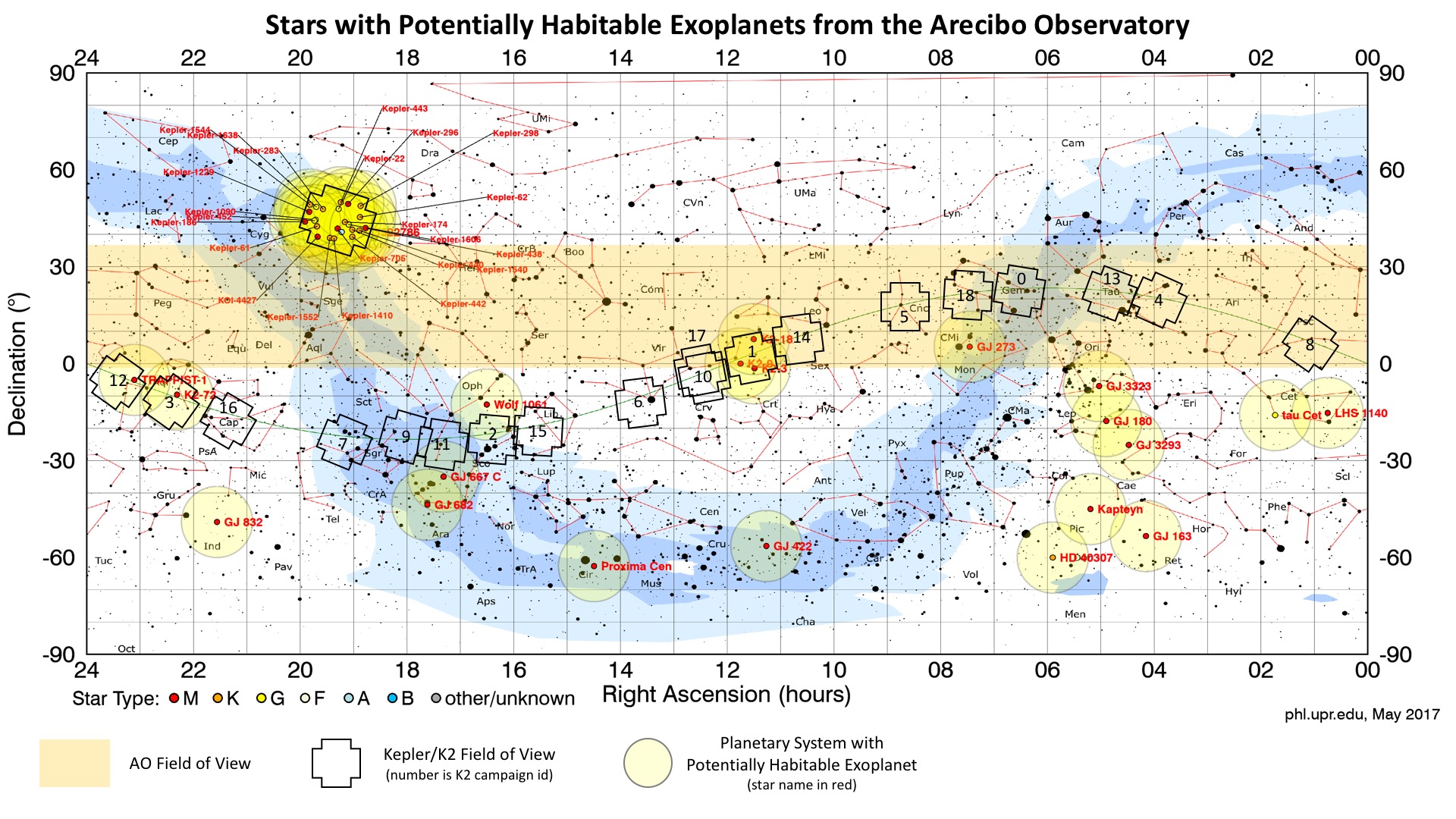
The discovery was part of a campaign being conducted by Abel Méndez - the director of the Planetary Habitability Laboratory (PHL) in Peurto Rico - and Jorge Zuluaga of the Faculty of Exact and Natural Sciences at the University of Antioquia, Colombia. Inspired by the recent discoveries around Proxima Centauri and TRAPPIST-1, the GJ 436 campaign relied on data from Arecibo Observatory to look for signs of exoplanets around nearby red dwarf stars.
Arecibo Observatory, the world's biggest single dish radio telescope, was and is still being used to image comet 45P/H-M-P. Courtesy of the NAIC - Arecibo Observatory, a facility of the NSF
In the course of looking at data from stars systems like Gliese 436, Ross 128, Wolf 359, HD 95735, BD +202465, V* RY Sex, and K2-18 - which was gathered between April and May of 2017 - they noticed something rather interesting. Basically, the data indicated that an unexplained radio signal was coming from Ross 128. As Dr. Abel Mendez described in a blog post on the PHL website: 
"Two weeks after these observations, we realized that there were some very peculiar signals in the 10-minute dynamic spectrum that we obtained from Ross 128 (GJ 447), observed May 12 at 8:53 PM AST (2017/05/13 00:53:55 UTC). The signals consisted of broadband quasi-periodic non-polarized pulses with very strong dispersion-like features. We believe that the signals are not local radio frequency interferences (RFI) since they are unique to Ross 128 and observations of other stars immediately before and after did not show anything similar."
After first noticing this signal on Saturday, May 13th at 8:53 p.m., scientists from the Arecibo Observatory and astronomers from the Search for Extra-Terrestrial Intelligence(SETI) Institute teamed up to conduct a follow-up study of the star. This was performed on Sunday, July 16th, using SETI's Allen Telescope Array and the National Radio Astronomy Observatory's (NRAO) Green Bank Telescope.
They also conducted observations of Barnard’s star on that same day to see if they could note similar behavior coming from this star system. This was done in collaboration with the Red Dots project, a European Southern Observatory (ESO) campaign that is also committed to finding exoplanets around red dwarf stars. This program is the successor to the ESO's Pale Red Dot campaign, which was responsible for discovering Proxima b last summer.
Images of the star systems examined by the GJ 436 Campaign. Credit: PHL/Abel Méndez 
As of Monday night (July 17th), Méndez updated his PHL blog post to announced that with the help of SETI Berkeley with the Green Bank Telescope, that they had successfully observed Ross 128 for the second time. The data from these observatories is currently being collected and processed, and the results are expected to be announced by the end of the week.
In the meantime, scientists have come up with several possible explanations for what might be causing the signal. As Méndez indicated, there are three major possibilities that he and his colleagues are considering:
"[T]hey could be (1) emissions from Ross 128 similar to Type II solar flares, (2) emissions from another object in the field of view of Ross 128, or just (3) burst from a high orbit satellite since low orbit satellites are quick to move out of the field of view. The signals are probably too dim for other radio telescopes in the world and FAST is currently under calibration."
Unfortunately, each of these possibilities have their own drawbacks. In the case of a Type II solar flare, these are known to occur at much lower frequencies, and the dispersion of this signal appears to be inconsistent with this kind of activity. In the case of it possibly coming from another object, no objects (planets or satellites) have been detected within Ross 128's field of view to date, thus making this unlikely as well.
The stars currently being examined as part of the GJ 436 campaign. Credit: PHL/Abel Méndez
Hence, the team has something of a mystery on their hands, and hopes that further observations will allow them to place further constrains on what the cause of the signal could be. "[W]e might clarify soon the nature of its radio emissions, but there are no guarantees," wrote Méndez. "Results from our observations will be presented later that week. I have a Piña Colada ready to celebrate if the signals result to be astronomical in nature."
And just to be fair, Méndez also addressed the possibility that the signal could be artificial in nature - i.e. evidence of an alien civilization. "In case you are wondering," he wrote, "the recurrent aliens hypothesis is at the bottom of many other better explanations." Sorry, alien-hunters. Like the rest of us, you'll just have to wait and see what can be made of this signal.
Further Reading: AFPPHL

Gas prices nationwide holding steady

Authentic news,No fake news.


A gas station sells gas for below $3.00 a gallon in Cranbury, NJ on October 29, 2014. This week, the national average for a gallon of regular might hit 3 dollars, a low that hasn't been reached since 2010. UPI/John Angelillo 
License Photo
July 18 (UPI) -- Demand pressures could lead to higher gasoline prices across the United States, though data from motor club AAA show relative stability at the national level.
AAA reports a national average retail price for a gallon of regular unleaded gasoline at $2.26 for Tuesday, relatively unchanged from last week. The price at the pump is slightly less than it was at this point last month and is about 2 percent, or 5 cents per gallon, less than it was on this date in 2016.
The motor club said that, with the summer travel season well under way, some demand pressures started to emerge last week. The U.S. Energy Information Administration reported last week that nation-wide inventories for gasoline declined 1.6 million barrels, which puts the national level at 4 million barrels below what it was this time last year.
AAA spokesperson Jeanette Casselano said more than half of the gas stations in the country are posting gas at the national average or less.
"If, however, demand keeps pace and stocks continue to draw down at sizable levels, gas prices are likely to increase this month into next," she said in a statement.
The West Coast remains the most expensive market in the country, though gas prices there were relatively stable. California gas prices continue to hold below $3 per gallon, posting $2.91 for Tuesday. That comes even though regional refineries are running below peak capacity because of regular maintenance. That means more relief could be coming for area drivers once those refineries return to normal later this week.
Drivers in the Great Lakes are still coping with the most volatile market. Two weeks ago, the area saw steep declines in gas prices, though that's reversing course this week. Michigan gas prices last week dropped 8 cents per gallon, but erased half of that overnight. That comes even as regional gasoline stockpiles are higher than last year.
Analysis emailed to UPI from price-tracker GasBuddy said that, because of the regional volatility, the Great Lakes states are usually the first to respond to movements in crude oil prices. Last week, oil prices gained 5 percent and that spike is starting to show up at the pump.
In the week ahead, a survey of analyst sentiments from S&P Global Platts found gasoline inventory levels are expected by fall by 700,000 barrels, less than half the draw from last week. Meanwhile, U.S. oil production continues to offset efforts by the Organization of Petroleum Exporting Countries to balance the market with coordinated declines in output.
"As the rebalance waiting game continues, drivers are likely to continue benefitting at the pump with cheaper summer gas prices," AAA reported.
The federal government estimated a national average price for gas at $2.38 per gallon for the summer driving season, which runs from April through December. That's lower than the forecast from April and, if realized, would be the second-lowers price during the summer since 2005.

WORLD NEWS-Saudi woman in short skirt arrested

Authentic news,No fake news.


ENERGY NEWS--Russia sees no damage from Bering Sea quakes

Authentic news,No fake news.


Mitra-mandal Privacy Policy

This privacy policy has been compiled to better serve those who are concerned with how their  'Personally Identifiable Inform...