MITRA MANDAL GLOBAL NEWS

The fate of Brazil’s president hangs in the balance

Authentic news,No fake news.


Dangling man

Michel Temer is in serious trouble. But he has reserves of strength
“IF THEY want, let them bring me down!” So declared Brazil’s president, Michel Temer, in a newspaper interview on May 22nd. He is the second president in the space of a year who is fighting to stay in office in the face of allegations of wrongdoing and dismal poll ratings. His predecessor, Dilma Rousseff, was impeached in 2016 on a technical violation of public-accounting law. The allegations against Mr Temer are far graver, but his chances of remaining president may be brighter. Whether he stays or goes, the accusations against him are momentous. The blow to his prestige and influence will delay, and might destroy, vital reforms to Brazil’s economy, which is only beginning to emerge from its worst-ever recession.
Mr Temer’s woes began on May 17th when O Globo, a newspaper, reported that, on a tape recorded by Joesley Batista, a billionaire businessman, he is heard endorsing payment of hush money to a politician jailed for his role in the Petrobras scandal. This originally centred on the state-run oil company but has expanded beyond it. In a related sting, police filmed Rodrigo Loures, a congressman from Mr Temer’s Party of the Brazilian Democratic Movement (PMDB) and formerly his right-hand man, accepting a bag with 500,000 reais ($153,000) in cash. Mr Temer solicited millions in irregular payments, claimed Mr Batista and a subordinate.

Latest updates

See all updates
Mr Temer has protested his innocence in speeches and interviews. He portrays himself as the victim of a “perfect crime” committed by Mr Batista, who framed him in exchange for near-total immunity from prosecution (see article). Mr Temer’s fate is in the hands of the courts, his allies in congress and public opinion, any one of which could bring him down. The evidence against him is shocking but inconclusive. Mr Temer has strengths that his hapless predecessor did not.
Trashing the tape
Edson Fachin, a judge on the supreme court, which tries sitting politicians, has authorised the attorney-general to open a criminal investigation into Mr Temer, Mr Loures and Aécio Neves, a senator from the centre-right Party of Brazilian Social Democracy (PSDB), who was caught in another Batista-related sting. Formal charges may be filed soon. Mr Temer’s lawyers contend that the tape is “worthless”. Their study of it turned up 70 “discontinuities”, which may suggest tampering. Mr Fachin has ordered a forensic examination.
Lawyers will poke holes in other evidence, including the plea-bargain testimony by Mr Batista and his brother, Wesley, co-owners of JBS, a giant meat exporter. Some of the Batistas’ allegations refer to wrongdoing that took place before Mr Temer became president. In such cases, he has immunity. But legal niceties will not help if he cannot scrub off the mud he apparently spattered on himself. When Joesley Batista boasts on the tape of having two judges and a prosecutor in his pocket, Mr Temer merely murmurs, “great, great”.
The political calculus of his allies in congress could be as important as the weight of the evidence, and will partly depend on it. His most important friend is Rodrigo Maia, the speaker of the lower house, who has signalled that he will shelve the dozen impeachment motions that have been filed so far. Two medium-sized parties have quit the PMDB-led coalition, but their ministers have clung on to their cabinet posts. The PSDB, the biggest coalition partner, seems unsure what to do.
They are hesitant in part because Mr Temer has no clear successor (he was Ms Rousseff’s vice-president, but does not himself have a deputy). Mr Maia will take over temporarily if Mr Temer is impeached or indicted. If he leaves office definitively, congress will have 30 days to choose a successor to serve the rest of his term, which ends at the end of next year.
That person would carry the stigma of election by a congress mired in corruption. Any politician with the skill to pilot reforms through the legislature is, like Mr Maia, already under investigation, or soon could be. Other potential successors are Cármen Lúcia, the respected chief justice of the supreme court, and Henrique Meirelles, the finance minister, who has the nous to serve as president. But Ms Lúcia is not a politician and Mr Meirelles was chairman of J&F, the Batistas’ holding company. Nelson Jobim, a former minister, worked for BTG, a bank whose founder was arrested in the Petrobras affair.
Unlike Ms Rousseff, Mr Temer is not loathed by the elite. Bosses know they have a big stake in the continuation of his policies, especially an overhaul of pensions and a reform of rigid labour laws. These should encourage interest rates, already falling, to come down further, and lift employment. Mr Meirelles now concedes that the reforms will be delayed. The stockmarket plunged and trading was suspended after the disclosure of the Batista tape. On May 22nd S&P warned that it might downgrade Brazil’s credit rating.
Mr Temer also arouses less passion than Ms Rousseff did among middle-class voters. Protests in 2015 and 2016 by prosperous urbanites, galvanised by anger over the Petrobras scandal, helped drive her out of office. Those people are reluctant to join left-wingers in lambasting Mr Temer and his pro-market reforms. Turnout at anti-Temer protests on May 21st was low. Participation may wane after protesters set a ministry ablaze in Brasília on May 24th.
The final arbiter of Mr Temer’s future may turn out to be the electoral tribunal. Much of the money sloshing around from Petrobras, JBS and others may have financed the election of Ms Rousseff and Mr Temer in 2014. On June 6th the tribunal will begin deliberations on whether to annul the results. Until last week, analysts doubted that it would risk instability by doing that. But its politically savvy judges may now believe that Mr Temer’s continuation in office is the greater threat. The PSDB is reportedly trying to make its decision easier by brokering an agreement on a successor to Mr Temer. Speculation focuses on Mr Jobim and Tasso Jereissati, a sensible PSDB senator from the state of Ceará.
Mr Temer could slow things down by appealing against the tribunal’s ruling. But if his allies turn against him, his defiance could crumble.
This article appeared in the The Americas section of the print edition under the headline "Dangling man"

Africa – More than Just Conflicts, Corruption, Disasters.

Authentic news,No fake news.


A woman in El Fasher, North Darfur, uses a Water Roller for easily and efficiently carrying water. Credit: UN Photo/Albert Gonzalez Farran.
ROME, May 25 2017 (IPS) - Natural and man-made disasters, armed conflicts, widespread corruption and deep social inequalities have been so far a dramatic source for most news coverage when it comes to Africa, the world’s second-largest and second-most-populous continent on Earth, which hosts 54 states spreading over 30 million square kilometres that are home to over 1.2 billion people.
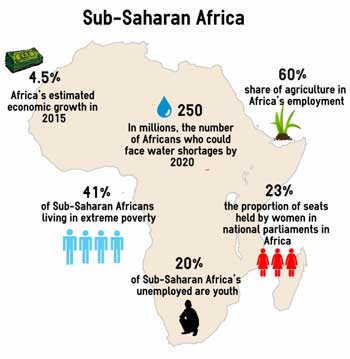
Nevertheless, an often neglected fact is that this vast continent with huge natural resources –which have been systematically depleted by private –and also in cases, state-owned corporations— registered an economic growth of around 4 per cent in 2014, “creating one of the longest stretches of uninterrupted positive economic expansion in Africa’s history,” according to the United Nations.
As a result, a growing number of Africans have joined the middle class each year.
May 25 has marked Africa Day, an annual commemoration of the establishment of the Organization of African Unity (OAU) on that very same date on 1963, when 32 independent African states signed the founding charter in Addis Ababa, Ethiopia. In 2002, the OAU became the African Union.
Just three weeks ahead of Africa Day, a new UN atlas charting data from 54 African countries revealed the continent’s energy potential; showing that investment in renewable energy would strengthen its economic advancement.
Credit: United Nations
“The Atlas makes a strong case that investments in green energy infrastructure can bolster Africa’s economic development and bring it closer to achieving the Sustainable Development Goals (SDGs),” said Juliette Biao Koudenoukpo, Director and Regional Representative of the Africa Office for the Nairobi-based UN Environment Programme (UNEP).
As such, she continued, it is an important policy guide for African governments as they strive to catalyse national development by making use of their energy resources.
The Atlas of Africa Energy Resources, released by UNEP and the African Development Bank at the World Economic Forum in Durban, South Africa, shows both the potential and the fragility of the continent’s energy resources, which are at the heart of Africa’s socio-economic development.
While Africa is richly endowed with both renewable and non-renewable energy resources, its current energy production is insufficient to meet demand, it says, adding that about a third Africa’s population still lacks access to electricity and 53 per cent of the population depends on biomass for cooking, space heating and drying.
According to UNEP, energy consumption on the continent is the lowest in the world, and per capita consumption has barely changed since 2000.
The poorest African households spend 20 times more per unit of energy than wealthy households when connected to the grid. A kettle boiled twice by a family in the United Kingdom uses five times as much electricity as a Malian uses in a year, UNEP reported.

The Big Challenges
According to the United Nations, climate change poses a significant threat to economic, social and environmental development in Africa. “There is strong evidence that warming in Africa has increased significantly over the past 50 to 100 years, with clear effects on the health, livelihoods and food security of people in Africa.”
Then comes corruption, which remains the “most daunting challenge” to good governance, sustainable economic growth, peace, stability and development in Africa, according to the international organisation.
Africa is richly endowed with energy resources, both renewable and non-renewable. The poorest African households spend 20 times more per unit of energy than wealthy households when connected to the grid. Credit: UNEP

“While corruption is a global phenomenon, the impact is felt more in poor and underdeveloped countries, where resources for development are unduly diverted into private hands, which exacerbates poverty. In many corruption perception surveys, Africa is perceived as the most corrupt region in the world, as well as the most underdeveloped and backward region…”
All this amidst the dramatic fact that Africa is also home to around half if the more than 4o conflicts worldwide, from South Sudan to Nigeria through Somalia.
The challenges posed by protracted conflicts and longstanding disputes on the African continent has been a major focus for the international community. In fact, already in 1960 the first peacekeeping operation in Africa was deployed in the Republic of the Congo to ensure the withdrawal of Belgian forces and to assist the government in maintaining law and order.
Since then thousands of peacekeepers have been deployed in nearly 30 peacekeeping operations to African countries, including Angola, Mozambique, Somalia, Sierra Leone, Ethiopia and Eritrea, Burundi and Sudan, and the Central African Republic, among others.

Decolonisation, Women Advancement
Another often-neglected fact is that at the end of World War II in 1945, nearly every country in Africa was subject to colonial rule or administration. Following the founding of the UN in 1945 and its massive decolonisation effort, Africa is now virtually free from colonial rule. In 2011 South Sudan became Africa’s newest country when it gained independence from the rest of Sudan.
Meantime, it would be needed to remind that in 11 African countries, women hold close to one-third of the seats in parliaments. Rwanda has the highest proportion of women parliamentarians in the world, according to the UN. Sub-Saharan Africa has the highest regional female entrepreneurial activity rate in the world, with nearly a third of businesses having some female ownership.

Africa’s Agenda 2063
An additional fact is that in January 2015 the heads of state and governments of the African Union adopted Agenda 2063, with visions and ideals aiming at serving as pillars for the continent in the foreseeable future.
“The Agenda is a strategic framework for the socio-economic transformation of the continent over the next 50 years. Its builds on, and seeks to accelerate the implementation of past and existing continental initiatives for growth and sustainable development,” according to the Africa Union (AU).
The guiding vision for Agenda 2063 is that of “An integrated, prosperous and peaceful Africa, driven by its own citizens and representing a dynamic force in international arena,” the AU states.
The seven “African Aspirations”, which were derived through a consultative process with the African Citizenry, are: a prosperous Africa, based on inclusive growth and sustainable development; an integrated continent, politically united, based on the ideals of Pan Africanism and the vision of Africa’s Renaissance, and an Africa of good governance, democracy, respect for human rights, justice and the rule of law.
Also a peaceful and Secure Africa; Africa with a strong cultural identity, common heritage, values and ethics, an Africa whose development is people driven, relying on the potential offered by people, especially its women and youth and caring for children, and an Africa as a strong, united, resilient and influential global player and partner.

Orlando Milesi interviews JULIO BERDEGUÉ, FAO regional representative

Authentic news,No fake news.


Julio Berdegué, FAO regional representative for Latin America and the Caribbean, in his office in Santiago. Credit: Maximiliano Valencia/FAO
SANTIAGO, May 24 2017 (IPS) - The fight against hunger has been “remarkably successful” in Latin America and the Caribbean, but “it is a crime” that 35 million people still go to bed hungry every day, FAO regional representative Julio Berdegué told IPS.
Berdegué, who is also assistant director-general of FAO (United Nations Food and Agriculture Organisation), with decades of experience in matters related to rural development, said during his first interview as the new regional representative that the biggest challenge in Latin America and the Caribbean is inequality, which “is present in every action and contributes to many other problems.”
In the FAO regional office in Santiago, Berdegué, from Mexico, discussed with IPS issues such as obesity, “in which we are losing the fight,” the weakness of rural institutions, which facilitates corruption, or the weakness of the social fabric, which drug trafficking mafias depend on, as well as the need to address the question of water scarcity which is here to stay due to climate change, and where the key is the transformation of agriculture, which uses 70 per cent of all water consumed.
IPS: What do you consider are the greatest debts of the region in the agri-food sector?
JULIO BERDEGUÉ: We unfortunately still have very high levels of rural poverty. Nearly 50 per cent of the rural population is still living in poverty conditions and almost 30 per cent in extreme poverty. There are 58 million rural poor and 35 million living in conditions of indigence, who are not even able to feed themselves adequately.
IPS: This is happening in the region that has been the most successful in reducing poverty and hunger in this century…
JB: We have a problem with malnutrition and hunger, which even though they have been notably reduced, still stand at 5.5 per cent, which in human terms means that 35 million Latin Americans are still going to bed hungry every day, and six million children are chronically undernourished… Which is a crime. And of these, 700,000 children suffer from acute and chronic undernutrition… that is terrible.
IPS: In that context, which will be the priorities of your administration?
JB: The main thrust has been continuity, and I want to adhere to that. FAO’s mission and strategic objectives are clearly defined in a medium-term work plan discussed and approved in May in Rome (at FAO’s global headquarters).
The first objective has to do with hunger…undernourishment and malnutrition will continue to have a central role in the agenda. The second has to do with greater sustainability of agriculture, contributing to global food security, in a sustainable manner.
The issues of rural poverty, where unfortunately family agriculture is included, beyond what people might think, are not yet lost, but we still have a long way to go. Also the importance of food systems, which have experienced in the past 25 to 30 years a radical shift in their depth and speed, and the importance of resilience in the face of climate change.
IPS: And what are the regional assets available to carry out these tasks?
JB: We must not lose sight of the fact that Latin America is a great contributor to global food security. What our region does in this matter is very important, and we must take advantage of this strength.
This is also a region with enormous biodiversity. In terms of biodiversity the region is a player of global importance and whatever we do well or badly affects each person on this planet.
IPS: Has there been progress in the political and social spheres?
JB: The question of peace in the region is another asset. What has happened in Colombia (with the peace agreements that came into force in late 2016) is exciting for all of us, and is of utmost importance. In the last 20 years there has also been heavy spending in rural areas, on roads, electrification, telecommunications, and access to basic services, education and health. The educational levels of our rural people under 35 are far higher than that of their parents. These are assets that we need to mobilise.
IPS: And what are the weaknesses you perceive in these same fields?
JB: In rural areas, government institutions are very weak, in most countries in the region… The exceptions can be counted on the fingers of one hand… and they are weak because they are outdated, because there is much corruption, patronage, use of public budgets for particular interests, and that weakens the government and public action for the benefit of society as a whole. It makes our job difficult.
IPS: Apart from that difficulty, what other challenges does the region face?
JB: The rural social fabric has been weakening in some countries. The penetration of drug trafficking, of violence, which often goes hand in hand with corruption, makes life very hard for the inhabitants of those rural areas and makes it very difficult to bring political solutions that would increase their opportunities and well-being. The situation in some Central American countries is extremely concerning. In my own country, Mexico, the situation worries all Mexicans. The levels of violence in Venezuela… There are countries where the weakening of the social fabric is a warning sign.
IPS: Latin Americans are facing a new and growing problem, obesity, without yet having solved that of chronic malnutrition…
JB: Malnutrition is a crime. The fact that more than half of the rural children in Guatemala suffer from chronic undernutrition is unacceptable in the 21st century, but obesity is killing us. Not long ago, Mexico’s minister of health, Dr. José Navarro, who until recently was the provost of the National Autonomous University of Mexico (UNAM), reminded us that obesity kills more people than organised crime in Mexico. Obesity is definitely killing us.
IPS: Do malnutrition and obesity have anything in common?
JB: First, let me say in what they differ. We have greatly reduced undernutrition. In this, Latin America has been remarkably successful, even at a global level. We are the only region that has met its Millennium Development Goals. But in terms of obesity we are losing the fight badly. Every day there are more overweight and obese people.
What they have in common, from FAO’s perspective, is a radical change in Latin America’s food systems. The world in which we had local markets and people ate locally produced food, where many people went home to eat, has disappeared forever.
Today our food systems are globalised, the bulk of the distribution of food products is through supermarket chains, most of what we eat are ultra-processed foods. Even our farmers eat mostly purchased food: processed and ultra-processed.
IPS: But this is a global phenomenon, as you say, not only regional…
JB: The point is not the transformation of the agri-food systems. That transformation can also be observed in Norway, Canada or New Zealand. They have the same patterns of urbanisation, of eating outside the home, purchasing in supermarkets, ultra-processed foods, etc. The difference is that in those places there are public policies. Ours is a transformation that responded to market forces without public policies. The market achieves important things… today food products are much cheaper, but with enormous consequences, one being obesity and the erosion of public health in all aspects that have to do with what and how we eat.
IPS: So, what public policies are needed in the region to tackle obesity?
JB: What has to be done is to ‘redirect’ these transformation processes of the food systems, bearing in mind that we have public objectives. Redirecting means setting certain limits. For example, what is being done in Chile and to some extent in Mexico with sugary beverages, and labeling. There are healthy and unhealthy foods, and consumers have to know this.
Redirecting also means putting greater emphasis on public education with regard to healthy eating. It means that if there are places with less access to a more varied diet, to fresh fruit and vegetables, we cannot leave it to be solved by the market.
IPS: Another problem that is creating conflicts is water, its scarcity and its uses. What should be done from the agri-food sector?
JB: We have a terrible problem here, which is that agriculture is consuming 70 per cent of our planet’s fresh water. This is not sustainable and has no future. If I were president of a given country in 30 or 50 years, and they told me: ‘To produce potatoes you are using 70 per cent of the water and people have no water in the cities because of climate change,’ as president I would say: ‘well, we will import potatoes, and stop growing them.’
Between giving water to the people or producing potatoes, lettuce or asparagus… we are going to lose that fight. Our farmers fight, they organise to get more water, and it is good that they do that. We make dams and reservoirs, that’s great. But we have to start thinking how we can practice agriculture using less water, how we can produce the same amount of food without using 70 per cent of the water, and using half of that instead. We cannot talk about ‘zero water’ agriculture, but it should be much less than 70 per cent, and this is something that we are not thinking about.
We are used to using water almost without restrictions, and climate change is putting an end to that. We will not be able to go rapidly from 70 to 35 per cent water use in agriculture, but we better start now because otherwise climate change will win the race.

Is Trump's Base Still Loyal to a Guy Who Is a Proven Disaster?

Authentic news,No fake news.


By Ken Levy, AlterNet
Trump supporters haven't been swayed by empathy or appeals to logic. READ MORE»


By Steven Rosenfeld, AlterNet
For sale: oil reserves, mineral rights, power lines. READ MORE»


By Taylor Link, Salon
Besieged by "liberal fascism," Hannity has been on a tear since Rich's family asked him to drop the conspiracy. READ MORE»


By Paul Armentano, AlterNet
These peer-reviewed studies lay waste to years of pot propaganda. READ MORE»


By Amy Goodman, Democracy Now!
And Trump's cozying up to Saudi Arabia is only making it worse. READ MORE»


By Alexandra Rosenmann, AlterNet
The strongman has boasted about killing in cold blood and even likened himself to Hitler. READ MORE»


By Jacob Sugarman, AlterNet
The policy analyst argues school reform has brought public education to the brink of destruction. READ MORE»


By Eric Boehlert, Media Matters
Network slips behind MSNBC, CNN in key demo during prime time. READ MORE»


By Amanda Marcotte, Salon
Iowa follows Texas in barring Medicaid patients from Planned Parenthood—and the effects are devastating. READ MORE»


By Travis Gettys, Raw Story
Two audience members left after his warning. READ MORE»


By Rochaun Meadows-Fernandez, AlterNet
Negative remarks about the male romper trend can harm black male identity development. READ MORE»


By Dennis Jett, The Conversation
Our “shared interests and values” do not include things that could be divisive, like respect for human rights and democracy. READ MORE»


By Kate Fried, Food and Water Watch
Millions in the U.S., particularly poor people and communities of color, have inadequate access to water. A bill in Congress is designed to fix that. READ MORE»


By Sidney Blumenthal, Just Security
He may have never traveled abroad, but Lincoln was more of an internationalist than our current administration. READ MORE»


By Olivia Solon, The Guardian
People taking mushrooms in 2016 needed medical treatment less than for MDMA, LSD and cocaine, while one of the riskiest drugs was synthetic cannabis. READ MORE»

Mitra-mandal Privacy Policy

This privacy policy has been compiled to better serve those who are concerned with how their  'Personally Identifiable Inform...