MITRA MANDAL GLOBAL NEWS

Google shells out $7.4 mln to settle administrative fine — Russia’s watchdog

Authentic news,No fake news.

© AP Photo/Virginia Mayo
MOSCOW, May 11. /TASS/. The US-based web search giant Google has paid an administrative fine amounting to 438 mln rubles ($7.4 mln) imposed by Russia’s Federal Antimonopoly Service (FAS), the regulator said Thursday.
"On May 9, 2017 Google Inc. paid an administrative fine in the amount of 438.067 mln rubles imposed by the Federal Antimonopoly Service (Russia’s FAS)," the report said.
According to Elena Zayeva, head of FAS’s department for control over information technologies speaking with TASS, the company now has to pay two more fines amounting to 500,000 rubles each imposed on its structures (Google Inc. and Google Ireland Ltd.).
On April 17, Google made a settlement agreement with FAS regarding the Android case for 6 years and 9 months. The settlement provides that Google waives exclusivity of its applications on devices with Android OS in Russia for its effective term. Users of Android-based smartphones will see the ‘selection window’ with several options of the search engine after update of the browser and the search widget.


More:
http://tass.com/economy/945462

Moldovan border police deport Russian journalist

Authentic news,No fake news.


CHISINAU, May 12. /TASS/. Moldova’s authorities have confirmed the deportation of Dmitry Yermolayev, Chief Editor of the Russian News weekly, whom the country’s border police believed to be suspicions, Moldovan Border Police Spokesperson Raisa Novitski told TASS.
"We did not detain Yermolayev. He failed to explain the purpose of his visit to Moldova, so he will be sent to Moscow on the next flight," Novitski said without going into further detail.
Earlier on Friday, Russia’s Union of Journalists reported that the Moldovan security services had detained Yermolayev at Chisinau airport. The Union added that the Russian journalist had been questioned for several hours with no particular reason. However, he was released after the Moldovan security services had learned that diplomats from the Russian embassy planned to tackle this issue.
Yermolayev is not the first Russian journalist to face trouble at Chisinau airport. Earlier Moldova’s authorities prevented crews from Russia’s Rossiya 24 and Zvezda TV channels from entering the country, claiming that the journalists did not have an accreditation.


More:
http://tass.com/world/945686

The Chamaeleon Constellation

Authentic news,No fake news.


Tammy Plotner द्वारा
Welcome back to Constellation Friday! Today, in honor of the late and great Tammy Plotner, we will be dealing with that famous lizard that seems to just fit in everywhere - the Chamaeleon constellation!
In the 2nd century CE, Greek-Egyptian astronomer Claudius Ptolemaeus (aka. Ptolemy) compiled a list of all the then-known 48 constellations. This treatise, known as the Almagest, would used by medieval European and Islamic scholars for over a thousand years to come, effectively becoming astrological and astronomical canon until the early Modern Age.
In time, this list would come to be expanded as astronomers became aware of more asterisms in the night sky. One of these is Chamaeleon, a small constellation located in the southern sky that was first defined in the 16th century. This constellation was appropriately named, given its ability to blend into the background! Today, it is one of the 88 constellations recognized by the IAU.

Name and Meaning:

Since Chamaeleon was unknown to the ancient Greeks and Romans, it has no mythology associated with it, but it's not hard to understand how it came about its fanciful name. As exploration of the southern hemisphere began, what biological wonders were discovered! Can you imagine how odd a creature that could change its skin color to match its surroundings would be to someone who wasn't familiar with lizards?
Map of the dark molecular clouds associated with the Chamaeleon constellation. Credit: Roberto Mura
Small wonder that a constellation that blended right in with the background stars could be considered a "chamaeleon" or that it might be pictured sticking its long tongue out to capture its insectile constellation neighbor - Musca the "fly"!

History of Observation:

Chamaeleon was one of twelve constellations created by Pieter Dirkszoon Keyser and Frederick de Houtman between 1595 and 1597. Both were Dutch navigators and early astronomical explorers who made attempts to chart southern hemisphere skies. Their work was added to Johann Bayer's "Uranometeria" catalog in 1603, where Chamaeleon was first introduced as one of the 12 new southern constellations and its stars given Bayer designations.
To this day, Chamaeleon remain as one of the 88 modern constellations recognized by the IAU and it is bordered by Musca, Carina, Volans, Mensa, Octans and Apus. It contains only 3 main stars, the brightest of which is 4th magnitude Alpha - but it also has 16 Bayer/Flamsteed designated stars within its boundaries.

Notable Features:

The Chamaeleon constellation is home to several notable stars. These include Alpha Chamaeleontis, a spectral type F5III star located approximately 63.5 light years from Earth. Beta Chamaeleontis is a main sequence star that is approximately 270 light years distant. This star is the third brightest in the constellation, after Alpha and Gamma Chamaeleontis.
Artist's concept of "hot Jupiter", a Jupiter-sized planet orbiting closely to its star. Credit: NASA/JPL-Caltech
And then there's HD 63454, a K-type main sequence star located approximately 116.7 light years away. It lies near the south celestial pole and is slightly cooler and less luminous than the Sun. In February of 2005, a hot Jupiter-like planet (HD 63454 b) was discovered orbiting the star.
The "Chamaeleon" also disguises itself with a huge number of dark molecular clouds that are often referred to as the "Chamaeleon Cloud Complex". Situation about 15 degrees below the galactic plane, it is accepted is one of the closest low mass star forming regions to the Sun with a distance of about 400 to 600 light years.
Within these clouds are pre-main sequence star candidates, and low-mass T Tauri stars. The southern region of the Chamaeleon Cloud is a complex pattern of dark knots connected by elongated, dark, wavy filaments, with a serpentine-like shape. Bright rims with finger-like extensions are apparent, and a web of very faint, extremely thin but very long and straight shining filaments.
These feeble structures, reflecting stellar light, extend over the entire Chamaeleon complex and are considered very young - not yet capable of the type of collapse needed to introduce major star formation. Thanks to Gemini Near Infrared Spectrograph (GNIRS) on Gemini South Telescope, a very faint infrared object confirmed - a very low-mass, newborn brown dwarf star and the lowest mass brown dwarf star found to date in the Chamaeleon I cloud complex.
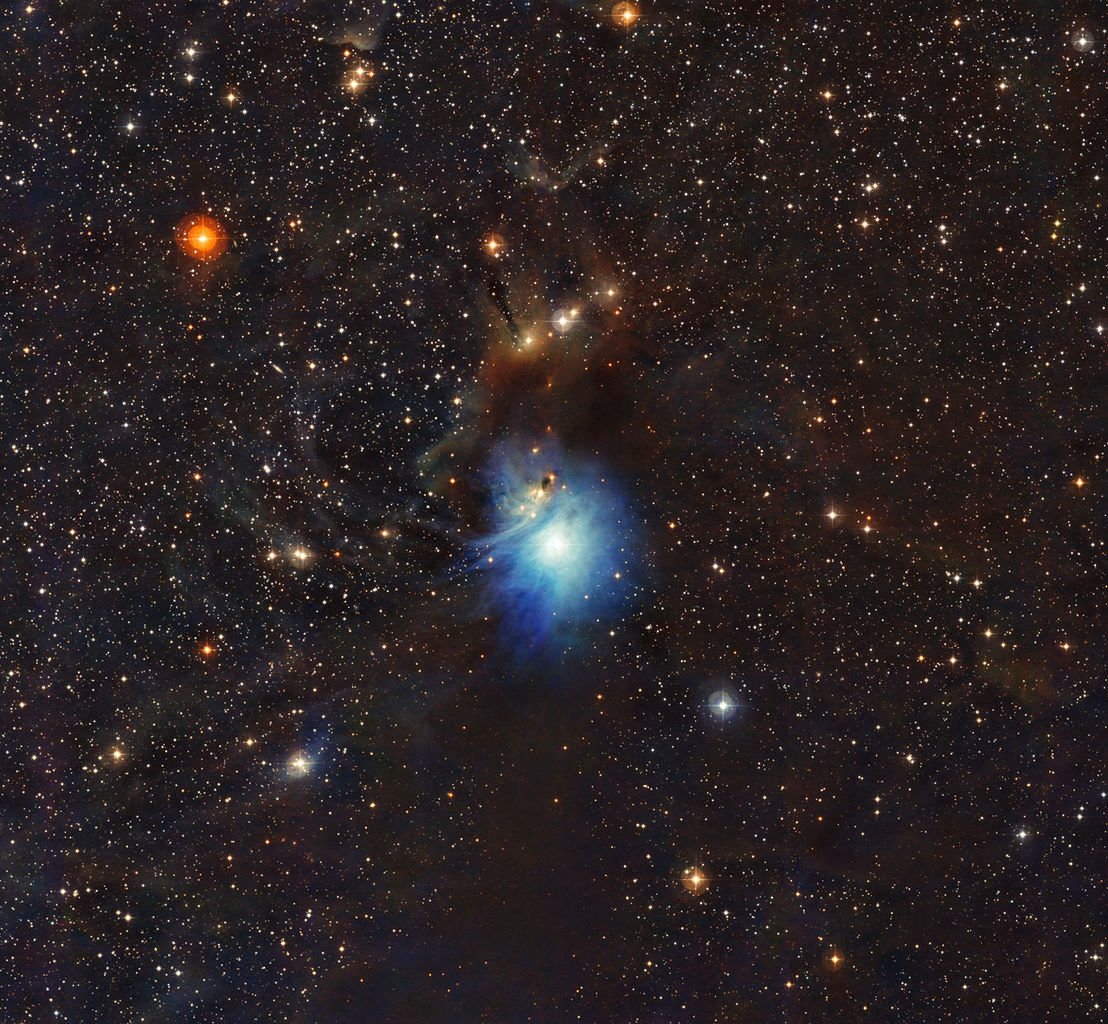
A newly formed star lights up the surrounding cosmic clouds in this image from ESO’s La Silla Observatory in Chile. Credit: ESO
Chamaeleon is also home to the Eta Chamaeleontis Cluster (aka. Mamajek 1). This open star cluster, which is centered on the star Eta Chamaeleontis, is approximately 316 light years distant and believed to be around eight million years old. The cluster was discovered in 1999 and consists of 12 or so relatively young stars. It was also the first open cluster discovered because of its X-ray emissions its member stars emit.

Finding Chamaeleon:

Chamaeleon is visible at latitudes between +0° and -90° and is best seen at culmination during the month of April. Now take out your telescope and aim it towards Eta for a look at newly discovered galactic star cluster - the Eta Chamaeleontis cluster - Mamajek 1. In 1999, a cluster of young, X-ray-emitting stars was found in the vicinity of eta Chamaeleontis from a deep ROSAT high-resolution imager observation.
They are believed to be pre-main-sequence weak-lined T Tauri stars, with an age of up to 12 million years old. The cluster itself is far from any significant molecular cloud and thus it has mysterious origins - not sharing proper motions with other young stars in the Chamaeleon region. There's every possibility it could be a moving star cluster that's a part of the Scorpius/Centaurus OB star association!
For binoculars, take a look at fourth magnitude Alpha Chamaeleontis. It is a rare class F white giant star that is about 63.5 light years from Earth. It is estimated to be about 1.5 billion years old. Its spectrum shows it to be a older giant with a dead helium core, yet its luminosity and temperature show it to be a younger dwarf.
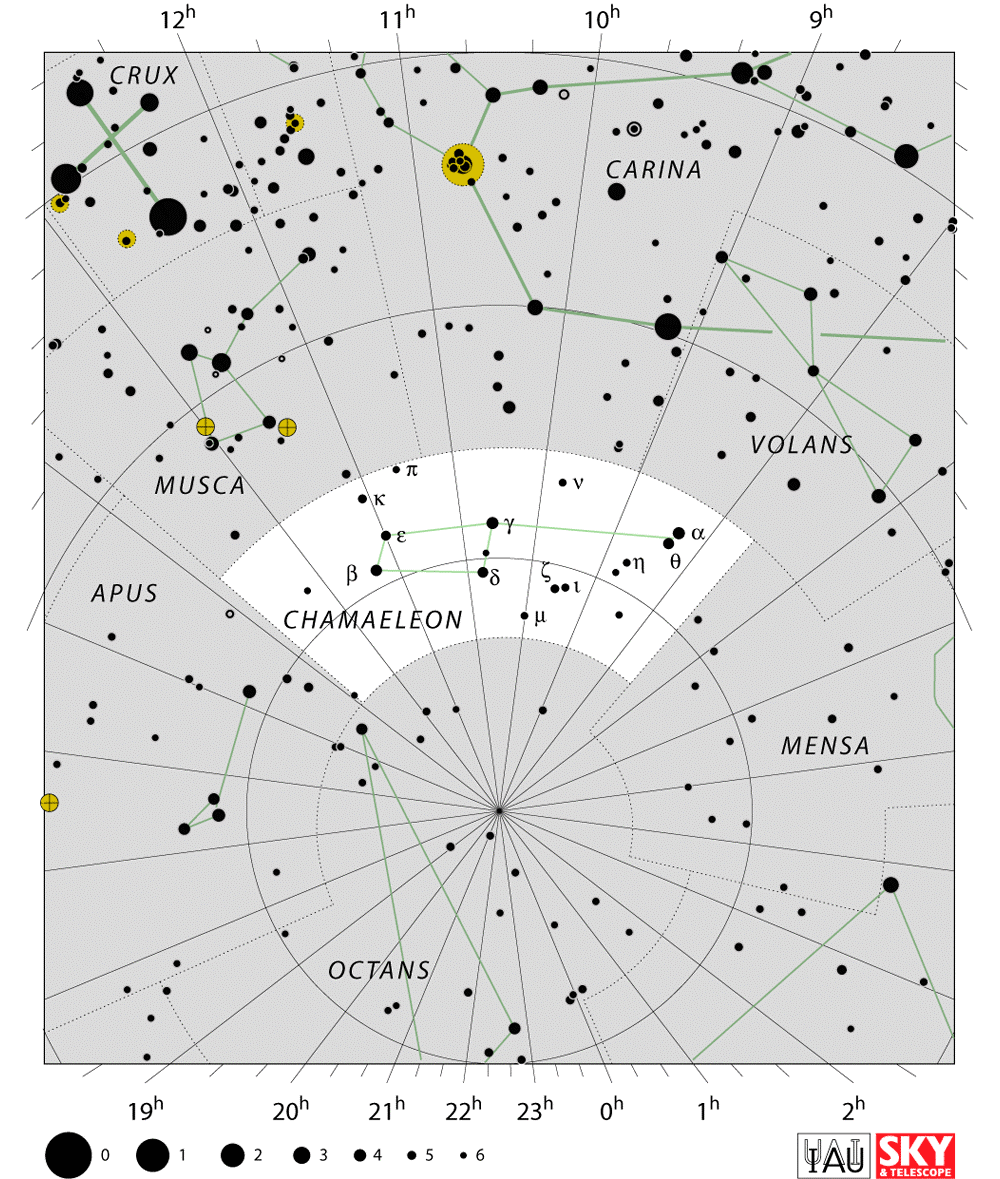
The location of the Chamaeleon Constellation. Credit: IAU /Sky&Telescope magazine
Now point your binoculars or telescope towards Delta Chamaeleontis. While these two stars aren't physically connect to one another, the visual double star is exceptionally pleasing with one orange component and one blue.
Last, but not least, take a look at Gamma Chamaeleontis. Although the south celestial pole currently lacks a bright star like Polaris to mark its position, the precession of the equinoxes will change that. One day - in the next 7500 years - the south celestial pole will pass close to the stars Gamma Chamaeleontis. But don't wait up...
We have written many interesting articles about the constellation here at Universe Today. Here is What Are The Constellations?What Is The Zodiac?, and Zodiac Signs And Their Dates.
Be sure to check out The Messier Catalog while you’re at it!
For more information, check out the IAUs list of Constellations, and the Students for the Exploration and Development of Space page on Canes Venatici and Constellation Families.
Sources:

Movie Review – Alien: Covenant

Authentic news,No fake news.


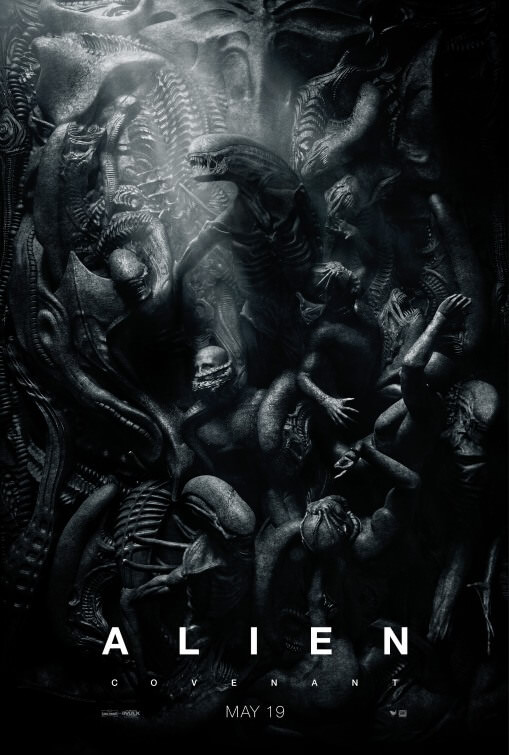
Promotional poster for Alien: Covenant. Credit: 20th Century Fox
Warning: mild plot spoilers ahead for the upcoming summer film Alien: Covenant, though we plan to focus more on the overall Alien sci-fi franchise and some of the science depicted in the movie.
So, are you excited for the 2017 movie season? U.S. Memorial Day weekend is almost upon us, and that means big ticket, explosion-laden sci-fi flicks and reboots/sequels. Lots of sequels. We recently got a chance to check out Alien: Covenant opening Thursday, May 18th as the second prequel and the seventh film (if you count 2004's Alien vs. Predator offshoot) in the Alien franchise.
We'll say right up front that we were both excited and skeptical to see the film... excited, because the early Alien films still stand as some of the best horror sci-fi ever made. But we were skeptical, as 2012's Prometheus was lackluster at best. Plus, Prometheus hits you with an astronomical doozy in the form of the "alien star chart" right off the bat, not a great first step. Probably the best scene is Charlize Theron's terrifying self-surgery to remove the alien parasite. Mark Watney had to do something similar to remove the antenna impaled in his side in The Martian. Apparently, Ridley Scott likes to use this sort of scene to really gross audiences out. The second Aliens film probably stands as the benchmark for the series, and the third film lost fans almost immediately with the death of Newt at the very beginning, the girl Sigourney Weaver and crew fought so hard to save in Aliens.
How well does Alien: Covenant hold up? Well, while it was a better attempt at a prequel than Prometheus, it approaches though doesn't surpass the iconic first two. Alien: Covenant is very similar to Aliens, right down to the same action beats.
The story opens as the crew of the first Earth interstellar colony ship Covenant heads towards a promised paradise planet Origae-6. En route, the crew receives a distress signal from the world where the ill-fated Prometheus disappeared, and detours to investigate. If you've never seen an Alien film before, we can tell you that investigating a mysterious transmission is always a very bad idea, as blood and gore via face-hugging parasites is bound to ensue. As with every Alien film, the crew of the Covenant is an entirely new cast, with Katherine Waterston as the new chief protagonist similar to Sigourney Weaver in the original films. And like any sci-fi horror film, expect few survivors.
Alien: Covenant is a worthy addition to the Alien franchise for fans who know what to expect, hearkening back to the original films. As a summer blockbuster, it has a bit of an uphill battle, with a slower opening before the real drama begins.
David Dickinson द्वारा
So how does the science of Alien: Covenant hold up?
The Good: Well, as with the earlier films, we always liked how the aliens in the franchise were truly, well, alien, not just human actors with cosmetic flourishes such as antennae or pointed ears. Humans are the result of evolutionary fortuity, assuring that an alien life form will trend more towards the heptapods in Arrival than Star Trek's Mr. Spock. Still more is revealed about the parasitic aliens in Alien: Covenant, though the whole idea of a inter-genetic human alien hybrid advanced in the later films seems like a tall order... what if their DNA helix curled the wrong way? Or was triple or single, instead of double stranded?
Spaceships spin for gravity in the Alien universe, and I always liked Scott's industrial-looking, gray steel and rough edges world in the Alien films, very 2001: A Space Odyssey.
Now, for a very few pedantic nit picks. You knew they were coming, right? In the opening scenes, the Covenant gets hit with a “neutrino burst” dramatically disabling the deployed solar array and killing a portion of the hibernating crew. Through neutrinos are real, they, for the most part, pass right through solid matter, with nary a hit. Millions are passing through you and me, right now. The burst is later described as due to a “stellar ignition event” (a flare? Maybe a nova?) Though the crew states there's no way to predict these beforehand... but even today there is, as missions such as the Solar Dynamics Observatory and SOHO monitor Sol around the clock. And we do know which nearby stars such as Betelgeuse and Spica are likely to go supernova, and that red dwarfs are tempestuous flare stars. An interstellar colonization mission would (or at least should) know to monitor nearby stars (if any) for activity. True, a similar sort of maguffin in the form of the overblown Mars sandstorm was used in The Martian to get things rolling plot-wise, but we think maybe something like equally unpredictable bursts high-energy cosmic rays would be a bigger threat to an interstellar mission.
The crew also decides to detour while moving at presumably relativistic speeds to investigate the strange signal. This actually happens lots in sci-fi, as it seems as easy as running errands around town to simply hop from one world to the next. In reality, mass and change of momentum are costly affairs in terms of energy. In space, you want to get there quickly, but any interstellar mission would involve long stretches of slow acceleration followed by deceleration to enter orbit at your destination... changing this flight plan would be out of the question, even for the futuristic crew of the Covenant.
Expect a high body count: the crew of the Covenant. Credit: 20th Century Fox
Another tiny quibble: the Covenant's computer pinpoints the source of the mysterious signal, and gives its coordinates in right ascension and declination. OK, this is good: RA and declination are part of a real coordinate system astronomers use to find things in the sky... here on Earth. It's an equatorial system, though, hardly handy when you get out into space. Maybe a reference system using the plane of the Milky Way galaxy would be more useful.
But of course, had the crew of the Covenant uneventfully made it to Origae-6 and lived happily ever after stomach-exploding parasite free, there would be no film. Alien: Covenant is a worthy addition to the franchise and a better prequel attempt than Prometheus... though it doesn't quite live up to the thrill ride of the first two, a tough act to follow in the realm of horror sci-fi.

South Korea’s new president could reach for the moon

Authentic news,No fake news.


A new era dawned in South Korea this week after liberal candidate Moon Jae-in was elected president. The country had been without a leader for 60 days, and before that, rocked by a corruption scandal that drew crowds of protesters to the streets every week for months, until former President Park Geun-hye was impeached and jailed.

Moon, the son of Korean War refugees, won more than 40 percent of the vote by appealing to the country’s hunger for political and economic reform.

With Moon in power, expectations are high Seoul’s North Korea policy would shift dramatically. In his inaugural address, Moon said he would “go to Pyongyang†under the right circumstances, and for the “peace of the Korean peninsula.â€

Some in South Korea, including business executives who were forced to shut down operations at a jointly operated factory park in North Korea, want Moon to hold to his promise of not only reopening the Kaesong complex, but to abide by his proposal to expand the plant.

Such moves, however, would run afoul of United Nations Security Council sanctions resolutions and U.S. expectations. Analysts also say it’s unlikely such a reversal of previous policies could take place so quickly.

In the meantime, Moon and U.S. President Donald Trump agreed to cooperate closely on North Korea, and the new South Korean president described the bilateral alliance with the United States as “the foundation of our foreign policy.â€

Moon also spoke with China’s Xi Jinping in a bid to ease tensions with Korea’s largest trading partner.

Beijing waited until after the elections to announce the test of a new missile in waters near the Korean peninsula.

The test comes after China warned South Korea of “necessary measures†that would be taken after the deployment of the U.S. missile defense system THAAD.

China may also be stepping up sanctions against North Korea. According to Chinese sources, the government is looking into shutting down a major bridge that connects the two countries.

Meanwhile, the absence of a nuclear provocation from North Korea does not mean tensions will subside.

According to Chinese analyst Liu Ming, North Korea is biding time until the United States initiates direct negotiations. The two sides should meet before a sixth nuclear test closes a window of opportunity, the analyst said.

why do so many cities have poor east ends?

Authentic news,No fake news.


The question is so obvious that you could easily forget to ask it: why do cities so often have a poor east side? To be clear, the mystery is not why every city has its leafy and its grubby sections – it costs money to live in nice places and to avoid nasty ones, which tends to group people into them by wealth. The mystery is why the poor groups always end up in the east.
Of course, the true picture is never neat nor simple, but by common consent a British-biased list of cities with poor eastern districts would include: London, Paris, New York, Toronto, Bristol, Manchester, Brighton and Hove, Oxford, Glasgow, Helsinki and Casablanca. No doubt there are some cities where poverty clusters in the west, but they seem harder to find; perhaps Delhi and Sydney?
The story seems easier to explain case by case. In London, for example, the docks are downstream in the east, and docks are rarely very salubrious in cities. For much of its history, the Thames also took the city’s waste, and smell, eastward. No wonder the poor wound up living there, you might say.
But then consider Paris, where the Seine flows westward, as does the Avon in Bristol. Or New York, which effectively has two rivers, and is a completely different shape. Or even Brighton, which has no rivers at all. Despite their differences, the story never varies: for poverty, look east.
One theory is that it’s all about air pollution. In the middle latitudes where most of the world’s cities can be found, the prevailing winds are westerlies, which means they blow to the east. Crudely, it has long been thought that they might take smoke and odours with them, and now a new study by Stephan Heblich, Alex Trew and Yanos Zylberberg for the Spatial Economics Research Centre suggests this theory might be right.
Detroit’s suburbs
Pinterest
 Detroit’s suburbs: in the US unlike the rest of the world, the outskirts tend to be home to the city’s more affluent residents. Photograph: Alamy
“This anecdotal discussion about pollution in the centre of cities and smoke drifting to the east is something that we have been documenting very precisely,” Zylberberg tells me. “Basically what we’ve been seeing in the past, because of pollution and wind patterns, is rich people escaping the eastern parts of town, because they were very polluted.”
For their research, published last November, Zylberberg and his colleagues built simulations of 70 British cities, including the sites of 5,000 industrial chimneys, as they would have been in 1880. Using mathematical models they claim to have been able to reconstruct the movement of air within the given topography and work out where the pollution would end up. They concluded that areas of high pollution were indeed more likely to become deprived areas, and found that they were generally in the east.
“Past pollution explains up to 20% of the observed neighbourhood segregation whether captured by the shares of blue collar workers and employees, house prices or official deprivation indices,” the paper says. It concluded that no British cities have wind patterns which ought to create a polluted west. Heblich, Trew and Zylberberg also looked for eastern poverty patterns before the industrialisation of the 19th century, and did not find them.
They also discovered that the deprivation of an area faded when the pollution did. “You can see this difference at the end of the 19th century,” says Zylberberg. “All neighbourhoods would converge back to the mean after that. The poor districts are not very poor. The rich districts are not very rich, and once pollution disappears, then everything comes back to normal.”
If pollution was severely concentrated to start with, however, segregation persisted even after it had gone, as the perception of schools, public amenities, infrastructure and reputation made the pattern hard to shift. Gentrification has begun to change this, but only in big, wealthy cities like Paris and London – and only recently.
A man stands on a wall with a slogan reading: ‘Police kills’ next to a burning car in Bobigny riots
Pinterest
 The north-eastern Paris suburb of Bobigny, where poverty and unemployment are widespread. Photograph: Yoan Valat/EPA
The eastward drift is not the only pattern of deprivation. Big cities that grow rapidly often develop rings of poverty around a more affluent core, as poor people arrive from rural areas looking for work and have to live in the cheapest place they can find, which tends to be far away. At any rate, by the time these people arrive, it is the only place left to build new homes. Moscow and Paris, again, are good examples, as are most Chinese cities. Although, some of the new urban centres being built from scratch by the authorities may turn out differently.
One country is a famous exception to this rule. In the US, the suburban ring is generally a place of greater peace and affluence, while the inner cities are often associated with deprivation – Detroit being the most sadly famous case. Why things happened in reverse in the US is not quite clear, and is much discussed by academics. Some, such as Kenneth T Jackson, have argued that “a national distrust of urban life and communal living” plays an important role; but of course there are other factors.
By the end of the first world war, most US cities were established with industrial centres, but the success of the car in the interwar years made it possible for wealthy people to build larger homes for themselves on the outskirts, but within reach of work. Indeed, some of these new suburbs were specifically designed to exclude people.
“In 1916, the US supreme court, in Buchanan v Warley, ruled racial zoning was unconstitutional,” writes Ann Durkin Keating. “Nevertheless, many real estate developers utilised restrictive covenants to maintain racial exclusion … Racial restrictive covenants excluded certain groups of people (most often African Americans, but also Jews, Catholics and other groups depending on the locale) from ever owning or renting the property.”
In very general terms, therefore, you might say that people have ended up living in either new world or old world city patterns.
In the old world – mostly Europe and Asia – cities were already large and well established when industrialisation came. This meant the flood of poor workers had to go and live on the outskirts, and many of the factories went there, too, leaving the centre – especially its western section – looking old, clean and civilised.
New world cities, on the other hand, were often built around industrial centres. This made people wealthy, upon which they escaped to the suburbs by car – and defended them vigorously against intruders. Indeed, British cities with their leafy commuter belts and partially reclaimed centres are often quite American, by European standards. Perhaps we have our own strain of national distrust as well.
Follow Guardian Cities on Twitter and Facebook to join the discussion, and explore our archive here

Mitra-mandal Privacy Policy

This privacy policy has been compiled to better serve those who are concerned with how their  'Personally Identifiable Inform...