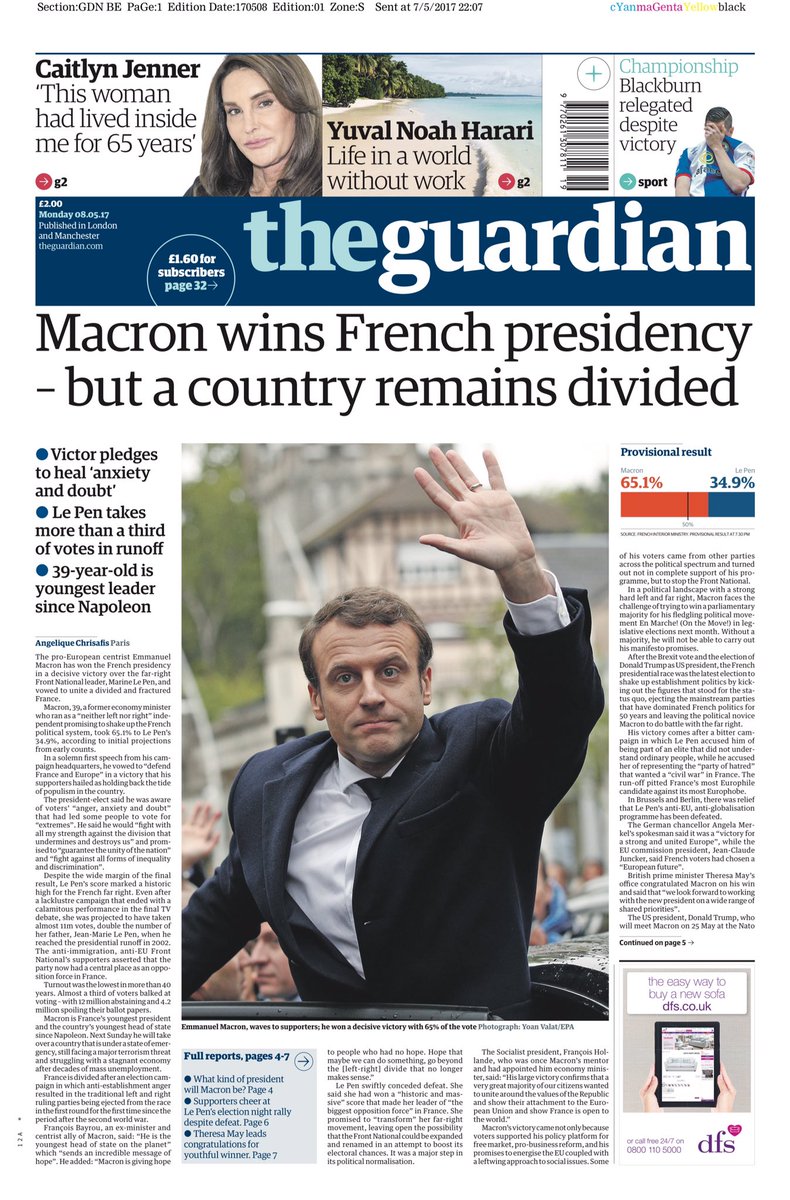
The Daily Mail, which loudly welcomed the “new French revolution” when Marine Le Pen made it into the second round of voting in April, somehow could not find a spot for the final election result on its front page - at least for the first edition.
Instead, the paper went with images of Prince Harry kissing his girlfriend and a story about insurance companies being unscrupulous.
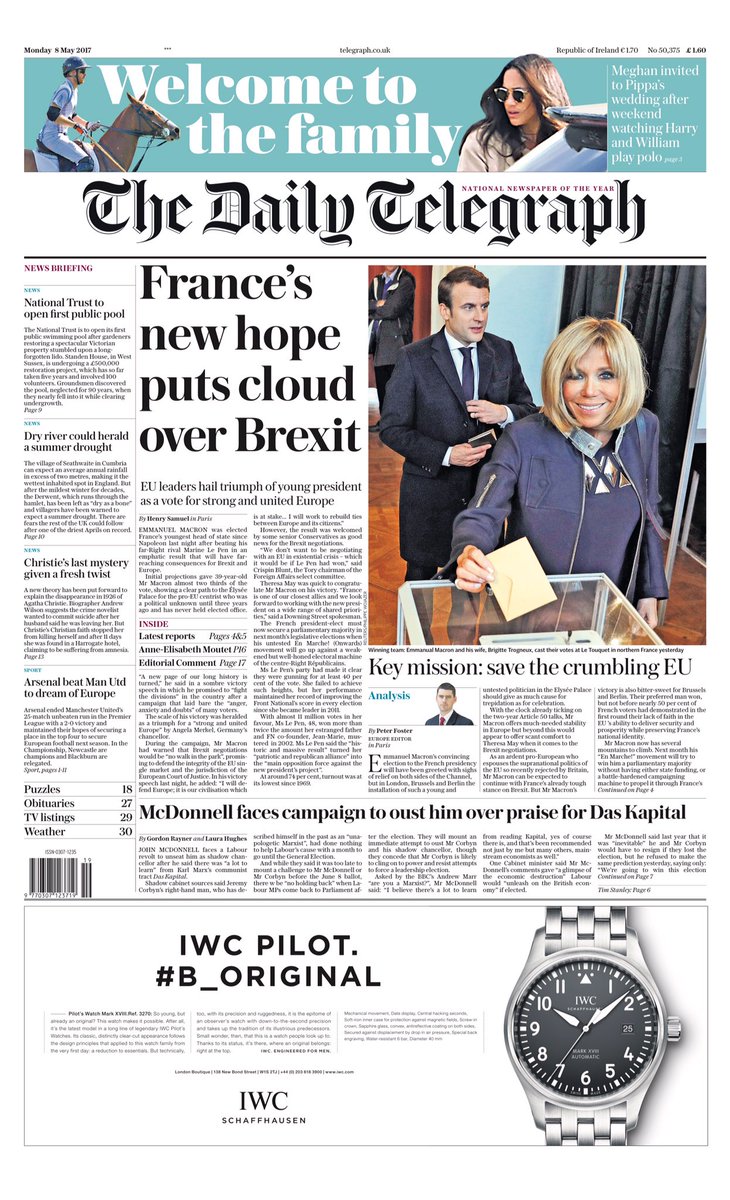
Macron’s victory did make it onto the front of the Daily Telegraph, but the historic news was presented solely in relation to how it could impact Britain’s exit from the EU. The paper’s page one headline made no mention of the far-right candidate being beaten by centrist Macron and instead warned that his victory “puts cloud over Brexit”.
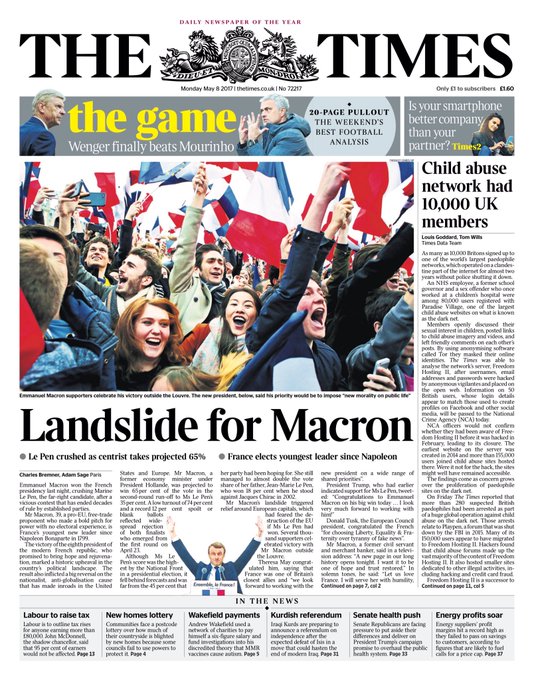
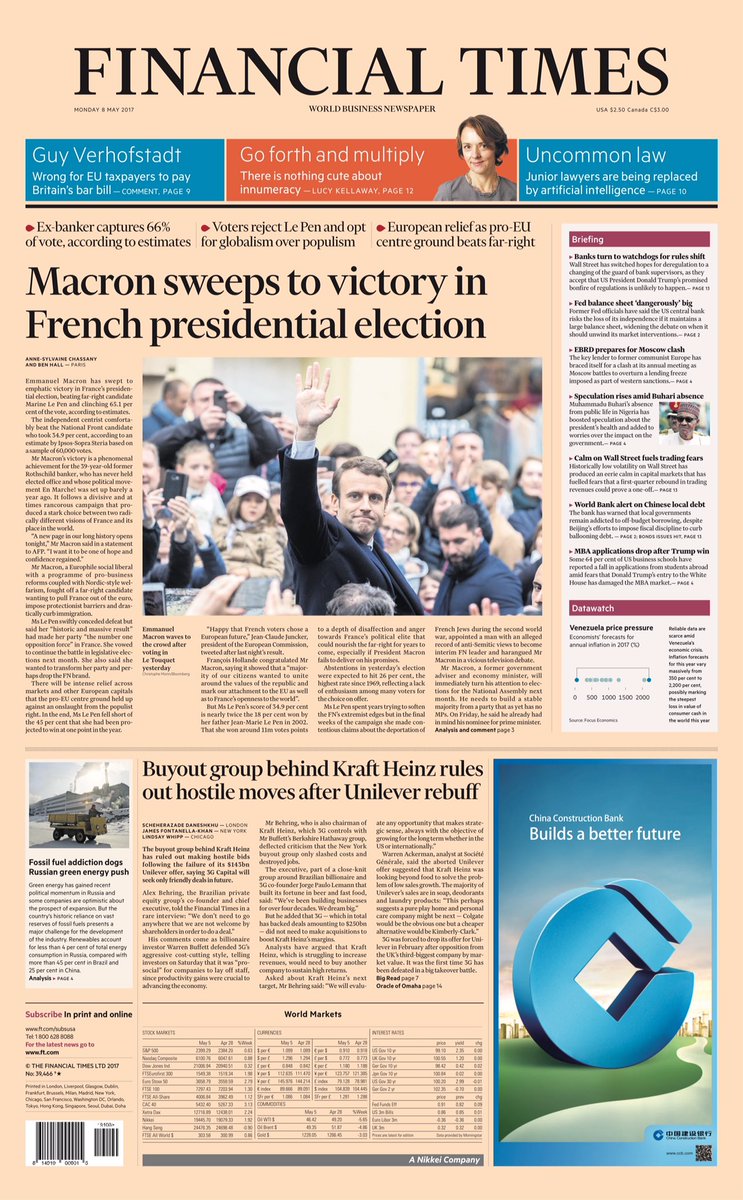
Elsewhere, the Times and Financial Times played it pretty straight. The Times lauded a “landslide for Macron”, while the FT announced “Macron sweeps to victory” as French voters opted for “globalism over populism”.
Chicago's political elite have fallen under the spell of the charter industry’s billionaire sponsors—and the results spell disaster for K-12 education. READ MORE»
PARIS (AP) — Far-right leader Marine Le Pen lost her bid to become France's first female chief of state, but she was unbowed, looking instead to the next battle: parliamentary elections next month. Le Pen's loss to centrist Emmanuel Macron still gave her a historic number of votes, reflecting the changing image of her once-pariah National Front party from fringe force to a political heavyweight.
(1 of 2) French far-right presidential candidate Marine le Pen delivers a speech, Sunday, May 7, 2017 in Paris. French voters elected centrist Emmanuel Macron as the country's youngest president ever on Sunday, delivering a resounding victory to the unabashedly pro-European former investment banker and strengthening France's place as a central pillar of the European Union.
Always a fighter defying the odds, the ambitious Le Pen set a new challenge for herself in the weeks ahead: "a profound reformation of our movement to constitute a new political force." The National Front's interim president, named while Le Pen campaigned for Sunday's runoff, said the changes include giving the party a new name.
"It's opening the doors of the movement to other personalities," Steeve Briois told The Associated Press. Changing the name was discussed at the height of Le Pen's efforts to scrub the party image and remove traces of racism and anti-Semitism that scared away potential backers. But party stalwarts saw the change as too radical.
A new name would help Le Pen distance herself from the old guard — including her father, party founder Jean-Marie, who was kicked out under his daughter's image revamping. Le Pen, who came third in the 2012 presidential election, has spent years planting a grassroots structure for her party. In 2014, the National Front won 11 towns in municipal elections, and her party performed better than any in France in elections for the European Parliament, where she co-presides over a far-right group.
Now she vows to go further with still more changes to reach an even wider spectrum of voters, "those who choose France, defend its independence, its freedom, its prosperity, its security, its identity and its social model."
"I will be at the head of this combat," she said. Le Pen credited herself with upsetting the French political landscape, creating a divide "between patriots and globalists." "It is this great choice ... that will be submitted to the French in legislative elections," she said in her concession speech.
She said she will seek new alliances, after one she clinched ahead of the runoff with the leader of a small conservative party, Nicolas Dupont-Aignan. Le Pen called on "patriots" — the word she uses to describe herself — to join her.
The deck is stacked against the National Front despite its strength. It now has only two deputies in the National Assembly due to a voting system that favors more mainstream parties. President-elect Macron had floated the idea of introducing a dose of proportional representation that favors smaller parties or those locked out. Without that, Le Pen could be hard-pressed to be more than a disruptive force instead of changing the nation's course.
It was unclear if she would seek a seat for herself. Her niece, Marion Marechal-Le Pen, is currently a lawmaker. With her fighting spirit, the 48-year-old Le Pen, a lawyer turned politician, resembles her father, who wrenched from a court the right to continue as honorary president for life of the party, even though he was expelled.
"I was never fascinated by power," she said in a recent interview on state-run TV. Power, she said, "is a tool ... not an end in itself." The mother of three portrays herself as the guardian of a disabused France, where citizens are losing their culture to an encroaching Islam, their identity to "massive immigration" and their sovereignty to the European Union.
Had she won, she says she would have immediately worked to pull France out of the European Union and NATO and put French francs back in the pockets of the French who now shop with the euro currency. She pledged to toughen laws to combat illegal immigration and terrorism and ensure that the French come first in jobs and benefits. Those measures would probably not be fully buried if her movement finds a powerful voice in the legislature.
At the least, Briois, the interim party president who is also mayor of the National Front's northern bastion, Henin-Beaumont, said the party thinks it can get enough lawmakers in the parliamentary voting to form a group — 15. He also looked beyond the election.
"It's not the end tonight. It's the start," said Jean Messiha, who coordinated Le Pen's presidential project. Macron's liberal project "belongs to the past."
PARIS (AP) — French president-elect Emmanuel Macron is laying the groundwork for his transition to power, with plans for a visit to Germany, a name change for his political movement and an appearance Monday with the man whose job he assumes.
(1 of 9) French President-elect Emmanuel Macron gestures during a victory celebration outside the Louvre museum in Paris, France, Sunday, May 7, 2017. Speaking to thousands of supporters from the Louvre Museum's courtyard, Macron said that France is facing an "immense task" to rebuild European unity, fix the economy and ensure security against extremist threats.
Macron defeated far-right leader Marine Le Pen handily in Sunday's presidential vote, and now must pull together a majority for his year-old political movement by mid-June legislative elections. His party, En Marche (Forward) is tweaking its name as it prepares a list of candidates. Macron has promised that half of those candidates will be new to elected politics, as he was before Sunday.
The far-right National Front party is also gearing up for a name change — if not a makeover of its ideas — after Marine Le Pen's decisive loss. In interviews Monday, her campaign director, David Rachline, said the party founded by her father would get a new name as bait to pull in a broader spectrum of supporters in France.
Macron won the presidency with 66 percent of votes cast for a candidate. But a high number of blank or spoiled votes and unusually low turnout are signs of an electorate dissatisfied with its choices.
Rachline said Le Pen will lead the opposition to Macron. The incoming president will appear Monday alongside current President Francois Hollande in commemoration of the end of World War II. Monday, a national holiday, marks the day of the formal German defeat in World War II.
It also marks decades of peace in Western Europe, something Macron made a cornerstone of his campaign against Le Pen's brand of populism. Le Pen called for France to leave the European Union and drop the euro currency in favor of the franc.
Sylvie Goulard, a French deputy to the European Parliament, said Macron would make Berlin his first official visit, with perhaps a stop to see French troops stationed abroad as well. Michael Roth, Germany's deputy foreign minister, applauded Macron's win but said the result was marred by the fact that 11 million people in France voted for Le Pen.
"It mustn't become normal that right-wing extremists and populists achieve such strong results," said Roth, whose portfolio includes relations with France. He suggested relaxing European Union rules on state spending to allow France to boost economic growth.
"If Macron fails then the next president will be Marine Le Pen and we need to prevent this at all cost," he added.
Antioquia, Colombia - Antioquia has been the heartland of the Colombian gold trade since colonial times, when Spanish conquerors came in search of the mythical El Dorado.
In the northeast of the province lies Segovia, a tiny township that for more than 400 years has produced gold, chiselled from the walls of thousands of underground tunnels.
Afro-descendant and indigenous Colombians have worked there as artisanal miners for decades, using the same techniques of their ancestors, whom the Spanish enslaved to mine the land.
Since the early 2000s, as the price of the precious metal has risen, the region has experienced a violent gold rush as leftist guerrillas, neo-paramilitary outfits and drug trafficking groups have established their presence to control mining operations. Illegally mined gold is fuelling violence as gold has overtaken cocaine as the main source of revenue for armed groups.
Illegal mining in Colombia brings in approximately $7bn a year (link in Spanish) to armed groups and criminal bands.
Segovia is at the centre of this violence. Almost 20 percent of Colombia's gold is produced in the nearly 50 mines operating there, according to Segovia's mayor's office.
Local villagers - many of them artisanal miners - have been shaken by extortions, threats, territorial disputes and grudge fights. These miners, including rural Colombians from across the country who have come in search of work, working in the mountains or on riverbanks, are forced to pay a "tax" to the armed group that controls their area.
"You have to pay them. If not, they will kill you," says Carlos Mario Alvarez, a 60-year-old mining leader.
A handful of mines are owned by Gran Colombia Gold, a Canada-based multinational. One of these mines includes the Cogote, once a successful informal mining cooperative, whose licence the Colombian government sold to the Canadian multinational.
Since 2015, President Juan Manuel Santos' administration has prioritised cracking down on unlicensed mining in order to cut off a lucrative source of income for armed groups and to curb mercury poisoning in the rivers - traditional miners use the chemical to separate gold from earth and other metals - and other environmental damage, in conjunction with a legalisation programme for the region's traditional miners.
Many miners feel caught between the armed groups and the government's clampdown on informal mining.
For Alvarez, "Being a miner is more than a job in this part of Colombia, it is an identity."
As a child, he'd bring lunch to his father at the mines after finishing school. Alvarez dropped out of school to start working as a "catanguero" (a carrier) at the mines when he was 14 years old.
"I'm currently the owner of my own mine," he says proudly. "But now the government wants to take it ... from us."
Alvarez says the government's reform of unlicensed mining is a facade.
"The government is forcing us out in favour of the multinational companies," he says. "He [Santos] just wants to open the way for multinational investors to buy up land."
Colombian miners drill a vein of gold inside the Cogote mine. There are more than 700 miners working inside this mine. [Diego Ibarra Sanchez/MeMo/Al Jazeera]
A Colombian miner is seen in the darkness working inside the Cogote mine. The Cogote was established as a legal cooperative in 1987 before being closed for almost 10 years. [Diego Ibarra Sanchez/MeMo/Al Jazeera]
Two Colombian miners inside a basket hanging from a crane descend into a traditional mine in Segovia. The informal miners' way of life has been threatened by the government's crackdown on unlicensed mining and armed groups taking over land. [Diego Ibarra Sanchez/MeMo/Al Jazeera]
A Colombian miner carries a bag on his back with minerals from an informal mine in Segovia. The wider Antioquia region has seen a boom in illegal gold mining, which has become the main source of income for local communities and illegal armed groups. [Diego Ibarra Sanchez/MeMo/Al Jazeera]
A Colombian miner transports minerals using a boxcar outside the Cogote mine. Armed groups have threatened and intimidated employees into paying them money which they refer to as 'vacunas', or vaccines. [Diego Ibarra Sanchez/MeMo/Al Jazeera]
Colombian miners play pool after a long day inside the mine. Most of the inhabitants of Segovia depend financially - either directly or indirectly - on the mines. [Diego Ibarra Sanchez/MeMo/Al Jazeera]
Two Colombian miners spend their money on slot machines. [Diego Ibarra Sanchez/MeMo/Al Jazeera]
Colombians walk through the streets of Segovia, which has a number of stores for buying and selling gold. [Diego Ibarra Sanchez/MeMo/Al Jazeera]
A memorial for the 1988 massacre of 43 civilians. On November 11, 1988, heavily armed men drove in trucks into the centre of Segovia, opened fire and threw grenades indiscriminately, killing 43 people, including three children, and wounding more than 50 others. Segovia has been the site of numerous acts of violence in recent times. [Diego Ibarra Sanchez/MeMo/Al Jazeera]
The graffiti of a neo-paramilitary group is seen outside a Colombian house on the outskirts of Segovia. Armed groups have threatened miners and extorted money from them. Extortion has become a mainstay of illegal armed groups' mining operations. [Diego Ibarra Sanchez/MeMo/Al Jazeera]
Maria Ligia holds photographs of her sons, Jonathan Esteban and Wilfer Norberto Alvarez, who were killed by armed groups in 2016. They were both miners in Segovia. [Diego Ibarra Sanchez/MeMo/Al Jazeera]
A Colombian woman holds a picture of her son, who was a miner killed by an armed group in Segovia in March 2016. The mother lives in the 20th July neighbourhood which is controlled by a right-wing paramilitary group. [Diego Ibarra Sanchez/MeMo/Al Jazeera]
A holy statue with a funeral wreath is seen inside Segovia's graveyard. The graveyard has numerous unidentified graves. Violence has resulted from the gold boom of recent years. [Diego Ibarra Sanchez/MeMo/Al Jazeera]
Maria Luisa Montanes, who has been a gravedigger for more than 30 years, writes the name of Jonathan Esteban, son of Maria Ligia, who was killed in July 2016. [Diego Ibarra Sanchez/MeMo/Al Jazeera]
A view of Segovia early one rainy morning in July 2016. [Diego Ibarra Sanchez/MeMo/Al Jazeera]