MITRA MANDAL GLOBAL NEWS

EnergyWorld-• Five charts that explain crude oil's sudden nosedive toward $45

Authentic news,No fake news.


Top Stories
PM Modi's dream project 'Urja Ganga' gets underway in Varanasi
French put pro-EU Macron into presidency, dash Le Pen hopes
Petrol sales scam: Seized fuel stations to reopen only if company runs it
Hinduja brothers top United Kingdom 2017 annual rich list
ONGC Videsh Ltd output touches record 12.57 million tonne in 2016-17
Mistry-backed trustees Keki Dadiseth and Nasser Munjee no longer part of Tata Trusts
OPINION: Melting Arctic ice: Call to climate action
Oil & Gas
Petrol sales scam: STF finds 11 cases of tampering at Aliganj petrol pump
Turning plastic waste to oil, this startup has a game-changer technology
Sri Lanka only leasing out oil tanks to India: Ranil Wickremesinghe
Government starts multiple waterways transportation for cargo movement
Crude oil prices rise on expectation of output cut extension by OPEC
Five charts that explain crude oil's sudden nosedive toward $45
Mozambique's gas boom dream under threat from low gas prices, govt debt scandal
BHP Billiton under pressure to sell shale fields, even as oil prices fall
Renewable
India asks ADB to reduce time for processing loans, focus more on health, education
India Railways will save Rs 41,000 crore in next 10 years: Suresh Prabhu
Merger of Orient and IL&FS wind power businesses hits tax hurdle Www.livemint.com
Aligarh's answer to minority tag is nanotech, solar research
India assists Mauritania with $65.68 million rural electrification project
Australian push may open more doors for batteries on electricity grids
Power
Energy Efficiency Services Ltd to invest 100 million pounds in UK over next 3 yrs
Norway sovereign wealth fund excludes BHEL from portfolio on environment risk
Every Swedish company is looking at India: Minister Eva Svedling
China-Pakistan-Economic-Corridor fuels fears of social upheaval
Exclusive - India's green car plan prioritises electric vehicles over hybrids
Bhupinder Singh Hooda hits out at government over state-run power projects
Coal
CIL mines re-graded to fix slippages: Coal Secretary
Coal India to engage tax consultant to get ready for Goods and Services Tax
Billionaire investor Warren Buffett says coal won't make a comeback
EU pollutant limits threaten large coal power plants - IEEFA research

Source-Economics Times

TODAY'S TOP STORIES - May 7, 2017 Millions Are Facing Death by Famine in Yemen

Authentic news,No fake news.


By Ana Maria Archila, Javier H. Valdés, AlterNet
Corporate Backers of Hate campaign calls on companies to end practices that benefit from Trump's agenda. READ MORE»


By Kali Holloway, AlterNet
In the Republican approach to health care, the sick could be priced out of the insurance they so desperately need. READ MORE»


By Phillip Smith, AlterNet
How the league responds to marijuana and medical marijuana use among its players is becoming an issue that can no longer be ignored.  READ MORE»


By Erin Keane, Salon
I read “Women Who Work” so you don’t have to. Ivanka's “successful businesswoman” reputation is kind of a sham. READ MORE»


By Michael Hayne, AlterNet
The ramifications of the AHCA will be felt far and wide.  READ MORE»


By Nomi Prins, TomDispatch
Voters who cast their ballots for Donald Trump, the patriarch, got a package deal for his whole clan. READ MORE»


By Tom Boggioni, Raw Story
A public relations aide told reporters they were disturbing the “stability” of the program. READ MORE»


By Charles Bramesco, The Guardian
Under Trump, the stakes have been raised – and Samantha Bee, Jimmy Kimmel and Stephen Colbert have been leading the way to take on the president. READ MORE»


By Liz Hayes, Americans United for Separation of Church and State
"We’ve been doing it for 25 years and the places that have adopted... vouchers have seen no gains.” READ MORE»


By Dan Sisson and Thom Hartmann, AlterNet
Western civilization itself is under attack. READ MORE»


By Robin Scher, AlterNet
Wake up and chew your coffee? READ MORE»


By Kathy Kelly, AlterNet
Millions of people in Yemen are on the brink of starvation while the world looks away. READ MORE»


Source-Alternet

It’s Time to Make Your PC Startup Faster

Authentic news,No fake news.

Make Your PC Startup Faster
Too many programs wanting to start at the same time is slowing everything down.
READ NOW  
READ THESE NEXT
What Does ‘System Restore’ Actually Do?
Build Your Own (Secret) Password System
Create Your Own (Nearly) Unhackable Email Password
30 Internet Terms Everyone Should Know
Source-Lifewire

Space-Science-- Does Jupiter Have a Solid Core?

Authentic news,No fake news.

Matt Williams à¤¦्वारा
The gas giants have always been a mystery to us. Due their dense and swirling clouds, it is impossible to get a good look inside them and determine their true structure. Given their distance from Earth, it is time-consuming and expensive to send spacecraft to them, making survey missions few and far between. And due to their intense radiation and strong gravity, any mission that attempts to study them has to be do so carefully.
And yet, scientists have been for decades that this massive gas giant has a solid core. This is consistent with our current theories of how the Solar System and its planets formed and migrated to their current positions. Whereas its outer layers of Jupiter are composed primarily of hydrogen and helium, increases in pressure and density suggest that closer to the core, things become solid.

Structure and Composition:

Jupiter is composed primarily of gaseous and liquid matter, with denser matter beneath. It’s upper atmosphere is composed of about 88–92% hydrogen and 8–12% helium by percent volume of gas molecules, and approx. 75% hydrogen and 24% helium by mass, with the remaining one percent consisting of other elements.
upiter's structure and composition. (Image Credit: Kelvinsong CC by S.A. 3.0)
Jupiter's structure and composition. Credit: Kelvinsong CC by S.A. 3.0
The atmosphere contains trace amounts of methane, water vapor, ammonia, and silicon-based compounds as well as trace amounts of benzene and other hydrocarbons. There are also traces of carbon, ethane, hydrogen sulfide, neon, oxygen, phosphine, and sulfur. Crystals of frozen ammonia have also been observed in the outermost layer of the atmosphere.
The interior contains denser materials, such that the distribution is roughly 71% hydrogen, 24% helium and 5% other elements by mass. It is believed that Jupiter’s core is a dense mix of elements – a surrounding layer of liquid metallic hydrogen with some helium, and an outer layer predominantly of molecular hydrogen. The core has also been described as rocky, but this remains unknown as well.
In 1997, the existence of the core was suggested by gravitational measurements, indicating a mass of from 12 to 45 times the Earth’s mass, or roughly 4%–14% of the total mass of Jupiter. The presence of a core is also supported by models of planetary formation that indicate how a rocky or icy core would have been necessary at some point in the planet’s history in order to collect all of its hydrogen and helium from the protosolar nebula.
However, it is possible that this core has since shrunk due to convection currents of hot, liquid, metallic hydrogen mixing with the molten core. This core may even be absent now, but a detailed analysis is needed before this can be confirmed. The Juno mission, which launched in August 2011 (see below), is expected to provide some insight into these questions, and thereby make progress on the problem of the core.

Formation and Migration:

Our current theories regarding the formation of the Solar System claim that the planets formed about 4.5 billion years ago from a Solar Nebula (i.e. Nebular Hypothesis). Consistent with this theory, Jupiter is believed to have formed as a result of gravity pulling swirling clouds of gas and dust together.
Jupiter acquired most of its mass from material left over from the formation of the Sun, and ended up with more than twice the combined mass of the other planets. In fact, it has been conjectured that it Jupiter had accumulated more mass, it would have become a second star. This is based on the fact that its composition is similar to that of the Sun - being made of predominantly of hydrogen.
Artist's concept of a young star surrounded by a disk of gas and dust - called a protoplanetary disk. Credit: NASA/JPL-Caltech
In addition, current models of Solar System formation also indicate that Jupiter formed farther out from its current position. In what is known as the Grand Tack Hypothesis, Jupiter migrated towards the Sun and settled into its current position by roughly 4 billion years ago. This migration, it has been argued, could have resulted in the destruction of the earlier planets in our Solar System - which may included Super-Earths closer to the Sun.

Exploration:

While it was not the first robotic spacecraft to visit Jupiter, or the first to study it from orbit (this was done by the Galileo probe between 1995 and 2003), the Juno mission was designed to investigate the deeper mysteries of the Jovian giant. These include Jupiter’s interior, atmosphere, magnetosphere, gravitational field, and determining the history of the planet’s formation.
The mission launched in August 2011 and achieved orbit around Jupiter on July 4th, 2016. As the probe entered its polar elliptical orbit, after completing a 35-minute-long firing of the main engine, known as Jupiter Orbital Insertion (or JOI). As the probe approached Jupiter from above its north pole, it was afforded a view of the Jovian system, which it took a final picture of before commencing JOI.
Since that time, the Juno spacecraft has been conducting perijove maneuvers - where it passes between the northern polar region and the southern polar - with a period of about 53 days. It has completed 5 perijoves since it arrived in June of 2016, and it scheduled to conduct a total of 12 before February of 2018. At this point, barring any mission extensions, the probe will be de-orbited and burn up in Jupiter’s outer atmosphere.
As it makes its remaining passes, Juno will gather more information on Jupiter's gravity, magnetic fields, atmosphere, and composition. It is hoped that this information will teach us much about how the interaction between Jupiter's interior, its atmosphere and its magnetosphere drives the planet's evolution. And of course, it is hoped to provide conclusive data on the interior structure of the planet.
Does Jupiter have a solid core? The short answer is, we don't know... yet. In truth, it could very well have a solid core composed of iron and quartz, which is surrounded by a thick layer of metallic hydrogen. It is also possible that interaction between this metallic hydrogen and the solid core caused the the planet to lose it some time ago.
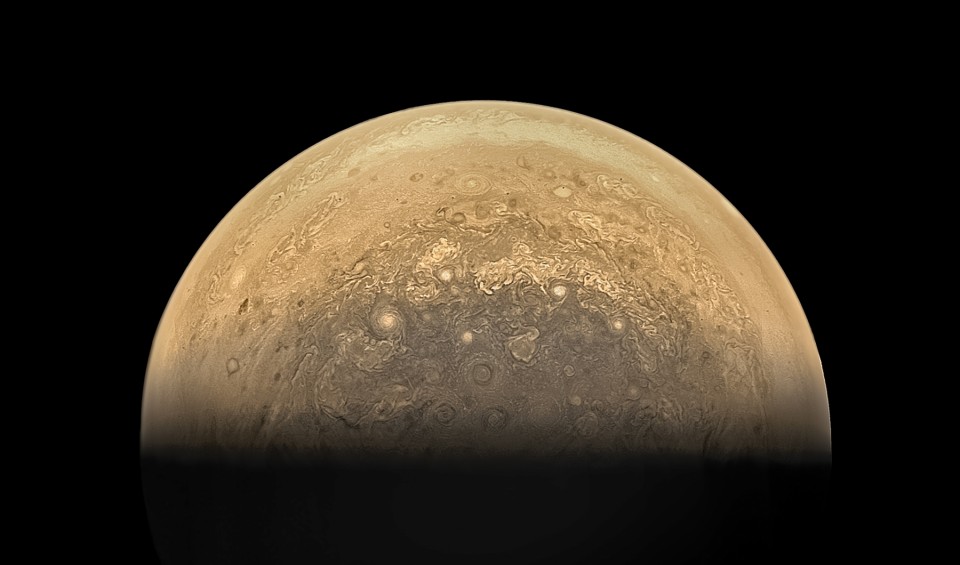
The South Pole of Jupiter, taken during the Juno mission's third orbit (Perijove 3). Credits: NASA/JPL-Caltech/SwRI/MSSS/ Luca Fornaciari © cc nc sa
At this point, all we can do is hope that ongoing surveys and missions will yield more evidence. These are not only likely to help us refine our understanding of Jupiter's internal structure and its formation, but also refine our understanding of the history of the Solar System and how it came to be.
If you'd like more information on Jupiter, check out Hubblesite's News Releases about Jupiter, and here's a link to NASA's Solar System Exploration Guide to Jupiter.
We've also recorded an episode of Astronomy Cast just about Jupiter. Listen here, Episode 56: Jupiter.
Sources:

Trudeau Mulls Coal Ban in Response to U.S. Lumber Tariffs


  • B.C. Premier Clark has requested ban on coal shipments
  • U.S.’ Ross responds that Canada’s threats ‘inappropriate’
Canadian Prime Minister Justin Trudeau told the leader of timber-rich British Columbia that he would consider her request to ban thermal coal shipments in retaliation for new U.S. tariffs on softwood slumber.
In a letter to B.C. Premier Christy Clark, a copy of which was posted on the provincial government’s website, Trudeau said his officials are seriously considering the federal ban on thermal coal shipments through the province’s ports that she’s proposed.
“The Government of Canada is considering this request carefully and seriously. I have asked federal trade officials to further examine the request to inform our government’s next steps,” Trudeau said in the letter. “We disagree strongly with the U.S. Department of Commerce’s decision to impose an unfair and punitive duty on Canadian softwood lumber products.”
U.S. Commerce Secretary Wilbur Ross said in response that “threats of retaliatory action are inappropriate” and won’t influence the White House’s decision on tariffs. “We continue to believe that a negotiated settlement is in the best interests of all parties,” Ross said in an emailed statement on Saturday.
Canada’s move is a shift for Trudeau, who until now has been telling U.S. officials that bilateral trade irritants are minor, and that both nations benefit from having integrated production. Clark, who faces an election next week, has been more vocal and said she will impose a carbon tax on coal shipments if Trudeau doesn’t ban them.
President Donald Trump stoked trade tensions last week by slapping duties on softwood lumber imports from Canada, reigniting a dispute that dates backs decades, while threatening to take actions against Canadian dairy over what the U.S. says are unfair subsidies.
British Columbia says 94 percent of the 6.6 million tonnes of thermal coal exported from the West Coast province last year came from the U.S. Clark’s original request for a ban triggered a fall in the shares of Canadian export terminal operator Westshore Terminals Investment Corp. and U.S. miner Cloud Peak Energy Inc.
Trudeau is also considering other trade actions against the U.S. including duties on Oregon companies, Canadian Press reported on Friday, citing sources who requested anonymity.

Mitra-mandal Privacy Policy

This privacy policy has been compiled to better serve those who are concerned with how their  'Personally Identifiable Inform...