Bob King posted: " If one of your New Year's resolutions is to spend more time under the stars in 2017, you'll have motivation to do so as soon as Tuesday. That morning, the Quadrantid (kwah-DRAN-tid) meteor shower will peak between 4 to about 6 a.m. local time just bef"
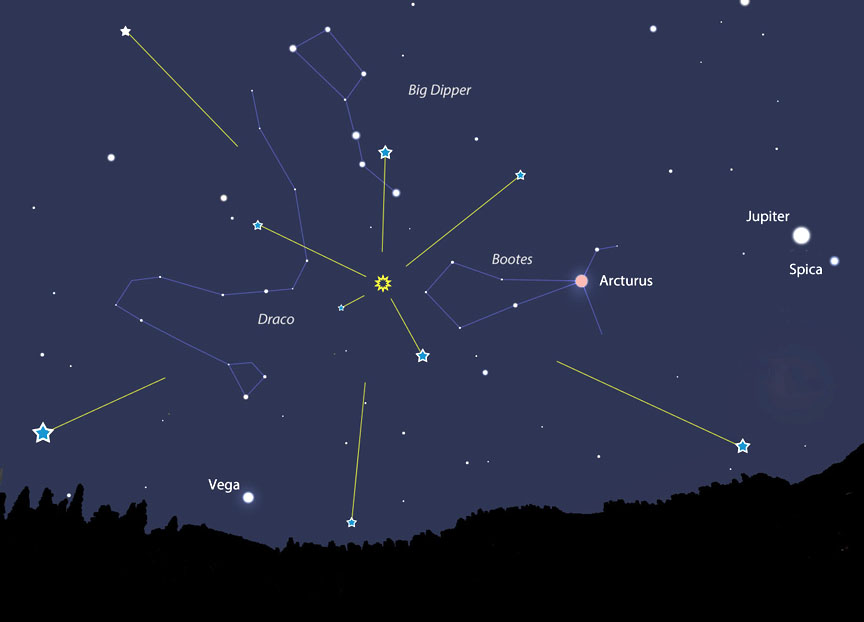
The Quadrantid meteor shower, named for the obsolete constellation Quadran Muralis, will appear to stream from a point in the sky called the radiant (yellow star), located below the end of the Big Dipper's handle and across from the bright, orange-red star Arcturus. The map shows the sky around 4 a.m. local time Tuesday, Jan. 3. The shower will be best between 4 a.m. and 6 a.m., the start of dawn. Map: Bob King, Source: Stellarium
If one of your New Year's resolutions is to spend more time under the stars in 2017, you'll have motivation to do so as soon as Tuesday. That morning, the Quadrantid (kwah-DRAN-tid) meteor shower will peak between 4 to about 6 a.m. local time just before the start of dawn. This annual shower can be a rich one with up to 120 meteors flying by an hour — under perfect conditions.
Those include no moon, a light-pollution free sky and most importantly, for the time of maximum meteor activity to coincide with the time the radiant is highest in the pre-dawn sky. Timing is everything with the "Quads" because the shower is so brief. Meteor showers occur when Earth passes through either a stream of dusty debris left by a comet or asteroid. With the Quads, asteroid 2003 EH1 provides the raw material — bits of crumbled rock flaked off the 2-mile-wide (~3-4 km) object during its 5.5 year orbit around the sun.
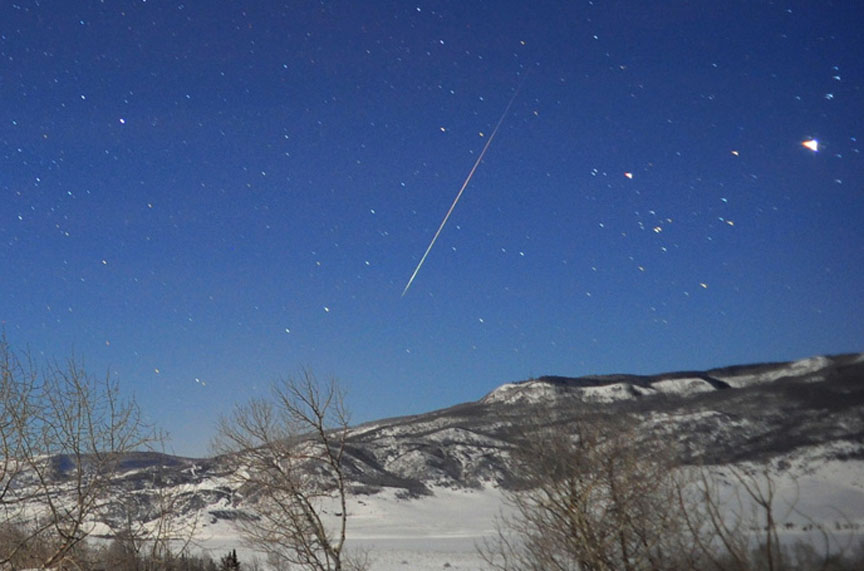
A Quadrantid fireball flares to the left of the Hyades star cluster and Jupiter in 2013. As Earth travels across the debris stream, bits and pieces of asteroid 2003 EH1 strike the atmosphere at nearly 100,000 mph (43 km/second) and vaporize while creating a glowing dash of light called a meteor. Credit: Jimmy Westlake via NASA
Only thing is, the debris path is narrow and Earth tears through it perpendicularly, so we're in and out in a hurry. Just a few hours, tops. This year's peak happens around 14 hours UT or 8 a.m. Central time (9 a.m. Eastern, 7 a.m. Mountain and 6 a.m. Pacific), not bad for the U.S. and Canada. The timing is rather good for West Coast skywatchers and ideal if you live in Alaska. Alaska gets an additional boost because the radiant, located in the northeastern sky, is considerably higher up and better placed than it is from the southern U.S. states.
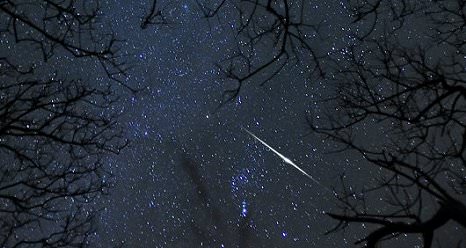
Another Quadrantid fireball. Credit: NASA
The Quads will appear to radiate from a point in the sky below the Big Dipper's handle, which stands high in the northeastern sky at the time. This area was once home to the now defunct constellation Quadrans Muralis (mural quadrant), the origin of the shower's name. As with all meteor showers, you'll see meteors all over the sky, but all will appear to point back to the radiant. Meteors that point back to other directions don't belong to the Quads are called sporadic or random meteors.
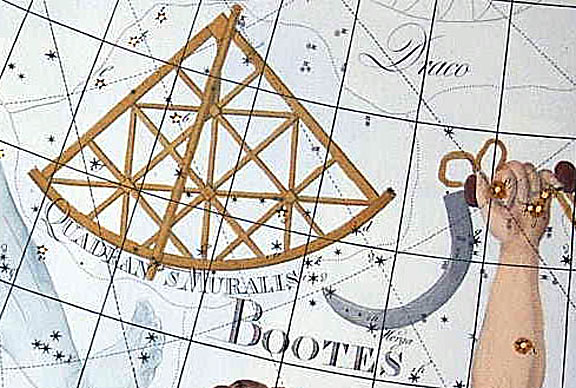
The long-obsolete constellation Quadrans Muralis represents the wall quadrant, a instrument once used to measure star positions. It was created by French astronomer Jerome Lalande in 1795. Credit: Johann Bode atlas
Off-peak observers can expect at least a decent shower with up to 25 meteors an hour visible from a reasonably dark sky. Peak observers could see at least 60 per hour. Tropical latitude skywatchers will miss most of the the show because the radiant is located at or below the horizon, but they should be on the lookout for Earthgrazers, meteors that climb up from below the horizon and make long trails as they skirt through the upper atmosphere.
Set your clock for 4 or 5 a.m. Tuesday, put on a few layers of clothing, tuck hand warmers in your boots and gloves, face east and have at it! The Quads are known for their fireballs, brilliant meteors famous for taking one's breath away. Each time you see one chalk its way across the sky, you're witnessing the fiery end of an asteroid shard. As the crumble burns out, you might be fulfilling another resolution: burning away those calories while huddling outside to see the show.
Please click on headlines for more details,where details are not available.
View photos
Migrants pictured on the ground in El Tarajal, Ceuta, close to the border with Morocco on December 9, 2016 after being rounded up by police to be attended to by Red Cross personnel (AFP Photo/Antonio SEMPERE)
Madrid (AFP) - More than 1,000 migrants tried to jump a high double fence between Morocco and the Spanish enclave of Ceuta on Sunday in a violent assault that saw one officer lose an eye, local authorities said.
A group of 1,100 people from Sub-Saharan Africa trying to reach Europe stormed the border fence just after 4 am (0300 GMT) on New Year's Day in an "extremely violent and organised" way, said the central government's representative office in Ceuta.
None however managed to get through bar two who were badly injured and taken to hospital in Ceuta, the office said in a statement. A similar assault on December 9 saw more than 400 migrants enter the tiny enclave.
They tried "to force open some of the doors in the external fence, using iron bars, wire cutters and large stones with which they assaulted Moroccan forces and (Spanish) Guardia Civil (police) agents," it added.
Five Spanish policemen and 50 members of the Moroccan forces were injured, including one who lost an eye, it said.
Ceuta along with Melilla, another Spanish territory in North Africa, have the European Union's only land borders with Africa.
They are one of the entry points for African migrants seeking a better life in Europe, who get there by either climbing over the border fence or by swimming along the coast.
According to local authorities, of the 1,100 migrants who stormed the border, just over 100 managed to climb up the external fence and stayed on top for hours.
Footage shot by the local Faro TV shows one man perched at the top of the six-metre (20-foot) high fence, sitting uncomfortably near rolls of barbed wire, his head hanging down onto his chest.
Eventually as darkness turns to light, he slowly climbs down to a space between both fences and lies down as a Spanish policeman fetches him a bottle of water before taking him to an entry back into Morocco.
Separately, coastguards said they had rescued 52 people who were packed onto a small boat at sea south of Malaga on Spain's southern coast.
Please click on headlines for more details,where details are not available.
Rescue workers working with sniffer dogs and underground imaging raised the body count to 17 on Sunday, after a mine collapse in eastern India. They were forced to work carefully to avoid further collapses.
Police feared the death-toll at Lalmatia coal mine in Jharkhand state would eventually reach 23 after the Thursday incident, spokesman RK Mallick told news agency AFP.
"Besides the challenging terrain and foggy weather, the cave-in area is spread around 300 meters (980 feet) and it's obviously taking time to clear the debris and search for the unaccounted miners," Mallick said.
Rescuers were forced to work delicately to avoid a further collapses at the Godda district mine.
"We are carrying on the rescue operation in a systematic manner so that the situation does not aggravate as the debris is too much and it should not fall," R R Mishra, chairman and managing director of the mining company said.
The accident happened when a massive mound of earth crushed dozens of workers
Baleshwar Mahato, a bulldozer operator at the open cast mine site whose son died in the collapse, accused the mine's operators of ignoring two safety warnings before a massive mound of earth came crashing down on excavators
"After that first warning, there was another alert around 6 p.m. (on Thursday), when a bigger chunk of mud slid down," Baleshwar told "The Indian Express."
"But work continued where Kuleshwar (his son) was and then, this tragedy struck."
Authorities launched an investigation into the cause of the collapse
Authorities launched an investigation into the cause of the incident at Eastern Coalfields Ltd's mine.
The last major mining accident in India was in 1975, when 372 workers were killed after the Chasnala mine in Dhanbad was flooded.
Compared to neighboring China, India has a relatively safe record for mining-related accidents. China averaged about 1,000 fatalities every year. In 2015, India recorded 38 deaths across 570 mining sites.
Please click on headlines for more details,where details are not available.
Nielmar de Oliveira reports from Agência Brasil
Unemployment has hit 12.1 million people in Brazil, equivalent to 11.9% in the moving quarter ended in November. The unemployment rate and the unemployed population are the highest in the time series of the Continuous National Household Sample Survey (Continuous PNAD), which began in 2012.
The data was released today (Dec. 29) by the Brazilian Institute of Geography and Statistics (IBGE) and shows the unemployment rate has remained relatively stable compared to the previous quarter's 11.8% (June-August).
Comparing the latest data to a year before, there has been an increase of 2.9 percentage points.
The number of unemployed people has grown 33.1% compared to the same quarter of 2015—which means 3 million more people looking for jobs. The employed population today is 90.2 million people.
Please click on headlines for more details,where details are not available.
The government will be able to ban trade in GMO seeds under an amendment to seeding laws to come into force on January 1, 2017. Under present laws GMO seeds can be marketed but not grown.
The amendment, filed by the Senate (upper house) in the course of ongoing adjustments of Polish seeding laws to EU directives, allows the government to issue a trade ban on GMO seeds on grounds of their unsuitability for Polish agriculture, threat to the health of people, animals and plants, and for environmental reasons.
The government will have 12 months from the new law's introduction to impose a GMO trade ban in Poland.(PAP) mb/
Please click on headlines for more details,where details are not available.
Armenian armed forces have 92 times violated the ceasefire along the line of contact between Azerbaijani and Armenian troops over the last 24 hours, the Azerbaijani Defense Ministry said on Yan.01
Armenian armed forces, located in Voskevan village in Noyemberyan region, in Paravakar, Berkaber villages and nameless hills in Ijevan region, in Aygepar, Mosesgekh, Chinari villages and in nameless hills in Berd region, in nameless hills in Krasnoselsk region subjected to fire the positions of the Azerbaijani Armed Forces located in Kohnagishlag village of Aghstafa region, Ashaghi Askipara, Gizilhajili villages and nameless hills in Gazakh region, Alibayli, Aghdam, Aghbulag, Kokhanabi, Munjuglu villages of Tovuz region and nameless hills in Gedebey region.
The positions of Azerbaijan's Armed Forces were also fired from positions of Armenian military units located near to the occupied Goyarkh, Chilaburt villages of Tartar region, Yusifjanli, Sarijali villages of Aghdam region, Kuropatkino village of Khojavand region, Garakhanbayli, Ashaghi Veysalli, Ashaghi Seyidahmadli, Horadiz villages of Fuzuli region, Mehdili village of Jabrayil region, as well as from positions located in the nameless hills in Goranboy, Tartar, Khojavand, Fuzuli and Jabrayil regions.
Please click on headlines for more details,where details are not available.
New Year Address from Belarus President Alexander Lukashenko President 01.01.2017 | 00:01 fvkoktgm Alexander Lukashenko Another year of the 3rd millennium passes into history. The year was complicated, bright and eventful. For some people 2016 was a sad and sorrowful year because of the loss of a family member or a friend, some people might have failed to achieve their goals. Others had to deal with family or professional issues. But I am convinced that 2016 was a joyful and happy year for the majority of people. It was a good year because they loved, had fun at weddings starting a new life, smiled hearing the voices of their babies for the first time. Those who set ambitious goals and overcame many obstacles to fulfill their dreams felt the joy of victory! Sovereign and independent Belarus was at the epicenter of the global geopolitical and economic events. Since Belarus is an open country, it has been affected by the economic circumstances of traditional business partners. Violent conflicts break out, terrorist attacks are committed, interethnic and interreligious wars escalate in various corners of the planet. It was not easy to keep Belarus as an island of stability. But we did our best to ensure peace and security of the nation! Our neighbors, friends, brotherly nations should know that Belarus will never be the source of aggression and threats. At the same time, we, military people, know very well that it is needed to keep powder dry. The defense of the Fatherland is our sacred duty! Step by step, Belarus is strengthening its authority in the international community. The country took the spotlight as the platform of peacemaking initiatives. Belarus' friendliness, hospitality, and openness to cooperation attract many nations. Belarus pursues balanced international and domestic policy. We have a strong resolution to promote the unity of the nation, prevent extremism and the incitement of ethnic and religious hatred. The political campaigns of the outgoing year demonstrated the civil maturity and culture of our people. Together, we determined the priorities and major guidelines of the country's development. I am convinced that all of them will be fulfilled in the coming years. We can say so because over the years of sovereignty the Belarusian state has gained the priceless experience of overcoming difficulties and solving problems, has learned to find adequate responses to emerging challenges and threats. We set up new enterprises, build roads, power plants, important social facilities and dwelling houses. We make towns and villages more beautiful. Every year Belarus is doing a lot to enhance its image as a modern European state. Looking into the future, we have many hopes for 2017. It should be a momentous year which will give a strong impetus to the development of the country. We will prioritize the creation of new enterprises and new jobs, promote business. Belarusian science will play a crucial role. The innovative development is our priority. The coming Year of Science should be a beacon of the country's renewal and discoveries in all walks of life. All scientific achievements and projects should be efficiently applied in production. Thanks to these efforts, we will provide jobs and decent salaries to people. The living standards of Belarusians should be much higher than they are today. It is a difficult task. However, we will do our utmost to significantly raise the incomes of citizens next year. It is for the first time since gaining independence that Belarus posted a natural population increase in 2016. Our families have more children, and they are the future of Belarus. We must keep this positive trend. Dear women, give birth to children and be sure that we will continue providing families with children with the maternity capital, allowances, and accommodation. The senior generation has done a lot for our country. And we are grateful for it. But now we should move forward, apply as many progressive and useful things as possible. For this purpose, we must learn, improve ourselves, and keep up with the times. Our patriotic youth concerned about the future of the Homeland should be more proactive. There are many talented people among you. I believe in you and hope that you will find a place under the sun in Belarus, will use your talents and skills for the benefit of the country. Twenty-five years have passed since the acquisition of sovereignty, and now you are responsible for the future and prosperity of the Fatherland. In the last moments of the year, I would like to express sincere gratitude to you, dear compatriots. Thank you for your selfless work in the manufacturing sector, agriculture, education, healthcare, railway and air transportation, the R&D sector, construction and the forestry industry, mining and military service. Thanks to your personal merits, professionalism and loyalty, we can sit at the festive table, sing and joke, make wishes and face the future with optimism. I want to tell you one more thing: remember the warmth of your home, your teachers and friends, your native country wherever you are. May the coming year bring you luck and wellbeing. I am convinced that it will be so because I believe in the wisdom, unity, diligence, and unflagging creative energy of our people. Happy New Year, dear friends! Read full text at: http://eng.belta.by/president/view/new-year-address-from-belarus-president-alexander-lukashenko-97629-2017/ If you use BelTA’s materials, you must credit us with a hyperlink to eng.belta.by.
Newswise — In a survey of almost 2,000 people who said they had had a past negative experience when taking psilocybin-containing "magic mushrooms," Johns Hopkins researchers say that more than 10 percent believed their worst "bad trip" had put themselves or others in harm's way, and a substantial majority called their most distressing episode one of the top 10 biggest challenges of their lives. Despite the difficulty, however, most of the respondents still reported the experience to be "meaningful" or "worthwhile," with half of these positive responses claiming it as one of the top most valuable experiences in their life.
The researchers caution that their survey results don't apply to all psilocybin mushroom use, since the questionnaire wasn't designed to assess "good trip" experiences. And, the survey wasn't designed to determine how often bad trips occur.
"Considering both the negative effects and the positive outcomes that respondents sometimes reported, the survey results confirm our view that neither users nor researchers can be cavalier about the risks associated with psilocybin," says Roland Griffiths, Ph.D., a psychopharmacologist and professor of psychiatry and behavioral sciences and neurosciences at the Johns Hopkins University School of Medicine. Griffiths has spent more than 15 years conducting studies of psilocybin's capacity to produce profound, mystical-type experiences, treat psychological anxiety and depression and to aid in smoking cessation.
Psilocybin and use of other hallucinogens became popular in the U.S. in the 1960s due to charismatic proponents, who suggested anecdotally that users would experience profound psychological insights and benefits. But drugs such as psilocybin and LSD were banned for supposed safety reasons shortly thereafter, in the 1970s, without much scientific evidence about risks or benefits.
In recent years, Griffiths and his team have conducted more than a dozen studies confirming some of those benefits. The current study was designed, he said, to shed light on the impact of so-called "bad trips."
For the new survey, Griffiths' team used advertisements on social media platforms and email invitations to recruit people who self-reported a difficult or challenging experience while taking psilocybin mushrooms. The survey took about an hour to complete and included three questionnaires: the Hallucinogen Rating Scale, the Mystical Experience Questionnaire, developed by Griffiths and colleagues in 2006, and parts of the 5D-Altered States of Consciousness Questionnaire.
Participants were asked in the survey to focus only on their worst bad trip experience, and then to report about the dose of psilocybin they took, the environment in which the experience occurred, how long it lasted, and strategies available and used to stop this negative experience and any unwanted consequences.
Of 1,993 completed surveys, 78 percent of respondents were men, 89 percent were white, and 51 percent had college or graduate degrees. Sixty-six percent were from the U.S. On average, the survey participants were 30 years old at the time of the survey and 23 years old at the time of their bad trips, with 93 percent responding that they used psilocybin more than two times.
Based on the survey data that assessed each respondent's absolute worst bad trip, 10.7 percent of the respondents said they put themselves or others at risk for physical harm during their bad trip. Some 2.6 percent said they acted aggressively or violently, and 2.7 percent said they sought medical help. Five of the participants with self-reported pre-existing anxiety, depression or suicidal thoughts attempted suicide while on the drug during their worst bad trip, which the researchers say is indicative of requiring a supportive and safe environment during use, like those conditions used in ongoing research studies. However, six people reported that their suicidal thoughts disappeared after their experience on their worst bad trip -- the latter result coinciding with a recent study published by Griffiths showing the antidepressive properties of psilocybin in cancer patients.
Still, Griffiths said, a third of the participants also said their experience was among the top five most meaningful, and a third ranked it in the top five most spiritually significant experiences of their lives. Sixty-two percent of participants said the experience was among the top 10 most difficult ones in their lifetime; 39 percent listed it in their top five most difficult experiences; and 11 percent listed it as their single most difficult experience.
"The counterintuitive finding that extremely difficult experiences can sometimes also be very meaningful experiences is consistent with what we see in our studies with psilocybin -- that resolution of a difficult experience, sometimes described as catharsis, often results in positive personal meaning or spiritual significance," Griffiths says.
¬In all of Griffiths' clinical research, people given psilocybin are provided a safe, comfortable space with trained experts to offer support to participants. "Throughout these carefully managed studies, the incidence of risky behaviors or enduring psychological problems has been extremely low," Griffiths says. "We are vigilant in screening out volunteers who may not be suited to receive psilocybin, and we mentally prepare study participants before their psilocybin sessions."
"Cultures that have long used psilocybin mushrooms for healing or religious purposes have recognized their potential dangers and have developed corresponding safeguards," says Griffiths. "They don't give the mushrooms to just anyone, anytime, without a contained setting and supportive, skillful monitoring."
The researchers say that survey studies like this one rely on self-reporting that cannot be objectively substantiated, and that additional scientifically rigorous studies are needed to better understand the risks and potential benefits of using hallucinogenic drugs.
According to the Substance Abuse and Mental Health Services Administration's National Survey on Drug Use and Health, about 22.9 million people or 8.7 percent of Americans reported prior use of psilocybin. While not without behavioral and psychological risks, psilocybin is not regarded as addictive or as toxic to the brain, liver or other organs.
Please see the Q&A with Griffiths for more information on the study: http://bit.ly/2ivcRJ7
Additional authors included Theresa Carbonaro, Matthew Bradstreet, Frederick Barrett, Katherine MacLean, Robert Jesse and Matthew Johnson, of The Johns Hopkins University.
The study was funded by grants from the National Institute on Drug Abuse (R01 DA03889 and 5T32 DA007209), the Council on Spiritual Practices and the Heffter Research Institute.