NASA's Wide-field Infrared Survey Explorer (WISE) accomplished much during its first mission, which ran from December of 2009 to September of 2010. During the many months that it was active, the orbital telescope conducted an all-sky astronomical survey in the infrared band and discovered thousands of minor planets and numerous star clusters.
The extension of its mission, NEOWISE, has brought new life to the telescope as a comet and asteroid hunter. And since its re-activation in December of 2013, the orbiting telescope has spotted hundreds of Near Earth Objects (NEOs) and thousands of Main Belt asteroids. Most recently, it has detected two new objects (both possibly comets) which could be observable from Earth very soon.
The most recent object to be detected - 2016 WF9 - was first observed by NEOWISE on November 27th, 2016. This comet's path through the Solar System takes it on a circuitous route, taking it from Jupiter to just inside the orbit of Earth over the course of 4.9 years. Much like other objects of its kind, 2016 WF9 may have once been a comet, or part of a population of dark objects in the Main Asteroid Belt.
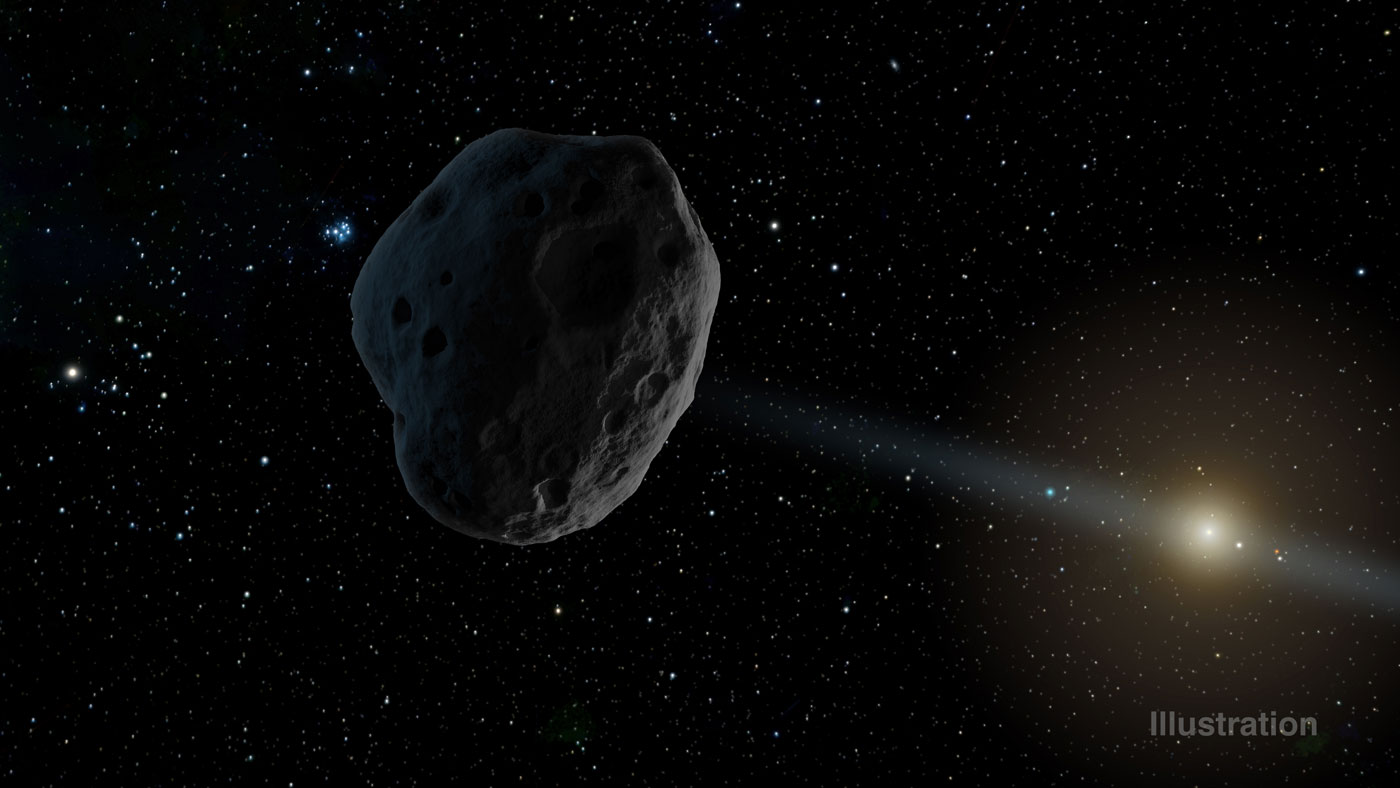
Artist's rendition of the comet 2016 WF9 as it passes Jupiter's orbit and moves toward the sun. Credit: NASA/JPL-Caltech
In any case, 2016 WF9 will approach Earth's orbit on February 25th, 2017, passing Earth at a minimum distance of almost 51 million km (32 million mi). This will place it well outside the orbit of the Moon, so the odds of it threatening Earth are negligible. But for those keen observers hoping to catch sight of the object, it will be close enough that it might be visible with just a pair of binoculars.
Since its discovery, 2016 WF9 has been of interest to astronomers, mainly because it straddles the already blurry line between asteroids and comets. While its proportions are known - roughly 0.5 to 1 kilometer in diameter (0.3 to 0.6 miles) - its other characteristics have led to some confusion as to where it came from. For one, its appearance (which is quite dark) and its orbit are consistent with what one expects from a comet.
But on the other hand, it lacks the characteristic cloud of dust and gas that comets are known for. As James Bauer, NEOWISE's Deputy Principal Investigator at JPL, said in a NASA press release:
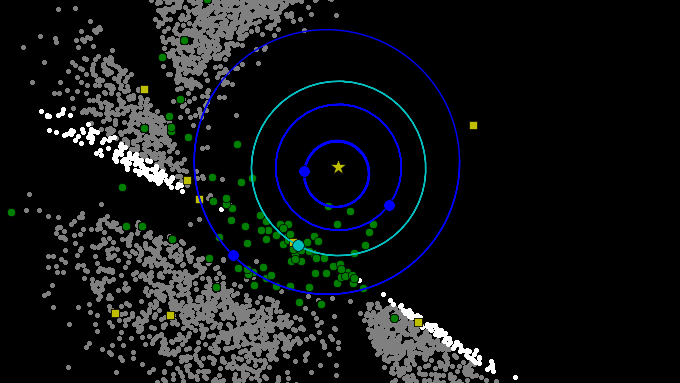
Graphic showing the asteroids and comets observed by NASA's Near-Earth Object Wide-field Survey Explorer (NEOWISE) mission. Credit: NASA/JPL-Caltech/UCLA/JHU
The other object, C/2016 U1 NEOWISE, was discovered about a month prior to 2016 WF9. Its orbit, which can you see by checking out the 3D Solar System Simulator, takes it from the outer Solar System to within Mercury's orbit over the course of thousands of years. According to NASA scientists, this object is very clearly a comet, as evidenced by the dust it has been releasing as it gets closer to our Sun.
During the first week of 2017, comet C/2016 U1 NEOWISE is also likely to be visible in the night sky - in this case, in the southeastern sky shortly before dawn (for those looking from the northern hemisphere). It will reach its closest point to the Sun on January 14th (where it will be passing within Mercury's orbit) before heading back out towards the outer Solar System.
Once again, it is believed that comet-hunters should be able to see it, though that is open to question. Paul Chodas, the manager of NASA's Center for Near-Earth Object (NEO) Studies at the Jet Propulsion Laboratory, thinks that this object "has a good chance of becoming visible through a good pair of binoculars, although we can't be sure because a comet's brightness is notoriously unpredictable."
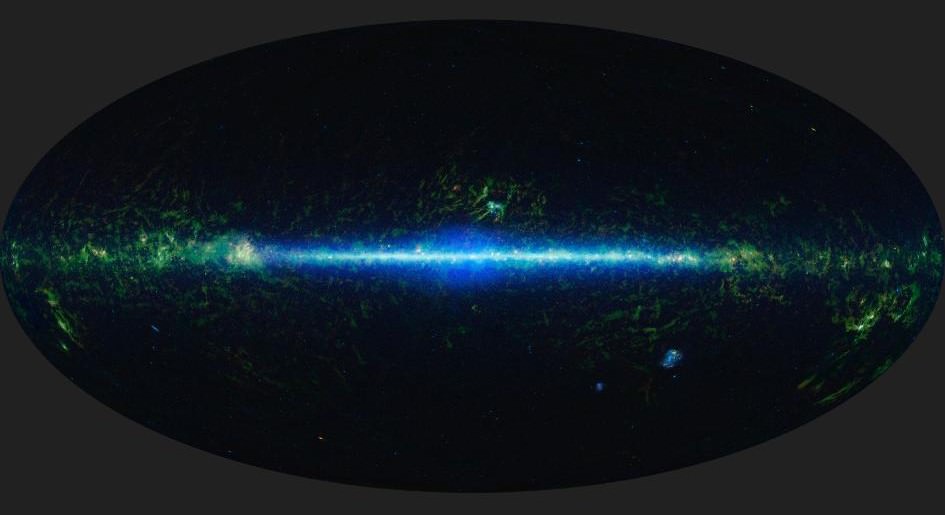
A mosaic of the images covering the entire sky as observed by the Wide-field Infrared Survey Explorer (WISE), part of its All-Sky Data Release. Credit: NASA/JPL
In any case, NASA will be continuing to monitor 2016 WF9 to see if they can't sort out what it is. Should it prove to be a comet, it would be the tenth discovered by NEOWISE since it was reactivated in December of 2013. If it turns out to be an asteroid, it would be the one-hundredth discovered since its reactivation.
As of November 2016, the orbital telescope has conducted over 562,000 infrared measurements have been made of 24,024 different solar system objects, including 613 NEOs and 110 comets. It has also been responsible for discovering 249 new near-Earth objects and comets, as well as more than 34,000 asteroids during its original mission.
At present, NEOWISE's science team is currently reprocessing all its primary mission data to extend the search for asteroids and comets. It is hoped that by taking advantage of the latest in photometric and astrometric calibrations, they will be able to push the limits of what the telescope can detect, thereby adding many more minor planets and objects to its suite of discoveries.
And be sure to enjoy this video, detailing the first two years of asteroid data collected by the NEOWISE mission:
Further Reading: NASA
|
NASA’s NEOWISE Missions Spots New Comets


Afghanistan's Sikh, Hindu Minorities Demand Probe Into Sikh Killing

Sikh and Hindu communities in Afghanistan have demanded authorities investigate attacks against members of their communities, after a local Sikh community leader was shot dead in the northern city of Kunduz.
Narmang Singh, a shopkeeker also known as Dilsoz, was killed by gunmen on his way to work on December 29, the second deadly attack against members of the Sikh community in Afghanistan since September.
Senator Anarkali Honaryar, who represents the Hindu and Sikh minorities in the upper house of Afghanistan's parliament, says the attack has deeply affected the communities.
'The incident has left a serious negative psychological impact on the Hindus and Sikhs. We urge authorities to investigate this incident as well as past attacks against the Hindus and Sikhs,' Honaryar told RFE/RL on December 30.
Police in Kunduz say three suspects were arrested in connection with Singh's killing.
On September 30, a Sikh man was abducted from his home and shot dead by suspected militants in the eastern city of Jalalabad. The killing sparked protests by the Sikh community.
A vast majority of Afghanistan's Hindus and Sikhs -- whose were estimated to number around 220,000 in the 1980s -- have left the conflict-torn country in the past three decades.
Energyworld
| Coal | |
| • | With few challenges ahead, coal will be an open commodity: Piyush Goyal |
| • | Modi talks to Jharkhand CM over coal mine tragedy |
ScienceDaily: Top News
ScienceDaily: Top News |
- Fossil fuel formation: Key to atmosphere’s oxygen?
- Researchers urge caution around psilocybin use
- Using 'fire to fight fire' to combat disease could make it worse, tests show
- Lack of standards for infant cereals threatens child nutrition in lower-income countries
- Ancient DNA can both diminish and defend modern minds
- New class of hydrogen sulfide donor molecules
- Role for immune cells in cancer’s ability to evade immunotherapy
- Endometrial cancer mutations are detectable in uterine lavage fluid before a cancer is diagnosed
- Biologist's ant research provides long-term look at effects of climate change
|
Posted: 30 Dec 2016 03:54 PM PST
For the development of animals, nothing -- with the exception of DNA -- may be more important than oxygen in the atmosphere. A study now links the rise in oxygen to a rapid increase in the burial of sediment containing large amounts of carbon-rich organic matter.
     |
|
Posted: 30 Dec 2016 03:06 PM PST
In a survey of almost 2,000 people who said they had had a past negative experience when taking psilocybin-containing 'magic mushrooms,' a researchers say that more than 10 percent believed their worst 'bad trip' had put themselves or others in harm's way, and a substantial majority called their most distressing episode one of the top 10 biggest challenges of their lives.
|
|
Posted: 30 Dec 2016 09:29 AM PST
A treatment billed as a potential breakthrough in the fight against disease, including cancer, could back-fire and make the disease fitter and more damaging, new research has found. Ground-breaking research has found that introducing 'friendlier' less-potent strains into a population of disease-causing microbes can lead to increased disease severity.
|
|
Posted: 30 Dec 2016 07:35 AM PST
The first global analysis of infant cereals sold in lower-income countries highlights the need for basic quality assurance services to improve nutritional consistency and healthy growth of infants from 6 to 24 months of age.
|
|
Posted: 30 Dec 2016 07:35 AM PST
You've likely heard about being in the right place at the wrong time, but what about having the right genes in the wrong environment? In other words, could a genetic mutation (or allele) that puts populations at risk for illnesses in one environmental setting manifest itself in positive ways in a different setting?
|
|
Posted: 30 Dec 2016 07:35 AM PST
Researchers have designed molecules with the potential to deliver healing power to stressed cells -- such as those involved in heart attacks. The research, at a cellular level in the lab, involves organic molecules that break down to release hydrogen sulfide when triggered by oxidative stress.
|
|
Posted: 30 Dec 2016 07:32 AM PST
One of the main reasons cancer remains difficult to treat is that cancer cells have developed a multitude of mechanisms that allow them to evade destruction by the immune system. One of these escape mechanisms involves a type of immune cell called myeloid-derived suppressor cells (MDSCs). A recent study provides new insight into how MDSCs enable tumor cells to circumvent immune attack and offer the potential for improving cancer immunotherapy.
|
|
Posted: 30 Dec 2016 07:32 AM PST
Mutations that have been linked to endometrial cancer can be found in the uterine lavage fluid of pre- and post-menopausal women both with and without detectable cancer.
|
|
Posted: 30 Dec 2016 07:32 AM PST
Many scientists have attempted to tackle how climate change will affect the natural world by determining the thermal tolerance of various species, then predicting what will happen to them as our world warms. However, this approach as a way to understand nature has its drawbacks because one species never acts alone, so comprehending how global change impacts these interactions is crucial to a holistic understanding.
|
Subscribe to:
Posts (Atom)
-
Authentic news,No fake news. TNN | MUMBAI: If you can touch the sky while parasailing in Kamshet or Panchgani, dive into the depths of...
-
Authentic news,No fake news. Alejandro Casas’s electric taxi, which he drives in Montevideo, cost him 63,000 dollars, but he was given...
-
NAIROBI, Sept. 29 (Xinhua) -- An estimated 100,000 Kenyans die annually due to cardiovascular diseases, officials said on Thursday. Dr ...
-
Authentic news,No fake news. आईएएनएस टीम ने सिरपुर में जगह-जगह शूटिंग की रायपुर छत्तीसगढ़ का पूरा इतिहास अपने अंदर कई ऐसे रह...
-
Authentic news,No fake news. By Celeste McGovern LifeSiteNews 31 May 2021 All Global Research articles can be read in 51 languages by act...
-
Authentic news,No fake news. Monday, March 20, 2017 How much is an Afghan life worth? That depends. Nearly 16 year...
-
Authentic news,No fake news. By Sania Farooqui The following opinion piece is part of series to mark the upcoming International Women’s Da...


