During the 19th and 20th centuries, physicists began to probe deep into the nature of matter and energy. In so doing, they quickly realized that the rules which govern them become increasingly blurry the deeper one goes. Whereas the predominant theory used to be that all matter was made up of indivisible atoms, scientists began to realize that atoms are themselves composed of even smaller particles.
From these investigations, the
Standard Model of Particle Physics was born. According to this model, all matter in the Universe is composed of two kinds of particles: hadrons – from which
Large Hadron Collider (LHC) gets its name – and leptons. Where hadrons are composed of other elementary particles (quarks, anti-quarks, etc), leptons are elementary particles that exist on their own.
Definition:
The word lepton comes from the Greek leptos, which means “small”, “fine”, or “thin”. The first recorded use of the word was by physicist Leon Rosenfeld in his book Nuclear Forces (1948). In the book, he attributed the use of the word to a suggestion made by Danish chemist and physicist Prof. Christian Moller.
![The Standard Model of Elementary Particles. Image: By MissMJ - Own work by uploader, PBS NOVA [1], Fermilab, Office of Science, United States Department of Energy, Particle Data Group, CC BY 3.0](https://lh3.googleusercontent.com/blogger_img_proxy/AEn0k_tUuMnzolEl-NnP97d7tjGonJ417dmGrbIkZrba7MKCVftyc0Rb7mrMqu7s2ZeHn0c7eVCKIaPllrucGmSy7lRdTeBggkcimE-_8LzQiN3--JWcPMZ1f0Gbmav-W9q5nEOVkPP82h-SpXyLwSeC7jgVrFhlge9J_qq3_QIDpAkbg7XgUgT0hMJ3Ma4ZM45HKDTx=s0-d)
The Standard Model of Particle Physics, showing all known elementary particles. Credit: Wikipedia Commons/MissMJ/PBS NOVA/Fermilab/Particle Data Group
The term was chosen to refer to particles of small mass, since the only known leptons in Rosenfeld’s time were muons. These elementary particles are over 200 times more massive than electrons, but have only about one-ninth the the mass of a proton. Along with quarks, leptons are the basic building blocks of matter, and are therefore seen as “elementary particles”.
Types of Leptons:
According to the Standard Model, there are six different types of leptons. These include the Electron, the Muon, and Tau particles, as well as their associated neutrinos (i.e. electron neutrino, muon neutrino, and tau neutrino). Each of these has a negaive charge and a distinct mass. Electrons are the lightest, with a mass of 0.000511 gigaelectronvolts (GeV), while Muons have a mass of 0.1066 Gev and Tau particles (the heaviest) have a mass of 1.777 Gev.
The different varieties of the elementary particles are commonly called “flavors”. While each of the three lepton flavors are different and distinct (in terms of their interactions with other particles), they are not immutable. A neutrino can change its flavor, a process which is known as “neutrino flavor oscillation”.
This can take a number of forms, which include solar neutrino, atmospheric neutrino, nuclear reactor, or beam oscillations. In all observed cases, the oscillations were confirmed by what appeared to be a deficit in the number of neutrinos being created. One observed cause has to do with “muon decay” (see below), a process where muons change their flavor to become electron neutrinos or tau neutrinos – depending on the circumstances.

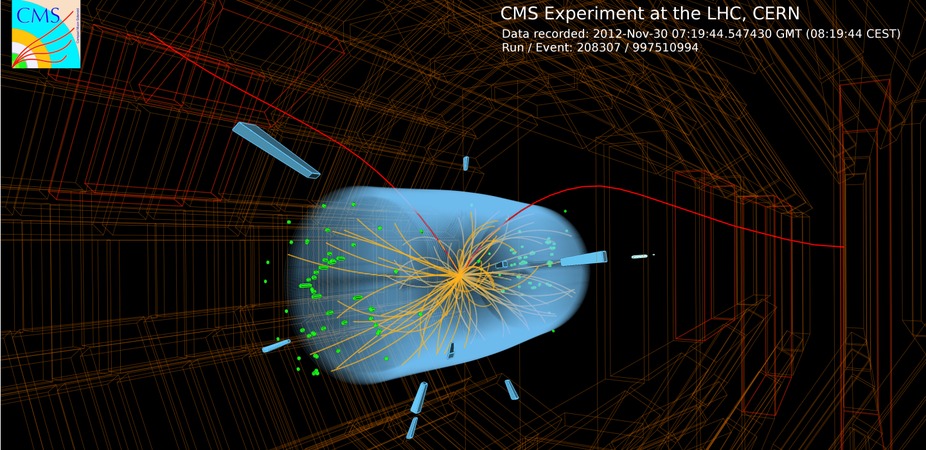
Muons, a type of lepton, shown being produced by the Large Hadron Collider. Credit: CERN
In addition, all three leptons and their neutrinos have an associated antiparticle (antilepton). For each, the antileptons have an identical mass, but all of the other properties are reversed. These pairings consist of the electron/positron, muon/antimuon, tau/antitau, electron neutrino/electron antineutrino, muon neutrino/muan antinuetrino, and tau neutrino/tau antineutrino.
The present Standard Model assumes that there are no more than three types (aka. “generations”) of leptons with their associated neutrinos in existence. This accords with experimental evidence that attempts to model the process of nucleosynthesis after the Big Bang, where the existence of more than three leptons would have affected the abundance of helium in the early Universe.
Properties:
All leptons possess a negative charge. They also possess an intrinsic rotation in the form of their spin, which means that electrons with an electric charge – i.e. “charged leptons” – will generate magnetic fields. They are able to interact with other matter only though weak electromagnetic forces. Ultimately, their charge determines the strength of these interactions, as well as the strength of their electric field and how they react to external electrical or magnetic fields.
None are capable of interacting with matter via strong forces, however. In the Standard Model, each lepton starts out with no intrinsic mass. Charged leptons obtain an effective mass through interactions with the Higgs field, while neutrinos either remain massless or have only very small masses.
History of Study:
The first lepton to be identified was the electron, which was discovered by British physicist
J.J. Thomson and his colleagues in 1897 using a series of cathode ray tube experiments. The next discoveries came during the 1930s, which would lead to the creation of a new classification for weakly-interacting particles that were similar to electrons.
The first discovery was made by Austrian-Swiss physicist Wolfgang Pauli in 1930, who proposed the existence of the electron neutrino in order to resolve the ways in which beta decay contradicted the Conservation of Energy law, and
Newton’s Laws of Motion (specifically the Conservation of Momentum and Conservation of Angular Momentum).
The positron and muan were discovered by Carl D. Anders in 1932 and 1936, respectively. Due to the mass of the muon, it was initially mistook for a meson. But due to its behavior (which resembled that of an electron) and the fact that it did not undergo strong interaction, the muon was reclassified. Along with the electron and the electron neutrino, it became part of a new group of particles known as “leptons”.
In 1962, a team of American physicists – consisting of Leon M. Lederman, Melvin Schwartz, and Jack Steinberger – were able to detect of interactions by the muon neutrino, thus showing that more than one type of neutrino existed. At the same time, theoretical physicists postulated the existence of many other flavors of neutrinos, which would eventually be confirmed experimentally.
The tau particle followed in the 1970s, thanks to experiments conducted by Nobel-Prize winning physicist Martin Lewis Perl and his colleagues at the SLAC National Accelerator Laboratory. Evidence of its associated neutrino followed thanks to the study of tau decay, which showed missing energy and momentum analogous to the missing energy and momentum caused by the beta decay of electrons.
In 2000, the tau neutrino was directly observed thanks to the Direct Observation of the NU Tau (DONUT) experiment at
Fermilab. This would be the last particle of the Standard Model to be observed until 2012, when CERN announced that it had detected a particle that was likely the long-sought-after
Higgs Boson.
Today, there are some particle physicists who believe that there are leptons still waiting to be found. These “fourth generation” particles, if they are indeed real, would exist beyond the Standard Model of particle physics, and would likely interact with matter in even more exotic ways.
For more informationm, SLAC’s Virtual Visitor Center has a good introduction to
Leptons and be sure to check out the
Particle Data Group (PDG) Review of Particle Physics.


/about/reconditionedpcs-56a1b4e85f9b58b7d0c1e399.jpg)


![The Standard Model of Elementary Particles. Image: By MissMJ - Own work by uploader, PBS NOVA [1], Fermilab, Office of Science, United States Department of Energy, Particle Data Group, CC BY 3.0](http://www.universetoday.com/wp-content/uploads/2016/05/Standard_Model_of_Elementary_Particles.svg_.png)


 Why do some animals have extravagant, showy ornaments -- think deer antlers, peacock feathers and horns on beetles -- that can be a liability to survival? Northwestern University researchers have a possible explanation for this puzzling phenomenon of evolution.
 Geologists have for the first time seen and documented the Banda Detachment fault in eastern Indonesia and worked out how it formed.
 Wives who have a romantic view of marriage are less likely to do volunteer work, leading their husbands to volunteer less as well.
 In a remote area of north-central Tanzania, men leave their huts on foot, armed with bows and poison-tipped arrows, to hunt for their next meal. Dinner could come in the form of a small bird, a towering giraffe or something in between. Meanwhile, women gather tubers, berries and other fruits.
 UBC researchers develop new method to test for antioxidants in chocolate
 Johns Hopkins investigators report that their analysis of a national database representing more than 1 billion emergency department visits shows that over a recent eight-year period, nothing much has changed in the rates of unsuccessful suicide attempts, or in the age, gender, seasonal timing or means used by those who tried to take their lives in the United States.
 Creative achievement can provide a buffer against being anxious about death, research from psychologists at the University of Kent shows.
 Researchers at Stockholm University and Brooklyn College have combined knowledge from the fields of artificial intelligence, ethology and the psychology of learning to solve several problems concerning the behaviour and intelligence of animals.
 NIBIB-funded researchers have used fast fMR Ito image rapidly fluctuating brain activity during human thought. fMRI measures changes in blood oxygenation, which were previously thought to be too slow to detect the subtle neuronal activity associated with higher order brain functions. The new discovery is a significant step towards realizing a central goal of neuroscience research: mapping the brain networks responsible for human cognitive functions such as perception, attention, and awareness.
 Whether Peter Paul Rubens or Damien Hirst – the personal taste of art can be argued. Scientists from the Faculty of Psychology of the University of Vienna have now shown that the individual taste of art is also dependent on social factors. The personal valuation of art was influenced by who else liked the work - or not. And even the value of a painting strengthened the subjective feeling of how much a work of art appeals to us. The study was recently published in the international journal "Psychology of Aesthetics, Creativity and the Arts".
 48 skeletons discovered in ‘Plague Pit’ – 27 of them children; Extremely rare discovery suggests community was overwhelmed by the Black Death
 In a new study, Columbia Engineering researchers looked at increasing trends in the severity of tornado outbreaks where they measured severity by the number of tornadoes per outbreak. They found that these trends are increasing fastest for the most extreme outbreaks.


