MITRA MANDAL GLOBAL NEWS

10 Really Cool Websites to Always Have Bookmarked


So you've got a question that Google can't answer, an interest that leaves you stumped on where to find out more, or a hankering for some good old fashioned entertainment. The internet is a treasure trove of digital gold, but knowing this doesn't do you any good if you don't know what's hiding in there.
Behold, 10 websites that might just be along the lines of what you were looking for. And if not, well, at least you'll have them (bookmarked hopefully) for future reference!

Lifehacker

lifehacker on laptop
Laptop: mama_mia / Shutterstock.com
A great blog for anyone looking to streamline their life, Lifehacker provides tricks and tips for getting stuff done. Whether you need tips to help with time management or a shortcut to completing a certain task, Lifehacker is a great site that can help you solve almost any problem. More »

Reddit

Reddit Alien
Photo made with Canva.com
Reddit is a social news site. Simply subscribe to threads based on topics of interest (or even your geographical location) to see the best user submitted topics rise to the top. You can contribute links to the community as well, plus choose to get involved with the discussions if you want. More »

SoundCloud

SoundCloud App
Photo made with Canva.com
If you're looking for some free music to stream while do you whatever you need to do, there's SoundCloud. This is a social music network where artists and producers of all types (amateur to professional) upload their musical creations for anyone to listen to for free. Build playlists, tune into stations and follow your favorite artists.More »

Product Hunt

Product Hunt
Photo © RobinOlimb / Getty Images
Want to be the first to know about the best new products and services that launch? Product Hunt is sort of like Reddit for entrepreneurs and creative people who want to promote their new tech products/services, books, games or podcasts. Like Reddit, you can get involved in the voting and discussions as well. More »

Vimeo

Vimeo
Photo © exdez / Getty Images
So, everyone knows that YouTube is the king of internet video, but Vimeoholds a special place in viewers' hearts — particularly for their beautiful full-length films, animated shorts, amazing documentaries and more. Vimeo is where cinematography really comes to life. If you want to watch something that will blow you away, start using Vimeo. More »

Quora

Quora
Photo © mattjeacock / Getty Images
Yahoo Answers has been the general go-to site to crowdsource answers to questions, but they're not always terribly useful, informative or even correct. Quora, on the other hand, has a much higher quality community of members with knowledge and expertise in every topic under the sun. Search for questions, create your own or offer your answers to others. More »

Rotten Tomatoes

Rotten Tomatoes
Photo © doodlemachine / Getty Images
Rotten Tomatoes is the place to go for everything movies and TV. It's particularly helpful in gouging whether something is worth watching, thanks to the reviews this site offers. In addition to that, you can also watch trailers, see what's hot right now, catch up on movie/TV news and more. It's basically a couch potato's dream come true. More »

IFTTT

IFTTT
Photo © DrAfter123 / Getty Images
IFTTT (If This Then That) is a web tool that allows you to connect the apps and internet services you use so that when you manually create an action on one app/service, it automatically generates an action on a corresponding app/service that you set up. It basically helps you cut down on manual tasks by automating them. Super useful if you use a lot of online tools. More »

Medium

Medium
Photo © DrAfter123 / Getty Images
Medium is a blogging/publishing website where lots of talented writers go to share their stories and to educate others willing to read their stuff. You can find everything there from opinion pieces and personal development hacks, to marketing advice and health tips. If you love to read really great stuff, get on Medium and start browsing your interests.More »

IMDb

IMDb
Photo © LPETTET / Getty Images
Here's another for the movie and TV loving couch potatoes. Or at least for those who can never remember actors' names. Similar to Rotten Tomatoes, IMDb is a popular source for entertainment news and information. One of the big advantages of having this site bookmarked is access all the celeb content. This is where you go to find out more about a particular celebrity.
Updated by: Elise Moreau More »

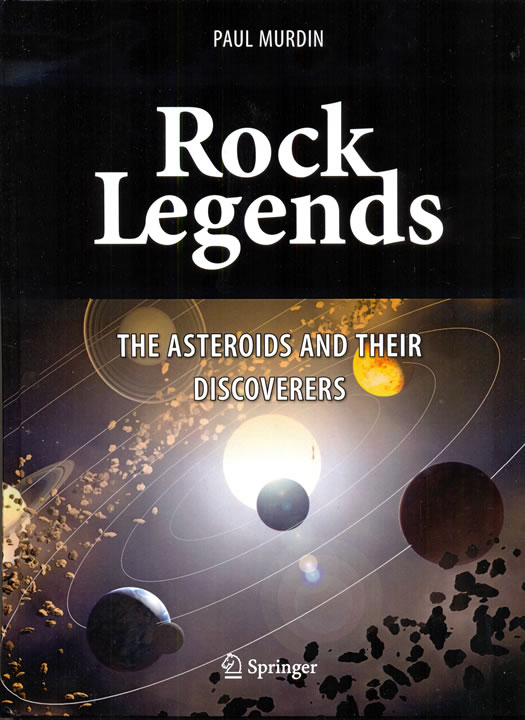
Rock Legends – the Asteroids and Their Discoverers

New post on Universe Today

Rock Legends – the Asteroids and Their Discoverers

by Mark Mortimer
If we are indeed stardust, then what will our future hold? And what happened to all that other dust that isn't in people or planets? These are pretty heady questions perhaps best left for late at night. Since the age of Galileo and perhaps even beforehand these inquisitive night goers have sought an understanding of "What's out there?" Paul Murdin in his book "Rock Legends – the Asteroids and Their Discoverers" doesn't answer the big questions directly but he does shed some capricious light upon what the night time reveals and what the future may hold.
rock-legends
We're pretty confident that our solar system evolved from a concentration of dust. Let's leave aside the question about where the dust came from and assume that, at a certain time and place, there was enough free dust that our Sun was made and so too all the planets. In a nice, orderly universe all the dust would have settled out. However, as we've discovered since at least the time of Galileo this didn't happen. There are a plethora of space rocks -- asteroids -- out wandering through our solar system.
And this is where Murdin's book steps up. Once people realized that there more than just a few asteroids out there, they took to identifying and classifying them. The book takes a loosely chronological look at this classification and at our increasing knowledge of the orbits, sizes, densities and composition of these space wanderers.
Fortunately this book doesn't just simply list discovery dates and characteristics. Rather, it includes significant amounts of its contents on the juicy human story that tags along, especially with the naming. It shows that originally these objects were considered special and refined and thus deserved naming with as much aplomb as the planets; i.e. using Greek and Roman deities. Then the number of discovered asteroids outpaced the knowledge of ancient lore, so astronomers began using the names of royalty, friends and eventually pets. Today with well over a million asteroids identified  setting a name to an asteroid doesn't quite have the same lustre, as the author is quick to point out with his own asteroid (128562) Murdin. Yet perhaps there's not much else to do while waiting for a computer program to identify a few hundred more accumulations of dust, so naming some of the million nameless asteroids could happily fill in some time.
With the identifying of the early asteroid discoverers and the fun names they chose, this part of the book is quite light and simple. It expands the fun by wandering a bit just like the asteroids. From it you learn of the discovery of palladium, the real spelling of Spock's name and the meaning of YORP.  Sometimes the wandering is quite far, as with the origins of the Palladium Theatre, the squabbling surrounding the naming of Ceres and the status of the Cubewanos. Yet it is this capriciousness that gives the book its flavour and makes it great for a budding astronomer or a reference for a generalist. The occasional bouts of reflection on the future of various asteroids and even of the Earth add a little seriousness to an otherwise pleasant prose.
So if you're wondering about the next occultation of Eris or the real background of the name (3512) Eriepa then you're into asteroids. And perhaps you're learning how to survive on a few hours of sleep so you can search for one more faint orbiting mote. Whether that's the case or you're just interested in how such odd names came to represent these orbiting rocks then Paul Murdin's book "Rock Legends – the Asteroids and Their Discoverers" will be a treat. Read it and maybe you can use it to place your own curve upon an asteroid's name.

Russia's revenge: Why Donald Trump's triumph is a big win for Vladimir Putin

A man passes by a graffiti mural by Lithuanian artist Mindaugas Bonanu depicting then-U.S. Republican presidential candidate Donald Trump (R) kissing Russian President Vladimir Putin on the wall of a barbacue restaurant in Vilnius, Lithuania, on August 4. Photo by VALDA KALNINA/European Press Agency
Where much of the world has received news of Donald Trump's election victory with shock, Russia has been quick to congratulate the president-elect. Moscow's motives for doing so predate the tycoon's decision to enter politics – perhaps by as much as two decades.
Their roots lie in the question: Who won the Cold War? After the fall of the Berlin Wall, and the subsequent collapse of the Soviet Union, there were two main views. One, the more conciliatory, held that everybody had. The nuclear standoff was over – so the world was a better place for all.
The second, more confrontational, insisted that the West had won. The West's superior resources – so this narrative ran – were a function of its superior system: liberal capitalist democracy. A system so far superior that the flagging planned Soviet economy and its military-industrial complex simply ran out of stream trying to keep up. It was a victory of ideas as well as wealth.
It was at this time that Francis Fukuyama wrote of "the end of history" – the idea that political and economic liberalism had triumphed. But what has followed has been anything but.
As a young TV news producer, I covered the end of the Soviet Union. In the years that came after, Western goods crossed into Russia in unprecedented quantities, while Western ideas were planted into politics and economics. As we now know, the latter only briefly took root before withering.
This was not always well understood in the West. My fellow foreign correspondents and I, living in Moscow in the 1990s – Russia's era of chaos and post-superpower humiliation – used to try to imagine the kind of politician who could re-energize Russia. At the end of the decade, we got our answer. Where other former Communist countries welcomed the leadership of former dissidents such as Vaclav Havel in the Czech Republic and Lech Walesa in Poland, Russia chose a former KGB officer, Vladimir Putin.
Putin rising
As his time at the top of Russian politics has gone on, Putin has largely removed the last dry stalks of the liberal ideas which had been sown in the 1990s. He has enjoyed a great deal of popular support as he has done so. The counsel of former Cold War foes was not always well-received – especially when it was seen as being to blame for the poverty which dominated that time.
Even a former British ambassador to Moscow, Sir Anthony Brenton, subsequently wrote of it as "inadequate financial support and insanely neo-liberal economic advice which produced economic chaos and collapse."
The successful Russian politician we Western journalists dreamt up as an answer to Russia's woes even had an imaginary slogan: "Order and sausage" – signifying the importance of a strong state and affordable, plentiful, food. Western liberalism didn't figure.
And so it has come to pass. Putin's genius as a politician has been to understand his electorate, and to give it – or more importantly to tell it – what it wanted. To Russia's men, he has been a tough guy, able to chat with workers and soldiers in their own language. To women, he has seemed organized and sober in a country plagued by alcoholism. Internationally, he has been taken seriously, even if not universally admired.
Now, a quarter of a century after the end of the Cold War, not only are Western ideas of liberal democracy gone from Russia, they are under unprecedented pressure in the West. Russia knows it. In the wake of Trump's election victory, Margarita Simonyan, the editor-in-chief of state broadcaster RT (the success of which I wrote about recently), tweeted that "people were fed up with aggressive liberalism. People were fed up with immigrants."
West in decline?
Having witnessed the failure of Western liberalism in Russia, I would now argue that Russia's political tactics are flowing westward. Trump's victory, Brexit, the rise of nationalist parties across the West – all of these are hammer blows to the edifice of liberal values. They are sinister echoes of those that pounded away at the Berlin Wall 27 years ago this week.
Having reported on several elections in Russia, the 2002 French election (when Jean-Marie Le Pen sensationally made it to the final round) and having written more recently about the possible consequences of Brexit, I would identify a common thread. Illiberal politicians have become highly skilled at articulating their electorates' fears in language they recognize. At this, liberals have failed. Their critics decry them as an out-of-touch elite.
So as we consider the implications of Trump's victory, let us also consider this: We may not have witnessed the end of history, but we may have witnessed the high point of liberal democracy.
James Rodgers is a senior lecturer in journalism at the City University of London.

The Alps are still growing, 18,000 years after the thaw of the last ice age

The Alps are still growing, and researchers say the relief offered by the end of the last ice age explains the uplift. Photo by Anthony Anex/EPA
BONN, Germany, Nov. 10 (UPI) -- New research suggests an ancient thaw explains the continued growth of the Alps.
During the latter half of the last ice age, some 18,000 years ago, the planet began to warm and the glaciers started melting. The pressure relief offered by the thaw continues to affect Earth's crust today.
With the weight gone, Earth's surface experiences forces of uplift. New analysis -- detailed in the journal Nature Communications -- shows 90 percent of growth in the Alps can be attributed to the aftershock of deglaciation.
Until now, scientists believed growth in the Alps could be explained by a variety of factors.
On older continents like North America, scientists agree almost all vertical tectonic shifts are caused by the "rebound effect." The case was less obvious in Europe, where mountains are younger and the reach of ice age glaciers was less extensive.
Many scientists suggested erosion was main cause of uplift in the Alps. But new models designed by scientists at the Helmholtz Association of German Research Centres suggest otherwise.
While other tectonic effects and erosion accentuate the rebound effect, they account at best for just 10 percent of the growth measured in the Alps. The rest, models show, is caused by the ongoing relief precipitated by the retreat and disappearance of the glaciers 18,000 years ago.

Energy Industry News

With election of Trump, Duterte changes mind on scaling back alliance with U.S.

Phillipine President Rodrigo Duterte, who has cursed U.S. President Barack Obama and threatened to end his country's alliance with the United States, embraced the election of Donald Trump as president, saying he no longer wants to cut off ties to the United States and that nearly cancelled military exercises between the two countries can continue. Photo courtesy Malacañang Photo Bureau
MANILA, Nov. 10 (UPI) -- The controversial president of the Philippines, who cursed U.S. President Barack Obama and announced his country's alliance with the United States was being scaled back, said he changed his mind about the relationship between the two countries after Tuesday's presidential election.
Philippine President Rodrigo Duterte said Wednesday he no longer wanted to scale back ties with the United States after the election of President-elect Donald Trump, suggesting their propensity to use vulgarity in public addresses could help ramp-up a better relationship than he has had with Obama.
"We both like to swear," Duterte said of Trump on Wednesday. "One little thing, we curse right away. We're the same."
Duterte made global headlines in September when he called Obama a "son of a bitch" and said he could "go to hell," and then weeks later said he was ending joint military drills with the United States.
Rather than cancel military exercises for the next year with the United States, as he'd announced would happen, Duterte said the election of Trump changed his mind and the exercises will continue as planned.
"I would like to congratulate President Trump," Duterte said. "Now we're here, I don't want to... fight because Trump is already there."
Duterte may already have a leg up on developing a positive relationship with Trump after naming the president-elect's business partner, Jose Antonio, the chairman of Century Properties Group, as an envoy to the United States for trade, investment and economic affairs.
Century Properties is building Trump Tower at Century City, a 57-story apartment building in Manila. Trump leased his name to the building for branding, however is not involved in development of the property.

Chinese, Russian law enforcement officials elected to head Interpol

Meng Hongwei, China’s vice minister of public security, has been elected as the new Interpol president. Photo courtesy of Interpol
BALI, Indonesia, Nov. 10 (UPI) -- Chinese and Russian law enforcement officials were elected Thursday to head the international police organization Interpol, sparking fears the appointments will bolster human-rights violations and efforts to track down political dissidents who have fled China.
China's Meng Hongwei and Russia's Alexander Prokopchuk were elected president and vice president, respectively, and assumed their posts immediately after the election. Meng, a former head of Interpol China, is the first Chinese official to be Interpol president. Prokopchuk, head of the Interpol National Central Bureau in Moscow, is the first Russian to be elected Interpol vice president.
Meng, taking the reigns from Mireille Ballestrazzi of France, said he plans to continue the tradition of global policing, with an eye on making changes based on current situations.
"We currently face some of the most serious global public security challenges since World War II," he said.
Amnesty International said the election of a Chinese law enforcement official could strengthen the country's quest to track down and punish those considered political dissidents, including some who have been granted asylum in other countries.
"This is extraordinarily worrying given China's longstanding practice of trying to use Interpol to arrest dissidents and refugees abroad," Nicholas Bequelin, regional director for East Asia Amnesty International, said.
Interpol is made up of law enforcement from 190 member countries in an effort to fight international crime, including terrorism and cyber crimes.

German train operator playing with smartphone in crash that killed 12, lawyers say

Accused train dispatcher Michael P., whose face is blocked due to German privacy laws, sits between his lawyers Thilo Pfordte (R) and Ulrike Thole (L) in the court room at the regional court in Traunstein, Germany. Michael P. is accused of negligent killing. The railway employee is alleged to have misaligned signals and played on his smartphone shortly before the fatal head on collision of two trains. Photo by Peter Kneffel/European Press Agency
BAVARIA , Germany, Nov. 10 (UPI) -- A German train operator told a courtroom Thursday he caused a crash that killed 12 passengers because he was distracted by a game on his mobile phone and activated the wrong signals that caused two trains to collide.
Michael Paul, 40, said he was playing Dungeon Hunter 5 on his phone when he activated signals that allowed two trains on to a single-track line. He then dialed the wrong emergency number to notify the other train of the impending collision on Feb. 9 near Bad Aibling, Germany. Twelve people, all men between the ages of 24 and 59, died in the crash and 89 other passengers were injured.
Paul, accused of involuntary manslaughter, apologized through his attorney to the victims and their families. His attorneys said he admitted to playing the game while on duty, which is banned by the railway.
"I know that I cannot undo what has happened, even if I wish I could," he said.

Driver of south London tram that crashed, killing 7, arrested

British Transport Police Assistant Chief Constable Robin Smith, seen here addressing the media on Wednesday, said the driver of the tram that derailed and overturned has been arrested on suspicion of manslaughter. Authorities are attempting to determine whether the driver fell asleep, as well as "a number of factors." Photo courtesy of British Transport Police
LONDON, Nov. 10 (UPI) -- Authorities have arrested the driver of the tram that derailed and overturned in the town of Croydon, killing at least seven people, London officials said.
The 42-year-old driver from Beckenham has been arrested on suspicion of manslaughter. British Transport Police said officials are investigating whether he fell asleep before the derailment that injured more than 50 people.
Robin Smith, assistant chief constable of the British Transport Police, said authorities are investigating "a number of factors," as well as whether he fell asleep.
"We can confirm that at least seven people have lost their lives as a result of this incident," British Transport Police Deputy Chief Constable Adrian Hanstock said. "Our officers will continue to work tirelessly throughout the evening to formally identify them and provide care and support for their families."
The train was traveling at a "significantly higher speed than is permitted," the Rail Accident Investigation Branch said. Wednesday's tram incident is believed to be the first in England to involve fatalities aboard since 1959.
"Everyone just literally went flying," Martin Bamford, who was aboard the train and sustained broken ribs, told The Guardian. "It was just terrifying. There was a woman that was on top of me ... I don't think she made it at all. She wasn't responsive. There was blood everywhere."
Bamford said he asked the tram driver if he was OK.
"He said: 'Yeah.' I said to him, 'What happened?' He said he thinks he blacked out," Manford said, adding that he recalls the tram was speeding up prior to the incident.
The first victim of the tram incident has been identified as 19-year-old Dane Chinnery, who was described as "a beautiful lad" by a family friend.

Ultralight aircraft crash in northern Florida kills two

The crash of an ultralight aircraft Wednesday in Putnam County, Fla., killed two people. Screenshot from WJAX-TV, Jacksonville
CRESCENT CITY, Fla., Nov. 10 (UPI) -- The crash of an ultralight aircraft in rural Putnam County, Fla., killed the two people on board, police said.
The pilot, Thomas Stevens, 67, of Crescent City, and passenger Joe Fyock of Orange City died when the plane struck a grove of trees near the town of Crescent City on Wednesday. They were the only people aboard the small aircraft.
Officials described the plane as a homemade, experimental ultralight plane, with wings of canvas-like material.
Gordon Bolay, who was working on a nearby farm Stevens managed, told WJAX-TV, Jacksonville, "We heard an explosion. We looked up and saw the airplane, the aircraft, whatever you want to call it, has exploded, and as soon as we saw that, we all got into the trucks [and] came down to the area where we saw it go down."
The accident remains under investigation.

Protesters shut down highway, burn effigy in reaction to Donald Trump win

Demonstrators gather during a protest against President-elect Donald Trump outside the City Hall building in Los Angeles on Wednesday. Thousands filled the streets of downtown area of Los Angeles to march against the Trump presidency. Photo by Eugene Garcia/European Press Agency
WASHINGTON, Nov. 9 (UPI) -- Protesters in Los Angeles, New York, Chicago and other cities blocked the entrances to Trump Tower and other properties owned by President-elect Donald Trump, airing fears about policies endorsed by him during the campaign.
Thousands of people took to the streets to protest Trump's electoral win over former Secretary of State Hillary Clinton. Demonstrators took to the streets in the early hours Wednesday on the West Coast soon after Trump's victory was announced, and continued throughout the day and night across the country.
Even before the election was officially called for Trump, activist and advocacy groups, and supporters of former Secretary of State Hillary Clinton, took to the Internet and streets expressing concern about the president-elect's proposed policies on immigration, reproductive rights, health insurance and the environment, among others.
"We are making noise. We are telling Donald Trump that we don't like that he's here. I feel like we're doomed. This can't be real," one activist told KGW- TV.
In Chicago, protesters marched down North Michigan Avenue toward Trump Tower, where they gathered, blocking the entrance to the building and shouted "Not my president," "Racist, sexist, anti-gay! Donald Trump must go away!" and "[Expletive] your wall!"
Many in the crowd, some with children, said they felt it was the only thing they could do in reaction to Trump's election and their concern about some of his proposed policies.
"The president is supposed to be a role model for children and somebody that they look up to. I feel like if I stand by my values, I can't be quiet for the next four years. I have to be a role model if our president won't be," said Kathryn Schaffer, a protester who brought her 3-year-old daughter with her.
On the campus of American University in Washington, D.C., a flag was burned. At least 10,000 people protested at multiple locations in New York City, virtually shutting down Midtown. Protests also occurred in Pittsburgh, Portland, Nashville and Austin, Texas.
Many of the protesters shared a sentiment of fear about the direction of the country.
"The question on the minds of these people is if Trump will govern the way he campaigned," Andrea Gillespie, a political scientist at Emory University, told NBC News. "He's said a lot, but without a track record, it's unclear what he will actually do."

Mitra-mandal Privacy Policy

This privacy policy has been compiled to better serve those who are concerned with how their  'Personally Identifiable Inform...