| Renewable | |
| • | Renewable energy upsetting power eco-systems |
| • | Renewable energy, electric cars to boost copper demand |
| • | Inox Wind net profit dips 40 per cent in Q2 |
ETEnergyworld.com

This Land Is Not Your Land
| |||||||
|


Chinese buy world's largest mining project
Africa's iron mountains
World number two miner Rio Tinto is exiting the world's largest mining project, by selling its stake in Guinea's Simandou iron ore to partner Chinalco, potentially opening up a new path to development for the $20 billion project.
According to a statement by Melbourne-based Rio the deal is worth between $1.1 billion and $1.3 billion payable when Simandou starts commercial production and based on output. Rio says a final agreement could be inked within six months. In February this year Rio wrote down the value of Simandou by $1.1 billion, before deciding to shelve the project.
Rio owns 46.6% of Simandou south; Chinalco's stake is 41.3% and the Guinea government holds 7.5%. Earlier this month the World Bank's financing arm – the International Finance Corporation – sold its its 4.6% interest.
With complete control, Beijing-based Chinalco may revive the stalled project with the backing of the Chinese government
Rio has already spent more than $3 billion on the project having first acquired the property in the late nineties. With complete control, Beijing-based Chinalco may revive the stalled project, no doubt with the backing of the central government. In September Chinalco took private its Hong Kong listed mining arm, primarily focused on copper.
China consumes more than 70% of the world's seaborne iron ore and is on track to import one billion tonnes of the steelmaking raw material this year. Imports have gradually displaced domestic production, pushing dozens of Chinese iron ore mines into bankruptcy.
The shelving of the project has been devastating news for Guinea. Simandou by itself would've been the world's fifth-largest producer at 95 million tonnes per year.
Simandou with over two billion tonnes of reserves and some of the highest grades for direct-shipping-ore in the industry (66% – 68% Fe which attracts premium pricing) has a back-of-the-envelope calculation value of more than $110 billion at today's prices.
The initial agreement signed in May 2014 called for a new 650km railway across the West African country to Conakry, Guinea's capital in the north, plus a new deep water port at a conservatively estimated cost of $7 billion; infrastructure investments that would double the economy of the impoverished country.
The impoverished nation, which was one of the worst affected country's by the recent Ebolo epidemic, and is in dire need of infrastructure to develop other parts of the industry, particularly the export of bauxite, the primary ore used to manufacture aluminum. Bauxite represents some 80% of the country's export earnings. Chinalco is primarily an aluminum manufacturer.
Simandou's chequered history
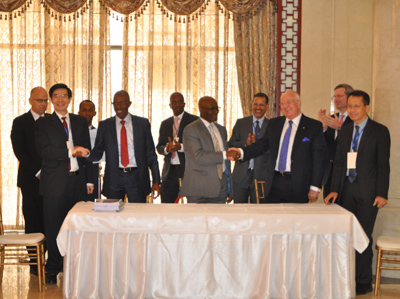
Simandou investment framework signing ceremony May 2014
Rio Tinto held the licence for the entire deposit since the early 1990s, but was stripped of the northern blocks in 2008 by a former dictator of the country.
BSG Resources, a company associated with Israeli diamond billionaire Beny Steinmetz acquired the concession later that year after spending $160 million exploring the property.
In 2010 BSGR sold 51% to Vale for $2.5 billion. The Rio de Janeiro-based company stopped paying after the first $500 million after missing a number of development milestones. Then the new Guinean government under Conde launched a review of all mining contracts awarded under previous regimes and launched an investigation into the Vale-BSGR joint venture.
The Guinea government withdrew the mining permit in April last year, accusing BSGR of obtaining its rights through corruption. BSGR has denied wrongdoing and filed an arbitration request in an attempt to win compensation from the Western African nation.
Shortly after BSGR's rights were stripped Rio filed a lawsuit for billions of dollars against both Vale and BSGR in New York courts for what it called a "steal" of its previously-owned concession. Rio alleged BSGR paid a $200 million bribe to Guinea's former minister using funds from Vale's initial payment.
The US district court threw out the case in November last year saying Rio "had waited too long to file the lawsuit" under the Racketeer Influence and Corrupt Organizations Act, which calls for a four year time limit.
Russian Foreign Ministry: Pictures of attacked school in Idlib are 'computer graphics'
MOSCOW, October 28 /TASS/. The photos of an attacked school in Haas village, the Idlib province, have turned out to be computer graphics, Russian Foreign Ministry Spokeswoman Maria Zakharova wrote on her page in Facebook on Friday.
"An expert analysis of the photos of the Haas village in Syria revealed that there had been no air strike at the local school and that there had been no casualties. The photos are the products of computer graphics, and the killed schoolchildren are a horrible fantasy of ‘activists’ from Al-Jazeera and The Independent," Zakharova stressed.
Zakharova recalled what French Foreign Minister Jean-Marc Ayrault had told a news conference a day earlier on Thursday. He said that either Moscow or Damascus were to blame for the school attack in the Hass village in Idlib province. "Who is responsible? Anyway, it is not the Syrian opposition because it does not have the planes necessary for delivering air strikes. It is either the Syrians - the Syrian president’s regime or the Russians," the Russian diplomat quoted Ayrault as saying.

"Decent people usually present their apologies in such cases. So we will see," Zakharova stressed.
Earlier the United Nations Children’s Fund (UNICEF) reported two new school attacks in Syria, including in Idlib province, where 28 people died. UNICEF Executive Director Anthony Lake said that five schools had been attacked in Syria less than in three weeks.
Vitaly Churkin, Russia’s Permanent Representative to the United Nations, described the school attack in Haas village as horrible while Russian Foreign Ministry Spokeswoman Maria Zakharova said Russia had nothing to do with the incident.
Video footage of an alleged airstrike published in foreign media is doctored up, it is more than ten separate fragments assembled together, Russian Defense Ministry spokesman Igor Konashenkov said on Thursday.
To check information of the United Nations Children’s Fund (UNICEF), the Russian Defense Ministry has thoroughly analyzed all data recorders monitoring the air situation in the northern part of Syria.
More:
http://tass.com/world/909535
Russia does not plan to ratify Paris Agreement on climate earlier than 2020 — minister
MOSCOW, October 28. /TASS/. Russia does not plan to ratify the Paris Agreement on climate before 2020, Minister of Natural Resources Sergei Donskoi told reporters on Friday.
"Risk assessments were performed and the conclusion was made that we have time. Plans that Russia will ratify the agreement not earlier than 2020 remain in force for the time being," the Minister said.
The Paris Agreement will succeed to the Kyoto Protocol expiring in 2020.
Russia will ratify the Paris Agreement aimed at combating global climate changes not earlier than 2019 or 2020, adviser to the President Alexander Bedritsky told TASS in June.
Kremlin: Russia may use all available means against terrorists in Aleppo

SOCHI, October 28. /TASS/. Russia reserves the right in case of emergency to use all available means to counter terrorists’ provocations in Aleppo, Kremlin spokesman Dmitry Peskov said on Friday.
The Russian presidential spokesman thus commented on an address by Russia’s General Staff to the supreme commander-in-chief on the issue of resuming air strikes on east Aleppo.
"Considering that terrorists have announced the planned intensification of combat actions and also that they have really switched partially to active offensive operations, the Russian president proceeds from the fact that in case of emergency the Russian side reserves the right to use all available forces and resources to counter the terrorist groupings’ provocative actions and provide due support to the armed forces of the Syrian Arab Republic," the Kremlin spokesman said.
Resumption of airstrikes on Aleppo 'inexpedient'
Putin believes that a resumption of airstrikes on the Syrian capital of Aleppo would be inexpedient, Peskov said.
"The Russian president believes that it would be inexpedient at the moment to resume airstrikes against Aleppo," Peskov told journalists.
"The president believes that it would be possible to extend the ongoing humanitarian pause for the withdrawal of wounded people and militants wishing to leave the city as well as most importantly to give our American partners a chance to implement earlier assumed obligations and made promises on separating the so-called moderate opposition from terrorist groups," Peskov added.
READ ALSO
Putin’s spokesman also said that the Russian president pointed out to the country’s right to reserve its help to the Syrian government military forces "using all means and at a proper level considering recent statements made by militants on their intentions to step up military actions."
Peskov said that "decisions regarding further (Russia’s) actions will depend on the unfolding developments."
Vladimir Putin will make strategic decisions on the Russian operation in Syria while the General Staff will be in charge of operational command.
"The General Staff will certainly be in charge of operational command but as for the setting of strategic tasks and the adoption of strategic decisions, they will certainly be set and made by the (Supreme) Commander-in-Chief of the Russian Armed Forces," Peskov told journalists when asked who would make a decision on ending the humanitarian pause in Aleppo and on other Russian military activities in Syria.
Peskov said that the president would "make decisions on further actions dependent on the situation." He hesitated to say if the decisions would be announced in advance or not. According to him, that will depend on expediency of preliminary announcements.
Peskov explained that the General Staff stance and information received directly from Syria would be taken into account in making those decisions.
Pause in force only in Aleppo
Russia’s military have halted air strikes on terrorists in Syria only in Aleppo, Peskov noted.
"The humanitarian pause is in force only around Aleppo," Peskov said.

Peskov said it was difficult to set a deadline until which Russian President Vladimir Putin would extend the humanitarian pause in Aleppo.
"The deadline was set ages ago. Unfortunately, in spite of the fact that all deadlines had been missed, our American counterparts failed to fulfil the promise," Peskov said.
When asked how long Putin was ready to wait before ordering to resume bombardment of terrorists in Aleppo, the presidential press secretary answered, "I am unable to give a precise answer to your question."
"The top priority task, from the point of view of the president, is evacuation of the wounded and safe exit for the militants who wish to leave the city," he said.
New Russia-US contacts on Syria
According to Peskov, there are no plans for another contacts on the recent developments in Syria between the Russian and the US presidents, Vladimir Putin and Barack Obama, in the near future.
"No, there is no such plans," the Kremlin official said.
When asked if Russia had notified the US of the decision to extend the humanitarian pause in Aleppo, the Kremlin spokesman answered that "information is exchanged via operative military channels."
"I cannot give you a detailed answer now whether this decision has gone through to the US counterparts or not but regular exchanges of information are being carried out," he added.
No Russian Federation to the UN HRC will not have positive effects

MOSCOW, Oct. 28 -. RIA Novosti Absent Russia in the UN Human Rights Council will not have positive effects, said State Duma deputy from the Communist Party, Leonid Kalashnikov, specializing in international issues.

Russia on Friday in a vote in the UN General Assembly has not received enough votes for election to the UN Human Rights Council.
"These are consequences of the last days, months, years, or even when trying to do in Russia for a scarecrow, do the judgment seat," - said the Kalashnikov.
He recalled that once the Soviet Union was expelled from the League of Nations. "The UN and the HRC are gradually rolling down this path they should remember these sad results when an exception is the great nations and the denial of their right to their own opinion, ultimately only leads to one-sidedness and rolls of humanity for war." - Said the deputy.
At the same time, he expressed the hope that "people have enough memory and the realization that this can not be done."
Pedestrian killed in bomb attack targeting Egyptian police in Cairo
|
Nepal to revive textile factory established with Chinese assistance after 15 years
KATHMANDU, Oct. 28 (Xinhua) -- The Nepali government on Thursday announced that it was going to revive the closed Hetauda Textile Factory which established with the Chinese assistance in 1976.
The state-owned factory, located at Hetauda town in southern Tarai, has remained closed since 2001 as it could not compete with cheap imported textiles and mismanagement on the part of the government. Prior to the closure, the factory used to consume 1,200 tons of cotton and was employing about 1,200 people.
Nepalese Industry Minister Nabindra Raj Joshi announced at a press meet in Kathmandu that the state-owned factory would be brought into operation with a joint investment of the Nepali government, Nepal Army, Armed Police Force and Nepal Police. "The action plan for resuming the operation of the factory will be prepared within the next 15 days," he said.
The minister said that the government planned to manufacture textiles necessary for dresses of students, security agencies and the civil servants in the first phase.
According to the Industry Ministry, there will initial investment of 0.93 million U.S. dollars to revive the factory. The government plans to create a fund of 2.33 million U.S. dollars to run the factory in a full-fledged way.
The resumption of the factory's operation is expected to reduce the cost of importing textiles for the government staffers working in state agencies which is over 18.6 million U.S. dollars a year, according to the Industry Ministry.
|
Subscribe to:
Posts (Atom)
-
Authentic news,No fake news. ISLAMABAD, Mar 28 (APP): Economic Coordination Committee of the Cabinet (ECC) approved on Tuesday the exp...
-
Authentic news,No fake news. Alejandro Casas’s electric taxi, which he drives in Montevideo, cost him 63,000 dollars, but he was given...
-
Authentic news,No fake news. MARCH 19, 2017 Syria war: 'Worst man-made disaster since World War II...
-
Authentic news,No fake news. Big Story Read with synopsis President bats for simultaneous polls India, UAE ink 14 pacts in ...
-
Authentic news,No fake news. By Celeste McGovern LifeSiteNews 31 May 2021 All Global Research articles can be read in 51 languages by act...
-
Authentic news,No fake news. WASHINGTON (AP) — President Joe Biden is confronting the political risk that comes with grand ambition. As one...


