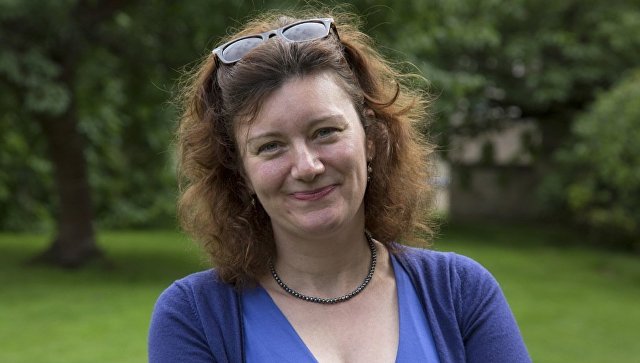
MOSCOW, Oct. 9 - RIA Novosti . Turi King, one of the trailblazers of the remains of Richard III of, told RIA Novosti on the new mysteries of the last medieval king of England, about the unusual discovery that could shake the royal line of the UK, and shared her thoughts on what other historical figure she would like to find and study .
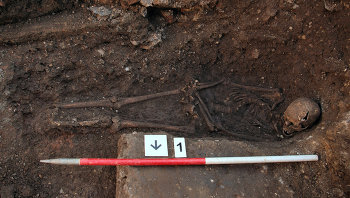
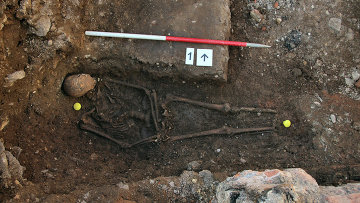
Turi King and a number of archaeologists, historians, experts in the field of genealogy and other sciences made four years ago, one of the most important archaeological discoveries of this century. They were able to discover the remains of Richard III Plantagenet, the last monarch of medieval England, under the municipal parking of Leicester, the city, next to which Richard was killed in 1485 in the Battle of Bosuortovom field.
The remains of the monarch and his DNA confirmed their authenticity, have helped scientists to figure out what to eat, Richard, what diseases he suffered, where he lived at different periods of his life and how he was buried. All this Dr. King told within lectures, which she read Lomonosov Moscow State University University within the framework of the festival Science 0+.
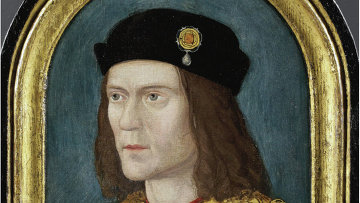
- When we talk about Richard, we always think about Shakespeare. Your findings and interpretation of DNA helped us first look at him, he looked like in reality. Did you use other genetic data, in addition to the color of eyes and hair, for example - genes chin length or shape of the face in the reconstruction of his appearance, and whether a complete reconstruction of the body on the basis of DNA analysis is planned?
- No, we have not studied yet, and did not use the data. In our first studies we were able to find only the color of eyes and hair, and when Caroline (Wilkinson, professor at the University of Dundee) made the reconstruction, she dabbed a special effort to forget the portraits of Richard of the National Gallery, who remembers every Briton, when someone -That starts talking about the king.
On the other hand, we are now completing work on deciphering the complete genome of Richard, and all the data that we have received or will get, will be published on the web, and anyone will be able to study them. Now we are learning more and more about the genes that control the shape of the face, and the public will know the genome of the monarch, which had exactly the shape of the face Richard.So far, unfortunately, there are no such data.
If we talk about the complete reconstruction of the body, there is a need to realize that genes work affects not only their design, but also the environment in which their owner lives. Therefore, genetic data will never give us a complete and accurate picture of how someone looks - and the growth of many other human characteristics are highly dependent on diet and other things not related to genetics.
In addition, a complete reconstruction can prevent that Richard actually missing the lower part of the legs, which was accidentally severed the builders back in the Victorian era. We conducted a large-scale excavations in the following summer, after we discovered the remains of Richard, all the time trying to find underground "extra pair of legs", but we found nothing. So Richard is legless. Of course, we can hope that they will find ever, but we could not do that.
On the other hand, the anatomy of his feet indicates that his feet were normal, although he was rather slender, but not stocky man, but, however, it is unlikely to hobble and limp, as Shakespeare wrote.
- Let's go back to Shakespeare - what do you think, why the playwright has decided to portray Richard gloomy hunchback and lame, "lopsided toad" extremely ill-tempered?
- It should be noted that a small grain of truth in the form of "hunchback" is still there - as we know, Richard suffered from scoliosis, his spine was twisted to one side.Negative same traits can be explained by the political realities of the time.
Tudors, defeating Richard ended the Plantagenet dynasty, and they probably would not have allowed someone to say "Richard was a good guy, and we killed him and seized power." They arranged for a different narrative - "Richard was bad, we had to kill him and take power into their own hands."
The remains of King Richard III, was found during excavations in the city of Leicester
So Shakespeare, who lived in England during Tudor times, not quite logically began to portray it as a positive character, as embodied in it all the rumors that have walked at that time - he "embellished" Richard withered hand and the limbs of different lengths, and other things that They are traditional attributes of the evil characters. Many of these features, of course, could be elements of propaganda on the part of the Tudors.
- That is, Shakespeare could be punished if he tried to reveal Richard from all sides?
- Of course, I'm not a historian, but I believe that this was quite real in the circumstances of the time. Queen Elizabeth certainly not have been so treated favorably to Shakespeare, if she knew that he was "denigrating" the memory of her grandfather.
- In March last year, Richard was buried with great honors in the Cathedral of Leicester, whether it is right from the point of view of science, given the importance of his remains for geneticists, historians and other scholars, and such issues should be solved Richard relatives or people of the whole country?
- In this case, the decision on the burial of Richard was not taken relatives - has long been the vital idea in England that his remains will be buried intact. New methods of DNA analysis at all times and bones appear, and if we will have new questions to which these techniques could answer, then you can think about it again, removing the remains, but it will need a very good reason.
I understand why Richard was re-buried - generally in the UK to re-found the remains are buried again. In fact, everyone knew that Richard's bones will be re-buried in the cathedral, and no scandals about this did not occur.
For me as a scientist, this situation was interesting in that it has changed the way we work. Usually in such cases it is often a situation arises where the reviewers are asked to carry out repeated experiments, or to supplement them by studying the remains, but in my case I can not do this, as the remains of Richard were already buried.
In March last year, when I returned his remains, I am often plagued by doubts and regrets during those moments when I thought about what I might be asked to examine or clarify one point or another, and so I had a good time to anticipate all the issues that could would be the publication of our research. We had a lot of effort to ensure that complete all the studies before Richard will again be buried.
- As far as ethical in terms of academics and relatives of Richard disclosure of genetic data associated with the disease, and other personal belongings?
- All our work is passed through the ethical review system. We, of course, moved scientific interest - me, for example, were interested in genes that are associated with the development of scoliosis. Recently, our colleagues have opened two sites in the DNA that are associated with the development of this disease, and it was very interesting to learn what, if Richard has mutations in these parts of the genome.
Such information is invaluable - any information about these mutations can tell us how much genetics influences the development of these diseases, not only today but also in the past.
What is interesting, now I am studying the DNA of the monks, who were buried in the cemetery of the abbey in the north west of England. Many of them suffered from Paget's disease, the development of which the bones begin to deform properly grow and resemble the structure airy chocolate. If it affects the skull, the bones begin to grow inward and compress the brain.
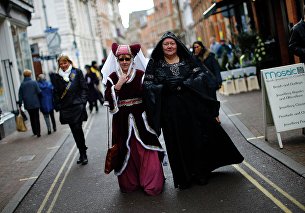
Women in fancy dress after the ceremony of reburial of King Richard III in Leicester
Recently, one of my colleagues from Nottingham discovered a gene associated with the development of this disease. I was curious, and I checked that it is these monks. It turned out that they did not have this version of the gene, which indicated that in the development of Paget's disease may be to blame, and other areas of the genome that we are now looking into the DNA of the inhabitants of medieval England. Thus, the study of ancient DNA helps us to reveal the roots of today's illnesses.
As for Richard, of course, I asked permission to family members of Richard - Michael (Ibsen) and Wendy (Daldig) enthusiastically participated in our studies, they were very interested in the fact that science can tell us about the past.
- Two years ago you went to an article published on the extraordinary differences in the DNA of the Tudor and Richard, have been able to clarify something on this issue? Were you able to find traces of Richard's illegitimate children, if they were?
- Unfortunately, nothing new is learned. We know that his son Richard was killed by Henry Tudor and his daughter died - we know that she was married to a gentleman, who in a few years after the wedding, visited one of the social events, where it was recorded as a "widower". She died, and left no children.
The only "official" son Richard died in 11 years, and therefore we can say that he left no direct descendants, at least those we know. All the modern relatives of Richard are the descendants of his brothers and sisters. All this has been obtained based on the Y-chromosome and mitochondrial DNA research. Genome-wide studies do not give us the answer to this question, because it took too many generations, the genomes of too much "mixed" so we do not find Richard's illegitimate children and their descendants.
- Whether the DNA will help Richard to reveal other secrets of this age - for example, to examine why the Yersinia pestis caused the terrible epidemic, "Black Death", a century before the birth of Richard?
- The full genome of Richard, which we are now preparing for publication, will be available including for such studies. Anyone who is interested in this issue, or, for example, the frequency of cancer among medieval Europeans will be able to clarify for myself this question.
Despite all the progress in recent years, so we do not know much about the structure and operation of the DNA. For example, we do not know exactly which genes influence the development of heart disease and blood vessels - we know only a part of them, and the ancient genomes will help us uncover other genes. It is not part of my personal research interests, but one that definitely will - that's the beauty of science. After 10 years, I and my children would be interesting to know which genes are affected by these diseases and other problems, and whether it is predisposed to Richard.
- The remains of Richard gave us rich information about how ate, drank monarch, where he lived, from which he suffered, and several other important historical information that just are not stored in the chronicles. How important are such multidisciplinary research?
- If you have money for it, of course, such research is carried out. Excavations Richard were unusual in this respect - usually archaeologists simply can not use these additional methods for the study of cultural monuments. We had such an opportunity, and we used everything we could think of - radar, DNA analysis and other techniques. In a sense, we are very lucky that Richard literally fell upon us, and that we were able to study his remains.
- Over the past 5 years we have found Richard, Philip II of Macedon, and learned many new things about their appearance and life. Who else would you find a famous historical figures? Or, for example, whether you can solve the mystery of the birth of King Tut, if it is found the tomb of Nefertiti and her remains, as is often said today Egyptologists?
- Speaking of Nefertiti - is unlikely to be possible, as this would require the DNA of her parents and all her relatives. The same applies to Philip II - requires a broader set of genetic data. Individual genomes can reveal only some individual features of their appearance - the same color of eyes or hair, their origin and the like. For larger studies, similar to our projects with Richard III of, it requires a different set of data.
As for the other well-known figures from history - I do not know if we can ever find the answer to this question, but it is believed that Richard had ordered to kill his nephews, the sons of Edward IV of, imprisoned in the Tower of London. In the 1700s, as the other legend, their remains buried in the castle, were found during the restoration of the stairs.
Builders allegedly threw them in the trash heap, but then realized that they could belong to the prince. These remains, along with chicken bones and other debris have been collected and poured into an urn, which now stands at Westminster Abbey. Of course, they will never know for study confirms that killed them was Richard, but a comprehensive study of these bones, including their DNA analysis, radiocarbon dating and other things will help clarify the situation.
For example, the dating show, whether they lived in the time of Richard and were generally Romans, isotopic analysis will tell us about their diet, and DNA will help to clarify whether they are relatives or not Richard.
These plans have two problems. The first is bureaucratic - for this dream I somehow have to overcome two obstacles - the Queen of Great Britain and Chapter of Westminster Abbey. The second is that I would like to spend such a study only if about it will not know the press!
Press a "crushed" us with their attention during excavations Richard - journalists are constantly calling me and trying to elicit from me the results before we wanted to hold a press conference. Eventually I just stopped responding to calls, and ran out of the office to another room at the opposite end of the university, and no one knew that I am there and work. Even my friends were constantly coming and asked if I was able to prove that it is "he", and many were offended when I refused to speak.
And it seems to me that the study of the DNA of children Edward will attract even more media attention. In general, such projects are best done in silence, without much attention from the outside, and then explain to the media that we have discovered and how it is done.