MITRA MANDAL GLOBAL NEWS

Italian General praised the results of the US operation in Afghanistan


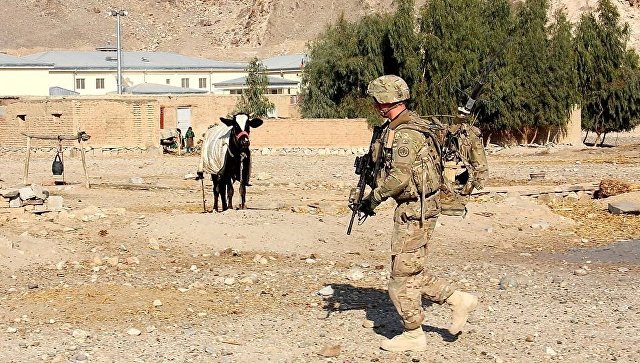
US Army soldier in the Nangarhar province of Afghanistan
ROME, Oct. 7 - RIA Novosti, Natalia Shmakov. One can not assess the operation "Enduring Freedom", launched by the US in Afghanistan 15 years ago, because on the one hand, the invasion of Afghanistan did not help combat terrorism, on the other hand - in this country have government, own army, as well as the social and cultural growth, according to an Italian general, the analytical institute president of ICSA Leonardo Tricarico (Leonardo Tricarico).
The US military in Afghanistan.  Archival photo
Rise and Fall of "Enduring Freedom": 15 years of US operations in Afghanistan
"We went into Afghanistan to root out terrorism, and, unfortunately, today we can see the extent to which we have succeeded," - he told RIA Novosti Tricarico.
According to him, despite the fact that Osama bin Laden has been eliminated, and with it lost influence the terrorist organization "Al Qaeda", the periphery of European cities "inundated" by terrorists, who are both originally from the Middle East, and European citizens, and also many "veterans returning from combat zones."
"If the enemy was then the only terrorism, the invasion of Afghanistan has significantly worsened the situation, and especially here in Europe. At the same time any encouraging prospects for the coming years there is no idea of ​​how to get out of this situation" - the general said.
However, in his opinion, there is a positive outcome of the 15-year-old Western presence in Afghanistan.
"Afghanistan now has its own army, the government, even if it is not perfect, social and cultural growth and my country, Italy, is proud to have made a significant contribution to it.", - Concluded the agency.
US military operation and its allies in Afghanistan began October 7, 2001. It was held in the framework of "Operation Enduring Freedom" (Enduring Freedom), launched in response to a terrorist attack September 11, 2001.
US Army soldier in Afghanistan.  Archival photo
Expert: US operation in Afghanistan has led to the strengthening of the Taliban
The reason for the introduction of the US and UK troops in Afghanistan served as a UN Security Council resolution №1368 from September 12, 2001.
In addition to anti-terrorism efforts in Afghanistan was connected contingent of the International Security Assistance Force (ISAF) in Afghanistan (International Security Assistance Force - ISAF) led by NATO representatives, acting in accordance with the resolution №1386 of the UN Security Council on December 20, 2001.
The main objectives of both contingents, according to their management - search and destroy militants Afghan extremist movement "Taliban" and an international terrorist group "Al Qaeda".

Kerry accused Russia of war crimes in Syria


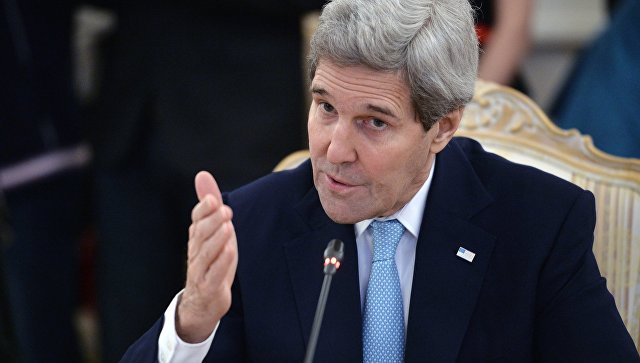
US Secretary of State John Kerry.  Archival photo
MOSCOW, October 7 -. RIA Novosti US Secretary of State John Kerry demanded to investigate the actions of Moscow in Syria as war crimes, according to the Associated Press . He said this in Washington before meeting with Foreign Minister of France, Jean-Marc Eyraud.
Antiaircraft gun Syrian opposition forces.  Archival photo
In Syria since February, "moderate" opposition has made more than 2 thousand violations
"Russia and the (Syrian) regime should not just explain to the world why they continue to bomb hospitals and medical facilities, women and children", - said Kerry.
US Secretary of State has accused the Syrian authorities in the attack on the hospital, as a result, he said, 20 people died and 100 were injured.
Such actions "require appropriate investigation as war crimes," Kerry said.
The Russian Foreign Ministry called groundless accusations that Moscow supposedly strikes at the health facilities and schools. In the department stressed that the militants deliberately equip a small hospital in homes and do not mark them.

Tom Hanks enjoys playing 'smartest guy in the room' in 'Inferno'

Actor Tom Hanks said the real draw for him to reprise his role as fictional symbologist Robert Langdon in the film adaptation of Dan Brown's thriller "Inferno" was the chance to be "the smartest guy in the room."
"You give me the right amount of verbiage and just enough time to do the right amount of research, and I can convince you that I may be the smartest guy in the room," the actor said with a laugh to reporters on Thursday.
"The gift that Dan Brown gave me as an actor is to play a guy who's always curious, who's always opinionated and who's always searching for an answer."
Hanks joined cast members including Felicity Jones and Irrfan Khan, director Ron Howard and author Brown at a news conference for the film in Florence's Palazzo Vecchio.
Hanks and Howard previously brought Brown's "Da Vinci Code" and "Angels and Demons" to life in hit blockbuster films.
Sony Pictures' "Inferno," due in theaters on Oct. 28, follows Langdon as he wakes up in Florence with amnesia and has to decipher clues to stop a plague being released by an elusive billionaire who tries to tackle overpopulation.
left
right
Actor Tom Hanks poses at a screening of his film 'Inferno' in Florence, Italy October 6, 2016. REUTERS/Max Rossi
1/3
Hanks said the film's take on overpopulation suggests "we are creating our own version of Dante's inferno here in the real world."
He added that there were places in the world where "the environment is hellacious and the people are held in slavery and there is any numbers of degrees of misery that are in fact created by ourselves one way or another."
Much of the film showcases Florence's historic buildings and piazzas, as Langdon speeds through the city's rich history, solving riddles related to Florentine poet Dante Alighieri's famed 14th century saga "Divine Comedy," about a man's journey through 'Inferno,' or hell.
Brown said framing Dante as prophecy and not as history made the story relevant to a modern audience, drawing threads between overpopulation and real world issues such as immigration or lack of natural resources.
Director Howard said he was inspired by the powerful imagery of Dante's "Inferno" and how it has resonated through centuries and generations.
"I felt that he was giving us the vocabulary of every horror movie we've ever seen and admired and you begin to look at it not only on a kind of philosophical level but also as a cultural, a huge cultural and political shift," Howard said.

(Reporting by Reuters TV in Italy; Writing by Piya Sinha-Roy; Editing by Lisa Shumaker)

German companies consider taking symbolic stake in Deutsche Bank

German companies consider taking symbolic stake in Deutsche Bank: source


By Edward Taylor and John O'Donnell | FRANKFURT
Some of Germany's top industrial companies have revived a decades-old network to discuss the possibility of taking a symbolic stake in Deutsche Bank, aiming to help it through its current turmoil, an executive at one of the firms told Reuters.
If such a support plan went ahead, it would mark a reversal of roles from the years of the post-war economic miracle till the 1990s, when Deutsche (DBKGn.DE) owned chunks of German industry, coming to the rescue of some that ran into trouble.
The discussions have involved a handful of blue-chip firms, covering whether they should club together to buy a relatively small stake in Deutsche, a step which could then help the Frankfurt-based bank to persuade other investors to inject more capital, the executive at the large DAX-listed company said.
"There were talks and discussions about that topic," the executive said. However, no decision has yet been made on whether to push forward with the plan.
Handelsblatt reported the capital injection that has been discussed is in the low single-digit billions of euros. Deutsche Bank declined to comment on the report.
If implemented, the plan would mean a comeback of "Deutschland AG", which despite its name was never a company but rather an opaque corporate network dominated by top German executives which shielded vulnerable companies from volatile market forces, bankruptcy or an unwelcome takeover.
Following the days when Deutschland AG was active, Deutsche Bank strayed from its roots in supporting industry, pursuing a strategy of extremely risky market bets before the global financial crisis of 2008-09.
Shares in Deutsche - which despite the might of the German manufacturing economy is the country's only global heavyweight lender - hit a record low last week on fears about its ability to shoulder a U.S regulatory penalty that could cost it up to $14 billion.
The shares have rebounded partly on signs that efforts are afoot to shore up confidence in Deutsche. For instance, Qatari investors who own the largest stake are planning to hold onto their shares and are keeping open the possibility of buying more if the bank decides to raise capital, sources familiar with Qatari investment policy told Reuters.
Nevertheless, the stock remains 46 percent below where it was at the end of last year and German public opinion is hostile towards a bank that ran into trouble on Wall Street.
THE RIGHT GOALS
The fact that some of Germany's top companies are considering stepping in underscores the depth of Deutsche's crisis, given the high political risk of even contemplating state aid before national elections in 2017.
Siemens (SIEGn.DE) chief executive Joe Kaeser repeated his support on Friday for Deutsche, which is making big job cuts to lower its costs and selling some businesses. "Management is pursuing the right goals and has our full support. Deutsche Bank for us is a long-standing and reliable partner," he said.
Earlier this month Kaeser joined other business leaders to defend the bank in a front-page article in a German newspaper. The others were Juergen Hambrecht, the chairman of chemicals giant BASF (BASFn.DE), Dieter Zetsche, chief executive of carmaker Daimler (DAIGn.DE) and Johannes Teyssen, head of energy firm E.ON (EONGn.DE).
"German industry needs a Deutsche Bank to accompany us out into the world," Hambrecht said at the time.
Economy Minister Sigmar Gabriel said on Friday that Germany had an interest in ensuring Deutsche had a successful future, but reiterated the government was not planning state aid.
It remains to be seen how many companies might be willing to spend money on a bank that is not only facing billions in fines but also whose earnings power has been sapped by tougher regulation that has restricted a business once based on taking large market bets.
Deutschland AG predates World War Two and lasted until the late 1990s when it faded away at a time of rapid economic change and internationalization. It was tasked with looking after the broader national economic interest, including by giving loans at favorable conditions if it helped Germany gain a competitive advantage in a particular industry.
In the 1990s, Deutsche Bank was at the center of this network and held a 28 percent stake in Daimler-Benz AG, a 25 percent stake in retailer Karstadt AG, 100 percent in steel firm Kloeckner & Co. AG and a 23 percent stake in sugar refinery Suedzucker AG.
Through board seats on these companies, Deutsche Bank could force changes in corporate Germany and in 1987, ousted the Daimler-Benz chief executive. It eventually sold the industrial stakes, saying they were a hindrance to effective corporate governance.
DRIVING SEAT
This time around, the industrial companies are in the driving seat, a sign that corporate Germany is willing to flex its muscles to reassert its primacy in times of crisis.
The expression of support came despite the fact that Deutsche Bank is widely disliked by the German public for its aggressive drive into global investment banking.
A glimpse into the level of distrust toward investment bankers was once offered by Helmut Schmidt, a German chancellor during the Cold War who died last year.
"Deutsche Bank is no longer German," Schmidt lamented in 2011. "Today the understanding that Deutsche will look out for German interests no longer holds true," he wrote in Die Zeit, a weekly newspaper.
In 2011 a U.S. Senate Subcommittee report said the bank, which at the time was worth around 47 billion euros (now $52 billion) - about three times its current market value - used its own funds to make investments in mortgage-related securities that had a notional value of $128 billion in 2007.
Even if German executives decide to back the bank, they face a tough task in selling the idea to their shareholders.
Speaking on Friday at the market debut of RWE's Innogy unit, CEO Peter Terium said: "We have just raised billions with the promise to invest in (power) networks and renewables. I don't think this included a promise for a Deutsche Bank investment."
($1 = 0.8977 euros)
(Additional reporting by Christoph Steitz, Alexander Huebner and Jens Hack; Editing by Georgina Prodhan and David Stamp)
Germany to curb EU citizens' access to welfare payments


Germany plans to sharply curb EU citizens' access to welfare benefits with new draft legislation that would save local communities billions of euros, government officials said on Friday.
New legislation was required after a federal court ruled in 2015 and 2016 that non-working EU citizens had a right to social welfare benefits after six months in Germany. Before the ruling, there was no right to such benefits.
Chancellor Angela Merkel's center-right government is taking a number of steps to stem losses to the anti-immigrant Alternative for Germany party amid growing frustration about an influx of refugees and other migrants.
The new legislation would make EU citizens who are not working in Germany ineligible for social welfare or unemployment benefits until they have lived there for five years.
Officials said the change was aimed at ensuring that those who moved to Germany were actively looking for work and not simply living off benefits.
The cabinet is due to review the bill next week before it is sent to the lower house of parliament, the officials said, confirming a report published on Friday by the Funke Medien Gruppe newspaper chain.
(Reporting by Thorsten Severin; Writing by Andrea Shalal; Editing by Kevin Liffey)

Turkey says Shi'ite role in Iraq's Mosul battle will 'increase problems'

Turkey says Shi'ite role in Iraq's Mosul battle will 'increase problems'


Involving Shi'ite militias in an operation to drive Islamic State out of the Iraqi city of Mosul will not bring peace, Turkey's foreign minister said on Friday, adding that Turkish-trained forces should be involved.
As expectations of an assault to retake Mosul grow, tensions between Iraq and Turkey have escalated. The main point of contention is the presence of Turkish troops in Iraq, mainly at the Bashiqa camp in the north of the country, training Sunni Muslim and Kurdish Peshmerga units which Turkey wants to take part in the battle for Mosul.
However, the Shi'ite-led government in Baghdad is keen that its forces be in the forefront of the offensive on the city, the largest under Islamic State control.
"The forces we have trained at the Bashiqa camp are Mosul's own people. The participation of these forces is important to the operation's success," Turkish Foreign Minister Mevlut Cavusoglu told a news conference.
"Involving Shi'ite militias in the operation will not bring peace to Mosul. On the contrary, it will increase problems," he said, adding Turkey was ready to support the offensive.
Turkish Prime Minister Binali Yildirim added to Turkey's hardening rhetoric on the issue, saying Baghdad's remarks on the Bashiqa camp were "dangerous and provocative".
"Our troops are carrying out very useful work in Iraq. We have no hostile attitude towards them. Our soldiers are fighting against Islamic State militants there," he told reporters.
Turkey's parliament voted last week to extend the deployment of an estimated 2,000 troops across northern Iraq by a year to combat "terrorist organizations" - a wording broad enough to refer to Kurdish militants as well as Islamic State.
Iraq condemned the vote, and Prime Minister Haider al-Abadi warned Turkey risked triggering a regional war. His government has requested an emergency United Nations Security Council meeting to discuss the issue.
The assault to retake Mosul, which has been in the hands of Islamic State since 2014, is expected to take place in the coming weeks.
In an analysis published on Thursday, Human Rights Watch also questioned whether Shi'ite militias should be involved in the assault because of abuses in previous operations against Sunni militant strongholds.
"Those prohibited from participating should include elements of the Popular Mobilization Forces, a group of armed forces allied with the government," the rights group said. The Popular Mobilization Forces are made up of mainly Shi'ite fighters.
"The last thing the authorities should allow is for abusive forces to carry out revenge attacks in an atmosphere of impunity."
(Reporting by Tulay Karadeniz and Ece Toksabay; Writing by Daren Butler; Editing by Mark Trevelyan)

Satellite images show activity at North Korea nuclear test site: report

An increase in activity at North Korea's nuclear test site could signal preparations for a new test or a collection of data from its last one, a U.S.-based monitoring group said on Friday, citing satellite images.
The 38 North group, run by Johns Hopkins University's School of Advanced International Studies, said there was activity at all three tunnel complexes at the Punggye-ri nuclear test site involving a large vehicle and personnel.
"One possible reason for this activity is to collect data on the Sept. 9 test although other purposes cannot be ruled out, such as sealing the portal or other preparations related to a new test," the group said, referring to the last nuclear test.
The North is believed to be ready for another nuclear test at any time and there has been speculation it could mark the Oct. 10 anniversary of the founding of its Workers' Party with another underground detonation.
North Korea conducted its first nuclear test in 2006 and has since then defied U.N. sanctions and rejected international talks to press ahead with the development of the weapons and missiles to carry them, which it says it needs for its defense.
In January, it conducted its fourth nuclear test and last month its fifth and biggest, on the anniversary of the nation's founding.
The United States and South Korea are pushing for tighter sanctions against North Korea by closing loopholes left in a U.N. Security Council resolution in March.
South Korea's Unification Ministry spokesman Jeong Joon-hee told a briefing there were no particular indication of a plan for a nuclear test timed to coincide with the Oct. 10 anniversary.
South Korea's Yonhap news agency cited an unidentified government official that there was activity at the North's rocket launch station near the west coast that could be preparations for a long-range missile launch.
Last month, the North said it had successfully conducted a ground test of a new rocket engine that would be used to launch satellites. South Korea said the engine could be used for a long-range missile.
North Korea last month fired three missiles that flew about 1,000 km (600 miles). In August, it tested a submarine-launched ballistic missile that international experts said showed considerable progress.
Japan said the possibility of further "provocative action" by North Korea could not be ruled out.
"The government is taking all possible measures in gathering information, exercising vigilance and taking surveillance activities to be able to respond to any situations," Japan's Chief Cabinet Secretary Yoshihide Suga told a news conference.

(Reporting by Jack Kim and Ju-min Park; Editing by Robert Birsel)

Hurricane cuts power to over 300,000 Florida homes and businesses

Electricity companies in Florida said Hurricane Matthew knocked out power to over 300,000 homes and businesses on Friday as the storm blasts the state's east coast.
NextEra Energy Inc's FPL power company, the biggest in Florida, forecast on Thursday that Matthew could leave as many as 2.5 million homes and businesses without service, some for extended periods of time.
Matthew, the first major hurricane threatening a direct hit on the United States in more than 10 years, lashed Florida on Friday with heavy rains and winds after killing at least 339 people in Haiti on its march north through the Caribbean.
At 5 a.m. EDT (0900 GMT), Matthew was about 40 miles (65 km) southeast of Cape Canaveral, the hurricane center said. It was heading north-northwest at about 13 mph (20 kph) and was expected to continue on this track through the early part of Friday. The center said the storm is expected to gradually weaken during the next 48 hours.
The following lists outages at U.S. power companies neat Matthew's forecast path.
Power Company                  State/Province          Out Now
NextEra - FPL                               FL                    307,200
Duke - Progress Florida                FL                    39,000
Emera - Tampa Electric                 FL                    100
Southern - Gulf Power                   FL                     -
JEA                                                   FL                    100
Southern - Georgia Power              GA                    200
Jackson EMC                                 GA                    -
Cobb EMC                                     GA                    -

                                                  Total               346,600


Mitra-mandal Privacy Policy

This privacy policy has been compiled to better serve those who are concerned with how their  'Personally Identifiable Inform...