MITRA MANDAL GLOBAL NEWS

Afghan asylum seekers stranded at Hungary-Serbia border

A 24-year-old man from Afghanistan lost his leg due to a land-mine explosion. He said he fled his country with his wife and two children because, “the Taliban are killing people.” Photo by Danielle Villasana
"Now there's a stalemate, and people who are coming are not going to get in. Nobody seems to have an answer as to how it will improve in light of Hungary's closure over the last couple of months," said Albert Grain, the volunteer coordinator for Refugee Aid Miksaliste, a nongovernmental organization in Belgrade providing assistance to migrants.
Thirty-six-year-old Marzia, far left, holding her youngest daughter, walks with her two other daughters toward Belgrade’s “Afghan Park” after receiving food from a distribution center. Photo by Danielle Villasana
Grain said about 65 percent of people they receive are from Afghanistan. Thirty-six-year-old Marzia and her husband left Afghanistan with their three daughters because of the ethnic and religious discrimination they faced as Shiite Muslims. "Every day it's becoming worse and worse," said her husband, adding that they will try to reach Western Europe using smugglers.
Marzia says her children suffer from psychological problems and from the pressures of the long journey that has now lasted eight months. “My little daughter is very nervous. She’s not the same as she was, and she’s not listening to me as she would before.” Photo by Danielle Villasana
"The main problem for vulnerable groups like families is the lack of accommodation and the lack of a safe space, where they can rest even for a couple of hours," said Grain. Like Marzia and her family, the majority of migrants sleep in these two parks on cardboard, covering themselves with blankets provided by aid organizations.
Faced with overcrowded camps with poor facilities, where people wait for extended periods hoping to be admitted into Hungary, people are increasingly turning toward smugglers.
Marzia’s daughters look at a map of Serbia in a pamphlet that provides information for migrants and asylum-seekers. “I think this is a problem that will dramatically change the entire concept of borders and the entire geography of Europe, if we’re not careful,” Grain said. Photo by Danielle Villasana
"The conditions of the transit zones, the lack of adequate shelters, hygiene, proper water systems and showers are creating increasing problems with skin conditions and gastrointestinal diseases," said Medecins Sans Frontieres humanitarian affairs officer Francois Tillette de Mautort, at the Horgos border camp, where 60 percent of the occupants are women and children, most of them waiting an opportunity to cross the border.
The makeshift refugee camp is located near one of two border crossings in an area that is neither Serbian territory nor administered by Hungary. Organizations such as Medecins Sans Frontieres are working to improve camp conditions. Photo by Danielle Villasana
"The world has forgotten about Afghanistan because our country has been at war for 40 years. [First] Russia, then the Taliban, now Daesh [Islamic State] and the Taliban, are all in my country," said Mohammad Hanif, who left Afghanistan six months ago with his wife and four children, and now lives in the Horgos camp. Hanif was an employee at Kabul's Northgate Hotel, which was attacked by the Taliban in August.
Afghan asylum seeker Mohammad Hanif, left, attempts to fix a sink in Horgos border camp. Hanif, who left Afghanistan six months ago, now lives in the camp with his wife and four children. Photo by Danielle Villasana
Many of these families "don't see any futures in their home countries because even if these countries are not at war in this moment or involved in a conflict, they're all coming from countries with histories of conflict and violence," said Tatjana Ristic, who works with Save the Children in Belgrade.
Twenty-seven-year-old Maroof, not pictured, carried his son, who has disabilities, on his back, while fleeing Afghanistan with his wife and two other children. Photo by Danielle Villasana
Save the Children provides a child-friendly space and a teenage corner where Ristic said children and their families can relax and feel like they're at home. "Because we are working with children in distress, children who went through traumatic experiences, we provide a space where they rest, relax, feel safe and also have a chance to be children again so that they can play and express themselves as they want to, in their way," she added.
One of the activities that the child-friendly space offers is called “Superhero” in which children can paint and draw superheroes that resemble themselves as a way to focus on their strengths that helped them during their journey. Photo by Danielle Villasana
Refugee Aid Miksaliste is one of the Belgrade-based organizations serving as a distribution and integration center. From distribution of non-food items such as clothing, shoes, hygiene supplies and blankets, to providing "safe" spaces for mothers and minors, as well as computers, showers and various workshops, the organization covers a range of asylum seekers' needs. They also provide meals to about 350 and 400 migrants a day.
An Afghan man holds his daughter as he walks into Refugee Aid Miksaliste, a distribution and integration center in Belgrade. Photo by Danielle Villasana
Recounting his experience of arriving in Greece by boat only to find out that the borders had been closed, Hanif asks: "Why did you allow the women and the children in, and then close the borders?"
Hanif’s daughter helps her sister drink juice that is distributed daily, along with other food items such as bread and milk, by the Hungarian government. Photo by Danielle Villasana
Danielle Villasana is an independent photojournalist whose documentary work focuses on women, identity, human rights and health. This article originally appeared on Refugees Deeply, and you can find the original here. For important news about the global migration crisis, you can sign up to the Refugees Deeply email list.

Infants use prefrontal cortex for learning, study finds


Researchers typically regard the prefrontal cortext to be too undeveloped for infants to use, but Brown University scientists say this may not be the case. Photo by Alena Ozerova/Shutterstock
PROVIDENCE, R.I., Oct. 6 (UPI) -- Infants may begin using their prefrontal cortex earlier than previously believed, according to a study conducted by Brown University scientists.
Researchers have traditionally considered the prefrontal cortex, the portion of the brain responsible for higher cognitive activity, to be too underdeveloped in young children. However, a study involving 8-month-old infants suggests this may not be the case.
In the study, published in the Journal of Neuroscience, babies were tasked with learning simple hierarchical rules. Researchers observed the infants employed many of the same circuits to complete those tasks as adults do. Senior study author Dima Amso says their findings may mean the prefrontal cortex in an infant is not necessarily less developed, but rather adjusting to a different environment.
"The wow factor isn't 'Look the PFC works," Amso said in a press release. "It's that what seems to be happening is that its function is a really good fit for what these babies need to be mastering at that moment in their development."
The research team came to their conclusion after testing 37 babies in a bilingual scenario. The babies were placed in front of screens, which showed a face and then an image of a toy. The task was to determine which words were associated with which person, effectively testing two sets of vocabulary. Researchers measured their responses by tracking brain activity and eye blinks.
Brown University scientists say their study changes the conventional understanding of neurodevelopment.
"Atypical development, then, might reflect an inability to adapt to an environmental challenge, or an earlier adaptation because of a negative environment," Amso added. "We and others are probing with these ideas as relevant to PFC development."

Hurricane Matthew strengthens near northern Bahamas; Florida braces


1 of 4
The center of Hurricane Matthew is seen between Cuba and the northern Bahamas -- southeast of south Florida -- in this infrared satellite image, while Tropical Storm Nicole, with maximum sustained winds of 70 mph, is seen northeast of Matthew. Image courtesy of NOAA
MIAMI, Oct. 6 (UPI) -- Category 3 Hurricane Matthew gained strength as it neared the northwestern Bahamas on Thursday while a hurricane warning has been extended as far north as Georgia in the U.S. east coast.
Matthew is expected to continue to strengthen on Thursday, becoming a Category 4 hurricane by the time it nears the east coast of Florida on Thursday night, the National Hurricane Center said in its 5 a.m. update.
Hurricane warnings are in effect for the Bahamas, Florida's Lake Okeechobee and along the U.S. coast from Golden Beach, Fla., up to Altamaha Sound, Ga. A hurricane watch is in effect from Altamaha Sound north to South Carolina's South Santee River.
Matthew, which is less than 60 miles south-southeast from Nassau, has maximum sustained winds of 125 mph and is moving northwest at a speed of 12 mph, the NHC said. The hurricane is expected to turn north-northwest later on Thursday.
"The eye of Matthew should pass near Andros Island and New Providence in the northwestern Bahamas early this morning, then pass near Grand Bahama Island late today, and move very close to the east coast of the Florida peninsula tonight through Friday night," the NHC said in its Thursday update, adding that life-threatening floods could occur from Deerfield Beach, Fla., up to Altamaha Sound within the next 36 hours.
"The combination of a dangerous storm surge and the tide will cause normally dry areas near the coast to be flooded by rising waters moving inland from the shoreline," the NHC said.
The Bahamas is expected to see total rainfall of 8-12 inches, with isolated accumulation of 15 inches, the NHC said. The U.S. east coast from Florida up to Georgia and South Carolina should see rainfall of 4-8 inches, with isolated accumulations of 12 inches.
The NHC warns people to protect themselves from life-threatening wind conditions, as well as from dangerous storm surges and surf swells. Hurricane-force winds extend out 40 miles from the center, and tropical storm-force winds extend out 160 miles.
Matthew could make make a tight, troubling U-turn east into the Atlantic beginning Friday afternoon ending up southbound on Monday.
Residents north of Miami are emptying many store shelves and boarding up in preparation for what is expected to be a Category 4 hurricane hugging the coast with the eye from about 50 miles or less off West Palm Beach to virtually overhead at Cape Canaveral between Thursday night and Friday afternoon.
Hurricane conditions are expected to first reach hurricane warning areas in Florida by late Thursday and will spread north into Thursday night and Friday. Tropical storm conditions are first expected in Florida by early Thursday.
Matthew is the most powerful Atlantic storm since 2007 and the most powerful hurricane to hit Haiti in 52 years. The hurricane made landfall near Les Anglais in southwestern Haiti at 7 a.m. Tuesday with 145 mph winds and torrential rains. The extent of damage in Haiti isn't yet clear.
Matthew made landfall in extreme eastern Cuba as a Category 3 storm late Tuesday, bringing life-threatening winds, storm surge and heavy rains.
Officials in Florida's Broward, Miami-Dade, Palm Beach, St. Lucie and Martin counties north of the Miami area announced the closure of all schools there Thursday and Friday to prepare for their potential use as shelters. School buses typically do not run in winds stronger than 40 mph.
Meanwhile, another storm formed Tuesday -- Tropical Storm Nicole -- currently with 70 mph maximum sustained winds in the open Atlantic between Puerto Rico and Bermuda. Nicole is forecast to meander slowly north for the next several days and is currently no threat to land.
This is a developing story. Check back throughout the day for the latest updates.
Composite radar animation courtesy of Brian McNoldy, University of Miami, Rosenstiel School.
Infrared satellite animation shows Hurricane Matthew's updated position and movement.
Visible satellite animation of Hurricane Matthew, updated every 30 minutes.

Climate change will make the poisonous ocean at the western coast of the United States


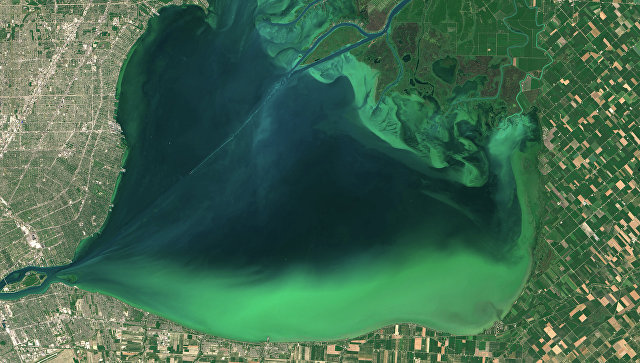
Algae bloom in the US Lake Erie
MOSCOW, Oct. 4 -. RIA Novosti Increasing temperature water in the Pacific Ocean due to global warming may make the water in the western US coast of almost unfit for life of animals and dangerous for humans because of the rapid algal blooms and water pollution "zombie acid," says in an article published in the journal ofGeophysical Research Letters.
"Every three to five years before it happened, and other incidents of toxic algae, which has forced Washington's power and Oregon restrict catch shellfish. But on the other side of what happened here last year, it was a completely different event on the scale and strength of effects, and our research shows that it was due to the unusual weather conditions in the ocean "- says Ryan McCabe (Ryan McCabe) from the University of Washington in Seattle (USA).
Flowering water cause brown or blue-green algae that live in freshwater lakes and reservoirs, as well as in sea water. With the explosive growth of the number of cyanobacteria and brown algae in the water there are extensive patches, which may pose a threat to human and animal health due to the toxins that emit algae in the water, clearing a "living space".
It is thought that climate change and, in particular, the rise in water temperature will contribute to more frequent algae blooms, but all the climatic effects of these spots are still unknown. McCabe and his colleagues presented evidence in favor of what is really going on, trying to figure out what caused the outbreak of algal blooms heavy-duty off the west coast of the USA in the spring and winter of 2015.
Pond.  Archive
Flowering water accelerates climate change, say climatologists
The culprit of all problems, as they say, scientists have been kind of algae Pseudo-nitzschia australis, whose cells during flowering produce large amounts of the neurotoxin the DA, the so-called "zombie acid". The molecules of this substance is easily accumulate in fish and shellfish tissues of the body, and their eating mammals, birds or humans causes hallucinations, spasms and death.
Intrigued flash reproduction of these algae, the researchers looked at how and where to grow Pseudo-nitzschia australis in the past and tried to determine the factors that affect their reproduction, including human activities. The analysis carried out McCabe's group demonstrated that the outbreak in the activity of these algae mainly occur at abnormally high water temperatures during the winter and summer.
These episodes were associated with flowering three things - the climate phenomenon El Nino, global warming and ocean water pollution by fertilizers and other nutrients. Global warming plays a special role because it heats the water of the Pacific Ocean itself and also further enhances the El Niño phenomenon, which leads to even more warming waters.
Corals, algae.  Archive
Red algae is used "chemical weapons" with a lack of food
In recent years, the temperature of surface waters as they note, was above normal by 2.5 degrees Celsius, and in the following decades and centuries, this deviation will only grow with the increase of average temperatures on Earth.
Accordingly, the frequency of algae stains and pollution of the Pacific Ocean "zombie acid" and other toxins will only grow. Therefore, if humanity will not be able to stop climate change, the US West Coast may be a "dead zone", polluted by toxic secretions of brown algae and dangerous to animal and human life.

Scientists from Russia and the US have identified the biggest dinosaur of Central Asia


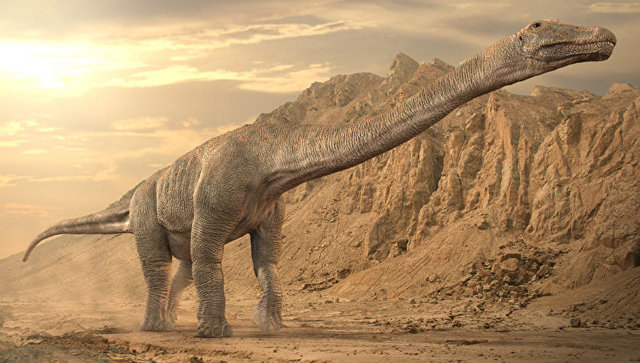
titanosaurs
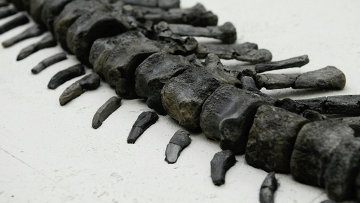
MOSCOW, October 5 -. RIA Novosti Paleontologist of the Zoological Institute, Russian Academy of Sciences, and his colleague from the US Smithsonian Institution found that the largest dinosaurs in the territory of modern Central Asia were titanosaurs - gigantic 100-ton plant-eating dinosaurs, as they wrote in an article in the journal Cretaceous Research.
"We made one step in the ordering of knowledge about the biota of the Cretaceous Central Asian previously identified taxa turtles, carnivorous dinosaurs, amphibians, mammals and other animals on the stage to explore other dinosaur groups -.. Ornithopods, ankylosaur, horned dinosaurs - and many other groups of vertebrates ", - says Alexander Averyanov from Zoological Institute in St. Petersburg, whose words the press service Rossiykogo Science Foundation.
As a Russian paleontologist explains, in recent years, his colleagues have found many fossils of large dinosaurs in the countries of Central Asia, but these findings have not been systematically studied, and in the general population. This gave rise to disputes about what species, genera and families of sauropods - long-necked and large four-legged lizards - were the largest creatures in the region as "the era of the dinosaurs."
The situation is complicated by the fact that most of the remains of sauropod found in the territory of the former Soviet Union, are extremely fragmented bones and teeth, which is quite difficult to determine their size and species.
Protoptitsa kofutsiornis.  Left - female, right - male.  Illustration of the article authors
Scientists have discovered why birds survived the extinction, and the dinosaurs - no
Of particular interest to scientists called teeth, found in 90 years Averyanov and American paleontologists in the Kyzylkum desert, in the tract Dzharakuduk reminiscent in structure teeth titanosaurs - gigantic sauropod weighing 100 tons and a length of 25-30 meters, whose remains are often found in the south Argentina, in Patagonia, and north China.
Averyanov and his colleague Hans-Dieter Süss (Hans-Dieter Sues) of the Smithsonian Institution in Washington, DC (USA) studied the teeth and other putative remains of titanosaurs from Central Asia and to check whether these lizards are widespread in the region, and whether they were the largest its inhabitants in the middle of the Cretaceous period.
This analysis showed that the remains titanosaurs or similar to them large sauropod, whose teeth and vertebrae are very similar to teeth titanosaurs from China have been found in dozens of different points on the territory of the Kyzyl-Kum and other natural regions of Central Asia. It is said Süss and Averyanov, said that these dinosaurs were widespread in the region, and were the largest dinosaurs of their time.
Stegosaurus skeleton.  Archival photo
Found by Russian scientists in Siberia has appeared a new type of dinosaur
On the other hand, the extreme rarity of their remains in the rocks of the Cretaceous period in Uzbekistan, Kyrgyzstan, Tajikistan and Kazakhstan, said that they are unlikely to dominate among herbivorous dinosaurs of the time, and is quite rare in ecosystems.
In the near future Averyanov and his colleagues have promised that they will conduct similar studies in other groups of dinosaurs and other vertebrates. In total, current estimates Russian paleontologists, about 200 new species of ancient animals have been found in Central Asia and their systematization as expressed by a scientist, will help us to look into the "window to the past, to see nature the way it was 90 million years ago in its entirety. 

RESOLUTION ON SYRIA FRANCE provides for an immediate halt to the bombing in Aleppo and implementation of humanitarian access - Eyraud

Scientists have discovered the limit of human life


The oldest inhabitant of the earth Emma Morano.  Archival photo
MOSCOW, Oct 5 -. RIA Novosti Further improvement of medicine will not increase the average life expectancy is infinite - limit a person's age, most likely, is rising sharply around 100 years old, at which mortality, regardless of any external factors, say researchers in an article published in the journal of Nature .
The typical duration of a human life is not some constant value - before the birth of civilization, it ranged from 20 to 30 years, and then rose steadily with the development of science and medicine. Today people live more than 60 years in most countries in the world, and more than 80 years - in Japan and other developed countries with a high quality of life and first-class medicine.
Yang Vijgen (Jan Vijg) and his colleagues at the University of New York (USA), as well as many other scientists have reflected on how long you can last the process, and whether there is a maximum age at which people start to inevitably die, despite all the advances in medicine and technology.
How much rope does not curl ...
Villagers Acciaroli, whose age is close to 100 years
Scientists may have discovered the secret of the most long-lived people on the planet
As they note, this idea is true for most animals - almost all mammals live to a certain age. His step over a very small number of individuals, most of whom died a few years after reaching the intersection and this "life limit". Since man is more complicated, since there is evidence in favor and against this hypothesis.
To test whether this is actually Vijgen and his colleagues came up with the original method of analysis of mortality data, which were collected over the past hundred years. They were interested not in fact the number of deaths of people at a certain age, and that where there is the most significant decline in the number of dead people when comparing data earlier and later years.
If there is no limit of life, this "hump survival," as scientists call it, will smoothly and continuously move towards a more advanced age. If it exists, the "hump" will stop at a certain point, and will not move forward.
Laboratory mouse
Scientists: Cleaning the mouse body by decrepit cells to extend their life by 30%
Following this idea, Vijgen team analyzed how the changed mortality in France, Japan, the US and the UK in the last 40 years, focusing on the age at which most long-lived people have died in these countries.
Their analysis showed that the "hump survival" is gradually moving towards a more mature years until mid-1980, after which it ceased to grow. In turn, the maximum age of people who die in a given year, is not only not increased, but has fallen markedly in the last 20 years after the death of the oldest inhabitant of the planet, Jeanne Calment, who died in 1997 aged 122 years.
... Anyway will end
Dean of the Faculty of Bioengineering and Bioinformatics, Moscow State University, Director of the Institute of Physical and Chemical Biology named after AN  White Lake, Academician Vladimir Skulachev
Naked mole rats will be the key to human immortality, says biologist
In general, researchers evaluated the annual probability that at least one person to reach 125 years of age and then die 1 chance in 10,000 attempts.
Such a low probability, as noted Vijgen and his colleagues said that the limit of human life exists and that it is approximately equal, as shown by their calculations, a hundred years. You can say that humanity has reached its limit, step over that it alone can not without artificial intervention in the vital activity.
"Further progress in the fight against diseases, are likely to increase the average life expectancy, but the maximum length of a person's life. It is possible that future breakthroughs in medicine prolong human life beyond these limits, but they will have to suppress or overcome the influence of the set of genetic factors, measure our life on Earth may have that the resources that we now spend on life extension, should be used for the extension of health -. how long older people remain in good health, "- explains Vijgen.
Does this mean that there is a genetic program of aging programmed evolution? The authors point out that such an outcome is unlikely, as our ancestors, and all the other animals have died and are dying much earlier than old age begins. This makes such a "clockwork" meaningless, the scientists conclude.

Mitra-mandal Privacy Policy

This privacy policy has been compiled to better serve those who are concerned with how their  'Personally Identifiable Inform...