MITRA MANDAL GLOBAL NEWS

Argentina news-To Macri, education is "the tool for reducing poverty go"

President Mauricio Macri said Thursday that "education is the central tool that will make a difference to go year after year reducing poverty" and said "it is a stark truth" that "more than 30 percent of Argentines are below the poverty line. "

Macri: "Education is the central tool for combating poverty in Argentina"

Macri, when presenting the awards "Masters Argentinos" innovative teaching projects across the country, at an event in Technopolis, said that "the main characters, key people are you, teachers, and is like the flipside, but also the door that opens to what touched me raise yesterday, which is to recognize what is the starting point in our country , "referring to theofficial report on poverty in the country released by the Indec. 

the president called to" recognize the serious problem and express the anger, the pain generated by us and, at the same time transform that anger and that pain commitment, which is clearly work together to defeat poverty. " 

at that level, the head of state said that" when we are aware, many we knew, but also when you see it reflected in numbers, one out of three Argentines do not have the opportunities that we all deserve, we must convene to work together. " 

the president also said that" the solution to poverty clearly passes by generating quality jobs and we all know that this is not achieved magically, which is reached is achieved through education. "
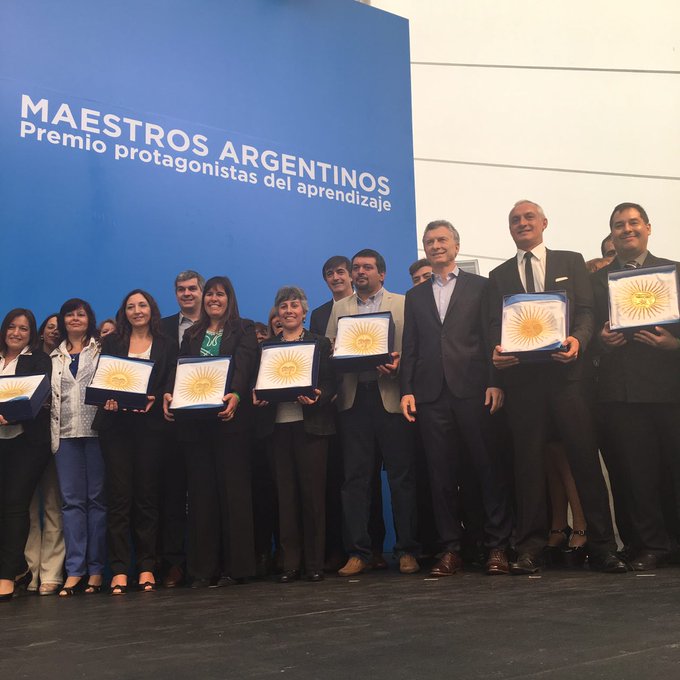


Accompanied by Education Minister Esteban Bullrich; and the chief of staff, Marcos Peña, Macri said that education "given the tools" and assumed that "the challenge that lies ahead we understand all there is much to do, and that no use claiming that we had the best education system in Latin America. " 

in another part of his speech, he asked the teachers present at the event in Technopolis, in the north of Buenos Aires, that" help overcome fears, because there are many other teachers who have the same capabilities but living the need for innovation as a threat as a danger. " 

so he said it is time to go" opening the way to new technologies "and" we must embrace the tools and infect everyone so that you can embark on a path growth. "

Murders, Crackdown Create Lingering Climate of Fear in Bangladesh


Maruf Rosul, a Bangladeshi writer and activist who has received death threats from Islamic militants for his blog posts. Credit: Amy Fallon/IPS
DHAKA, Sep 29 2016 (IPS) - Like the living room of any proud family, the one in Ajoy Roy’s house boasts photos of the eldest son, Avijit.
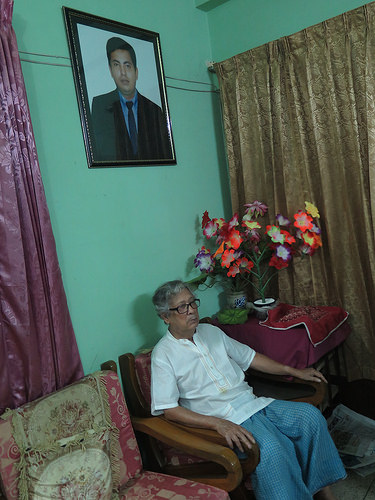
A large framed portrait which has a powerful presence in the room hangs on the mint-coloured wall as Ajoy, a retired physics professor who at the age of 80 is frail but still very mentally alert, sits in a chair below it, sipping tea.
It is the image of a popular Bangladeshi writer and bio-engineer, tragically murdered for his beliefs along with scores of other atheist writers, bloggers, publishers, gay activists and religious figures by suspected Islamist militants in the predominantly Muslim country over the past few years.
“Avijit wasn’t an activist on the streets, but he used his pen to protest against social injustice, religious fanaticism and propagate the idea of secularism, the main theme of his writing,” Ajoy, wearing a traditional lungi around his waist, told IPS. “It’s a terrible loss. It cannot be compensated for.”
Ajoy Roy, the father of Bangladeshi writer Avijit Roy, who was murdered in 2015. Credit: Amy Fallon/IPS
More than 50 writers, activists and others have been killed in Bangladesh since 2013, according to Human Rights Watch (HRW).
Avijit, 42, a U.S. citizen who lived in America with his wife Rafida Ahmed, was hacked to death after the pair went to the Bangladeshi capital Dhaka for a book festival in February 2015.
There have been many more killings since then.
This July, 23 people, including 17 foreigners, were killed at a bakery in the diplomatic zone of Dhaka, in one of the worst terror attacks ever in Bangladesh.
Five of the involved suspects were killed in a police operation at the eatery, while one survivor was arrested and remanded, and another jailed, the Dhaka Tribune later reported.
The suspected ringleader of the attacks and his two affiliates died in a police raid in August, but the search is still on for a coordinator, the arms suppliers and funders of the attacks.
After the murders of two other activists, LGBT campaigners Xulhaz Mannan and Mahbub Rabbi Tonoy, in April, the government, under international pressure over the spate of killings, arrested about 14,000 people.
Meenakshi Ganguly, South Asia director at HRW, said despite no further attacks since the brutal bakery murders, there were “concerns” that the crackdown was leading to “an arbitrary rounding up of usual suspects”.
The drop in incidents meanwhile “suggest that the state could have acted effectively earlier” to prevent the killings, she said.
There was still a “climate of fear” in Bangladesh among writers and members of minority groups, said Ganguly.

“Some have been able to leave the country, but many more, still in Bangladesh, fear that the government will not do enough to protect them,” she said.
Maruf Rosul, 29, a secular writer, photographer, filmmaker and activist who pens for various outlets, including freethinking site Mukto-Mona, set up by Avijit and now being run by his successors, said Islamic extremists in the country had been silenced.
“But the government has not taken the proper action to uproot these evil forces,” Rosul, who said he was on an extremist group’s hit list, but as a “frontier activist” couldn’t go into hiding, told IPS. “I am worried about the future.”
His anxiety was growing ahead of the Durga Puja, the biggest religious festival for south Asia’s Hindu community, which will begin next week, on Oct. 7.
Rosul said “every year” during the festival there were attacks by Islamic extremist groups in Bangladesh, yet officials did nothing but issue “sympathetic statements”.
“As there is no strong law enforcement, we are worried about our Hindu friends,” he told IPS. A Hindu tailor, hacked to death in April, is among those who have been killed in the country.
The sixth edition of Dhaka Literary Festival (DLF) is also due to take place in mid-November. Director Ahsan Akbar told IPS that preparations were in “full-swing”.
“We have had only a couple of cancellations so far, citing security fears, but the encouraging news is our speakers are really looking forward to the event and we expect no more cancellations,” he said.
Given the recent wave of murders though, Akbar said “writers in the country today are unfortunately self-censoring and thinking twice about what they write and publish”.
“Bangladeshi writers outside of the country are deeply sympathetic and doing many things to raise the awareness amongst the international community, such as engaging with PEN International,” he said.
“It is astonishing how we sometimes forget the interconnectivity in of all this: an attack on a writer in Bangladesh is – in a way – an attack on a writer in the West or anywhere else for that matter.”
Olof Blomqvist of Amnesty International told IPS that “the investigations into the targeted killings are ongoing, and there have been arrests made in some of the cases. Genuine justice will of course take time, but it is worrying that the perpetrators have so far only been held to account in one case, the killing of Rajib Haider in 2013.
“The authorities must ensure that those responsible are held to account, but also do more to protect those people at risk,” he said, adding that, “We still get desperate pleas on a weekly basis from people who have received threats and are afraid for their lives if they stay in Bangladesh.”
“Police must create a climate where activists who have been threatened feel safe to approach police and not fear further harassment,” Blomqvist said.
Ganguly also said in order to prevent more attacks, the Bangladeshi authorities needed to deliver a message that they believe in “peaceful free expression”.
“They should not recommend to those at risk that they self-censor to avoid hurting religious sentiment and becoming targets for retribution,” she said.
In 2015, after the killing of writer Niladri Chatterjee Niloy, Bangladesh’s police chief warned bloggers that “hurting religious sentiments is a crime”.
Police killed one of the key suspects involved in Avijit’s murder in June, but two others escaped, they said, and are still at large.
Following his son’s death, Ajoy, who said Avijit had been targeted by extremists in the few weeks before his death, and that he had warned him not to return to Bangladesh, could be forgiven for going into hiding.
But he said he was continuing “my activism” against fundamentalist groups, and had been invited to speak at various institutions.
“I’m not scared,” said Ajoy. “I have lost my son, after that I have nothing to care about.”
Ajoy said he wanted Avijit to be remembered as a “courageous young man who would face any hard situation for democracy, for secularism, for free-thinking”.
It was his wish that “the younger generation follow in his footsteps”.
“I would not discourage these courageous young people to quit blogging, speaking your mind, because Bangladesh is constitutionally a secular, democratic country so we must uphold the constitution,” said Ajoy.
“We have to make the common people understand that this is not an anti-Muslim country, it is liberal,” he said. “Although a large number of Muslims are here, they’re also liberal.”
IPS made several attempts to contact the Bangladeshi police and government for comment, but they did not respond.

Three reported dead, multiple critical in US train crash


Three reported dead, multiple critical in US train crash
At least three people were reported killed in a rush hour train crash Thursday in New Jersey, with officials confirming more than 100 people were injured, many of them critical.

South Australia battered by lightning, high winds


By Shawn Price   |   Sept. 29, 2016

Severe weather in South Australia knocked out power for tens of thousands of people including the city of Adelaide. Lightning strikes, heavy rains and high winds have lashed the state for two days. Screen shot: BOM SA/Twitter
ADELAIDE, Australia, Sept. 29 (UPI) -- South Australia is being lashed by lighting strikes, heavy rain and high winds that have knocked out power to city of Adelaide and surrounding rural areas.
About 80,000 lightning strikes have been recorded during the severe weather, hitting electrical plants, while wind knocked down at least 20 transmission towers.
State Premier Jay Weatherill compared the storm to 2012's Hurricane Sandy.
South Australia Police Commissioner Grant Stevens urged the public to leave work early, to avoid the congestion and being caught in the weather.
About 100 schools remain closed as tens of thousands remain without power in many areas.
Between to three inches of rain could be dumped on the state over the next 24 hours with Weatherill declaring it an "unprecedented weather event."

At least 1 dead, 100 injured in New Jersey commuter train crash


HOBOKEN, N.J., Sept. 29 (UPI) -- At least one person died and up to 100 people were injured when a New Jersey Transit commuter train slammed into the Hoboken station at the height of the Thursday morning rush.
Early investigations show the crash involved train No. 1614 on the Pascack Valley Line. Photos on social media show some of the train's cars inside the train terminal,surrounded by twisted metal.
"There are fatalities,'' a senior transportation official who did not want to be identified because he was not authorized to speak publicly told The New York Times. "There are a significant number of injuries. The train was going very fast. There are structural concerns about the facility."
New Jersey Transit said rail service was suspended in and out of Hoboken, a major transportation hub into and out of New York City.
The crash happened about 9 a.m. The Federal Railroad Administration is sending investigators to the scene.
This story is developing.

Stanford, MIT and Harvard top the second annual Reuters Top 100 ranking of the most innovative universities


NEW YORK – Stanford University, the Massachusetts Institute of Technology and Harvard University top the second annual Reuters Top 100 ranking of the world’s most innovative universities. The Reuters Top 100 ranking aims to identify the institutions doing the most to advance science, invent new technologies and help drive the global economy. Unlike other rankings that often rely entirely or in part on subjective surveys, the ranking uses proprietary data and analysis tools from the Intellectual Property & Science division of Thomson Reuters to examine a series of patent and research-related metrics, and get to the essence of what it means to be truly innovative.
In the fast-changing world of science and technology, if you're not innovating, you're falling behind. That’s one of the key findings of this year’s Reuters 100. The 2016 results show that big breakthroughs – even just one highly influential paper or patent – can drive a university way up the list, but when that discovery fades into the past, so does its ranking. Consistency is key, with truly innovative institutions putting out groundbreaking work year after year.
Stanford held fast to its first place ranking by consistently producing new patents and papers that influence researchers elsewhere in academia and in private industry. Researchers at the Massachusetts Institute of Technology (ranked #2) were behind some of the most important innovations of the past century, including the development of digital computers and the completion of the Human Genome Project. Harvard University (ranked #3), is the oldest institution of higher education in the United States, and has produced 47 Nobel laureates over the course of its 380-year history.
Some universities saw significant movement up the list, including, most notably, the University of Chicago, which jumped from #71 last year to #47 in 2016. Other list-climbers include the Netherlands' Delft University of Technology (#73 to #44) and South Korea's Sungkyunkwan University (#66 to #46).
The United States continues to dominate the list, with 46 universities in the top 100; Japan is once again the second best performing country, with nine universities. France and South Korea are tied in third, each with eight. Germany has seven ranked universities; the United Kingdom has five; Switzerland, Belgium and Israel have three; Denmark, China and Canada have two; and the Netherlands and Singapore each have one.
For more on the Reuters Top 100, including a detailed methodology and profiles of the universities, visit www.reuters.com/most-innovative-universities-2016.
The Reuters Top 100: The World’s Most Innovative Universities
1          Stanford University
2          Massachusetts Institute of Technology (MIT)
3          Harvard University
4          University of Texas System
5          University of Washington System
6          KAIST
7          University of Michigan System
8          University of Pennsylvania
9          KU Leuven
10         Northwestern University
11         Pohang University of Science & Technology (POSTECH)
12         Imperial College London
13         University of Wisconsin System
14         Duke University
15         University of California System
16         University of Tokyo
17         University of Southern California
18         Ecole Polytechnique Federale de Lausanne
19         University of Cambridge
20         Vanderbilt University
21         Osaka University
22         University of Illinois System
23         Johns Hopkins University
24         Georgia Institute of Technology
25         Ohio State University
26         Cornell University
27         University of Oxford
28         California Institute of Technology
29         Kyoto University
30         Seoul National University
31         Tohoku University
32         Princeton University
33         Purdue University System
34         Tufts University
35         Oregon Health & Science University
36         University of North Carolina System
37         Indiana University System
38         Technical University of Munich
39         University of Pittsburgh
40         University of Utah
41         Boston University
42         Columbia University
43         Tokyo Institute of Technology
44         Delft University of Technology
45         University of Colorado System
46         Sungkyunkwan University
47         University of Chicago
48         Keio University
49         University of Erlangen Nuremberg
50         University of British Columbia
51         Swiss Federal Institute of Technology Zurich
52         University of Massachusetts System
53         Technical University of Denmark
54         Yale University
55         Yonsei University
56         Emory University
57         University of Toronto
58         University of Zurich
59         Technion Israel Institute of Technology
60         Pierre & Marie Curie University - Paris 6
61         University of Munich
62         State University System of Florida
63         University of Arizona and Board of Regents
64         National University of Singapore
65         University of Minnesota System
66         Tsinghua University
67         Baylor College of Medicine
68         Hanyang University
69         Gwangju Institute of Science & Technology
70         Peking University
71         University of London
72         Mount Sinai School of Medicine
73         Korea University
74         Ghent University
75         University of Copenhagen
76         University of Rochester
77         University of Claude Bernard - Lyon 1
78         University of Paris Sud - Paris XI
79         Kyushu University
80         State University of New York (SUNY) System
81         University System of Maryland
82         Dresden University of Technology
83         University of Montpellier
84         University of Alabama System
84         Case Western Reserve University
86         University of Freiburg
87         University of Manchester
88         University of Paris Descartes – Paris V
89         Tel Aviv University
90         Nagoya University
91         Rutgers State University
92         Free University of Berlin
93         Grenoble Alpes University
94         Hebrew University of Jerusalem
95         Hokkaido University
96         University of Strasbourg
97         University of Aix-Marseille
98         University Libre Brussels
99         Ruprecht Karl University Heidelberg
100       University of Virginia

Reuters
Reuters, the news and media division of Thomson Reuters, is the world’s largest international multimedia news provider reaching more than one billion people every day. Reuters provides trusted business, financial, national, and international news to professionals via Thomson Reuters desktops, the world's media organizations, and directly to consumers at Reuters.com and via Reuters TV. Follow news about Reuters at@ReutersPR.
Thomson Reuters
Thomson Reuters is the world's leading source of intelligent information for businesses and professionals. We combine industry expertise with innovative technology to deliver critical information to leading decision makers in the financial and risk, legal, tax and accounting, intellectual property and science and media markets, powered by the world's most trusted news organization. Thomson Reuters shares are listed on the Toronto and New York Stock Exchange.

Click here to view the online version of this release.

Biologists have found confirmation of an alternative theory of life birth


So the artist imagined a hot spring, where 3.6-3.7 billion years ago could appear RNA-protein life
MOSCOW, September 29 -. RIA Novosti Biologists from the US showed the likelihood of an alternative embodiment of the evolution of life, according to which the RNA and DNA molecules having simultaneously, bypassing the stage of the RNA world, according to a paper published in the journal Angewandte Chemie.
"Even if you believe in the" world of RNA, "you have to take on faith and the position that something existed simultaneously with the RNA and helped life evolve in the direction of DNA and proteins. Why not assume that DNA and RNA arose at the same time rather than trying to turn the second into the first with the help of some crazy chemistry "- said Ramanarayanan Krishnamurthy (Ramanarayanan Krishnamurthy) of the Scripps Institution in La Jolla (USA).
According to the generally accepted theory today "RNA world", the role of proteins and DNA in the first living organisms on earth playing an RNA molecule. As a consequence of cellular processes began to control proteins and the role of genetic information storage took DNA. Today, scientists are experimenting with short RNA molecules, trying to reproduce the process of the origin of life in the laboratory.
In particular, the molecular evolutionary biologists are now trying to understand how RNA molecules have been replaced by their DNA analogues. Most scientists assume that this happened gradually - at first appeared so-called "chimeras", a molecule consisting of units of RNA and DNA, and then the RNA nucleotides have been gradually supplanted by our usual "letters" contained in our genetic code.
So the artist imagined a hot spring, where 3.6-3.7 billion years ago could appear RNA-protein life
Scientists: Life on Earth appeared due to the "union" of RNA and proteins
Krishnamurti and his colleagues have found that it is most likely could not take place in reality, examining the extent to which these will be stable chimeric "hybrids" of DNA and RNA. To this end, scientists have collected a few short chains of "pure" DNA and RNA molecules, made up of 16, 10 and 6 "letters" -nukleotidov.
Some of these molecules researchers treated such that some of the "letters" in them become analogues used in RNA or DNA, whereby they become chimeric "hybrids," the likes of the "building blocks of life," which existed during the generation of life. Having prepared solutions of such "chimeras", the authors of the article is heated them and followed up with how quickly they decompose.
It was found that the addition of even one foreign "letters" led to a sharp decrease in the stability of the molecules, reducing its decomposition temperature by 10-20 degrees Celsius. A similar response was observed in the DNA molecules and RNA molecules with changes in all types of letters and the connections between them, which means that all chimeras are extremely unstable in nature.
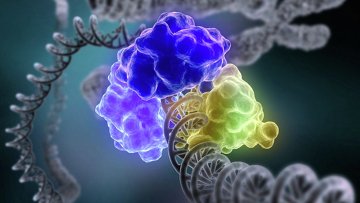
So the artist imagined the process of repair single breaks in the DNA helix
Biologists have uncovered the secret of the existence of DNA
Their volatility, as recognized by Krishnamurti, does not mean that they can not exist in principle in the primary "soup" Earth's oceans, but their existence in the first living cells, would require the presence of complex enzymes which would permanently "repaired" such molecules and protect them from decay. It is highly unlikely that they originated before there were the first proteins and DNA.
Therefore, according to Krishnamurti, a smooth transition from the RNA world to modern life was impossible, that gave him the idea that RNA and DNA having at the same time, and that the first life could be used both in his life. Such a scenario is, in his opinion, is more consistent with the experimental results and the fact that we see in modern organisms than a hypothesis "RNA world".

Mitra-mandal Privacy Policy

This privacy policy has been compiled to better serve those who are concerned with how their  'Personally Identifiable Inform...