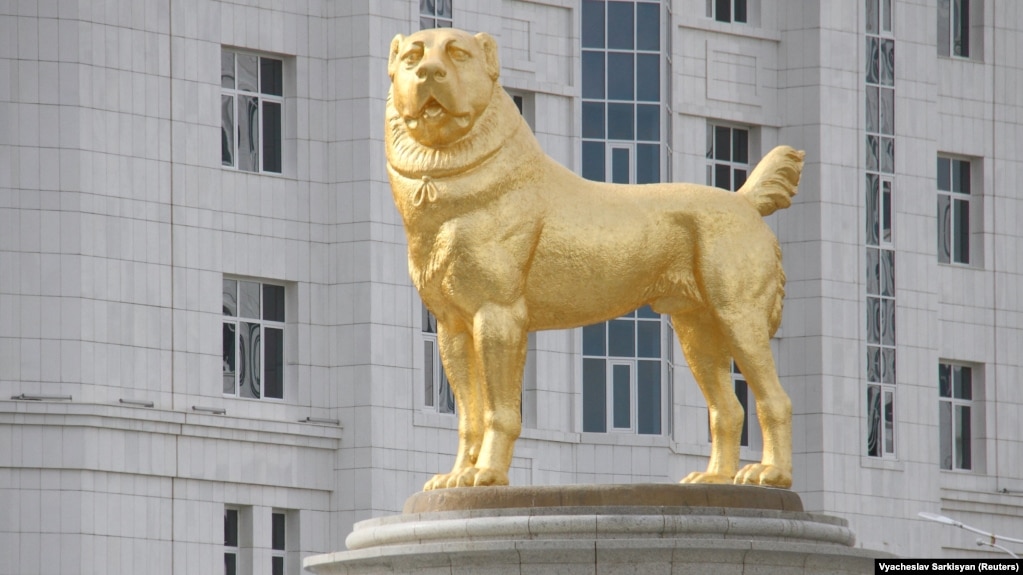
According to state media, the statue is dedicated to a dog breed that has played a role "in the historical destiny of the nation."
ASHGABAT -- Man's best friend is now Turkmenistan's latest hero.
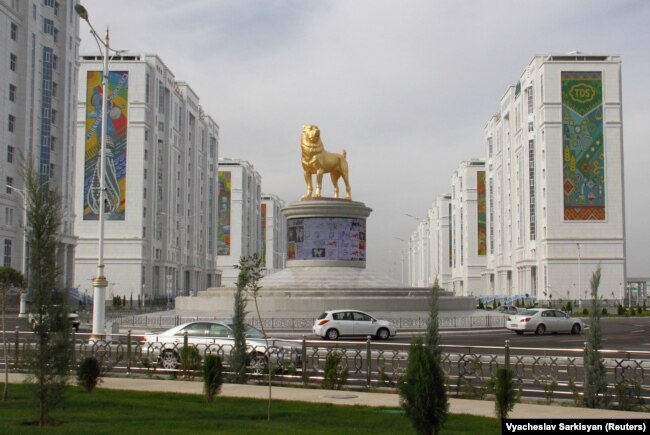
The Central Asian nation's authoritarian President Gurbanguly Berdymukhammedov, who heads one of the world's most oppressive governments, has unveiled a 6-meter-high golden statue of his favorite dog breed, the Alabay, an ancient livestock shepherd that's also used for protection.
State media reported that the statue is located in a complex of residential and cultural facilities in the capital where civil servants live.
The statue was dedicated to a dog that has "demonstrated respect and honor, exemplary courage and a cordial heart" to highlight "their role in the historical destiny of the nation," one news said.
The unveiling came amid a campaign to put down stray dogs in the country, RFE/RL correspondents report.
The Alabay dog statue is the latest of many imposing monuments that have been erected in the Turkmen capital.
Videos showing men hunting strays across the country in recent days were provided to RFE/RL by local animals rights groups and activists. Due to the graphic nature of the images, RFE/RL's Turkmen Service has refrained from posting them on its website.
Residents of the eastern city of Turkmenabat told RFE/RL that they turned to police to register complaints about the mass killings of stray dogs in the city, but were in turn referred to the city sanitary control service.
Those officials said they had nothing to do with the killings.
Berdymukhammedov issued the order for the Alabay monument in November last year.
The president, who is often shown on state television as a musician, singer, horse rider, and military commando, has long promoted the Alabay breed, calling the dogs a national treasure.
He has even written books about them, and in September 2019, Berdymukhammedov read aloud his verses about the Alabay dog during a government session.
Media in the tightly controlled Central Asian nation do not report about stray animals being destroyed.
Amid an outcry by animal activists and media reports about mass killings of strays pets, Turkmen authorities announced in February 2019 plans to open a shelter for homeless domestic animals and started a fundraising campaign for the plan.
Last year authorities announced that special Alabay breeding grounds will be built across the country and asked citizens to contribute to that plan as well.
Berdymukhammedov has established a pervasive cult of personality since becoming Turkmenistan’s leader in 2006 after the death of his autocratic predecessor Saparmurat Niyazov.
Grandiose statues and monuments scattered across the country obscure a nation where many live in poverty despite Turkmenistan's abundance of energy resources, mainly natural gas, which are exported.
Berdymukhammedov tight control of the media and freedom of expression -- Western rights organizations are banned from Turkmenistan -- have prompted Human Rights Watch to label it "one of the most repressive and closed countries in the world."
France says its forces have killed a senior al-Qaida commander during an operation in northeastern Mali. Bah ag Moussa was a leader of the militant group's North Africa wing.
A French soldier stands inside a military helicopte
France said Friday its forces had killed a senior al-Qaida commander during an operation in northeastern Mali.
Armed Forces Minister Florence Parly said that a French military strike claimed the life of Bah ag Moussa, a leader of the militant group's North Africa wing.
"A historic figure of the jihadist movement in the Sahel, Bah ag Moussa is considered responsible for several attacks against Malian and international forces," Parly said in a statement.
Moussa, who was on the US terrorism list, was killed on Tuesday after an operation involving ground troops and helicopters.
What impact does Moussa's death have?
His death comes after a series of operations that have seen French forces kill dozens of Islamist fighters in recent weeks.
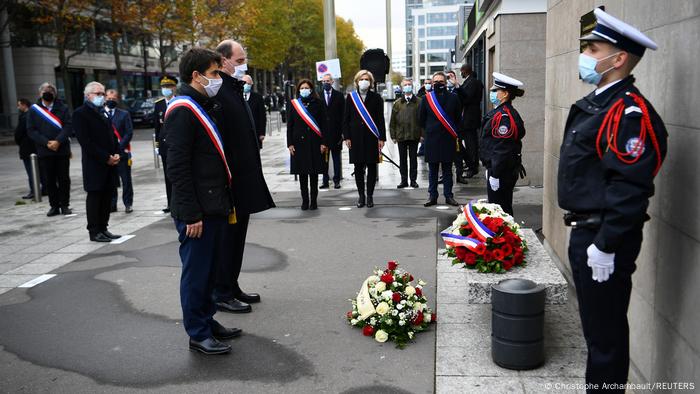
FRANCE COMMEMORATES 2015 PARIS TERROR ATTACKS — IN PICTURES
Remembering victims of 2015 attacks
France marked the fifth anniversary of the 2015 Paris terror attacks with solemn memorials across the city. Over 130 people were killed by Islamic State extremists who carried out coordinated attacks at France's national stadium, the Bataclan theater and several cafes. Prime Minister Jean Castex and other French officials attended silent ceremonies, starting at the Stade de France.
"This is a major success in the fight against terrorism," Parly said.
Security experts in Mali are more skeptical regarding the impact of Moussa's death. Ousmane Kornio, a Mali security expert who advises the Friedrich Ebert Foundation in Germany, does not believe that his killing will curb terror activities in the country.
"Terrorism in the region is like a snake with many heads," Kornio told DW. "If you cut off one, another head grows in its place."
Why are French forces in Mali?
Former colonial power France has more than 5,100 personnel spread across the region with a large portion in Mali operating against rising militancy.
But fighting has spread to central Mali, and to neighboring Burkina Faso and Niger, leaving thousands dead and hundreds of thousands forced to flee their homes.
Mali's military coup
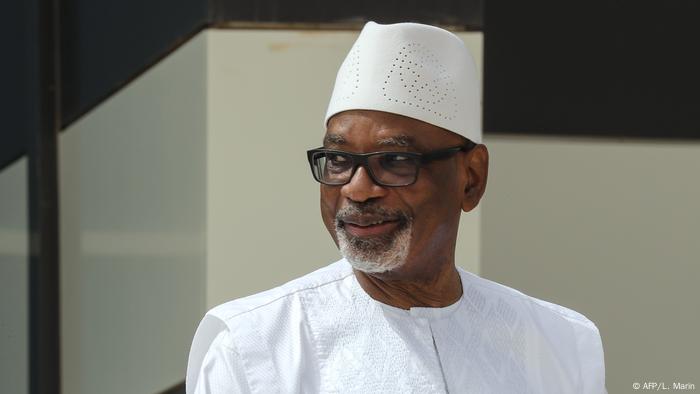
Vast swathes of Mali lie outside effective government control. Frustration over the seemingly endless conflict contributed to mass protests that led to the military ousting President Ibrahim Boubacar Keita (below) on August 18.
Former Malian president Ibrahim Boubacar Keita, who was ousted in an August 18 coup
Mali’s new interim government, which was appointed to rule for 18 months before staging elections, appears willing to engage in dialogue.
Last month, it secured the release of four hostages held by Islamist groups — including 75-year-old Sophie Petronin, the last remaining French hostage in the world — in exchange for about 200 prisoners, some of whom are thought to have been jihadists.
Rights defenders have criticised an amendment to the Indian Foreign Contributions Act (FCRA), which oversees foreign funding to NGOs, with International Commission of Jurists (ICJ) saying it is “a tool to silence” civil society organisations in the South Asia nation.
In a briefing paper released on Thursday, the ICJ states that the FCRA is “severely shrinking” civil space in India and poses unnecessary obstacles to human rights defenders in India by “unlawfully obstructing” the work of NGOs in the country of 1.3 billion.
The ICJ said the FCRA “fails to comply with India’s international legal obligations to respect and protect the rights to freedom of association, expression, peaceful assembly, and the right to take part in the conduct of public affairs”.
The FCRA regulates foreign donations with the aim of ensuring that such donations do not adversely affect the “national security” of India.
Originally enacted in 1976 with the aim to prevent foreign donations to political parties, the law has been amended to starve NGOs, particularly rights groups and environmental NGOs critical of the Hindu nationalist government of Prime Minister Narendra Modi. Foreign funding to political parties remains illegal in India.
UN High Commissioner for Human Rights, Michelle Bachelet, expressed concern in October that the FCRA was being used to “deter or punish NGOs for human rights reporting and advocacy”.
In September Amnesty International decided to halt its work in India after the bank account of its India branch was frozen by the right-wing government [File: Aijaz Rahi/AP Photo]The ICJ is concerned that the overbroad language of the FCRA law means that it can be applied in an arbitrary manner. It considers the Act as being part of a “clampdown on Indian human rights defenders” consisting of arbitrary arrests and other forms of harassment.
“All governments have a duty to prevent corruption, but financial regulation should not be used to stifle the crucial role of civil society simply because the authorities find it hard to deal with constructive criticism,” Meenakshi Ganguly South Asia director at Human Rights Watch told Al Jazeera.
The Act prohibits civil society organisations from accessing an FCRA certificate based on the prohibition on receipt of foreign funds for organisations of a “political nature” and activities against “public interest”, “economic interest” or “security”, where these terms are not defined or defined overly broadly.
On Wednesday the Indian government amended the FCRA rules making it tougher for NGOs to access foreign contributions. According to the new rules, an NGO is now prohibited from transferring funds to another NGO, Aadhaar card, the biometric ID, is mandatory for registration, and prior permission required to receive foreign funds.
“The new Act together with the new regulations make running a human rights organisation in India with any foreign contribution extremely difficult,” Anubha Rastogi, a human lawyer based in Mumbai, told Al Jazeera.
“The wording of the law ensures that the state has the power and wide discretion to interpret any activity as being political in nature”.
Greenpeace and Amnesty
The Act has been used to obstruct civil society as early as 2015 when the Ministry of Home Affairs cancelled the FCRA registration of Greenpeace India. Priya Pillai, a member of the environmental watchdog, was prevented from flying to the UK where she was expected to campaign against use of coal mining that impacts tribal people.
Crippled by funding cuts, the Greenpeace India was forced to shut its offices in India and lay off staff.
Since taking power in 2014, Modi government has cancelled the licenses of more than 20,000 NGOs which received foreign funds under the FCRA. A leaked report by intelligence bureau, India’s domestic intelligence agency, said Greenpeace and Amnesty among others were stalling development.
A number of activists particularly those working among marginalised sections such as Dalits – former untouchables – and tribals have been arrested after being dubbed as “Maoist sympathisers”.
In September Amnesty International decided to halt its work in India after the bank account of its India branch was frozen by the right-wing government, forcing it to lay off staff and stop its work in the South Asian nation.
Amnesty has complained of continuous harassment by the government of Prime Minister Narendra Modi. The London-based rights organisation also accused the government of running an “incessant witch hunt” campaign against human rights organisations over “unfounded and motivated” allegations.
Rights defenders say the FCRA has a “chilling effect” on NGOs in India who are not accepting foreign donations for fear of running afoul of the FCRA. According to a 2019 report, foreign funding to more than 3 million NGOs in India saw a decline of 40 percent between 2015 and 2018.
“While it will impact a large number of organisations, two specific sets of organisations will be hit worst: firstly the small, grassroots NGOs who work collaboratively with larger organisations or NGOs, since the new amendment now prohibits sub-granting to any other organisation,” Yamini Mishra, South Asia director of Amnesty International, told Al Jazeera.
“This will mean almost a death knell for hundreds and thousands of small NGOs.
“The other set of groups who will be directly hit by the law is those engaged in advocacy, policy research work, alliance and network mobilisation,” said Mishra.
The ICJ is calling on the Indian government to set up an independent committee to review the FCRA.
The UN Human Rights Committee has also weighed in on the matter. It stated that the restrictions in the law on funding has to be expressed with a degree of precision that can enable individuals or an organisation to regulate their conduct accordingly.
According to Mishra, Amnesty India has already appealed against the state’s actions in the high court and is “intent on fighting this battle till there is a final resolution in our favour”.
The Indian government has defended its actions saying NGOs have flouted funding rules and some of them indulged in corruption.
Wall Street shares backpedaled on Friday, while the U.S. dollar pared losses after Democrat Joe Biden pulled ahead of President Donald trump in two battleground states that could put him in the White House.
FILE PHOTO: Democratic U.S. presidential nominee Joe Biden is accompanied by vice presidential nominee Kamala Harris as he makes a statement on the 2020 U.S. presidential election results during a brief appearance before reporters in Wilmington, Delaware, U.S., November 5, 2020. REUTERS/Kevin Lamarque
Biden took the lead in Pennsylvania and Georgia for the first time on Friday, three days after polls closed, according to Edison Research. With a 253 to 214 lead in the Electoral College vote that determines the winner, according to most major television networks, Pennsylvania’s 20 plus Georgia’s 16 electoral votes would put the former vice president over the 270 he needs for victory.
MARKETS
* STOCKS: Dow down 0.57, S&P 500 down 0.63%, Nasdaq down 1.2%
* BONDS: Yields on the 10-year note rose 0.8218%
* FOREX: The dollar index was off 0.22%
* VIX: The VIX was off 0.2% at 27.45
COMMENTS
JUSTIN HOOGENDOORN, HEAD OF FIXED INCOME STRATEGY, PIPER SANDLER, CHICAGO
“The probability of a Democratic (White House) victory was already high. In some sense the elimination of the uncertainty is pushing up yields.”
“Also a rising possibility of the Democrats being able to push more significant legislation through in the Senate. It may not be likely , but even if they capture one Senate seat, it just becomes more plausible to push some legislation through. The closer they are to that, the more plausible.”
Newswise — The climate seems to be getting warmer. This could be bad news for species that depend on stable and abundant access to food at certain times of the year.
"If the changes happen too fast, species can become extinct," says Emily Simmonds, an associate professor at the Norwegian University of Science and Technology's (NTNU) Department of Biology.
She is the first author of an article in Ecology Letters that addresses how great tits can be affected if the supply of larvae changes in the spring.
Several bird species depend on the abundance of larvae while their young are small. If the larvae supply peaks earlier in the spring than normal, there may simply be too little food for the hatchlings.
The warming climate can bring about changes like this. An earlier spring causes trees to leaf out earlier, which in turn causes the larvae that feed on the plants to hatch out earlier.
"When the climate changes, the interactions between different species changes too," Simmonds says.
She and a team of researchers at the University of Oxford used population models to calculate the consequences of different climate scenarios. They wanted to see at what point the changes would happen too fast for the great tit to modify its behaviour quickly enough to keep up with the larvae.
Great tits have genetic variations and varying abilities to adapt to different conditions. This means that they can evolve in tandem with their prey up to a point.
An earlier larvae hatch can be advantageous for the great tits that also hatch their young earlier in the spring. This advantage can be transferred to the next generation of birds, which can in turn become early birds. And so on.
For this advantage to last, the great tits have to evolve fast enough and be flexible enough to keep up with the genetic variation in their prey.
"Given conditions with big greenhouse gas emissions, the great tits won't always be able to keep up with the changes in the larvae supply," says Simmonds.
In the worst case scenario, whole populations of great tits will simply disappear by the year 2100 because they aren't able to procure enough food for their young.
"This could happen even if the great tits are also modifying their behaviour faster in a rapidly changing environment. The larvae might be changing even faster than the great tits," Simmonds says.
The researchers found that populations of great tits would be guaranteed to become extinct by the year 2100 if the larvae appeared about 24 days earlier than the current norm in 2020. This also applies to populations that appear to be completely stable now.
"It could be that the apparent stability today is hiding a future collapse," says Simmonds.
The reason is that we might reach a kind of threshold where the great tits aren't keeping up. The rubber band gets stretched too far, you could say.
"The good news is that the populations will be able to survive scenarios with lower or medium warming trends," Simmonds says.
###
Simmonds collaborated with Dr. Ella Cole, Professor Ben Sheldon and Professor Tim Coulson at the University of Oxford on the project, which was part of Simmonds' doctoral dissertation at the British university.
Source: Ecology Letters. Phenological asynchrony: a ticking time-bomb for seemingly stable populations?



![The ICJ is concerned that the overbroad language of the FCRA law means that it can be applied in an arbitrary manner [File: Vijay Pandey/Al Jazeera]](/wp-content/uploads/2019/04/233fe23f2f9f4db48b4da12c50af214b_18.jpeg?resize=770%2C513)
 In September Amnesty International decided to halt its work in India after the bank account of its India branch was frozen by the right-wing government [File: Aijaz Rahi/AP Photo]


