MITRA MANDAL GLOBAL NEWS

सरकार ने चीन की 47 और ऐप पर रोक लगाई:

Authentic news,No fake news.

पीटीआई-भाषा संवाददाता 14:29 HRS IST


नयी दिल्ली, 27 जुलाई (भाषा) सरकार ने चीन की 47 और ऐप पर रोक लगा दी है। इसके साथ ही अब तक चीन की कुल 106 मोबाइल एप को देश की संप्रभुता, एकता और सुरक्षा के लिये नुकसानदेह बताते हुये रोक लगाई जा चुकी है। सूत्रों ने यह जानकारी दी है।

इस घटनाक्रम की जानकारी रखने वाले सूत्र ने बताया कि जिन 47 नई चीनी ऐप पर अब रोक लगाई गई है वह पहले बंद की गई ऐप के ही प्रतिरूप अथवा भिन्न रूप हैं।

सूत्र ने बताया कि इस संबंध में शुक्रवार को आदेश जारी कर दिया गया है। जिन नई ऐप पर रोक लगाई गई है उनकी सूची तुरंत उपलब्ध नहीं हो पाई है और न ही इसके बारे में आधिकारिक तौर पर कुछ कहा गया है।

सरकार ने इससे पहले 29 जून को चीन की 59 ऐप पर पूरी तरह से रोक लगा दी है। सरकार ने इन ऐप को देश की संप्रभुता, एकता और सुरक्षा को नुकसान पहुंचाने वाला बताया है।

लंबा जीवन जीने का आसान तरीका।

Authentic news,No fake news.

МОСКВА, 27 июл — РИА Новости, Альфия Еникеева. По данным исследователей, у тех, кто ходит на работу пешком, ниже риск преждевременной смерти. Такие люди выносливее, у них реже бывают инфаркты и инсульты. Любители прогулок в среднем живут дольше, чем их ровесники, предпочитающие транспорт. Правда, это зависит от того, сколько шагов в день совершает человек.

Здоровье в ногах

В 2017 году ученые Университета Глазго (Великобритания) выяснили: люди, которые добираются до работы пешком или на велосипеде, чаще доживают до старости. Этот вывод специалисты сделали после почти пятилетнего наблюдения за 200 тысячами британцев.
За это время примерно две с половиной тысячи человек умерли. Еще у трех тысяч обнаружили злокачественные опухоли, а 1200 диагностировали сердечно-сосудистые заболевания. Среди них велосипедистов и тех, кто ходил на работу пешком, было мало. А меньше всего инфарктов и инсультов у любителей пеших прогулок.
Однако работа британских исследователей не учитывала скорости ходьбы и затраченного на нее времени. Эти параметры проанализировали сотрудники Медицинского университета Южной Каролины (США), изучив данные 135 тысяч американцев.
Ученые наблюдали за ними с 1999 по 2012 год. В начале проекта средний возраст добровольцев составлял 70,7 года у мужчин и 68,9 — у женщин. Спустя тринадцать лет примерно треть скончалась. Исследователи сопоставили данные о смертности и ее причинах с физической активностью. Те, кто ходил меньше 150 минут в неделю в среднем темпе или всего 75 в энергичном, умирали чаще. Кроме того, у них было больше легочных и сердечно-сосудистых заболеваний.
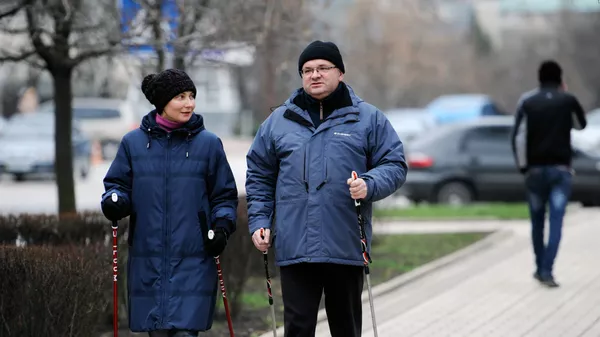
Скандинавская ходьба
Ученые выяснили, почему ходьба улучшает работу мозга

Главное — скорость

По мнению австралийских, британских и ирландских ученых, важна не столько регулярность ходьбы, сколько скорость. У любителей быстрого шага риск умереть, в том числе от сердечно-сосудистых заболеваний, в среднем на 20 процентов ниже. И с возрастом положительный эффект усиливается.
Исследователи попросили 50 тысяч здоровых британцев старше тридцати лет рассказать о привычках и образе жизни, в том числе о том, как часто и насколько быстро они ходят. В специальной анкете каждый доброволец обозначил свою скорость как медленную, обычную, оживленную — или высокую, 6,4 километра в час.
Дедушка с внуком на прогулке
Ученые рассказали, какая опасность может скрываться в медленной ходьбе
Два года спустя эти данные сопоставили со сведениями об умерших. Оказалось, у людей, шагающих со средней скоростью, риск преждевременной смерти на 20% ниже, чем у "тихоходов". А вот у тех, кто двигается быстро, этот показатель ниже уже на 24%.
Еще заметнее эффект среди добровольцев старше 60 лет. В этой группе средняя скорость уменьшала риск кончины от сердечно-сосудистых заболеваний на 46%, а оживленная ходьба — на 53%.

Так сколько все-таки шагов

Ученые из Гарвардской медицинской школы (США) предлагают измерять пользу ежедневных прогулок в количестве шагов.
Они попросили 16 тысяч женщин старше 70 лет неделю ходить со специальным устройством, фиксирующим передвижения в течение дня. Четыре года спустя данные о физической активности соотнесли с информацией о здоровье или причинах смерти — 504 участницы скончались.
Как выяснилось, важно даже незначительное увеличение количества шагов. Те, кто делал больше четырех тысяч, умирали реже, чем те, кто совершал всего 2700. Но закономерность работала только до семи с половиной тысяч шагов. Десять или даже 15 тысяч уже не давали ощутимого эффекта.
Скорее всего, эти цифры актуальны для возраста от 70 лет, отмечают авторы работы. И не исключают, что у молодых все иначе — чем больше шагов, тем выше защита.
Мужчина работает за компьютером
Это предел. Ученые назвали максимальную продолжительность жизни человека
Эксперимент американских коллег это подтвердил. Ученые из Национального института онкологии и Университета Теннеси 12 лет наблюдали за физической активностью и состоянием здоровья 4840 американцев старше сорока.
Каждый около недели носил фитнес-браслет с акселерометром. Фиксировали не только количество шагов в день, но и интенсивность ходьбы — по пиковой скорости в минуту, полчаса и за сутки. Затем сопоставили эти данные со сведениями о смертности за 12 лет исследования.
Анализ показал: делавшие по восемь тысяч шагов в день умирали на 51% реже. А среди совершавших 12 тысяч шагов и больше смертность ниже уже на 65%. При этом интенсивность ходьбы никак не влияла на состояние здоровья и продолжительность жизни.
Другое дело, что выполнять определенную норму по ходьбе тяжело психологически, отмечают британские исследователи. Группа подростков по их просьбе делала не меньше десяти тысяч шагов ежедневно — вскоре участники пожаловались на сложность задания, хотя до конца эксперимента продержались все.

Trump the Wannabe Dictator

Authentic news,No fake news.


By Alon Ben-Meir

Dr. Alon Ben-Meir, a professor of international relations at the Center for Global Affairs at New York University (NYU), teaches courses on international negotiation and Middle Eastern studies.
US President Donald Trump with UN Secretary-General Antonio Guterres. Credit: UN Photo/Manuel Elias
NEW YORK, Jul 24 2020 (IPS) - I, like many of my fellow Americans, am extremely concerned about Trump’s dictatorial tendencies. Given his behavior – what he said and did over the past four years – he may well act on some of these tendencies, especially if he loses the election by a narrow margin.
The concerns I have are not numerous, but are extremely critical: what if he challenges the results of the election and remains adamant on calling for a recount or a new election entirely? What if he refuses to leave the White House and prevents the peaceful transition of power?
What if he calls on the military to occupy all major American cities while he still is the Commander-in-Chief between Election Day and the inauguration of the new president? And what if he prompts his supporters to take up arms, converge into the streets, and violently confront the likely massive number of protesters who would demand Trump’s removal from the White House, which could lead to some kind of a civil war?
Although many Democratic leaders, including Joe Biden, and scores of journalists and others have spoken about their concerns in this regard, there is still no rife discussion about the above unthinkable scenarios.
Besides, does Congress – the House and/or the Senate – have the constitutional power to take action in such a situation, or does the Supreme Court have the authority to intervene? Is there anything else in the constitution that would address these troubling issues?
The 20th Amendment says that “The terms of the President and the Vice President shall end at noon on the 20th day of January.” But what if he doesn’t leave? I posed this question to Erwin Chemerinsky, Dean of the UC Berkeley School of Law and one of the country’s foremost constitutional scholars. “After all,” he said, “that has happened elsewhere in the world. 
My hope is that the courts would quickly rule that Joe Biden is the President and has all of the powers of the office… Every incumbent president who has lost a reelection bid, starting with John Adams in 1800, has left office without incident.”
In my view, however, Trump may well be an aberration. And what if Trump still will not leave the White House? Chemerinsky said, “I doubt that the military would stick with him in that circumstance. Of course, if it did, we would then have a military dictatorship, as other countries have experienced. What if some of the military with the right-wing militias support Trump.  Then we would have some kind of a civil war.”
While many Republicans and Democrats may think that any of these scenarios are far fetched, the fact remains that Trump has dictatorial tendencies and occasionally acts on them by testing the ground to gauge the public reaction and weigh how his base responds to his moves. Here is what he displays, and how much in common he shares with dictators in general.
President for life: Trump has said on many occasions that he will be president for life —in March of 2018, he played around with the idea after praising Xi Jinping for granting himself precisely that term extension. Trump also retweeted an absurd meme showing him remaining president for 88,000 years — slightly longer than the human lifespan.
‘I can do whatever I want: Like many despots, on Tuesday July 23, 2019 Trump suggested that the constitution gives him the power to do “…whatever I want as president.” But I don’t even talk about that.” Albeit, he often tries to do just that to see if he can get away with it.
Defies reality: Trump notoriously lies and create his own reality just like many dictators do. Bob Woodward reports in his book Fear that John Kelly described Trump as unhinged: “He’s an idiot. It’s pointless to try to convince him of anything. He’s gone off the rails. We’re in Crazytown. I don’t even know why any of us are here.”
Presents himself as infallible: Authoritarian leaders never admit that they made a mistake, and neither does Trump. For example, in a tweet he refused to back down from his “forecast” that Alabama was going to be hit by Hurricane Dorian, which was false. Trump went so far as to alter the National Weather Service’s map of Dorian’s trajectory to include part of Alabama to ‘prove’ that he was right.
Vindictive: Vindictiveness is second nature to all dictators. Following his impeachment acquittal, Trump was characteristically vindictive towards his perceived enemies. They were “evil, vicious, corrupt ‘dirty cops.’” He is habitually mean-spirited and spiteful. Trump’s cruelty is often gratuitous, without any explanation. It is just who he is.
Narcissist: We have yet to know one despot who is not self-centered to the core. Trump, in fact, is a textbook narcissist. Sander Thomaes, developmental psychologist at Utrecht University, maintains that Trump is “a prototypical narcissist.” He has grandiose visions of oneself; the need to be admired, and envied.
Domestic military intervention: Trump is quick, like all tyrants, to resort to the military to show his strength and authority. On June 1, 2020 Trump deployed the military to intervene during the protests in DC. He dispatched federal troops with no identification to quell the protests in Portland two weeks ago against the will of the mayor, which continue to haul peaceful protesters off in unmarked cars, akin to the Gestapo. He is further threatening to send more federal law enforcement officers to major US cities. “We’re not going to let this happen in our country,” he said, “all run by liberal Democrats.”
Praises dictators: Trump’s affinity for dictators, whom he envies for doing whatever they please without accountability, is well-known. On Sept. 7, 2016 Trump said on NBC: “If [Putin] says great things about me, I’m going to say great things about him. I’ve already said, he is really very much of a leader.” About the ruthless Turkish President Erdogan, he stated “I’m a big fan of the president.”
Attacking media: Free media is the biggest threat to authoritarian regimes. Trump’s attacks on the media are routine, calling it the “enemy of the people.” During last year’s trip to the G20 summit in Japan, Trump said to Putin regarding the media present: “Get rid of them. Fake news is a great term, isn’t it?”
Conspiracy theorist: Trump is a master in conspiracy theories. That’s what despots often concoct to punish their enemies. Among the many conspiracies he promotes, Trump claims Ukrainians, not Russians, interfered in the 2016 election and were working against him (despite overwhelming agreement from intelligence that Russians hacked the DNC server).
Withdrawal from international agreements/organizations: Authoritarian leaders often defy international agreements when it serves their interests to appeal to their political base. Trump has withdrawn from the Paris Agreement on climate change in June 2017, the Joint Comprehensive Plan of Action in May 2018, and the UN Human Rights Council in June 2018, among many others.
Trump’s attacks on critics: Dictators do not tolerate any criticism. In January 2017, in response to criticism from Rep. John Lewis, Trump said “Congressman John Lewis should spend more time on fixing and helping his district, which is in horrible shape and falling apart (not to mention crime infested) rather than falsely complaining about the election results.”
Surrounding himself with Yes men: Like any despot, Trump retains only those who agree with him. As a former National Security Council official told Politico “I feel like you already don’t have an A Team or B Team. You’re really getting down to who’s left that will say ‘yes.”
I do not believe that Democrats and responsible Republican leaders should simply dismiss any of the above alarming scenarios only because they did not happen before. Trump is unlike any of his predecessors; he is corrupt to the core and his self-interest as he perceives it comes before the nation.
He desperately wants to cling to power, in whatever way he can. Just like any dictator, he will stoop to any low, cheat, lie, threaten, viciously attack his opponents, suppress voting rights (especially of the Black and Hispanic communities), and continue to delegitimize the upcoming elections even before they take place.
His enablers, the leadership of the Republican party, stood idly by all along and allowed him to run wild, to jeopardize the country’s domestic security and global standing, for which they will pay dearly come November.
I am hopeful that none of the above scenarios will occur. But can we be certain that, given his disturbing behavior and consistent efforts to emulate dictators, Trump would simply concede if he loses the election and peacefully vacate his office come January 20, 2021?
We can only hope so, but it will be a grave mistake not to take these clear warning signs seriously. Be aware America, and be prepared to act.


German sniffer dogs show promise at detecting coronavirus

Authentic news,No fake news.

 Deutsche Welle 

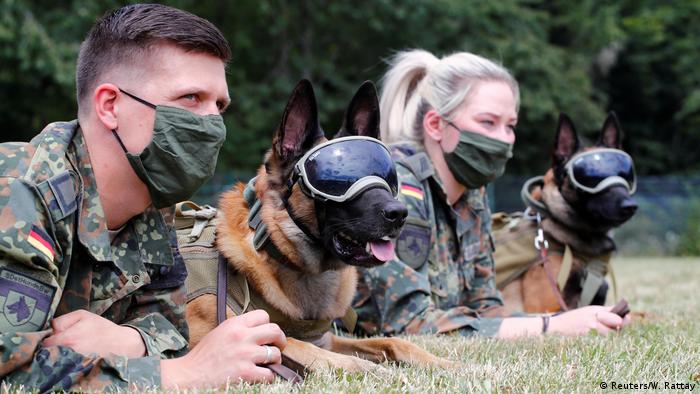
Deutschland Coronavirus Spürhunde der Bundeswehr (Reuters/W. Rattay)
Scientists at the University of Veterinary Medicine Hanover have found that trained sniffer dogs could be used to detect COVID-19 in human samples with a relatively high rate of accuracy, a study published on Thursday revealed.
Eight sniffer dogs from the German Bundeswehr were trained for only a weekto distinguish between the mucus and saliva of patients infected with coronavirus and non-infected individuals.
The dogs were then presented with positive and negative samples on a random basis by a machine.

'Potential to take this further'

The animals were able to positively detect SARS-CoV-2 infected secretions with an 83% success rate, and control secretions at a rate of 96%. The overall detection rate, combining both, was 94%.
In its conclusion based on more than 1,000 sniffed samples, published in the BMC Infectious Diseases journal, the team said dogs could play a role in detecting infected individuals.
Sniffer dogs that normally look for explosives or drugs have been used previously to smell various cancers and hypoglycemia in diabetics. This medical application motivated veterinary scientists to research the potential ability of sniffer dogs to detect the coronavirus. 
"We think that this works because the metabolic processes in the body of a diseased patient are completely changed and we think that the dog is able to detect a specific smell of the metabolic changes that occur in those patients," said Professor Maren von Köckritz-Blickwede, a specialist in the biochemistry of infections.
"What has to be crystal clear is that this is just a pilot study," said Holger Volk, chair of the university's department of small animal medicine. "There's a lot of potential to take this further — to really use these dogs in the field."
In their conclusion, the team envisaged using sniffer dogs to detect infectious individuals in certain places. 
"In countries with limited access to diagnostic tests, detection dogs could then have the potential to be used for mass detection of infected people," said the conclusion. "Further work is necessary to better understand the potential and limitation of using scent dogs for the detection of viral respiratory diseases."
The samples with which the sniffer dogs are being tested were chemically rendered harmless. The question remains whether the canines can detect active coronavirus cases in patients. 
The researchers are also looking at how well dogs can differentiate between samples from COVID-19 patients and those with other diseases such as flu.

10 of the Most Popular Science and Education YouTube Channels

Authentic news,No fake news.

By-

Elise Moreau


YouTube is the place to go to find out more about a topic you're interested in or to find an answer to a question. From human anatomy and physiology to astronomy and the environment, you can always count on some of the brightest, smartest people on YouTube to help you learn something new.
Science and education shows on YouTube are a big channel theme trend these days, with many of them racking up millions of views and subscribers for their ability to explore and present their information in such fun and creative ways. Adding special effects, filming real experiments, and pumping some personality into their lessons allow YouTubers to create videos that are far more exciting and interesting to watch than a similar lesson you might get from a college or university course.
The incredible people who run these channels know how to make learning fun. Take a look at the following list of top science and education channels that make you want to learn as much as possible while keeping you entertained.
01
of 10

Vsauce

Vsauce screenshot
Vsauce is a channel that never disappoints. Host Michael Stevens explains some of life's most interesting questions like Did the past really happen? or Why don't we all have cancer? His videos can be enjoyed by just about everyone; they never lack in thought-provoking details. Michael knows how to break down even the most complex topics and ideas in an intriguing way so everyone can understand them.
02
of 10

VlogBrothers

Vlog Brothers Screenshot
John and Hank Green of the VlogBrothers are two of the most accomplished and recognized YouTubers of all time. On their main channel, they take turns vlogging back and forth about various topics, often taking questions from their viewers — also known as nerd fighters. Together, they've launched lots of other successful projects including the annual VidCon YouTube conference and the DFTBA Records distribution network.
03
of 10

MinutePhysics

MinutePhysics Screenshot
MinutePhysics puts a cool spin on learning with bite-sized videos that explain science and physics topics in hand-drawn doodles that are sped up to the speed of the narration, so you get the clearest visual representation of what's being explained. For viewers who are short on time and attention span, MinutePhysics's 2- to 3-minute videos offer the perfect mini-lessons for straight-to-the-point learning.
04
of 10

SmarterEveryDay

SmarterEveryDay Screenshot
The SmarterEveryDay YouTube show features a mashup of everything from general vlogging about interesting science topics and telling stories via short animations to getting out and filming real experiments. Host Destin Sandlin is always mixing it up to keep it exciting. Unlike a lot of other YouTube channels out there, SmarterEveryDay often follows a casual vlogging style and doesn't have to use a ton of fancy editing tricks and effects to be interesting to watch.
05
of 10

PBS Idea Channel

PBS Idea Channel screenshot
Want a break from all that science stuff, but still want to learn something new and awesome? The PBS Idea Channel and host Mike Rugnetta explore fascinating connections in pop culture, technology, and art. A lot of the other channels on this list focus on presenting real facts and scientific explanations, while this one focuses more on ideas, trends, and opinions to back up interesting arguments. The channel is officially part of PBS.org. It releases a new video every Wednesday.
06
of 10

Numberphile

Numberphile screenshot
Hate math? You may want to reconsider after watching a video or two from Numberphile — a YouTube shows that's all about number exploration. You'll be surprised to learn just how many everyday things in life can be explained in a numerical sense. From figuring out how to win at a game of Dots, to understanding what infinity means, Numberphile can probably turn any bad math student into someone who wants to learn more about the wonderful world of numbers.
07
of 10

Veritasium

Veritasium screenshot
If you're looking for an all-around cool science show with great variety, maybe similar to the kind of stuff you see on the Discovery channel, then Veritasium is a YouTube channel you need to subscribe to. The show focuses on delivering "the element of truth" in all sorts of science and engineering topics, featuring everything from amazing demos and mind-blowing experiments, to interviews with experts and interesting discussions with all sorts of different people.
08
of 10

AsapScience

ASAPScience screenshot
Similar to MinutePhysics, AsapScience uses fun and colorful doodles to dig down deep into some of life's most fascinating questions, using science, of course. The show answers questions like, What if humans disappeared? and Should we all be eating insects? It's hard not to be enticed by some of these titles. Each video does such a great job at teaching that even some of the youngest and least scientifically educated people should be able to understand it. 
09
of 10

CrashCourse

CrashCourse screenshot
John and Hank Green from the Vlog Brothers also run the CrashCourse channel — a show dedicated to offering free courses in anatomy, physiology, world history, psychology, literature, astronomy, and politics. John and Hank host the show along with three other prominent YouTube hosts. With the help of these free online courses, both teachers and students can benefit from a learning style that's not only incredibly informative but fun and rewarding too.
10
of 10

SciShow

SciShow Screenshot
SciShow is yet another of the many other channels the Vlog Brothers have launched over the years. Primarily hosted by Hank Green, SciShow seeks to educate viewers about science, history and other interesting concepts. Out of all shows on this list, this one probably has some of the coolest editing effects. Colorful animations and text fly around the host as he speaks while tackling questions like Why are eggs egg-shaped? and How do oysters make pearls?

Mitra-mandal Privacy Policy

This privacy policy has been compiled to better serve those who are concerned with how their  'Personally Identifiable Inform...