MITRA MANDAL GLOBAL NEWS

Women & Youth Remain Politically Underrepresented in Africa’s Most Populous Nation By Ulrich Thum and Lena Noumi

Authentic news,No fake news.

Ulrich Thum is the Resident Representative of the Friedrich-Ebert-Stiftung office in Abuja, Nigeria. He has previously worked as a program coordinator for the GIZ Civil Peace Service program in Zimbabwe and as a peace worker for AGEH in South Sudan and Nigeria.

Lena Noumi holds a bachelor's degree in Political Science and is currently studying International Relations and Development Policy at the University of Duisburg-Essen.
Women queue during Nigeria's presidential election at Capital School polling unit, in Yola. Credit: Reuters
ABUJA, Nigeria, May 23 2019 (IPS) - Two months after the general elections in Nigeria, Africa’s most populous nation, things are back to normal. The incumbent President Muhammadu Buhari, a 76-year-old general and former military Head of State, clearly defeated his challengers.
With his All Progressives Congress (APC), he has been propagating the fight against rampant corruption, economic recovery and the restoration of security. Especially the North-Eastern part of the country has been terrorised by the Islamist insurgency group Boko Haram for over 10 years.
While his progress in economic recovery and restoration of security can at best be described as moderate, Buhari’s anti-corruption war is the subject of much contention. Some have trust in his efforts while others criticise his onslaught as one-sided and directed mostly at the opposition.
The main opposition party, the People’s Democratic Party (PDP), had put forward 72-year-old Atiku Abubakar, former Vice-President from 1999 to 2007, as their candidate. He’s a millionaire entrepreneur and now four-time presidential candidate who faced several allegations of corruption.
Even though the euphoria and hope that accompanied Buhari’s election in 2015 had long vanished, Atiku seemed for most to be no viable alternative to Buhari.
The opposition parties failed to come up with a joint candidate who could challenge the political establishment and bring fresh air into the country’s political scene. The tense security situation along with the postponed elections, which was announced only a few hours before, resulted in the lowest voter turnout since 1999 with only 35 per cent.
This suggests that a large portion of the population see little potential for positive change by casting their votes. Many others just sold their votes to at least reap some benefit.
Moreover, the two elderly men’s campaign was rather dispassionate and accompanied by frequent political manoeuvring and allegations against each other, rather than programmatic discussions.
In the aftermath of the election, disillusionment and frustration are widespread. The 2019 elections have shown that a real alternative to the established system of the ‘rule of old men’ has yet to emerge. Women and youths in particular, who make up the majority of the Nigerian population, are not adequately represented in the political system.
Nigeria at lowest rate of women representation
Women are gravely underrepresented in Nigerian politics. Currently, Nigeria has the lowest rate of female representation in parliaments across the continent. Globally, it ranks 181 out of 193 countries, according to the International Parliamentary Union.
Provisions to increase the percentage of women in elected and appointed positions to 35 per cent had no success. According to the Global Gender Gap Report, the gap between men and women in areas like economic participation, education and health, is not nearly as wide as in the realm of politics.
Women are deterred from entering politics by the patriarchal system, in which men are believed to be natural leaders of women, and a lack of transparency in the candidate selection process.
According to Independent National Electoral Commission (INEC), 47 per cent of registered voters and only 7 of the 71 presidential candidates for the 2019 elections were women. Nonetheless, there has never been a female president or state governor elected in Nigeria.
Women currently make up less than 6 per cent of the national parliament members. And it doesn’t look much better when looking at candidatures: of the candidates for the national and gubernatorial elections, women made up roughly one-in-eight. Why’s that?
Women are deterred from entering politics by the patriarchal system, in which men are believed to be natural leaders of women, and a lack of transparency in the candidate selection process. Cultural believes that women are supposed to be in charge of the family rather than being in politics and money politics support the existing system.
Moreover, the lack of a well organised grassroots women’s movement backing and supporting promising candidates results in poor political participation. Obiageli Ezekwesili, known through the successful #BringBackOurGirls campaign, bowed out to the final run-up for the presidential elections disillusioned.
‘We are waiting for the day the political class will now change and decide to be nice. They are never going to be nice, quote me. There is no incentive on the part of our political class to do things differently’.
Too young to run?
While registered youth voters (up to the age of 35) make up more than half of the voter population of 84 million, the young generation has no say in Nigerian politics. There might have been a sense of hope in 2018 within the circles of youth activists: as a result of the #NotTooYoungToRun campaign initiated by the Youth Initiative for Advocacy, Growth and Advancement (YIAGA), a law was passed that opened up the political space for increased youth participation. It reduced the age for presidential candidates from 40 to 35 and for House of Representatives candidates from 30 to 25 years.
Overall, there’s a positive trend in youth participation, as youth candidacy has increased from 21 per cent in 2015 to 34.2 per cent in the 2019 elections. However, the actual numbers of young women and men under the age of 35 voted into elected positions are more sobering. According to YIAGA, only twelve youth candidates under 35 managed to get elected into the House of Representatives, an increase by nine compared to 2015.
At least however, the discourse has shifted and the lack of representation is discussed publicly. For most Nigerian political parties, young people are at best seen as supporters, mobilisers or political foot soldiers.
They are hired to instigate violence, manipulate the elections and intimidate the opposing parties. Some of the smaller parties actively tried to promote women and youth participation through lowering the horrendous costs for the candidacy forms.
But for the major parties, only a few of the women and youth emerged from the primaries on state and federal political level.
The system remains the same
All in all, the Nigerian political system remains dominated by temporary political alliances of ‘old men’ and sustained by huge flows of money. Politics is a way of getting access to huge spoils of money. Political candidates have to invest heavily or are being invested in by others.
The aim is to get a return on that investment. Politicians, rather than considering themselves as representatives of the people, have obligations or intentions that are more monetary than anything else.
Women and youths do not feature well in this money game. Because their probability to win elections is more unlikely, they are not considered a secure investment.
Unfortunately, in the 2019 elections, political movements advocating for the participation of youth and women were unable to challenge the political structures of patriarchy supporting corruption and making Nigerian politics a dirty business.
Nonetheless, first important steps towards change have been made, even though they did not translate into votes yet to a significant degree.
At least however, the discourse has shifted and the lack of representation is discussed publicly. Nevertheless, it will be crucial to actually increase the representation of women and young people, without letting them become a part of the predominant system of money politics that currently exists.
Instead of seeing their future turn as a chance to get their own piece of the national pie, women and young people need to be ready and willing to be monitored and held accountable.
Accordingly, it’s important to nurture and select a future class of principled politicians, especially women and young people, who are ready to truly represent the Nigerian people.

Green party gains strength in Irish votes

Authentic news,No fake news.

BRUSSELS (AP) — The Latest on the European Parliament elections taking place Saturday (all times local): 5:40 p.m. Early vote counts and an exit poll in Ireland suggest that the Green Party is gaining strength in that European Union nation as it challenges three larger parties in local and European elections.


In the Irish votes Friday, an exit poll of more than 3,000 voters suggests that Ireland's top two parties — the governing party Fine Gael and the more conservative opposition party Fianna Fail — are running neck and neck, followed by the nationalist Sinn Fein party and the pro-environment Greens.
Early vote counts on Saturday in Ireland's local election confirmed these trends. Vote counting in the European parliament races will begin Sunday morning. The Red C Research exit poll, which had a margin of error of 3%, also suggests very strong support for a proposal to liberalize Ireland's divorce laws.
Irish voters last year decided in a referendum to overturn the country's ban on abortions.
10:15 a.m.
A far-right party in Slovakia that openly admires the country's wartime Nazi puppet state could win seats in the European Parliament for the first time.
Slovaks are among four countries voting Saturday in the Europe-wide vote, which finishes Sunday.
Polls favor the leftist Smer-Social Democracy party, the senior member of Slovakia's current coalition government to win the most votes.
Polls suggest People's Party Our Slovakia, a far-right party that has 14 seats in Slovakia's parliament, will win seats in the European legislature for the first time.
Party members use Nazi salutes, blame Roma for crime, consider NATO a terror group and want the country out of the alliance and the European Union.
The election reflects a continental struggle between nationalists who want to wrest power back from the EU and moderates who want to make the EU stronger.
8 a.m.
Voters in Slovakia, Malta, Latvia and the Czech Republic are casting ballots in European Parliament elections.
The stakes for the European Union are especially high in this year's elections, which are taking place over four days and involve all 28 EU nations.
Many predict nationalists and far-right groups will gain ground. They would try to use a larger presence in the legislature to claw back power from the EU for their national governments.
More moderate parties want to cement closer ties among countries in the EU.
Britain, Ireland and the Netherlands have already voted. The Czech Republic started voting Friday and continues Saturday. Slovakia, Malta and Latvia are holding their European Parliament elections Saturday — and all the other nations vote Sunday.
Results are expected Sunday night.

Top diplomats of S. Korea, Japan discuss Tokyo's wartime forced labor in Paris talks

Authentic news,No fake news.

PARIS/SEOUL, May 23 (Yonhap) -- The top diplomats of South Korea and Japan discussed a simmering row over Tokyo's wartime forced labor and other pending issues on the sidelines of an international conference in Paris on Thursday.
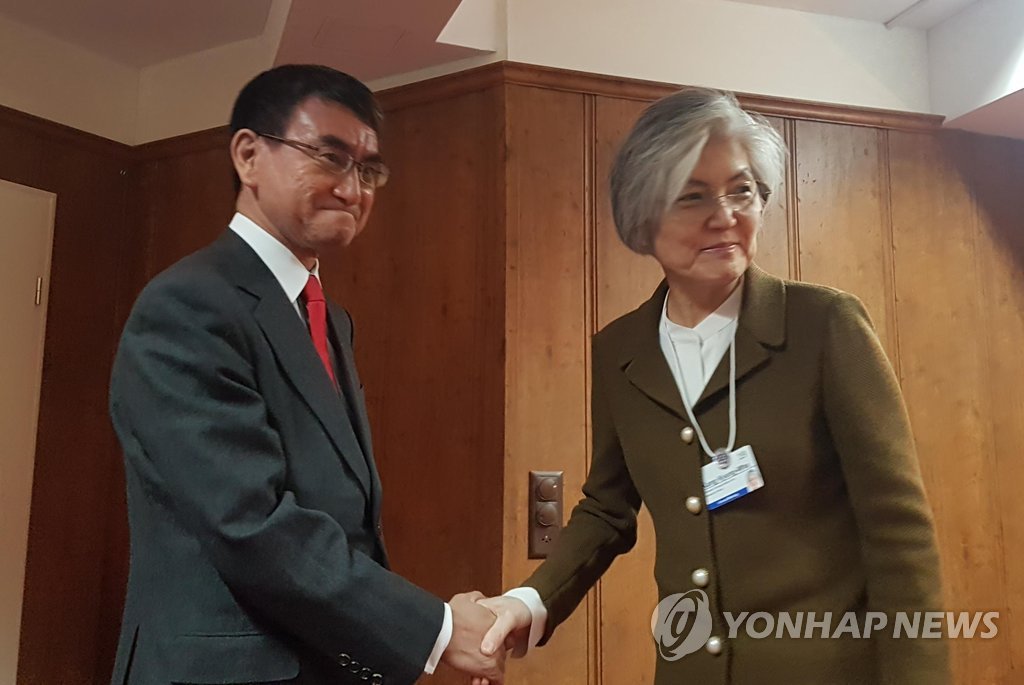
Foreign Minister Kang Kyung-wha called for close bilateral communication. But tensions were palpable as her Japanese counterpart, Taro Kono, voiced discontent over a Seoul official's thinly veiled criticism of Japanese firms' inaction in compensating Korean victims of forced labor.
"There are difficult issues between the two countries, but it is important to closely communicate whenever opportunities arise," Kang said during the talks on the margins of the Ministerial Council Meeting of the Organisation for Economic Cooperation and Development in Paris.
Noting that the new era of "Reiwa," or beautiful harmony, opened with the recent enthronement of Emperor Naruhito, Kang voiced hope that Seoul-Tokyo relations will evolve in a forward-looking manner.
Kono took issue with remarks by Kim In-chul, spokesman of Seoul's foreign ministry, that there would be "no problems" if the Japanese firms in question comply with court orders to remunerate the victims.
Kim made the remarks in reference to Kono's recent call for South Korean President Moon Jae-in to "responsibly" address the forced labor issue.
"I think that is a very serious statement that does not understand the gravity of this matter," Kono said.
"I urge (South Korea) to share the understanding that such remarks will make Japan-South Korea relations very difficult," he added.
Bilateral ties have chilled in recent months as Japan has challenged South Korean Supreme Court rulings last year that ordered Japanese firms to compensate South Korean victims of forced labor during its 1910-45 colonization of the peninsula.
The top court has recognized victims' rights to claim damages, but Tokyo maintains that all reparation issues stemming from its colonial rule were settled under a 1965 government-to-government accord that normalized bilateral relations.
Tensions flared anew on Monday as Japan requested the formation of an arbitration panel involving a third-country member to address the forced labor issue based on dispute settlement procedures enshrined in the normalization accord.
In January, Tokyo called for bilateral diplomatic talks over the issue also based on the accord. But Seoul has remained unresponsive, refusing to weigh in on civil litigation involving private citizens and Japanese firms.
The accord stipulates that the two sides are to settle any dispute related to the accord primarily through diplomatic channels. If they fail to settle it, the case can then be referred to an arbitration panel involving a third-country member agreed on by the two sides.
Should the arbitration panel fail to hammer out a solution, Japan could bring the case to the International Court of Justice.
Seoul has so far been taking a cautious approach, saying that it honors judicial decisions and that it cannot intervene in legal disputes between private citizens and foreign firms still in progress.
The forced labor issue aside, Kang and Kono were expected to discuss the possibility of a summit between President Moon and Japanese Prime Minister Shinzo Abe on the sidelines of the Group of 20 summit slated to take place in Osaka, Japan, on June 28 and 29.
Kang and Kono last held bilateral talks on the sidelines of a security forum in Germany in February.
This file photo, taken Jan. 23, 2019, shows Foreign Minister Kang Kyung-wha (R) shaking hands with her Japanese counterpart, Taro Kono, before their talks on the sidelines of the World Economic Forum in Davos, Switzerland. (Yonhap)
sshluck@yna.co.kr

Earliest evidence of red pigment found in 3 million-year-old mouse fossil

Authentic news,No fake news.


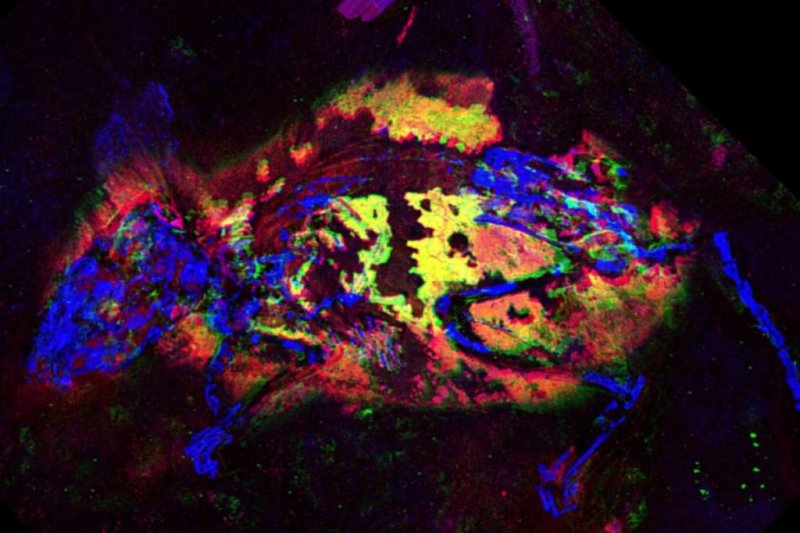
To identify the chemical signatures of ancient pigments, scientists bathed a 3 million-year-old mouse fossil in X-rays. Photo by Phil Manning/Manchester University
May 23 (UPI) -- Redheads are at least 3 million years old. Scientists have discovered red pigment inside the fossilized fur of an ancient mouse specimen found in Germany.
The discovery, detailed this week in Nature Communications, suggests mice a few million years ago looked a lot like they do today.
"Here we find that a 3 million-year-old mouse looks just like a modern mouse," Uwe Bergmann, research scientist at the U.S. Department of Energy's SLAC National Accelerator Laboratory, told UPI. "While this might not be a big surprise, it is -- the fact that we can identify such pigments, now, will have an impact on future findings."
Bergmann and his colleagues at SLAC worked with scientists at Stanford University to identify the chemical signatures of red pigment inside the ancient mouse cells.
RELATED Study: Colored bird eggs come from dinosaurs
To confirm the presence of ancient pigment, scientists first needed to study how modern -- and less-degraded -- pigments interact with other elements. To study these chemical interactions, scientists bathed old and new cells in X-rays using the Stanford Synchrotron Radiation Lightsource.
"With our technique, we take advantage of the fact the melanins associate with metals," SLAC scientist Nick Edwards said. "Other organic pigments such as carotenoids, which produce, for example, the bright colors in parrots, do not easily associate with metals and are currently not detectable with our technique."
Researchers found the same signatures of chemical bonds between red pigment and trace metals in the old and new cells.
RELATED Scientists discover world's oldest colors
The cornucopia of color visible throughout the animal world is proof of the evolutionary importance of pigmentation, but until recently, scientists could say little about the colors of the ancient world.
"Color and pigmentation is critical for survival of a species and for evolution as camouflage, sexual selection, UV protection, heat regulation and keeping the body in equilibrium," Bergmann said. "There is also some speculation that the presence of metals, such as copper for example, potentially prevents decay of soft tissues from bacterial attacks."
By coloring the ancient world, scientists can better understand how animals interacted with one another and with the natural world. An ancient ecosystem with color is one scientists can more easily decipher.
RELATED Ancient sea turtle reveals pigment-based survival trait at least 54 million years old
"For most fossils we have no idea about the color of the living animal. For example all color depictions of dinosaurs are purely imaginative," Edwards said. "We want to know how ancient live forms looked like, also for comparison to modern life form. Knowing this helps with understanding evolution."
Bergmann and Edwards continue to look for new ways to paint a fuller picture of ancient life.
"We are currently working on a series of fossil studies to show how the fossilization processes occur, and what influence the animal fossilization process has on its local environment and vice versa," Bergmann said. "This is basically a type of chemical forensics of dramatic events that happened millions of years ago, and we find that very exciting.

मालदीव में इस्लाम का परिचय

Authentic news,No fake news.


इमरान अब्दुल्ला
मालदीव आकर्षक समुद्र तटों, गोताखोरी के अनुभवों और करामाती सुंदरता की प्रकृति से जुड़ा हो सकता है, लेकिन आप उन द्वीपों के इतिहास को याद कर सकते हैं जिनके नागरिकों को आवश्यक रूप से मुस्लिम होना चाहिए।
मालदीव का संविधान कहता है कि इस्लाम मालदीव की नागरिकता के लिए एक शर्त है। सैंकड़ों छोटे, आकर्षक द्वीपों में कोई भी मालदीव का गैर-मुस्लिम नहीं है, जो बारहवीं शताब्दी तक अरब के समुद्री यात्रियों और व्यापारियों के लिए जाना जाता है।
मालदीव की राजधानी के बीच में "अबू बराकत यूसेफ अल-बरबरी" का मकबरा है, और जैसा कि प्रतीत होता है, वह एक मोरक्को के अमाज़ी तीर्थयात्री और तीर्थयात्री हैं जिन्होंने दस हजार द्वीपों और 87 द्वीपों में से एक में अपनी यात्राओं में से एक को समाप्त कर दिया।
मालदीव के सुल्तान ने मालदीव के सुल्तान अबू बक्रत को सौंप दिया, उसके बाद उनके हमवतन लोगों ने बौद्ध धर्म की पूजा की और सुल्तान ने मस्जिदों और स्कूलों का निर्माण लोगों को उनके नए धर्म की शिक्षा देने के लिए किया जिसमें उन्होंने प्रवेश किया।
मालदीव और मुसलमानोंथा जनसंख्यामालदीव से पहले उनके इस्लाम Marhunin आदतों नीचे अपने जीवन तौला बोझिलइस तरह के अवसर प्रदान करने केऔरत होने के लिएभेंटहै कि वे क्या "समुद्र राक्षस" कहते हैं, और जनजातियों थे मालदीव Tguetra चयन करने के लिएमहिला को हर महीने होमानव शिकार LCF क्रोध और बुराई जिन समुद्र "Ranamare"।

मालदीव के कानूनों में नागरिकों को मुस्लिम होने की आवश्यकता है (वेबसाइट)
मालदीव के कानूनों में नागरिकों को मुस्लिम होने की आवश्यकता है (वेबसाइट)
मोरक्को के अमेजिह यात्री ने चौदहवीं शताब्दी में द्वीपों की यात्रा के दौरान इब्न बतूता को इसके निवासियों और रीति-रिवाजों की स्थितियों के बारे में भी बताया। उन्होंने अपने इस्लाम की कहानी बताई: "फिर उन्होंने अबू बराक अल-बरबारी नामक एक मोरक्को को प्रस्तुत किया। वह महान कुरान के रक्षक थे। वह एक पुराने घर में चले गए। और उनकी योगिनी की केवल एक बेटी थी, अबू बकरत ने उससे कहा: मैं रात में तुम्हारी बेटी को बदलने जा रहा हूं, और आमद चेहरा था, और मैंने उससे कहा, और वे उस रात उसे ले गए, और वे उसे मूर्तियों के घर में ले आए, और उसे पानी पिलाया गया “उसने कहा।
अगली सुबह, जब बूढ़ी औरत और उसके माता-पिता लड़की को बाहर निकालने और उन्हें जलाने के लिए आए, उनके रीति-रिवाजों के अनुसार, उन्होंने अपना स्थान पाया। आशीर्वाद का पिता कुरान पढ़ता है। इब्न बतूता ने अपना उपन्यास पूरा करते हुए कहा: "वे अपने राजा के पास गए और उन्हें शूर्नजा कहा गया। "राजा ने उससे कहा," अगले महीने तक हमारे साथ रहो। यदि आप ऐसा करते हैं, तो आप अशुद्धता से बच जाएंगे। "
इब्न बतूता अगले महीने की घटनाओं को पूरा करता है, जब राजा ने मूर्तियों को सौंप दिया और मूर्तियों को तोड़ दिया, और घर को नष्ट कर दिया, "और द्वीप के सबसे सुरक्षित लोगों को, और बाकी द्वीपों में भेजा गया, Vslm लोग, और मोरक्को के अधिकांश लोगों को स्थापित किया और अपने सिद्धांत में, इमाम मलिक के सिद्धांत पर ईश्वर की दया करें।" , और उनके नाम से एक मस्जिद का निर्माण किया।
इब्न बतूता ने माले की राजधानी में मस्जिद के बारे में बताते हुए कहा: "मैंने लकड़ी में उकेरी गई मस्जिद के इंटीरियर को पढ़ा: सुल्तान अहमद श्नौराजा ने मोरक्को के बर्बर अबू बाराकत को सौंप दिया, और सुल्तान ने एक तिहाई लोगों को राहगीरों के लिए धर्मार्थ बनाया।
यद्यपि इस्लाम ने बारहवीं शताब्दी तक हिंद महासागर में अरब व्यापारियों के माध्यम से मालदीव में देर से प्रवेश किया, लेकिन यह परिवर्तन देश के इतिहास में आधुनिक मालदीव के लिए जाना जाने वाला सबसे महत्वपूर्ण बिंदु था।
अरब व्यापारी सातवीं शताब्दी ईस्वी से इस्लाम के लिए मालाबार तट (भारत के उप-महाद्वीप के दक्षिण-पश्चिमी तट) की आबादी के परिवर्तन का कारण थे, और उसी समय में मुहम्मद बिन कासिम अल-थकाफी के नेतृत्व में विजय प्राप्त करने के बाद से सिंध और पंजाब (अब पाकिस्तान) मुस्लिम बन गए हैं। जबकि इस्लाम धर्म परिवर्तन तक मालदीव 500 वर्षों तक बौद्ध राज्य बना रहा।
मालदीव के अंतिम मालदीव मालदीव के राजाओं के इस्लाम की ओर अग्रसर होने के साथ, सुल्तान मोहम्मद अल-अदेल को छह इस्लामिक राजवंशों द्वारा लाया गया, जिनमें अस्सी-चार शक्तियां थीं, जो 1932 तक चली जब सल्तनत एक निर्वाचित राज्य बन गया।
1965 तक सुल्तान का आधिकारिक शीर्षक भूमि और समुद्र का सुल्तान, बारह हज़ार द्वीपों का स्वामी और मालदीव का सुल्तान महामहिम था।
अरबी ऐतिहासिक रूप से वहां के प्रशासन की प्रमुख भाषा थी, न कि आसपास के इस्लामिक देशों में उपयोग की जाने वाली फारसी और उर्दू भाषाओं की तुलना में। मालदीव में उत्तरी अफ्रीका का एक और लिंक न्यायशास्त्र का मलिकी स्कूल था जो मोरक्को में प्रचलित था और 17 वीं शताब्दी तक उन लोगों में आधिकारिक स्कूल था।


मालदीव में सरितु के नाम से जाना जाने वाला "शरिया", मालदीव (संचार स्थल) का मूल कानून है
"इस्लामी कानून" में भाषा की मालदीव , के रूप में जाना Alsarret गठन की मूल विधि मालदीव (नेटवर्किंग साइटों)
यही कारण है कि इब्न बतूता ने मालदीव में न्यायपालिका के आदेश का पालन करना मुश्किल नहीं पाया, जब वह दौरा किया, जहां वह वर्षों तक रहा जिसमें उसने शादी की और 14 वीं शताब्दी ईस्वी के मध्य में अपने लोगों और उनकी संस्कृति और रीति-रिवाजों के इस्लाम के बारे में लिखा।
क्या अबू अल-बरकत मोरक्को या सोमाली था? कुछ शोधकर्ताओं का कहना है कि एक अन्य परिदृश्य यह है कि इब्न बतूता ने मालदीव के बारे में एक गलती की है, और बारबेरियन बर्बर से अमाज़ह (बेरर्स) के अनुपात में माघरेब कथाओं के पक्षपाती थे, जबकि अबू बाराकबरी बारबेरिया (उत्तरी सोमालिया में एक पुराना वाणिज्यिक बंदरगाह) से उतारा जा सकता है।
जब इब्न बतूता ने द्वीपों का दौरा किया, उस समय द्वीप के गवर्नर सोमाली अब्दुल अज़ीज़ अल-मकदीशवी (सोमाली मोगादिशु) थे। अब्दुल अजीज एक सुल्तान मुस्लिम सुल्तान था, जो मध्य युग में अफ्रीका के हॉर्न के बड़े हिस्से पर शासन करता था।
इस उपन्यास के अनुसार, अबू बराकत अल-बरबारी यूसुफ इब्न अहमद अल-कुनिन के समान था, जिसने हॉर्न ऑफ़ अफ्रीका में अल-वुश्मा के परिवार की स्थापना की, जिसने पूर्वी अफ्रीका में सल्तनत ऑफ एफेट और सल्तनत ऑफ जस्टिस पर शासन किया।
यह उपन्यास मालदीव पर शासन करने के लिए अरबी भाषा के उपयोग और पूर्वी एशिया में गैर-भौगोलिक भौगोलिक संदर्भ में मलिकी स्कूल के प्रभुत्व को समझाने में भी मदद करता है।
मालदीव एक रहस्यमय सूफी की विरासत को बरकरार रखता है और रमजान में दिन के दौरान कैफे और रेस्तरां बंद करता है और मालदीव में "इस्लामिक कानून" बनाता है जिसे मालदीव का सरितु मूल कानून कहा जाता है।
स्रोत: अल जज़ीरा, 

Indian ruling party heads to victory with wide lead in votes

Authentic news,No fake news.


NEW DELHI (AP) — Indian Prime Minister Narendra Modi’s Hindu nationalist party was headed to a landslide election victory in Thursday’s vote count, while the leader of the main opposition party conceded a personal defeat that signaled the end of an era for modern India’s main political dynasty.
Election Commission data on Thursday night showed that Modi’s Bharatiya Janata Party had won 92 seats and was leading in 211 other constituencies out of 542 seats in the lower house of Parliament. Its main rival, the Indian National Congress, had won 25 seats and was leading in 26 others. The final tally was not expected until Friday.
Modi tweeted, “India wins yet again.”
Addressing thousands of party workers celebrating the outcome, Modi urged the world to “recognize India’s democratic power.” He attributed the party’s showing to his pro-poor policies, including free medical insurance and relief for distressed farmers.
The election was seen as a referendum on the 68-year-old Modi, whose economic reforms have had mixed results but whose popularity as a social underdog in India’s highly stratified society has endured. Critics have said his Hindu-first platform risks exacerbating social tensions in the country of 1.3 billion people.
On the campaign trail, Modi presented himself as a self-made man with the confidence to cut red tape and unleash India’s economic potential, and labeled Congress party president Rahul Gandhi, the scion of a political dynasty that lost national power in 2014, as an out-of-touch member of the elite.
Gandhi conceded defeat for his own parliamentary seat to his BJP rival in Amethi, a constituency in the northern state of Uttar Pradesh that had for decades been a Congress party bastion. But Indian election rules allow candidates to run in more than one constituency, and Gandhi was ahead in the race for another seat he contested in the southern state of Kerala.
Asked if he would quit the party’s top post to take responsibility for its dubbing, Gandhi replied, “That’s something between me and my party’s policy-making body which is going to meet soon.”
Congress, the party of India’s first prime minister, Jawaharlal Nehru, and peace activist Mahatma Gandhi, ruled India for nearly half a century after it achieved independence from Britain in 1947. In 2014, it won only 44 seats.
The BJP’s performance “is absolutely stunning. Modi is the predominant leader in India today. He has pushed everybody else aside. Nobody in the opposition is a match for him,” said political commentator Arti Jerath.
A party or coalition needs a simple majority of 272 seats, or just over half the seats in Parliament’s lower house, to govern.
“Mr. Modi’s going to be the next prime minister, we are very assured of that,” said Meenakshi Lekhi, a member of Parliament running for re-election in New Delhi. Shortly after officials began tabulating the votes, India’s Sensex jumped 2.3% to an all-time high over 40,000, though it closed Thursday off 0.76% at 38,811.
If BJP’s lead holds, it won’t need a coalition partner to stay in power and could even improve its position compared to 2014, when it won 282 seats. This election may mark the first time in the party’s history that it has won two consecutive elections on its own.
World leaders, including Israeli Prime Minister Benjamin Netanyahu, Chinese President Xi Jinping, Pakistan Prime Minister Imran Khan and Sri Lankan President Maithripala Sirisena, congratulated Modi on Twitter.
“I congratulate Prime Minister Modi on the electoral victory of BJP and allies. Look forward to working with him for peace, progress and prosperity in South Asia,” Khan tweeted.
Trends in the election data suggest that BJP’s strategy of pursuing an aggressive campaign in eastern India paid off, with the party breaking into the citadels of Trinamool Congress Party in West Bengal state and the Biju Janata Dal in Odisha state.
The biggest losers appear to be the Communists who ruled West Bengal state for 34 years until they were ousted by Mamata Banerjee’s Trinamool Congress Party in 2011. Coalition partners of the Congress-led government in New Delhi between 2004 and 2008, the Communist Party of India (Marxist) was leading in only three constituencies and the Communist Party of India in two constituencies.
Outside BJP headquarters in New Delhi, hundreds of people cheered and shouted party slogans, lifting cardboard cutouts of Modi and BJP President Amit Shah into the air as other people played drums and set off fireworks.
Mohit Sharma, a 29-year-old who runs a bathroom fittings business, said India had never had a prime minister like Modi.
“In the past, when leaders after they won elections, they sat in air-conditioned rooms and they never reached out to people, but Modi was never like that. He was always connected to the people through social media,” Sharma said.
Fashion designer Sandeep Verma, 39, said he wasn’t a BJP supporter but voted for the party in the elections.
“A country like India needs a decisive leader and the people did not find that in Rahul Gandhi. There was no alternative to Modi,” Verma said.
The BJP harnessed social media, including Twitter, where Modi has 47.4 million followers, and WhatsApp to reach out to millions of supporters.
Modi also capitalized on a suicide bombing in Kashmir in February that killed 40 Indian soldiers. India retaliated with airstrikes at alleged terrorist training camps in Pakistan, fanning the flames of nationalism and helping the BJP turn voters’ attention away from the flailing economy and onto matters of national security.
As votes were being counted across India, Pakistan’s military said it successfully test-fired a long-range ballistic missile capable of carrying a nuclear warhead.
Tensions with Pakistan “gave him the narrative he needed to counter all these allegations of non-performance, unemployment and rural distress. It reenergized him and enabled him to reclaim his image as a strong leader India needs at this juncture,” Jerath said.
Analysts also said that Modi’s victory could embolden Hindu hard-liners calling for Hindu cultural practice to color more of India’s laws and norms.
BJP candidate Sadhvi Pragya, a Hindu holy woman who is awaiting trial on charges connected to a 2008 bombing that targeted Muslims, and who recently called independence leader Mahatma Gandhi’s assassin a “patriot,” was leading the polls in Bhopal.
At Congress headquarters, a few party workers stood outside looking dejected.
Jagdish Sharma, 50, blamed the counting method, using electronic voting machines, saying “Rahul Gandhi is the crowd’s favorite, but has always lost only due to EVMs. While EVMs exist even Lord Vishnu can’t defeat Modi,” he said, referring to a powerful Hindu god.
Voters cast ballots on some 40 million electronic voting machines, a method India began using 15 years ago after complaints that the manual count of paper ballots was tainted by fraud and abuse. But losing candidates and political parties have raised doubts about the accuracy and reliability of the electronic method, doing so again this week.
Top opposition leaders met with Election Commission officials on Tuesday after videos appeared on social media showing some electronic voting machines being moved. The party officials alleged that the machines were going to be altered, but the commission said the images showed unused machines being moved into storage.

INDIA ELECTIONS 2019

Authentic news,No fake news.


Roads, boats and elephants

How India mobilised a million polling stations

By  Simon Scarr, Manas Sharma and Marco Hernandez
PUBLISHED MAY 22, 2019
The final day of voting in India’s mammoth general election was on Sunday. Over 900 million people were eligible to cast their ballots in the staggered seven-phase polling.
The world’s biggest election involved around 1 million polling stations spread across the country, from remote corners of the Himalayas to crocodile-infested mangrove swamps of the Andaman Islands. Each polling station served about 900 voters on average but some catered for over 3,000 people.
Each voting location used electronic voting machines (EVMs) which were first introduced in 1982. Instead of issuing a ballot paper, electors cast their votes by pressing a button next to a candidate’s name and party symbol.
Voting compartment
Presiding officers
The control unit and status display unit are connected to equipment in the voting compartment and can open the ballot.
Printed confirmation
Connection to the control unit
Control unit
VVPAT
machine
Ballot unit
Status display
unit
The Voter-Verifiable Paper Audit Trail (VVPAT) system is attached to the EVM to confirm the vote. It prints a small slip of paper carrying the symbol and name of the candidate voted for. This is visible to the voter for a short period, and can be later used by the Election Commission of India (ECI) to verify the votes.
An election official marks the finger of a voter inside a polling booth in the northern Indian state of Uttar Pradesh, in this file picture taken February 2012. REUTERS/Pawan Kumar
After voting, people receive a mark of purple ink on their index finger as an indication that they have cast their ballot.

Polling stations

ECI guidelines say no voter should be more than 2 km away from a polling station. This means that in densely populated swathes of the country, such as the northern state of Uttar Pradesh, the distribution of polling stations tends to follow a similar pattern to population density.
Clusters of stations in major cities and towns are evident, along with populated road networks. Rivers and sparsely populated, rugged terrain or jungle show as empty space.
Home to 200 million people, the state is India’s most populous. This year it needed 160,000 polling stations, shown on the map below.
Polling stations
Forest
NEPAL
Uttarakhand
N
25 km
Ghaghara River
Ganges River
Uttar Pradesh
Delhi
Lucknow
Kanpur
Rajasthan
INDIA
Sparsely populated,
rugged terrain
INDIA
For such a mammoth exercise, nearly 11 million government officials and security forces were deployed, travelling by foot, road, special train, helicopter, boat and sometimes elephant.
Many locations are often in isolated areas with few facilities. More than 80,000 stations surveyed by the ECI lacked mobile connectivity, and nearly 20,000 were located in forest or semi-forest areas, according to data released last year.

In the forests

The small eastern state of Mizoram has over 86% of its geographical area under forest cover, the second-highest in India after the far-flung Lakshadweep islands.
Mizoram is also a mountainous state of steep, rocky cliffs and deep valleys, making for some almost inaccessible polling stations. The state shares an international border of about 722 km with Bangladesh and Myanmar, and the security agencies closed border gates during the elections. The ECI set up separate polling booths for about 15,000 state voters staying in refugee camps in the neighbouring state of Tripura since 1997 after ethnic clashes.
The distribution of polling stations in Mizoram is sparser and tends to follow the ridges of the hills that run in a north-south direction through the state.
Assam
Manipur
Many ridges with steep slopes
and narrow valleys covered
with thick forest
Forest cover
Mizoram
INDIA
Aizawal
MYANMAR
Remote
border villages
Lunglei
CHIN
HILLS
BANGLADESH
INDIA
Mizoram
10 km
In the far northeast of the country is Arunachal Pradesh, another state covered in thick forest. According to the latest India State of Forest Report, it has the largest area of very dense forest (VDF) in the country. This tree cover gives way to snow-capped mountain peaks along the northern border with China.
This challenging terrain means some of the most remote and hard-to-reach polling stations in the country were set up in the state. One temporary booth was set up for a single female voter. The Malogam Temporary Structure was constructed by a team of six election workers who travelled 30-40 km for two days to put up the booth.
Out of the 2,202 polling stations in the state, seven had less than 10 voters, 281 between 11 to 100.
Arunachal Pradesh
Assam
INDIA
N
Siang Valley
Stretch of remote
stations
10 km
CHINA
Arunachal Pradesh
Tawang
BHUTAN
Daporijo
INDIA
Temporary booth
Set up for one voter
Booth set up for
three voters
Assam
Brahmaputra River
Nimatighat
Shown in image below
MYANMAR
Immediately south of Arunachal Pradesh is Assam. The state has 13 times more polling stations than Arunachal Pradesh but is flatter and has less forest cover. However, the state has its own challenges due to a number of small islands and sandbars scattered around the Brahmaputra River that runs through the state, which are home to many voters.
Polling officers carry electronic voting machines towards their vehicles after arriving on a ferryboat in Nimatighat, Jorhat district, in the northeastern Indian state of Assam, April 9, 2019. REUTERS/Adnan Abidi
Election officials travelling to cut-off locations need to carry all of the necessary equipment and paperwork with them across tough terrain and any obstacles. Voting machines are packed in special carry cases after disconnecting power supply from connected batteries once voting is completed. They are sealed with the official stamp of the ECI and candidates’ agents. Journeys carrying these machines can sometimes take days.
Porters carry Voter Verifiable Paper Audit Trail (VVPAT) machines and Electronic Voting Machines (EVM) through Buxa tiger reserve forest to a remote polling station, in Alipurduar district in the eastern state of West Bengal, India, April 10, 2019. REUTERS/Rupak De Chowdhuri

High in the Himalayas

In the north of the country is Himachal Pradesh, a small state with a population of 70 million, predominantly a mountainous region in the Himalayas neighbouring Tibet.
Voters pose for a group photograph at Tashigang, the world’s highest polling station. May 19, 2019. Photo: ANI
With a backdrop of the snow-capped Himalayas stretched out across a vibrant blue sky, the village of Tashigang in the Spiti Valley was the highest polling station in the world when voting took place, according to the ECI. 49 voters were registered to vote at the station which sits 15,256 feet above sea level. The election team used helicopters to reach the remote area.
Another polling station in the remote village of Ka, 9,700 feet above sea level, was set up for just 16 voters, 12 female and four male, the smallest number for this state in this election.
Himachal Pradesh
INDIA
CHINA
Tashigang
India’s highest
polling station
Ka
Only 16 voters
HIMALAYAS
Spiti Valley
INDIA
Himachal Pradesh
Sutlej Valley
Kullu Valley
Uttarakhand
Dhauladhar range
Shimla
Pong Dam
Chandigarh
Haryana
N
Punjab
10 km
Small, sometimes dilapidated shelters scattered across this region become tremendously important for the one day every five years when they are used by citizens in these distant places to have their say in their country’s election.
Polling stations in Himachal Pradesh. Photos: Election Department, Himachal Pradesh.
India’s Election Commission has made elaborate arrangements to conduct a free and fair election and ensure that no voter is left behind. But analysts said it will have to take steps to regain its reputation of an impartial referee after it faced internal rifts and criticism from opposition parties for what they said was insufficient action taken against the ruling party for violating rules.
Source: The Election Commission of India; Election departments of Himachal Pradesh, Arunachal Pradesh, Assam, and Mizoram; Indian Space Research Organisation; GLAD (Global Land Analysis & Discovery) lab, University of Maryland; Forest Survey of India. Reuters reporting
By Simon Scarr, Manas Sharma and Marco Hernandez
Additional reporting and editing by Manoj Kumar, Raju Gopalakrishnan and Karishma Singh

Mitra-mandal Privacy Policy

This privacy policy has been compiled to better serve those who are concerned with how their  'Personally Identifiable Inform...