MITRA MANDAL GLOBAL NEWS

Captive coal miners allowed to sell 25% output in open market

,ETEnergyworld.com

New Delhi: The government has allowed captive coal block owners to sell 25% of their production in open market and provided some flexibility in coal output as it kick-started a fresh round of captive coal auctions on Thursday after a gap of about 15 months.

The coal ministry has invited tenders seeking bids for 18 captive coal blocks to non-power plants in Jharkhand, Madhya Pradesh, Maharashtra, West Bengal, Odisha and Chhattisgarh.

“The successful bidder shall utilise a minimum of 75% of the actual production in the specified end use plants and is allowed to sell up to 25% of the actual production in open market. No additional premium will be charged on such sale in the open market,” the bid guidelines said.

In India, coal mining has been a regulated domain with no scope for diversion from the attached end use.

The changes in the bidding norms have been made based on recommendations from an expert panel led by former central vigilance commissioner (CVC) Pratyush Sinha. The committee was set up after two rounds of coal mine auctions were annulled due to tepid response from steel companies.

The ministry has issued two tender notices inviting bids for allocation of coal mines.

While six blocks have been reserved only for iron and steel sector in the sixth tranche of auction, another dozen coal blocks have been offered to the iron and steel, cement and captive power plants in the seventh tranche.

The mines on auction include Rohne (Jharkhand), with 192 million tonnes of coal reserves, and Jamkhani (Odisha), with 115 million tonnes coal.

 
The winners of these captive coal blocks will also have flexibility in coal production. Currently, owners are penalised if the captive coal mines do not reach the production milestones as per schedule.

“The successful bidder shall produce coal not below 80% of scheduled production in a year in opencast mine and not below 70% in case of underground mine subject to the condition that successful bidder shall not produce coal less than 90% of scheduled production in any five year block in opencast mine and 80% in case of underground mine,” the revised norms said.

The last date for bid submission is November 28 and the auctions are likely to commence in mid-January, a senior coal ministry official said.

Other recommendations of the Sinha panel, including a suggestion to bid the mines on revenuesharing model, will require Cabinet nod or amendments in law.

The coal ministry in July last year indefinitely deferred the fifth round of captive coal block auctions citing lack of demand from steel makers.

The fourth round of coal mine auctions was also cancelled in 2016 due to lack of adequate number of bidders.

Hungry Hand

Authentic news,No fake news.

A worker on a farm in Kiambu district, central Kenya, that produces tea for export. Nearly 80 percent of rural farmers in developing countries earn less than USD1.25 per day. Credit: Charles Wachira/IPS
UNITED NATIONS, Oct 24 2018 (IPS) - The very people who help put food on our tables often face numerous human rights violations, forcing them go to bed hungry.
In an annual report set to be presented to governments at the United Nations this week, Special Rapporteur on the Right to Food Hilal Elver found that agricultural workers worldwide continue to face barriers in their right to food including dangerous work conditions and the lack of employment protections.
“[Agricultural workers] are a major element of our reaching available food but they are among the world’s hungriest people,” she said, highlighting the paradoxical relationship.
“We are dealing with smallholder farmers, poverty, inequality, and land issues but we don’t deal with the actual workers working from farm to table—there’s a huge chain of production that we are not paying attention,” Elver added.
Agricultural workers make up over one billion, or one-third, of the world’s workforce.
Despite playing a critical role in global food security, many farm workers are left without enough money to feed themselves or their families in both developing and developed countries due to low wages or even late payments.
According to the Food and Agriculture Organization of the U.N. (FAO), nearly 80 percent of rural farmers in developing countries earn less than USD1.25 per day. In Zambia, for example, agricultural workers earn less than USD2 per day on third-party farms.
In the United States, while the minimum wage is higher, 50 percent of farmworkers were paid less than minimum wage and 48 percent suffered from wage theft.
A survey by the Food Chain Workers Alliance also found that one-quarter of all farm workers have incomes below the federal poverty line, contributing to farmers’ food insecurity and trapping them in poverty.
Migrants and women in the sector often face the brunt of such violations, Elver noted.
“Employers are more likely to consider migrant workers as a disposable, low-wage workforce, silenced without rights to bargain collectively for improved wages and working condition,” she said.
The United Nations Special Rapporteur on the Right to Food, Turkish lawyer Hilal Elver, in Buenos Aires. In an annual report Elver found that agricultural workers worldwide continue to face barriers in their right to food including dangerous work conditions and the lack of employment protections. Credit: Daniel Gutman/IPS
For instance, in California, which produces the majority of the country’s fruits and vegetables, 91 percent of farmworkers are foreign-born, primarily from Mexico. The rates of food insecurity for such labourers and their families range from 40 to 70 percent across the state.
While many industries have adopted minimum wage standards put forth by the International Labor Organization (ILO), they remain unenforced.
Elver also noted that the agricultural sector is the one of the world’s most dangerous sectors with more than 170,000 workers killed every year on unsafe farms, twice the mortality rate of any other industry.
This is partly attributed to the exposure of toxic and hazardous substances such as pesticides, often leading to a range of serious illnesses and even death.
Argentine farmworker Fabian Tomasi, who recently died after contracting severe toxic polyneuropathy linked to his exposure to agrochemicals, is a reminder of this.
Glyphosate, a weed-killer developed by controversial company Monsanto, has been widespread around the world and its use has increased in the South American nation, which is one of the world’s largest soy producers.
Since its use, there has also been an increase in cancer and birth defects in farming regions in Argentina with rural populations experiencing cancer rate three times higher than those in the cities.
The World Health Organization also classified glyphosate as “probably carcinogenic to humans.”
In developed countries, acute pesticide poisoning affects one in every 5,000 agricultural workers, the report found.
In the U.S., Dewayne Johnson also used Monsanto’s glyphosate-based herbicides while working as a groundskeeper in California. Years later, he discovered he had non-Hodgkin lymphoma, a debilitating blood cancer.
After bringing the case to court, a California jury ruled against the agrochemical corporation, claiming that it caused Johnson’s terminal cancer and that they acted with malice and negligence in failing to warn consumers.
Monsanto continues to deny allegations that their glyphosate-based products cause cancer.
Now, the U.S. government is trying to reverse a ban on another pesticide chlorpyrifos which has been associated to developmental issues among children and respiratory illnesses.
However, like Johnson, many agricultural workers around the world have begun to organise and rise up to the face of corporations and countries that fail to protect their human rights.
“This is an important new thing, giving the public much more understanding about pesticides,” Elver said.
Migrant farmworkers from Vanuatu recently won a settlement against company Agri Labour Australia after being underpaid and working in dangerous conditions which included exposure to chemicals.
But states must do more to protect and promote the rights of agricultural workers, Elver noted.
“Labour rights and human rights are interdependent, indivisible, and mutually inclusive. The full enjoyment of human rights and labour rights for agricultural workers is a necessary precondition for the realisation of the right to food,” she said.
The report states that governments must set “living wage” and working standards, and it should establish enforcement and inspection mechanisms to ensure such standards are being met.
The international community should also reduce pesticide use worldwide, including the ban of highly hazardous pesticides and the development of alternative pest management approaches.
International organisations such as ILO and FAO also have a role to play and should establish a fact-finding group to examine whether nations are implementing such changes.
Companies who fabricate evidence or misinform the public of health and environmental risks should be penalised, the report adds.
“It is time for States to step up, and take swift and urgent action to hold accountable those who commit human rights violations against agricultural workers and to prevent further violations,” Elver concluded.

Despite Progress, Over 200 Million Women Still Waiting for Modern Contraception

Authentic news,No fake news.


End Child Marriage. Credit: UNFPA
OTTAWA, Canada, Oct 23 2018 (IPS) - The international community will be commemorating two milestones in the history of population and development next year: the 50th anniversary of the UN Population Fund (UNFPA) and the 25th anniversary of a Programme of Action (PoA) adopted at the1994 International Conference on Population and Development (ICPD) in Cairo.
“Let’s use these important benchmarks to launch accelerated action – together. Starting here in Ottawa,” UNFPA Executive Director Dr Natalia Kanem told a gathering of over 150 parliamentarians from more than 60 countries who were meeting in the Canadian capital to review the progress made in several key socio-economic issues on the UN agenda, including reproductive health, maternal and infant mortality, family planning, female genital mutilation (FGM), child marriage, women’s empowerment and gender equality.
She said this is a time to reflect on some fundamental questions.
“Have we done justice to the vision that world leaders articulated nearly 25 years ago in Cairo? What have we achieved? Where is progress lagging? For whom? Why is it that life-saving sexual and reproductive health and rights interventions come into question time and again?,”
She pointed out that the world has made great progress in recent decades, as reflected in impressive declines in maternal deaths and child marriage rates.
Fewer women around the world are dying in pregnancy and childbirth. More women are using modern contraception. More girls are in school.
“Yet, more than 200 million women and girls are still waiting for modern contraception. And every year, there are still nearly 100 million unintended pregnancies,” said Dr Kanem.
And over 300,000 women die during pregnancy or childbirth every year while tens of thousands of girls continue to be married off every day—in child marriages. And the global epidemic of violence against women and girls, including the violence of female genital mutilation (FGM) persists, she warned.
Marie-Claude Bibeau, the Canadian Minister of International Development, who played a key role in hosting the Parliamentarians’ Conference, which concluded October 23, said her country is committed to lead the discussion on gender equality– and welcomes the present conference as a key stepping stone towards hosting the “Women Deliver Conference” in 2019.
“Canada firmly believes that if we want to maximize the impact of our actions and help eradicate poverty, we must passionately defend gender equality and the rights of women and girls so they can participate fully in society,” she added.
To this end, Canada has fully committed itself to mobilizing global support for the sexual and reproductive health and rights of women and girls.
Both are key commitments in Canada’s “Feminist International Assistance Policy”.
As a vibrant discussion followed, Martha Lucia Micher, a parliamentarian from Mexico,
drove home the point that “women’s bodies were being politicized”.
Senator Catherine Noone of Ireland said some of those who opposed legalizing abortions in her country offered a convoluted theory that men will resort to more sex if abortion was made legal.
Dr Kanem said it was an outrage that so many women and girls have so few choices.
“Let’s turn outrage into action. Choice can change the world! Let’s expand rights and choices for all. This is key to gender equality and the only way to advance the ICPD and 2030 agendas.”
Meanwhile, UNFPA has its own ambitious aims for the 2030 deadline of the UN’s 17 Sustainable Development Goals (SDGs):
• Zero unmet need for family planning,
• Zero preventable maternal deaths and
• Zero gender-based violence and harmful practices against women and girls (including child marriage and female genital mutilation).
“And our actions towards these three zeros will be grounded in quality population data and evidence.”
“The 2020 census round is an important piece of this puzzle, and we are ramping up our preparations. When everyone is counted, we can identify and reach those still being left behind. That includes millions of women and girls,” she added.
Paying a tribute to parliamentarians, she said: “Your commitment to the principles and goals of the ICPD Programme of Action paves the way for further progress. Your defense of human rights, including reproductive rights; of gender equality; public participation and democratic principles is vital.”
“As parliamentarians, you have the power to transform the voices of your people into concrete action. You have the power to make a real difference. I appeal to you to protect the precious mandate that you share with UNFPA. Our women, girls and young people deserve no less,” she declared

Sex Offender Registry is Not Enough to Curb Sexual Violence Against Women

Authentic news,No fake news.


Protesters gather at a candlelight vigil in New Delhi. Credit: Sujoy Dhar/IPS
Oct 15 2018 (IPS) - India recently launched a sex offender registry to deter sex offenders from perpetrating crimes against women and children by indicating that the government is keeping track of them. The personal details of 440,000 sex offenders who have been convicted for various crimes like “eve-teasing”, child sexual abuse, rape and gang rape will be registered in this database and accessible to law enforcement.
The creation of the registry is hailed by many as a welcome move in India, where violence against women and girls is pandemic. Recently, the Thomson Reuters Survey stated that India is the most dangerous country in the world with regards to sexual violence. From the start of this year, there has been a series of gang rapes of little girls ranging from babies to teenagers in all parts of the country –  NorthSouth, WestNorthEast and Central India
Neighbouring country Pakistan does not have a sex offender registry but is equally bad when it comes to violence against women and sex offences. According to the Human Rights Commission of Pakistan (HRCP), in Pakistan an incident of rape occurs every two hours and 70 percent of women and girls experience physical or sexual violence in their lifetime by their intimate partners and 93 percent women experience some form of sexual violence in public places in their lifetime.
Measures to prevent sex offenses are needed in both countries and each country can learn from each other’s successful prevention programs. However, only workable solutions should be replicated, and a sex offender registry is not one.
Evidence suggests that sex offender registries have failed to reduce sex crimes and have made rehabilitation of offenders difficult. In fact, registries might work for other forms of crime but not for the sexually deviant

Sex offender registries exist in many countries including Australia, Canada, New Zealand, the United States, Trinidad and Tobago, Jamaica, South Africa, the United Kingdom, Israel and the Republic of Ireland. Sexual violence is a problem in each of those countries, too, but studies have shown that sex offender registries have little or no effect on crime prevention or recidivism. Furthermore, evidence from these countries suggests that sex offender registries have failed to reduce sex crimes and have made rehabilitation of offenders difficult. In fact, registries might work for other forms of crime but not for the sexually deviant.
Further, we think making the details public, which is how it works in the United States and is what some people in India want, is dangerous as it would further increase the risk for women and girls rather than protect them. Though the government has assured that the registry would have multiple layers of security, there are doubts that the names and identities of the victims would be revealed. The Indian authorities are planning to link the details of the perpetrators to the Aadhar database which has biometric information of the person. Reports have indicated that the Aadhar database is itself not secure and for as little as $8 one can access personal information of people.
Moreover, Googling and knowing that a sex offender lives next door does not ensure that you can google your way to safety since safety from sex offences entail more than sex offender registration laws and a registry. Research shows that most sex offenders are relatives or people known to their victims but systems that put in place sex offender registry assume that sex offenders are strangers.
Many sex offenders are not even reported – particularly in South Asia due to the cultural stigma, faulty police procedures and lengthy court cases – and they aren’t included on any registration/notification system.
Instead of implementing a sex offender registry and seeing that as a solution, more efforts should focus on addressing the underlying issues, like patriarchy and improving the effectiveness of the justice system. Specifically, we recommend the governments of India and Pakistan concentrate on the following measures:
  • Sex education in school curriculum to educate people about sex offences and teach them ways to have responsible, healthy and consensual relationships.
  • Advocacy efforts to break down social taboos around this topic and make it easier to discuss and have a dialogue in the family and community about sex offences.
  • Allocation of public resources toward the rehabilitation of sex offenders with a high risk of repeating their crimes. Research suggests that psychological treatment and cognitive behavioural treatment can reduce recidivism amongst sex offenders.
  • Including women in all policy formulation, including the passage of any relevant laws. They are the stakeholders most at risk of sexual violence and they are in a better position to provide guidelines for policies aiming to stop sex offences.
  • Training police officers to be sensitive to the needs of victim and knowledgeable about the relevant laws so they can be a resource to individuals who want to report crimes. For example, Sweden has a high reporting of sexual violence because the creation of a strong eco-system, a feminist mindset and sensitive police have made it easier to break the silence.
  • Ensuring quick and swift punishment for convicted sex offenses. Long court cases in the face of lingering social stigma puts many victims off reporting sex offences. Policy makers must take a hands-on approach to swiftly dispense justice in sex offences.
Elsa D’Silva is the Founder and CEO of Red Dot Foundation (Safecity) and works on women’s rights issues in India. She is a 2018 Yale World Fellow and a 2015 Aspen New Voices Fellow. Follow  her on Twitter, @elsamariedsilva. 
Quratulain Fatima is a policy practitioner working extensively in rural and conflict-ridden areas of Pakistan with a focus on gender inclusive development and conflict prevention. She is a 2018 Aspen New Voices Fellow. Follow her on Twitter, @moodee_q

G20 Women’s Summit Pushes for Rural Women’s Rights

Authentic news,No fake news.

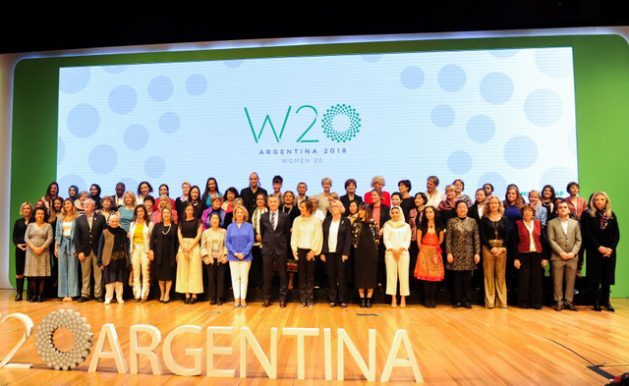
Group photo of the delegates who participated in the Women 20 Summit in Buenos Aires, after delivering their document of recommendations to Argentine President, Mauricio Macri (C). The proposals will form part of the agenda of the Group of 20 (G20) summit, to be held Nov. 30- Dec. 1 in the Argentine capital. Credit: G20
BUENOS AIRES, Oct 5 2018 (IPS) - Rural women play a key role in food production, but face discrimination when it comes to access to land or are subjected to child marriage, the so-called affinity group on gender parity within the G20 concluded during a meeting in the Argentine capital.
The situation of rural women was one of the four themes of the Women 20 Summit (W20). Women 20 is one of the seven sectors of civil society operating in the context of the G20 (Group of 20), which brings together industrialised and emerging countries and which this year is chaired by Argentina.
The mission of these affinity groups is to make recommendations to the main world leaders, who will meet in Buenos Aires for their annual summit from Nov. 30-Dec. 1.
“Rural women produce more than half of the world food production but they are at disadvantage in access to land, credit, productive resources and education...If rural women had the same rights as men, there would be less hunger in the world” -- Lilianne Ploumen
However, in a day of private meetings and two days of public exhibitions on women’s rights and gender issues, held Oct. 1- 3, peasant and indigenous women were conspicuously absent, during debates on the invisibility of rural women and their role in development.
The summit’s panels, held in the majestic former Argentine Post Office, were dominated by politicians, representatives of NGOs, officials of international organisations and managers and CEOs of companies.
The closing address at the summit was given by Argentine President Mauricio Macri, who received the document of W20 recommendations, debated over the space of seven months by 155 delegates of the different countries, which identifies the major challenges that must be addressed for their strategic value as a motor for sustainable development.
The event in Buenos Aires was not free from controversy, since a group of Argentine organisations, some of which participated in the discussion of the document, questioned in a statement that “55 percent of the people who made up the panels belong to international corporations or related foundations.”
“The W20 summit exhibit programme did not represent the diversity of the women’s group that discussed the statement,” said Natalia Gherardi, executive director of the Latin American Team for Justice and Gender (ELA) and one of nine Argentine delegates who participated in the debate.
“Evidently it had more to do with giving a place to the heads of the companies that financed the workshops,” she told IPS.
Simultaneously, a group of women members of the so-called Feminist Forum against the G20 demonstrated nearby “against the neoliberalism of the W20 businesswomen”.
The summit was held at a complex time for Argentina, with social problems arising from the recent strong devaluation of the local currency that accelerated inflation.
One of the panels of the Women 20 summit in the Argentine capital, which called for fighting the invisibility of rural women, as a prerequisite for advancing toward sustainable development. But the G20 summit itself was criticised by civil society because representatives of corporations dominanted the panels and peasant and indigenous women were conspicuously absent. Credit: Daniel Gutman/IPS
To overcome the crisis, Macri sought the help of the International Monetary Fund (IMF), which imposed a drastic austerity programme to reduce public spending and the government itself admitted that poverty has grown in recent months and will continue to do so.
“These meetings are to raise awareness about issues that could later become public policies. It’s very important to talk, because before it wasn’t talked about,” María Noel Vaeza, director of the U.N. Women’s Programme Division, told IPS.
Vaeza, who is a Uruguayan lawyer, said that “there are still 52 countries where legislative changes are needed to allow rural women to inherit land when they become widows.”
In the case of Latin America, the greatest urgency is to “eliminate child marriage. In rural areas there are girls who are married at age 12 and then drop out of school because they have to take care of their children,” said the official of the United Nations agency that promotes gender equality.
The situation of rural women and girls was also the focus of this year’s 62nd session of the United Nations Commission on the Status of Women, held in March in New York.
The conclusions of that assembly urged governments to “pass legislation to promote the registration of women’s lands and the certification of their land titles, irrespective of their marital status.”
In the case of the W20 document, it called for the promotion of economic participation and inclusion of rural women in decision-making, through the allocation of funds to strengthen cooperatives and enterprises and promote access to credit.
In addition to rural development, the other three themes of the W20 were labour, digital and financial inclusion.
“The world leaders should look at the policies of their own countries and see the ones that are needed to be changed,” said Lilianne Ploumen, a Dutch politician of the Labour Party and member of their country’s parliament.
Ploumen, who founded She Decides, a women’s rights movement, told IPS that “Rural women produce more than half of the world food production but they are at disadvantage in access to land, credit, productive resources and education.”
“If rural women had the same rights as men, there would be less hunger in the world,” she said.
Edith Obstchatko, a policy specialist at the Inter-American Institute for Cooperation on Agriculture (IICA), told IPS that “all the indicators show us that rural women are at a disadvantage compared to rural men and urban women.”
“The lack of infrastructure in rural areas affects them disproportionately. And new problems, such as climate change, affect them more, because they are more vulnerable,” said the expert of IICA, an organ of the Organisation of American States (OAS).
According to data released by the W20, rural women make up more than one-third of the world’s population and 43 percent of the agricultural workforce.
Most of them work in family-owned enterprises and do not receive any payment for their work. When they receive it, the amount is on average 25 per cent lower than what men are paid.
One of the central issues is education, and it was recognised that approximately two-thirds of the world’s illiterate people are women living in rural areas.
The issue of land ownership was also brought up, because globally women own less than 30 per cent of the land, although the situation varies greatly from country to country.
Another critical point is access to sexual and reproductive rights: the pregnancy rates among young women living in rural areas are three times higher than those living in cities.

Boiling Point: The World’s Biggest Jump in Greenhouse Gas Emissions

Authentic news,No fake news.

SINGAPORE, Oct 4 2018 (IPS) - The Blue Dragon, a small riverfront eatery in Hoi An, Vietnam, serves morsels of local trivia to tourists along with $2 plates of crisp spring rolls and succulent noodles.
On its damp-stained walls, the Blue Dragon’s owner, Nam, marks the level of annual floods that submerge this popular UNESCO World Heritage town renowned for its bright-yellow-painted buildings.
Last November, days before presidents and prime ministers arrived in nearby Da Nang for a meeting of the Asia Pacific Economic Cooperation forum, the water level at the Blue Dragon rose to 1.6 meters (5.25 feet) when typhoon-driven rains lashed the city. Patrons scurried to safety as pots and pans floated by.
“Every time we get big rains or typhoons, it floods and everything shuts down for three to four days,” says Nam, 65, who goes by one name. “Last year people had to escape in boats because the water was too high.”
Typhoons and floods are becoming more intense and frequent as Vietnam and the rest of Southeast Asia bear the brunt of climate change. Long coastlines and heavily populated low-lying areas make the region of more than 640 million people one of the world’s most vulnerable to weather extremes and rising sea levels associated with global warming. Governments are under pressure to act quickly or risk giving up improvements in living standards achieved through decades of export-driven growth.
Southeast Asia faces a dual challenge. It not only must adapt to climate change caused largely by greenhouse gases emitted over decades by advanced economies—and more recently by developing economies such as China and India—it also must alter development strategies that are increasingly contributing to global warming.
The region’s growing reliance on coal and oil, along with deforestation, are undermining national pledges to curb emissions and embrace cleaner energy sources.
Average temperatures in Southeast Asia have risen every decade since 1960. Vietnam, Myanmar, the Philippines, and Thailand are among 10 countries in the world most affected by climate change in the past 20 years, according to the Global Climate Risk Index (pdf) compiled by Germanwatch, an environmental group. The World Bank counts Vietnam among five countries most likely to be affected by global warming in the future. The economic impact could be devastating.
The Asian Development Bank (ADB) estimates Southeast Asia could suffer bigger losses than most regions in the world. Unchecked, climate change could shave 11 percent off the region’s GDP by the end of the century as it takes a toll on key sectors such as agriculture, tourism, and fishing—along with human health and labor productivity—the ADB estimated in a 2015 report (pdf). That’s far more than its 2009 estimate of a 6.7 percent reduction.
The region could shift to a “new climate regime” by the end of the century, when the coolest summer months would be warmer than the hottest summer months in the period from 1951 to 1980, says a 2017 study (pdf) by the ADB and the Potsdam Institute for Climate Impact Research.
In the absence of technical breakthroughs, rice yields in Indonesia, the Philippines, Thailand, and Vietnam could drop by as much as 50 percent by 2100 from 1990 levels. Hotter weather is also pushing tropical diseases such as malaria and dengue fever northward to countries like Lao P.D.R., where they were formerly less prevalent.
While the region’s greenhouse gas emissions have been low relative to those of advanced economies in per capita terms, that is starting to change, largely because of its increasing reliance on coal and other fossil fuels. Between 1990 and 2010, emissions of carbon dioxide increased faster in Southeast Asia than anywhere else.
Energy mix
Energy demand will grow as much as 66 percent by 2040, predicts (pdf) the Paris-based International Energy Agency (IEA). Coal alone will account for almost 40 percent of the increase as it overtakes cleaner-burning natural gas in the energy mix.
That poses a risk to the Paris Climate Agreement’s goal of limiting the average global temperature gain to 2 degrees Celsius above preindustrial levels. All 10 countries that make up the Association of Southeast Asian Nations (ASEAN) signed the Paris Agreement.
“At the present rate, Southeast Asia, coupled with India and China, could wipe out gains from energy efficiency and emissions reductions elsewhere in the world,” says Srinivasan Ancha, the ADB’s principal climate change specialist.
Demand for coal is partly driven by the fuel’s relative abundance and its low cost compared with oil, gas, and renewable energy. Coal-fired power plants are also easier to finance than renewable energy projects. Indonesia is the world’s fifth-largest coal producer and its second-largest net exporter, while Malaysia and Thailand are the eighth- and ninth-largest net importers, IEA data (pdf) show.
Reliance on coal is projected to grow: Vietnam’s coal-power capacity under active development is the third largest in the world after China’s and India’s, according to a March 2018 report (pdf) by environmental groups, including the Sierra Club and Greenpeace. Indonesia and the Philippines rank fifth and tenth, respectively.
Deforestation is another major source of greenhouse gases. In Indonesia and Malaysia, home to the world’s largest forestlands, trees are cut down to make way for farms to feed growing populations and for the production of pulp and paper and palm oil, which are big sources of export revenue. Deforestation accounts for almost half of Indonesia’s emissions—more than fossil fuels, though these are fast catching up.
Clearing forests in peatlands and peat swamps poses additional problems. Draining peat swamps releases thousands of tons of carbon dioxide trapped in each hectare of soil. The problem is compounded when farmers burn the dry peat, releasing the gas more quickly.
Smoke from such fires has repeatedly choked neighboring Singapore and Malaysia since 1997; emissions from the most recent incident in 2015 exceeded those of the entire European Union, according to Reuters.
Rapid economic growth and urbanization are contributing to climate change while also magnifying its impact. Migrants from rural areas flock to cities, which emit more heat. New construction in floodplains blocks waterways, leaving cities more vulnerable to floods. And the more cities grow, the greater the damage from increasingly frequent floods and storms.
“You have to unravel the impact of climate change, which is certainly there, and economic development and population growth,” says Marcel Marchand, a Hanoi-based expert in flood risk management. “The impact of a flood or storm is now generally more than in the past. That is not only because there are more hazards, or because hazards are more severe, but also because there are more people, and cities are becoming bigger.”
Marchand is advising on a $70 million internationally funded project that will provide more timely warning of floods to the residents of Hoi An. He attributes flooding, in part, to the construction of reservoirs in catchment areas upstream, which has changed river flows. The reservoirs become overwhelmed by extreme rainfall events, and excess water released downstream floods Hoi An and nearby Da Nang.
Both cities are growing fast as a tourism boom attracts migrants seeking work. A decade ago, Da Nang, Vietnam’s fourth-largest city, had just one luxury resort. Now it boasts almost 90 four- and five-star hotels, many of them dotting the 30-kilometer coastal road to Hoi An. The flow of workers is swelling Da Nang’s population, which is forecast to surge to 1.65 million by 2020 from 1 million today, according to World Bank estimates.
While tourism creates jobs, related infrastructure development also indirectly contributes to coastal erosion that makes the area more vulnerable to storm surges and rising sea levels. The shoreline along Hoi An’s popular Cua Dai Beach receded by 150 meters in the years from 2004 to 2012, according to a report prepared by the Quang Nam provincial People’s Committee. Floodwalls and sandbags have become eyesores for vacationers.
“In the last two decades the rainfall pattern has changed and increased significantly,” says Phong Tran, a technical expert at the Institute for Social and Environmental Transition-International (ISET-International), which works with several Vietnamese cities to develop climate resilience.
Phong worries that rising sea levels, along with prolonged dry spells, will cause salinity intrusion and hurt agriculture in the fertile Mekong Delta, one of the world’s most densely populated areas. The delta is Vietnam’s food bowl, producing more than half of its rice and other staples and over 60 percent of its shrimp, according to the Manila-based ADB.
Some 70 percent of Vietnam’s population lives along its 3,200-kilometer coastline and in the low-lying delta. Other Southeast Asian nations are similarly vulnerable.
Indonesia has one of the world’s longest coastlines at 54,700 kilometers. In the Philippines, which has 36,300 kilometers of coastline, 20 typhoons on average make landfall yearly, with increasing destructiveness. Cambodia, Lao P.D.R., and Thailand are also affected by storms and excessive rain, as well as by heat extremes that take a toll on agriculture and human health.
Southeast Asian governments, acutely aware of the magnitude of the threat, have pledged to reduce emissions. They also recognize the need to move toward low-carbon developmental strategies. ASEAN leaders approved a plan that targets a 23 percent share of renewables in the region’s energy mix by 2025, up from 10 percent in 2015. The need to curb deforestation also figures prominently in national and regional policy agendas.
Yet, promised emission cuts are partly or wholly conditional on international funding. Indonesia has pledged to reduce emissions by 29 percent by 2030 and said it could increase that to 41 percent with outside support. Vietnam’s analogous targets are 8 percent and 25 percent.
The Philippines has made only a conditional pledge, of a 70 percent reduction. Even these conditional pledges will result in higher global warming than envisaged under the Paris Agreement, highlighting the need for more ambitious goals.
While the region has seen increases in renewable energy sources, particularly solar and wind, their limited generation capacity means countries remain reliant on fossil fuels. Consumption of all types of fuels is rising as governments strive to provide universal access to electricity and petroleum-based fuels for cooking and transport. The IEA estimates that 65 million Southeast Asians lack electricity and 250 million use biomass, such as firewood and animal manure, for cooking fuel.
National goals for reducing fossil fuel use often conflict with policies to subsidize the cost of petroleum products and electricity for the benefit of the poorest sections of society.
Such subsidies not only boost fuel demand and render cleaner-burning fuels and renewable energy less competitive, they are also estimated to cost governments more than what it would take to meet the region’s Paris Agreement goals, according to the ADB-Potsdam Institute study.
Given the political and practical difficulties of cutting subsidies and encouraging the adoption of low-carbon technology, preventing deforestation may be the most effective way to cut emissions. Indonesia and Malaysia stand to earn billions of dollars in carbon credits; preserving forests would also cost less than radically cutting fossil fuel emissions and buying carbon credits.
According to analysts at the World Resources Institute, just enforcing Indonesia’s 2011 moratorium, which prohibits clearing certain primary forests and peatlands, could eliminate 188 million tons of carbon dioxide emissions each year, or about 60 percent of France’s total output in 2016. Increasing agricultural productivity could eliminate the need to clear forests, the institute said in a 2017 working paper.
The IEA sees the emergence of affordable low- carbon technologies as a path toward greater energy efficiency as declining costs of solar and wind energy boost investment in local manufacturing. Malaysia and Thailand, for example, are fast becoming global players in the manufacture of solar panels, with the help of Chinese investors seeking to circumvent antidumping duties imposed by the European Union and the United States.
Both countries may need to seek new markets after the United States this year announced plans for new tariffs on solar-panel imports as part of its crackdown on alleged unfair trade practices by Chinese companies. But with a significant increase in investment in renewable energy generation witnessed in Southeast Asia since the start of this century, the region is potentially a huge market for such products.
Even so, incentives such as tax breaks, duty-free imports, and preferential loans, along with easier access to financing, will be needed to increase investment in renewables and encourage adoption of more energy-efficient technologies.
“Policies and recommendations alone are not enough,” says Phong, from ISET-International in Vietnam. “Businesses need incentives to embrace renewable energy or environmentally friendly technologies, as well as for encouraging reforestation.”
*The article first appeared in Finance & Development published by the International Monetary Fund (IMF). The link follows:

Mitra-mandal Privacy Policy

This privacy policy has been compiled to better serve those who are concerned with how their  'Personally Identifiable Inform...