MITRA MANDAL GLOBAL NEWS

Profit from Generating Energy

Authentic news,No fake news.


Commercial Habitat, a high-end home appliance store located in the upscale municipality of Vitacura, in the east of the Chilean capital, supplies part of its electricity consumption with energy generated from solar panels installed on its roof. Credit: Orlando Milesi/IPS
SANTIAGO, May 27 2018 (IPS) - Chile has become a model country for its advances in non-conventional energy, and is now debating whether citizens who individually or as a group generate electricity can profit from the sale of the surplus from their self-consumption – a factor that will be decisive when it comes to encouraging their contribution to the energy supply.
A Senate committee has analysed whether to eliminate the payments to citizens for their surplus energy established in a law in force since 2012, in response to an indication to that effect from the government of socialist former president Michelle Bachelet (2014-March 2018), which her successor, the right-wing Sebastián Piñera, is keeping in place.
Now it is being studied by the Chamber of Deputies, which has been warned by leaders of environmental organisations that the proposal to eliminate payments to citizens who inject the surplus energy they generate into the grid will sentence these initiatives to death.
Gabriel Prudencio, head of the Ministry of Energy’s Renewable Energy Division, told IPS that the current government aims to make “distributed generation a major element in citizen power generation.”
“We will continue to encourage end users to be able to generate their energy because of the resultant benefits, but we must identify and avoid any inconvenience in terms of economy, especially for those who cannot install these systems, and for the sake of the security of the system,” he said.
Manuel Baquedano, president of the non-governmental Institute for Political Ecology (IEP), said “We hope that this proposal will not succeed and that we can continue with citizen-generated energy. Without the contribution of this sector, the goal of 80 percent non-conventional energy by 2050 will not be achieved.”
The expert believes that the authorities fear that citizen power generation, mainly solar, will become a business in itself and will not be used only for self-consumption and to cut the electricity bills of individuals or small businesses.
“They are legislating against a ghost,” he told IPS. “Energy should be born from thousands of connected points and by a system that allows buying and selling.”
The current installed electricity generation capacity in Chile, a country of 17.9 million inhabitants, is 22,369 MW. Of this total, 46 percent comes from renewable sources (30 percent hydropower), and 54 percent is thermal (21 percent coal).
All electricity generation is in private hands, most of it based on foreign capital. Consumption, which is constantly growing, reached 68,866 GW-h in 2013.
Revolution towards non-conventional sources
Chile’s solar and wind energy potential is 1,800 GW, according to a study by the Ministry of Energy and the German Agency for Technical Cooperation (GIZ).
If only five percent of the Atacama Desert in northern Chile were used to generate solar energy, 30 percent of South America’s electricity demand could be met, according to the Solar Energy Research Centre (SERC).
During Bachelet’s four-year term, Chile made an unprecedented leap in non-conventional renewable energies (NCRE), which went from contributing five percent of generation in 2013 to 20 percent in 2017.
“Solar energy showed the greatest growth, from 11 MW in early 2014 to 2,080 in late 2017, followed by wind energy, which grew from 333 to 1,426 MW,” said environmental engineer Paula Estévez in the book Energy Revolution in Chile, published by former Chilean Minister of Energy Máximo Pacheco on May 10.
According to Baquedano, “In the country’s energy revolution, the main thing is indeed the change towards renewable energy that took place. Chile’s energy mix is going to be 100 percent renewable at some point.”
Baquedano warned, however, that “the benefits of this energy revolution from the productive point of view have been only for the private sector and have not been passed on to the public sector.”
Prudencio said that “to date, there are approximately 16 MW of installed capacity of systems under Law 20,571 (payments to residential generators), which is equivalent to more than 2,600 operating projects throughout the country.”
A few cases in point
Ragnar Branth, general manager of Commercial Habitat, a high-end furniture and home design store in the municipality of Vitacura in eastern Santiago, installed solar panels on the roof to power a five-kW photovoltaic plant whose generation saves 13.5 percent in annual electricity bills.
“There is a benefit in the monthly fee, but the initial investment is quite significant. We’re talking about more than 20 million pesos (about 32,200 dollars) in the purchase of panels and their installation alone, and that is not compensated in savings until at least the fifth or sixth year of consumption,” he told IPS.
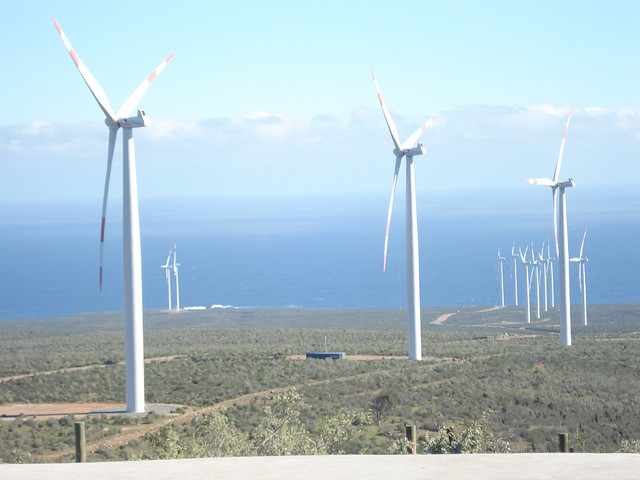
The Canela Wind Farm, with 112-m-high wind turbines and an installed capacity of 18.15 megawatts (MW), generates electricity with the force of the winds coming from the sea in the Coquimbo region of northern Chile. Credit: Orlando Milesi/IPS
“The government took a good first step with the cogeneration law. However, some adjustments are needed, including the recognition of 100 percent of the energy generated and some kind of benefit in the investment project,” he said.
“If the government wants this to spread and wants there to be significant cogeneration, there has to be a benefit in the investment or some form of tax reduction or benefit,” he added.
In the agricultural county of Buin, south of the city of Santiago, 99 citizen shareholders convened by the IEP financed the community project Solar Buin Uno that built a 10 kW photovoltaic solar plant connected to the grid.
Much of the energy is delivered to the Centre for Sustainable Technologies (CST), and the rest is injected into the grid. But the local distribution company pays only up to 60 percent of the value of the kWh billed to the CST. That is, it pays for the surplus only a portion of what it charges its users.
The generation by individuals received a special boost with the Distributed (decentralized) Generation Law, in force since 2017, also known locally as citizen generation.
Andrés Rebolledo, the last energy minister in the Bachelet administration, explained to IPS that this law “aims to encourage and give signals for the generation by citizens and show that homes and small businesses can generate their own energy based on NCRE.”
The former minister said there has been “exponential growth” of citizen generators and stressed that the modification being debated by parliament raises the possibility that they could increase their potential from 100 to 300 kW, favouring small and medium enterprises.
“The objective and vision is that the progress that Chile has made in terms of NCRE generation at the level of large plants can also be taken advantage of at the citizen level and that in this way households can generate their own electricity, save on their electricity bills and at the same time contribute to a more sustainable model,” he said.

“This implies an effort to strengthen the distribution networks, to have another form of measurement so that households can manage their own consumption and generation and, ultimately, so that they can become prosumers, that is, for a household to be both a producer and a consumer of energy at the same time,” he said.
The former minister explained that the request for a debate in parliament “was intended to try to send out signals and offer incentives so that more people could make an investment and this could become accessible to all, always taking care that households do not turn this into a business but rather for their own consumption.”
But non-governmental organisations say it will be a setback if the payment received for the injection of energy into the grid generated by citizens is eliminated.
According to Sara Larraín, executive director of Chile Sustentable, the proposed modification “eliminates the payment for the energy surplus injected by the residential generator over its own consumption.”
That, she told IPS, “discourages households from investing in self-generation and recovering their investment in less time thanks to the retribution for the electricity fed into the grid.”
Speaking to members of parliament, Larraín said that the reform “is a monopolistic distortion in favour of distribution companies that already constitute a monopoly as concessionaires of the distribution service.”
The president of IEP, Baquedano, said that the installation of a second citizens’ plant in the north of the country was suspended pending the legislative decision, “because the model will not work if this legislation is approved.”
“There’s a question mark over what’s going to happen to the energy generated by citizens. The government will have to understand that if citizen energy runs out, the environmental movement will not keep quiet. The conflicts will return, that’s my thesis, and not just my thesis because we are also preparing the scenarios,” he concluded.

Shipping and Industry Threaten Famed Home of the Bengal Tiger

Authentic news,No fake news.


A sunken ship after it was salvaged in the Sundarbans last year. Credit: Naimul Haq/IPS
DHAKA, Bangladesh, May 19 2018 (IPS) - Toxic chemical pollution in the Sundarbans, the largest mangrove forest in the world, is threatening thousands of marine and forest species and has environmentalists deeply concerned about the future of this World Heritage Site.
Repeated mishaps have already dumped toxic materials like sulfur, hydrocarbons, chorine, magnesium, potassium, arsenic, lead, mercury, nickel, vanadium, beryllium, barium, cadmium, chromium, selenium, radium and many more into the waters. They’re killing plankton – a microscopic organism critical for the survival of marine life inside the wild forest.
"Obviously, such cargo accidents involving shipment of toxic heavy metals inside the Sundarbans would have irreversible impacts on this unique and compact ecosystem." --Sharif Jamil
Scientific studies warn the sudden drastic fall in the plankton population may affect the entire food chain in the Sundarbans in the near future, starving the life in the rivers and in the forest.
The latest incident involved the sinking of a coal-loaded cargo ship on April 14 deep inside the forest, popularly known as the home of the endangered Royal Bengal Tigers, once again outraging environmentalists.
Despite strong opposition by leading environmental organizations vowing to protect the biodiversity in the Sundarbans, which measure about 10,000 square kilometers of forest facing the Bay of Bengal in Bangladesh in South Asia, policy makers have largely ignored conservation laws that prioritise protecting the wildlife in the forest.
Critics say influential businessmen backed by politicians are more interested in building industries on cheap land around the forest that lie close to the sea for effortless import of the substances causing the environmental damage.
Divers from the Bangladesh Inland Water Transport Authority (BIWTA) have traced the latest sunken vessel lying some 30 feet deep underwater, but they have not been able to salvage the ship.
It is the third to have capsized in less than two years in the ecologically sensitive region, some of which remains untouched by human habitation.
The deadliest accident occurred on Dec. 9, 2014. Amid low visibility, an oil tanker collided with a cargo vessel, spilling over 350,000 liters of crude oil into the Shela River, one of the many tributaries that crisscross the forest – home to rare wildlife species like the Bengal Tiger and Irrawaddy dolphin.
Then, in May 2017, a cargo ship carrying about 500 metric tons of fertilizer sank in the Bhola River in the Sundarbans. In October the same year, a coal-laden vessel carrying an almost equal weight of coal sunk into the meandering shallow Pashur River.
Each time toxic materials pollute the rivers, the government comes up with a consoling statement claiming that the coal has ‘safe’ levels of sulfur and mercury which are the main concern of the environmentalists.
Outraged by official inaction, many leading conservationists expressed their grievances at this “green-washing.”
Sharif Jamil, Joint Secretary of Bangladesh Poribesh Andolon or BAPA, told IPS, “I feel ashamed to know that such a scientifically untrue and dishonest statement of one cargo owner (safe level of sulfur and mercury) was endorsed by our government in their reports and acts which significantly damages the credibility of the government and questions the competency of the concerned authorities.”
“Obviously, such cargo accidents involving shipment of toxic heavy metals inside the Sundarbans would have irreversible impacts on this unique and compact ecosystem,” he said.
Jamil criticized the state agency responsible for protecting the environment, saying, “The department of environment or DoE has responsibility to monitor and control the pollution by ensuring punishment to the polluters. We have not witnessed any action from DoE so far, in this case particularly.”
While coal may not be as environmentally destructive as crude oil spill, the commercial shipping path across the Sundarbans has a long track record of disasters.
Professor Abdullah Harun, who teaches environmental science at the University of Khulna, told IPS, “The cargo ship disasters are proving to be catastrophic and destructive for the wildlife in the Sundarbans. We have already performed a series of studies titled ‘Impact of Oil Spillage on the Environment of Sundarbans’.
“Laboratory tests showed startling results as the toxic levels in many dead species and water samples were found way beyond our imagination. The most alarming is the loss of phytoplankton and zooplankton diversity and populations. Both these are known to play vital role in the food chain of the aquatic environment.”
Professor Harun fears that the embryos of oil-coated Sundari seeds, decomposed as a result of the spillage across 350 square km of land, will not be germinating. Sundari trees make up the mangrove forest and it has specialised roots which emerge above ground and help in gaseous exchange.
He said, “A primary producer of the aquatic ecosystems, source of food and nutrient of the many aquatic animals, has been affected by the oil spill in 2014. The aquatic population will be decreased and long-term impacts on aquatic lives like loss of breeding capacity, habitat loss, injury of respiratory organs, hearts and skins will occur.”
He said, “Our team of scientists tested for the fish larvae population. Before the 2014 disaster we found about 6,000 larvae in a litre of water collected from rivers in the Sundarbans. After the disaster we carried out the same test but found less than half (2,500 fish larvae) in the same amount of water. This is just one species I am talking about. Isn’t it alarming enough?”
Following the latest incident, the government imposed a ban on cargo ships using the narrow channels of the Pashur River where most of the vessels sail. But there are fears that the ban will only be a temporary measure as seen in the past. After the December 2014 oil spill, a similar ban on commercial cargo was lifted soon after.
These ‘ban games’ on cargo vessels will not solve the underlying problems in the Sundarbans. Several hundred activists recently marched towards the mangrove forest in Bagerhat to protest plans to build a coal-based power plant near the Sundarbans near Rampal. The activists called on the government to stop construction of the proposed 1.3-gigawatt Rampal Power Plant, which is located about 14-km upstream of the forest.
Environmentalists are also worried about rapid industrialization near the Sundarbans. The Department of Environment (DoE) has identified 190 commercial and industrial plants operating within 10 kilometres of the forest.
It has labeled ‘red’ 24 of these establishments as they are dangerously close to the world heritage site and polluting the soil, water and air of the world’s largest mangrove forest.
Eminent environmentalist Professor Ainun Nishat, told IPS, “My main worries are whether the main concerns for safety of the wildlife in the forest is being overlooked.”
Professor Nishat said, “If we allow movement of vessels to carry shipments through the forest then I like to question a few things like, where does the coal come from? What do we do with the fly ash from cement and other materials? How and where do we dispose of the waste and do we have the cooling waters for safety?”
“What we need is a strategic impact assessment before any such industrial plant is established so that we can be safe before we repeat such mishaps,” said Nishat.
Statistics from the Mongla (sea) Port Authority show that navigation in the Sundarbans waterways has increased 236 percent in the last seven years. This means vessel-based regular pollution may continue to impact the world’s largest mangrove habitat’s health even if disasters like the Sundarbans oil spill can be prevented.
Increasing volume of shipping and navigation indicates growing industrialisation in the Sundarbans Impact Zone and the Sundarbans Ecologically Critical Area, which in turn will increase the land-based source of pollution if not managed.
The Sundarbans is a UNESCO World Heritage Site which hosts range of animals and fish like fishing cats, leopard cats, macaques, wild boar, fox, jungle cat, flying fox, pangolin, chital, sawfish, butter fish, electric rays, silver carp, starfish, common carp, horseshoe crabs, prawn, shrimps, Gangetic dolphins, skipping frogs, common toads and tree frogs.
There are over 260 species of birds, including openbill storks, black-capped kingfishers, black-headed ibis, water hens, coots, pheasant-tailed jacanas, pariah kites, brahminy kite, marsh harriers, swamp partridges and red junglefowl.

What's next for Hezbollah in Syria?

Authentic news,No fake news.


Hezbollah's involvement in Syria currently appears open-ended [Wael Hamzeh/EPA-EFE]
Beirut, Lebanon - Safa'a Smeen sits propped between a Quran, some bright decorations and her son's grave.
"Of course I agreed", she says, when asked about her son's request to fight for Hezbollah in Syria, where the Lebanese political party and militia helped turn the conflict's tide in favour of the government of President Bashar al-Assad.
"I said that I would be happy if he went. I would be happy for him to go to protect his people, his religion and his country," said the 54-year-old, from south Beirut.
"Actually, I encouraged him to go."
Shortly after coming back from Syria, Safa'a's son Ibrahim was killed in a double suicide bomb attack on the Iranian embassy in Beirut in November 2013, which left 23 people dead. He was honoured as a "martyr" - the description Hezbollah gives to its fighters killed in battle.
It was incidents like that - claimed by an al-Qaeda linked group - that Hezbollah used to justify its presence in Syria.
The Iran-backed Shia group claimed that "takfiri" attacks in Lebanon by groups accusing others of irreligiosity would only increase if it did not send men across the border. 
"We send our sons to protect us," says Safa'a, in a mausoleum in southern Beirut built specially for those who fought with Hezbollah in Syria. "I feel sad and cry for them [the dead]. But at the same time, I feel it is a victory for us."

Syria intervention

Hezbollah's intervention in Syria became public five years ago during the spring offensive for al-Qusayr, a strategic town near the border with Lebanon. However, analysts believe that Hezbollah commanders advised the Assad government from the early days of the popular uprising in 2011.
The Syrian government's survival was made possible with the support of tens of thousands of Iran-backed fighters - including Hezbollah - on the ground, and Russian air power.
Hezbollah's popularity peaked in 2006 amid growing regional anti-Israel sentiment, but its involvement in the Syrian war has angered many in the region.
Still, Hezbollah has used the experience to become a military power.
In March, Naim Qassem, Hezbollah deputy chief, said the group would return to Lebanon if the warring sides reached a political solution, but that it would stay in Syria as long as necessary.
However, analysts believe that Hezbollah is not likely to give up its territorial gains and influence in Syria any time soon.

Loyalty to Iran

Strategically, Iran will not want to see Hezbollah leave Syria, they say. The party is now not only the Islamic Republic's most dependable ally in the Middle East but also the defender of its supply line.
"Wherever Iran will have interests, Hezbollah will be and will be called to be present," said Lokman Slim, a Beirut-based analyst from Lebanon's Shia community.
"This myth of a Syria war ending and each militia going back to its home is just delusional."
According to David Daoud, a Hezbollah analyst at the Washington, DC-based United Against Nuclear Iran advocacy group, Syria is critical to Hezbollah first and foremost as its umbilical cord to Iran - both militarily and ideologically.
"Hezbollah and the Iranians are the force on the ground; they're in control", Daoud told Al Jazeera.
"Assad needs them, and he is never going to ask them to leave; and if he does, they are going to say, 'No, we are not, what are you going to do about it? We control your country'."
In March, a Farsi-language, state-linked Iranian media outlet published an articledetailing a private speech given by Hezbollah leader Hassan Nasrallah in Beirut.
"We do not fight to preserve Bashar al-Assad, but rather to protect the principle of Shiism," Nasrallah reportedly told his audience, stressing the group's loyalty to Iran. The article was later retracted, and Hezbollah denied that its chief had given a speech.

Syria deployments

The US government believes that the party has deployed up to 7,000 men at a time to Syria.
Analysts say Hezbollah will also likely maintain advisers around Syria, particularly in the capital, Damascus. It may adopt a US-army style model with fighters carrying out tours of duty in Syria before returning to Lebanon.
"They will probably do as the United States does," said Daoud. "They will have bases throughout Syria and send guys for a few months, replace them with another batch, and so on and so forth."
It will likely concentrate that presence on the Lebanese border near the Bekaa Valley, where the group maintains training camps and weapons stores.
Hezbollah's support base in Lebanon has started to believe that the party will maintain a long-term presence in Syria and that this is essential in not only fighting threats from Syria but Israel too.
"Hezbollah will stay in Syria, alongside its allies, to back the resistance and to put an end to Israeli violations in Syria and Lebanon," said Abbas, 23, from the Lebanese city of Baalbek where support for Hezbollah is strong.
Israeli authorities have also suggested that fronts with Lebanon and Syria have merged.
"There is now only one front in the north composed of Lebanon, Syria, Hezbollah, the Bashar al-Assad regime and all those who help his regime," Israeli Defence Minister Avigdor Lieberman said last winter.
Analysts say that Hezbollah will not only maintain a military presence in Syria to propagate Iran's interests and protect weapons supply lines, it will likely also benefit economically from Syria. The same happened in Lebanon, where the party helped the Shia community prosper.
"Hezbollah has won support through creating wealth and jobs, and there is a strong economic element in its involvement in Syria - the hospitals that treat the wounded, the death industry around the martyrs," Lokman Slim, a Beirut-based analyst from Lebanon's Shia community, told Al Jazeera.
"It has even provided construction jobs for Lebanese people around cities where it has a presence in Syria."

Damaged reputation

While its involvement in Syria has benefitted it, both in terms of battlefield practice and regional clout, Hezbollah has still work to do to repair the damage to its reputation among ordinary Syrians.
Although there are no statistics on its popularity in Syria, dozens of interviews conducted by Al Jazeera suggest that support for its intervention in the conflict has declined.
Ghaith Alhallak, 33, was a sergeant in the Syrian army until 2013. He remembers serving at the main checkpoint on the Damascus-Homs motorway and answering to the Hezbollah commanders controlling it. They would order the troops to demean Sunni Muslims passing through the checkpoint, he said.
"I received orders from them to deal in a bad way with Sunnis", he told Al Jazeera from Italy, where he received asylum in 2016. "It would be weird orders, like, 'Take their [ID] cards and go and have your lunch', making them wait maybe for one hour."
Such views are supported by the findings of international conflict resolution organisations that have documented Hezbollah's sectarian-tinged military intervention in Syria.
"Once acclaimed by Arabs for struggle against a common enemy, most recently in the 2006 Lebanon war, it [Hezbollah] is widely viewed as a sectarian Shiite militia and, in parts of Syria, a ruthless occupier," found a 2017 report by International Crisis Group.
Hezbollah's involvement in Syria currently appears open-ended, which will not help to heal the sectarian wounds gouged by the war. "There are many types of Syrians today with many ideas about the war and Hezbollah," said Alhallak.
"Those people who support their presence are those who will benefit from them in a way. But I am sure that those people who lost their homes and families because of Hezbollah, they will not accept it."
Back in Lebanon, Hezbollah supporters such as Safa'a and Abbas claim pride in fighters killed in Syria. 
In reality, however, Hezbollah will find greater popular support for continued intervention in Syria when there are fewer young men coming back across the Syria-Lebanon border in coffins. The party refuses to reveal fighter death tolls, although analysts believe more than 1,200 have been killed in Syria, and graveyards across Lebanon have expanded to accommodate the dead.
Additional reporting by Mahmoud Bitar
SOURCE: AL JAZEERA NEWS

The hidden costs of coal in Romania

Authentic news,No fake news.


After signing up to the 2015 Paris Agreement - aimed at limiting the impact of climate change - European countries began announcing end dates for their coal industries, one of the main sources of CO2 emissions.
But in Eastern Europe, the situation is different, with countries there saying they want to keep burning coal for decades, insisting they are too poor to transition fast to other sources of energy.
Romania, however, boasts a diverse energy mix. The country produces about a quarter of its energy from coal, compared with almost a third from hydro and 15 percent from other renewables.
Coal producers argue that, regardless of the mix, the carbon-rich material is crucial for ensuring the stability of the energy system.
Producers also say coal is much cheaper than gas and nuclear power, the other stable energy sources.
Romania's coal equipment is old, and European Union pollution standards mean huge investments are necessary to ensure the plants keep working.
"Between 2009 and 2015, we spent €1bn ($1.2bn) to implement the European standards required by 2016, only to have an unpleasant surprise this autumn and discover more new standards will be put in place," said Sorin Boza, director for Complexul Energetic Oltenia (CEO), the biggest coal company.
Boza wants Romania to ask the EU for a postponement in implementing the newest standards - an allowance to keep polluting for longer.

Coal's hidden costs

According to data from the NGO coalition Beyond Coal, Europe-wide coal pollution is responsible for 19,500 premature deaths, 458,000 asthma attacks in children and almost 6 million lost working days annually.
In Romania alone, according to the same data, coal was responsible for over 1,000 premature deaths in 2015. More than half were estimated to be because of CEO alone.
Beyond Coal further estimated that coal pollution in Romania was responsible for 520 cases of chronic bronchitis, 800 hospital admissions, 26,000 cases of asthma attacks in children, and 267,000 lost working days, amounting to an estimated 2bn euro burden to the economy.

The negative impacts of coal mining on the environment - destruction of local ecosystems and agricultural land; underground and overground water pollution; contamination of land and dust pollution - have been widely documented by Greenpeace and other organisations.
"In Gorj, most CEO mines are very close to one another. When 1,000 hectares are dug out instead of 100, the water resources, for example, are affected tenfold,' says Alexandru Mustata from environmental group Bankwatch Romania.
"Several villages are already left without drinking water, while the habitats are also affected. Post-closure works are limited to planting willows, so the previous species cannot return."
The Romanian energy ministry, "upon consulting with CEO", denied most of the claims against the company.
In a written response, the ministry said CEO's mining operations are fully in line with the national legislation and the company pays "very big annual contributions" to the national budget, including approximately €800,000 annually in the form of environmental tax and another €130m through purchase of CO2 certificates.

Fair compensations

The energy ministry further said CEO negotiated fair compensations with each" expropriated inhabitant of Runcurel, that levels of sound around the mines are admissable, that the company does not use more water than allowed by law, that investments CEO made have led to improving air quality, that it planted more forest than it cut; that the Turceni leak was caused by locals but CEO did repair work anyway; and that landslides are natural".
According to the ministry, coal mining is not toxic and "at the same time, the long-term negative impact of 'green energy' on local ecosytems and human health is well known".
Incidentally, even though the coal industry's problems have been known for many years, not one of Romania's recent governments has seriously considered the idea of phasing out coal.
"Beyond the variations in the party politics layer on top, there's a very powerful layer below made up of those who are really in charge of the energy system, people from the energy companies, administration, some union leadership," said Corina Murafa, an energy expert formerly with the World Bank.
"And they have a fetish with coal as the backbone of the energy system."
People in Gorj and Dolj bear much of the hidden costs of coal mining, including the destruction of land on which they relied to survive. [Mihai Stoica/Al Jazeera]
Residents in the vicinity of CEO's mines and transport infrastructure complain of the negative impacts of noise and pollution on their livelihood – for which no compensation is offered. [Mihai Stoica/Al Jazeera]
Power plants use land to store vast amounts of coal ash containing heavy metals, negatively impacting the environment. When the ash becomes airborne, it poses a threat to the health of communities nearby. [Mihai Stoica/Al Jazeera]
Dust pollution from mining or runoff from tailings means crops are often compromised in villages where people make their living farming. [Mihai Stoica/Al Jazeera]
Some damage to property caused by mining is never compensated for. Locals know they stand little chance in court. [Mihai Stoica/Al Jazeera]
CEO plans to expand some of its mines, which would involve expropriating the property of about 500 people. The Romanian government wants to declare the mines a national interest project, therefore removing people for one euro per one square meter of land. [Mihai Stoica/Al Jazeera]
Mine expansions destroy land formerly used for agriculture, forcing people to move away. Expropriations can also mean depriving people of their traditional lifestyles and forcing them to swell the ranks of the urban poor. [Mihai Stoica/Al Jazeera]
Due to the country's mono-industrial profile, a steady income is hard to come by, and many people struggle to make ends meet. [Mihai Stoica/Al Jazeera]
Locals in mining towns depend on coal for cooking and heating. Due to poverty, theft from coal deposits is common.  [Mihai Stoica/Al Jazeera]
In Gorj, locals say, mining has polluted underground water sources. As a result, fountains have dried up, and villagers were left without clean water. [Mihai Stoica/Al Jazeera]
Landslides caused by improperly sealed-off mines happen whenever it rains, destroying people's houses. Compensations have been slow to come. [Mihai Stoica/Al Jazeera]
Local communities say they rely solely on NGOs to ask for fair treatment on their behalf. [Mihai Stoica/Al Jazeera]
Private property rights are often infringed on by expansions. In 2016, a scandal broke in Romania when CEO refused to offer fair compensations to 134 villagers it wanted to forcibly remove to make way for a mine expansion in Runcurel village, Gorj county. [Mihai Stoica/Al Jazeera]
Communities neighbouring mines or power plants are extremely unhappy with CEO's lack of accountability for their economic, environmental and health impacts. [Mihai Stoica/Al Jazeera]
Lignite - or brown coal - is an inefficient and extremely polluting type of coal but can be found in large deposits. [Mihai Stoica/Al Jazeera]

Mitra-mandal Privacy Policy

This privacy policy has been compiled to better serve those who are concerned with how their  'Personally Identifiable Inform...