Authentic news,No fake news.
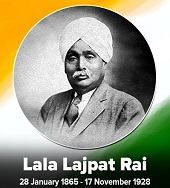 There are few leaders of the pre-independence era who, after having plunged themselves into the political struggle, continued to take an active interest in social, cultural and educational work. Lala Lajpat Rai was one of such leaders. Born on 28th January, 1865 at a small village, Dhudike in the Ferozepur district of Punjab, he belonged to the Agarwal Baniya caste and it was perhaps because of this, in addition to taking part in social and political life of the country, he took keen interest in industrial and financial matter also. His father was a teacher of Persian and Urdu in a government school.
Punjab under the British especially after annexation in 1849 witnessed a period of rapid development giving rise to a new educated class fired with a desire for freedom from the yoke of slavery. Amongst the cherished desires of this new class was also an overriding ambition to start a Swadeshi Bank with Indian Capital and management representing all sections of the Indian community. The idea was first mooted by Rai Mool Raj of Arya Samaj who, as reported by Lala Lajpat Rai, had long cherished the idea that Indians should have a national bank of their own. He felt keenly "the fact that the Indian capital was being used to run English banks and companies, the profits accruing from which went entirely to the Britishers whilst Indians had to contend themselves with a small interest on their own capital".
At the instance of Rai Mool Raj, Lala Lajpat Rai sent round a circular to selected friends insisting on an Indian Joint Stock Bank as the first special step in constructive Swadeshi. Lala Harkrishan Lal who had returned from England with ideas regarding commerce and industry, was eager to give them practical shape.
`PNB was born on May 19, 1894. The founding board was drawn from different parts of India professing different faiths and a varied back-ground with, however, the common objective of providing country with a truly national bank which would further the economic interest of the country.
The Bank opened for business on 12 April, 1895. The first Board of 7 Directors comprised of Sardar Dayal Singh Majithia, who was also the founder of Dayal Singh College and the Tribune; Lala Lalchand one of the founders of DAV College and President of its Management Society; Kali Prosanna Roy, eminent Bengali pleader who was also the Chairman of the Reception committee of the Indian National Congress at its Lahore session in 1900; Lala Harkishan Lal who became widely known as the first industrialist of Punjab; EC Jessawala, a well known Parsi merchant and partner of Jamshedji & Co. of Lahore; Lala Prabhu Dayal, a leading Rais, merchant and philanthropist of Multan; Bakshi Jaishi Ram, an eminent Civil Lawyer of Lahore; and Lala Dholan Dass, a great banker, merchant and Rais of Amritsar. Thus a Bengali, Parsi, a Sikh and a few Hindus joined hands in a purely national and cosmopolitan spirit to found this Bank which opened its doors to the public on 12th of April 1895. They went about it with a Missionary Zeal. Sh. Dayal Singh Majithia was the first Chairman, Lala Harkishan Lal, the first secretary to the Board and Shri Bulaki Ram Shastri Barrister at Lahore, was appointed Manager.
A Maiden Dividend of 4% was declared after only 7 months of operation. Lala Lajpat Rai was the first to open an account with the bank which was housed in the building opposite the Arya Samaj Mandir in Anarkali in Lahore. His younger brother joined the Bank as a Manager. Authorised total capital of the Bank was Rs. 2 lakhs, the working capital was Rs. 20000. It had total staff strength of nine and the total monthly salary amounted to Rs. 320.
The first branch outside Lahore was opened in Rawalpindi in 1900. The Bank made slow, but steady progress in the first decade of its existence. Lala Lajpat Rai joined the Board of Directors soon after. in 1913, the banking industry in India was hit by a severe crisis following the failure of the Peoples Bank of India founded by Lala Harkishan Lal. As many as 78 banks failed during this crisis. Punjab National Bank survived. Mr. JH Maynard, the then Financial Commissioner, Punjab, remarked...."Your Bank survived...no doubt due to good management". It spoke volumes for the measure of confidence reposed by the public in the Bank`s management.
The years 1926 to 1936 were turbulent and loss ridden ones for the banking industry the world over. The 1929 Wall Street crash plunged the world into a severe economic crisis.
It was during this period that the Jalianwala Bagh Committee account was opened in the Bank, which in the decade that followed, was operated by Mahatma Gandhi and Pandit Jawaharlal Nehru. The five years from 1941 to 1946 were ones of unprecedented growth. From a modest base of 71, the number of branches increased to 278. Deposits grew from Rs. 10 crores to Rs. 62 crores. On March 31, 1947, the Bank officials decided to leave Lahore and transfer the registered office of the Bank to Delhi and permission for transfer was obtained from the Lahore High Court on June 20, 1947.
PNB was then housed in the precincts of Sreeniwas in the salubrious Civil Lines, Delhi. Many a staff member fell victim to the widespread riots in the discharge of their duties. The conditions deteriorated further. The Bank was forced to close 92 offices in West Pakistan constituting 33 percent of the total number and having 40% of the total deposits. The Bank, however, continued to maintain a few caretaker branches.
The Bank then embarked on its task of rehabilitating the displaced account holders. The migrants from Pakistan were repaid their deposits based upon whatever evidence they could produce. Such gestures cemented their trusts in the bank and PNB became a symbol of Trust and a name you can bank upon. Surplus staff posed a big problem. Fast expansion became a priority. The policy paid rich dividends by opening up an era of phenomenal growth.
In 1951, the Bank took over the assets and liabilities of Bharat Bank Ltd. and became the second largest bank in the private sector. In 1962, it amalgamated the Indo-Commercial Bank with it. From its dwindled deposits of Rs. 43 crores in 1949 it rose to cross the Rs. 355 crores mark by the July 1969. Its number of offices had increased to 569 and advances from Rs. 19 crores in 1949 to Rs. 243 crores by July 1969 when it was nationalised.
Since inception in 1895, PNB has always been a "People`s bank" serving millions of people throughout the country and also had the proud distinction of serving great national leaders like Sarvshri Jawahar Lal Nehru, Gobind Ballabh Pant, Lal Bahadur Shastri, Rafi Ahmed Kidwai, Smt. Indira Gandhi etc. amongst other who banked with us.
Punjab Keshari Lala Lajpat Rai (Saluting The Spirit Of Our Founding Father)
The Life And Times Of Lala Lajpat Rai
There are few leaders of the pre-independence era who, after having plunged themselves into the political struggle, continued to take an active interest in social, cultural and educational work. Lala Lajpat Rai was one of such leaders. Born on 28th January, 1865 at a small village, Dhudike in the Ferozepur district of Punjab, he belonged to the Agarwal Baniya caste and it was perhaps because of this, in addition to taking part in social and political life of the country, he took keen interest in industrial and financial matter also. His father was a teacher of Persian and Urdu in a government school.
Having passed the final examination in Law from Punjab University, he started his practice in1883, when he was barely 18 years old. Endowed with a rich legacy of moral and intellectual background, Lala Lajpat Rai had benefit of education in the practical rationalism of western science combined with the religious purity and moral elevation of Eastern literature that put on him the hallmark of true culture. While sympathizing with and aiding every movement made for progress, Lala Lajpat Rai identified himself very closely with Arya Samaj, in which he found ample scope for the exercise of his patriotism, philanthropy and religious zeal.
Having qualified as a pleader, Lala Lajpat Rai started practice at Hissar and soon became a leading lawyer of the district. He organized the Arya Samaj there and put it on proper lines. In 1892, he transferred his practice to the wider field at Lahore.Education, both secular and religious, was in Lala Lajpat Rai’s view an important factor in national development. He took part in the foundation of the D.A.V. College at Lahore.
Lalaji And Politics
Lala Lajpat Rai always felt drawn towards politics. It was in 1888 that he joined the Indian National Congress when it met at Allahabad under the presidency of Mr. G. Yule. In 1905, the Indian National Congress Committee having recognized in him an austere, sincere and selfless devoted worker selected him as one of its delegates to place before the British, the political grievances of the Indian people. He met the expenses of his trip from his own pocket. He along with Gokhale carried on the political campaign in various parts of England and brought home to the mind of the British, the evils of an unsympathetic and bureaucratic government under which India was labouring and pleaded in eloquent language, adding facts and figures in supporting their contention, cause of the half starving and half dying people of India. Lala Lajpat Rai created an impression on the English Populace. After his return from England, he was busy devising and organizing ways and means for political advancement and industrial emancipation of the country.
The movement of “Swadeshi” was in the offing and he put his heart and soul into it. He preached the message of Swadeshi to the people of Punjab and made it very popular. This naturally enraged the bureaucracy and he came to be regarded as a revolutionary by the Britishers and the Anglo-Indian press. He was openly dubbed as a Revolutionary and an instigator of the armed forces.
The Jalianwala Bagh tragedy and the Government`s denial to censure the conduct of its officers made him a complete non cooperator. He lost his faith in the British and threw himself whole heartedly into the non-cooperation movement.In 1925, he joined the Swaraj Party and became its deputy leader. He took active part in the deliberations of the debates of the Assembly. It was he, who moved the resolution for the Boycott of the Simon Commission in the Assembly. It was while leading the boycott procession at Lahore on the 30th October, 1928 that he received lathi blows on his chest which ultimately brought about his death on the 17th November, 1928.
Lala Lajpat Rai And PNB
Lalaji was keenly concerned with the fact that though Indian capital was being used to run English Banks and companies, the profits went entirely to the British, while Indians had to contend themselves with a small interest on their capital. He echoed this sentiment in one of his writing while concurring with Rai Mul Raj of Arya Samaj who had long cherished the idea that Indians should have a National Bank of their own. At the instance of Rai Mul Raj, Lala Lajpat Rai sent a circular to selected friends insisting on an Indian joint stock Bank as the first step in constructive Swadeshi and the response was satisfactory After filing and registering the memorandum and Articles of Association on 19 May, 1894, the bank was incorporated under Act VI of the 1882 Indian Companies Act. The prospectus of the bank was published in the Tribune, and the Urdu Akhbar-e-Am and Paisa Akhbar. On 23rd May, 1894, the founders met at the Lahore residence of Sh. Dyal Singh Majithia, the first Chairman of PNB, and resolved to go ahead with the scheme. They decided to hire a house in the famous Anarkali Bazar of Lahore opposite the post office and near well known stores of Rama Brothers.On 12th April 1895, the Bank opened for business, a day before the great Punjab festival of Baishakhi. The essence of the Bank’s culture was clear at this first meeting itself. The fourteen original shareholders and seven directors took only a modest number of shares; the control of the Bank was to lie with the large, dispersed shareholders, a purely professional approach that was as uncommon then as it is today.
Source-Website Of P N B


