MITRA MANDAL GLOBAL NEWS

Battle Lines Drawn Over Indian Mega Mine

Murrawah Johnson, 21, of the Wangan and Jagalingou Family Council, is among those standing in the way of the huge Carmichael coal mine project in Australia's Queensland state. Photo courtesy of Murrawah Johnson.
MELBOURNE, Dec 30 2016 (IPS) - Among those leading the fight against the massive Indian-owned Carmichael coal project in Australia’s Queensland state is 21-year-old Murrawah Johnson of the Wangan and Jagalingou aboriginal people, the traditional owners of the land where the proposed mine is to be located.
“Our people are the unique people from that country,” says Murrawah, whose name means ‘rainbow’ in the indigenous Gubbi Gubbi language. “That is who we are in our identity, in our culture, in our song and in our dance,” she adds.
The mine’s estimated average annual carbon emissions of 79 million tonnes are three times those of New Delhi, six times those of Amsterdam and double Tokyo’s average annual emissions.
The Wangan and Jagalingou, numbering up to 500 people, regard the Carmichael coal mine as a threat to their very existence and have repeatedly rejected the advances of Adani Mining, the company behind the project. The traditional owners argue the mine would destroy their land, which “means that our story is then destroyed. And we as a people and our identity, as well,” Murrawah, a spokesperson for her people’s Family Council, told IPS.
Adani Mining is a subsidiary of the Adani Group, an Indian multinational with operations in India, Indonesia and Australia cutting across resources, logistics, energy, agribusiness and real estate. In March, the company announced its first foray into the defence industry.
Adani’s Carmichael project envisions a 40km long, 10km wide mine consisting of six open-cut pits and five underground operating for up to sixty years. The company intends to transport the coal to India to aid in that country’s electricity needs. According to the International Energy Agency, 244 million Indians – 19 percent of the population – are without access to electricity.
Should the project go ahead, it would be the largest coal operation here – Australia is already a major coal producing and exporting nation – and among the biggest in the world, producing some 60 million tonnes of thermal coal annually at peak capacity.
But at a time when global warming is a significant threat to humanity, the Carmichael mine is generating substantial opposition. Since the project was announced in 2010, there have been more than ten appeals and judicial processes against the mine.
Shani Tager, a campaigner at Greenpeace Australia Pacific, is adamant that the coal that Adani wants to dig up must remain in the ground. “It’s a massive amount of coal that they’re talking about exporting, which will be burnt and used and make the problem of global warming even worse,” she says.
Coal-fired power plants emit large amounts of carbon dioxide, a gas that traps heat within the Earth’s atmosphere and which plays an important role in the phenomenon of human-induced climate change.
According to a 2015 report by The Australia Institute, a local think tank, Adani’s project would release more carbon into the atmosphere than many major cities and even countries.
The report states that the mine’s estimated average annual carbon emissions of 79 million tonnes are three times those of New Delhi, six times those of Amsterdam and double Tokyo’s average annual emissions. It would surpass Sri Lanka’s annual emissions and be similar to both Austria’s and Malaysia’s.
Despite these alarming figures, both the Australian and Queensland state governments are backing Adani’s Carmichael mine. There has been widespread speculation here that the federal government will provide support via a AUD one- billion loan (722 million U.S. dollars).
The Queensland government, anticipating a boost to jobs, the regional economy and to its own coffers as a result of royalties, announced in October that it was giving the project “critical infrastructure” status in order to fast-track its approvals.
“This Government is serious about having the Adani mine in operation. We want this to happen,” Anthony Lynham, state minister for mines, told local media at the time.
In early December, Adani received what the state government describes as the project’s “final major” approval: Adani’s rail line to the port of Abbot Point, from where the coal will be shipped to India.
In 2011, Adani signed a 99-year lease on the Abbot Point coal terminal, which sits immediately adjacent to the Great Barrier Reef Marine Park. Australia’s iconic reef is the world’s largest coral reef ecosystem and among the most diverse and richest natural ecosystems on Earth.
In November, scientists from Queensland’s James Cook University confirmed the worst-ever die-off of corals in the reef, following a mass coral bleaching event earlier in the year. Heat stress due to high sea temperatures is the main cause of coral bleaching, with bleaching events expected to be more frequent and severe as the world’s climate warms up.
Adani plans to significantly expand the Abbot Point terminal in order to ship larger amounts of coal. This means dredging up the sea floor right next to the Great Barrier Reef.
“The Carmichael coal mine will have a domino effect of bad impacts on the reef, from driving the need for port expansion and more dredging and dumping to increasing the risk of shipping accidents on the reef,” says Cherry Muddle from the Australian Marine Conservation Society.
The reef’s tourism industry provides some 65,000 jobs, with numerous operators also speaking out against both the Carmichael mine and the Abbot Point expansion in recent times.
Despite Minister Lynham’s assurances that “200 stringent conditions placed on this project through its court processes” will protect the reef, others remain extremely concerned.
“Adani has a really worrying track record of environmental destruction, human rights abuses, corruption and tax evasion,” says Adam Black from GetUp, a movement which campaigns on a range of progressive issues.
Among the accusations leveled at Adani operations in India in a 2015 report by Environmental Justice Australia are the destruction of mangroves; failure to prevent salt water intrusion into groundwater; bribery and illegal iron ore exports; using political connections to purchase land cheaply; and obtaining illegal tax deductions.
Adani’s CEO in Australia, Jeyakumar Janakaraj, was in charge of a Zambian copper mine owned by Konkola Copper Mines (KCM) when, in 2010, the mine discharged dangerous contaminants into the Kafue River. Found guilty, the company was fined around AUD 4,000 (2,900 U.S. dollars).
Some 1800 Zambians have since taken KCM and its UK-based parent company, Vedanta Resources, to the High Court in London, alleging they were made sick and their farmland destroyed over a ten-year period from 2004. Janakaraj was with KCM from 2008 to 2013.
Now, with Adani hoping to break ground on its Carmichael coal project in mid-2017, opponents are prepared to continue their hitherto successful campaign of dissuading potential financiers from backing the AUD 16-22 billion project (11.5-15.8 billion U.S.).
“If they can’t get the money, they can’t build the mine,” says Murrawah Johnson.
The Wangan and Jagalingou recently set up what they call a “legal line of defence” against Adani and the Queensland government, consisting of four more legal challenges, with plans to take the matter to the High Court if needs be.
They have also been in contact with the United Nations for some time.
For Murrawah, this battle is about maintaining connection with both the past and the future. “I refuse to be the broken link in that chain,” she says.

NASA’s NEOWISE Missions Spots New Comets

NASA’s NEOWISE Missions Spots New Comets

Matt Williams द्वारा
NASA's Wide-field Infrared Survey Explorer (WISE) accomplished much during its first mission, which ran from December of 2009 to September of 2010. During the many months that it was active, the orbital telescope conducted an all-sky astronomical survey in the infrared band and discovered thousands of minor planets and numerous star clusters.
The extension of its mission, NEOWISE, has brought new life to the telescope as a comet and asteroid hunter. And since its re-activation in December of 2013, the orbiting telescope has spotted hundreds of Near Earth Objects (NEOs) and thousands of Main Belt asteroids. Most recently, it has detected two new objects (both possibly comets) which could be observable from Earth very soon.
The most recent object to be detected - 2016 WF9 - was first observed by NEOWISE on November 27th, 2016. This comet's path through the Solar System takes it on a circuitous route, taking it from Jupiter to just inside the orbit of Earth over the course of 4.9 years. Much like other objects of its kind, 2016 WF9 may have once been a comet, or part of a  population of dark objects in the Main Asteroid Belt.
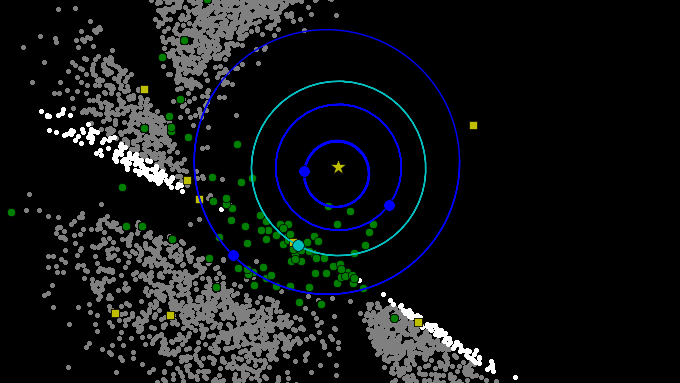
Artist's rendition of the comet 2016 WF9 as it passes Jupiter's orbit and moves toward the sun. Credit: NASA/JPL-Caltech
In any case, 2016 WF9 will approach Earth's orbit on February 25th, 2017, passing Earth at a minimum distance of almost 51 million km (32 million mi). This will place it well outside the orbit of the Moon, so the odds of it threatening Earth are negligible. But for those keen observers hoping to catch sight of the object, it will be close enough that it might be visible with just a pair of binoculars.
Since its discovery, 2016 WF9 has been of interest to astronomers, mainly because it straddles the already blurry line between asteroids and comets. While its proportions are known - roughly 0.5 to 1 kilometer in diameter (0.3 to 0.6 miles) - its other characteristics have led to some confusion as to where it came from. For one, its appearance (which is quite dark) and its orbit are consistent with what one expects from a comet.
But on the other hand, it lacks the characteristic cloud of dust and gas that comets are known for. As James Bauer, NEOWISE's Deputy Principal Investigator at JPL, said in a NASA press release:
"2016 WF9 could have cometary origins. This object illustrates that the boundary between asteroids and comets is a blurry one; perhaps over time this object has lost the majority of the volatiles that linger on or just under its surface."
Graphic showing the asteroids and comets observed by NASA's Near-Earth Object Wide-field Survey Explorer (NEOWISE) mission. Credit: NASA/JPL-Caltech/UCLA/JHU
The other object, C/2016 U1 NEOWISE, was discovered about a month prior to 2016 WF9. Its orbit, which can you see by checking out the 3D Solar System Simulator, takes it from the outer Solar System to within Mercury's orbit over the course of thousands of years. According to NASA scientists, this object is very clearly a comet, as evidenced by the dust it has been releasing as it gets closer to our Sun.
During the first week of 2017, comet C/2016 U1 NEOWISE is also likely to be visible in the night sky - in this case, in the southeastern sky shortly before dawn (for those looking from the northern hemisphere). It will reach its closest point to the Sun on January 14th (where it will be passing within Mercury's orbit) before heading back out towards the outer Solar System.
Once again, it is believed that comet-hunters should be able to see it, though that is open to question. Paul Chodas, the manager of NASA's Center for Near-Earth Object (NEO) Studies at the Jet Propulsion Laboratory, thinks that this object "has a good chance of becoming visible through a good pair of binoculars, although we can't be sure because a comet's brightness is notoriously unpredictable."
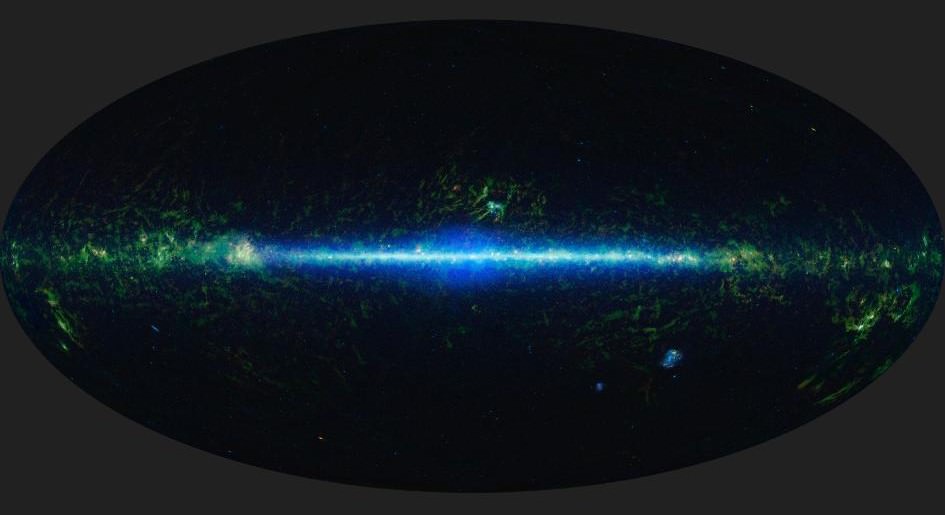
A mosaic of the images covering the entire sky as observed by the Wide-field Infrared Survey Explorer (WISE), part of its All-Sky Data Release. Credit: NASA/JPL
In any case, NASA will be continuing to monitor 2016 WF9 to see if they can't sort out what it is. Should it prove to be a comet, it would be the tenth discovered by NEOWISE since it was reactivated in December of 2013. If it turns out to be an asteroid, it would be the one-hundredth discovered since its reactivation.
As of November 2016, the orbital telescope has conducted over 562,000 infrared measurements have been made of 24,024 different solar system objects, including 613 NEOs and 110 comets. It has also been responsible for discovering 249 new near-Earth objects and comets, as well as more than 34,000 asteroids during its original mission.
At present, NEOWISE's science team is currently reprocessing all its primary mission data to extend the search for asteroids and comets. It is hoped that by taking advantage of the latest in photometric and astrometric calibrations, they will be able to push the limits of what the telescope can detect, thereby adding many more minor planets and objects to its suite of discoveries.
And be sure to enjoy this video, detailing the first two years of asteroid data collected by the NEOWISE mission:

Further Reading: NASA

Afghanistan's Sikh, Hindu Minorities Demand Probe Into Sikh Killing

afghanistan sikh, hindu minorities demand probe into sikh killing
Sikh and Hindu communities in Afghanistan have demanded authorities investigate attacks against members of their communities, after a local Sikh community leader was shot dead in the northern city of Kunduz.
Narmang Singh, a shopkeeker also known as Dilsoz, was killed by gunmen on his way to work on December 29, the second deadly attack against members of the Sikh community in Afghanistan since September.
Senator Anarkali Honaryar, who represents the Hindu and Sikh minorities in the upper house of Afghanistan's parliament, says the attack has deeply affected the communities.
'The incident has left a serious negative psychological impact on the Hindus and Sikhs. We urge authorities to investigate this incident as well as past attacks against the Hindus and Sikhs,' Honaryar told RFE/RL on December 30.
Police in Kunduz say three suspects were arrested in connection with Singh's killing.
On September 30, a Sikh man was abducted from his home and shot dead by suspected militants in the eastern city of Jalalabad. The killing sparked protests by the Sikh community.
A vast majority of Afghanistan's Hindus and Sikhs -- whose were estimated to number around 220,000 in the 1980s -- have left the conflict-torn country in the past three decades.

Energyworld

Top Stories
Ratan Tata vs Cyrus Mistry: Tatas fear sensitive info can trouble them in court'
Jharkhand coal mine collapse: Fatal accidents at coal mines fail to subside
Oil, metal stocks log biggest gains since 2009; IT, pharma perform poorly in 2016
JSW Energy to raise Rs 500 crore through debentures
OPINION: How did Power sector perform in the past year and what to expect in 2017?
Oil & Gas
Here's how major commodities are likely to perform in 2017
Top global defence, energy honchos to take part in Vibrant Gujarat Summit
Rosneft raises exposure to Germany's oil refining market after BP deal
Sale of petrol, diesel grew 9 per cent in Delhi last financial year
Coal
With few challenges ahead, coal will be an open commodity: Piyush Goyal
Modi talks to Jharkhand CM over coal mine tragedy
Power
India to supply additional 80 Megawatt power to Nepal from Jan 1
GE Power India bags Rs 271-cr contract from BHEL
China to build $1.5 billion power line across Pakistan
32,000 Jharkhand villages to get power in next 3 yrs
Central Board of Irrigation & Power Award to Tata Power CEO
Sterlite Power judged 'Best transmission utility, conferred CBIP award
Renewable
Vestas' strong 2016 finish offsets worry over Trump energy policy
Madhya Pradesh plans to develop 1,100 'climate-smart' villages
EUROPE POWER-German spot market buoyed by fall in wind power output

ScienceDaily: Top News

ScienceDaily: Top News


Posted: 30 Dec 2016 03:54 PM PST
For the development of animals, nothing -- with the exception of DNA -- may be more important than oxygen in the atmosphere. A study now links the rise in oxygen to a rapid increase in the burial of sediment containing large amounts of carbon-rich organic matter.
    
Posted: 30 Dec 2016 03:06 PM PST
In a survey of almost 2,000 people who said they had had a past negative experience when taking psilocybin-containing 'magic mushrooms,' a researchers say that more than 10 percent believed their worst 'bad trip' had put themselves or others in harm's way, and a substantial majority called their most distressing episode one of the top 10 biggest challenges of their lives.
    
Posted: 30 Dec 2016 09:29 AM PST
A treatment billed as a potential breakthrough in the fight against disease, including cancer, could back-fire and make the disease fitter and more damaging, new research has found. Ground-breaking research has found that introducing 'friendlier' less-potent strains into a population of disease-causing microbes can lead to increased disease severity.
    
Posted: 30 Dec 2016 07:35 AM PST
The first global analysis of infant cereals sold in lower-income countries highlights the need for basic quality assurance services to improve nutritional consistency and healthy growth of infants from 6 to 24 months of age.
    
Posted: 30 Dec 2016 07:35 AM PST
You've likely heard about being in the right place at the wrong time, but what about having the right genes in the wrong environment? In other words, could a genetic mutation (or allele) that puts populations at risk for illnesses in one environmental setting manifest itself in positive ways in a different setting?
    
Posted: 30 Dec 2016 07:35 AM PST
Researchers have designed molecules with the potential to deliver healing power to stressed cells -- such as those involved in heart attacks. The research, at a cellular level in the lab, involves organic molecules that break down to release hydrogen sulfide when triggered by oxidative stress.
    
Posted: 30 Dec 2016 07:32 AM PST
One of the main reasons cancer remains difficult to treat is that cancer cells have developed a multitude of mechanisms that allow them to evade destruction by the immune system. One of these escape mechanisms involves a type of immune cell called myeloid-derived suppressor cells (MDSCs). A recent study provides new insight into how MDSCs enable tumor cells to circumvent immune attack and offer the potential for improving cancer immunotherapy.
    
Posted: 30 Dec 2016 07:32 AM PST
Mutations that have been linked to endometrial cancer can be found in the uterine lavage fluid of pre- and post-menopausal women both with and without detectable cancer.
    
Posted: 30 Dec 2016 07:32 AM PST
Many scientists have attempted to tackle how climate change will affect the natural world by determining the thermal tolerance of various species, then predicting what will happen to them as our world warms. However, this approach as a way to understand nature has its drawbacks because one species never acts alone, so comprehending how global change impacts these interactions is crucial to a holistic understanding.
    

Mitra-mandal Privacy Policy

This privacy policy has been compiled to better serve those who are concerned with how their  'Personally Identifiable Inform...